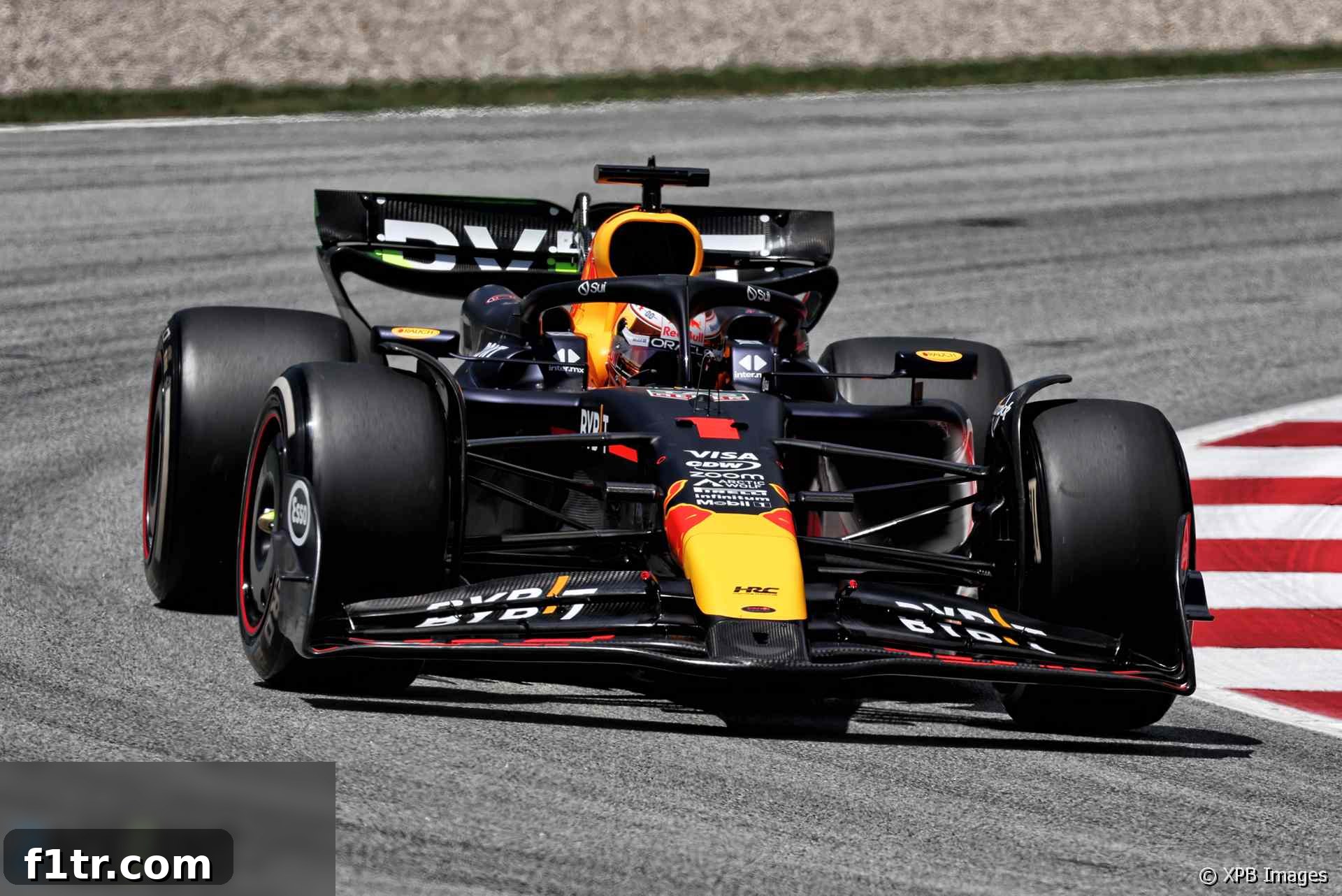
Reigning Formula 1 world champion Max Verstappen finds himself on the precipice of a grid penalty for the remainder of the 2024 season after Red Bull was compelled to install a fourth power unit in his car at the recent Spanish Grand Prix in Barcelona. This development places the championship leader at the maximum allowed limit for key engine components just ten rounds into the intensely competitive 24-race calendar, signaling potential strategic headaches for the team in the races to come.
The FIA regulations for the 2024 Formula 1 season strictly limit drivers to only three main power unit components: the Internal Combustion Engine (ICE), Turbocharger (TC), Motor Generator Unit-Heat (MGU-H), and Motor Generator Unit-Kinetic (MGU-K). Additionally, drivers are allowed two Energy Stores (ES), two Control Electronics (CE), and eight exhaust systems (EX). Exceeding these allowances for any component results in an automatic grid penalty, with the severity escalating depending on the number of components replaced. Typically, the first time a driver uses a fourth of any of the main power unit components, it incurs a ten-place grid drop. Subsequent changes often lead to further five-place penalties, or even starting from the back of the grid for a full power unit replacement beyond the allowed quota.
While some of Verstappen’s previously used power units may still be serviceable and available for re-use in future rounds, the installation of his fourth complete unit means that any further unapproved change to a core component will inevitably trigger a grid penalty. With a challenging 14 races still remaining on the calendar, it is highly probable that Verstappen will face a ten-place grid penalty at some point, a scenario that could introduce significant unpredictability into his otherwise dominant championship campaign.
The decision to switch to a fourth power unit arose from a problem encountered during practice for the Canadian Grand Prix two weeks prior. Red Bull engineers identified an issue with one of Verstappen’s power units, forcing him to stop running and prompting a thorough investigation into the fault. Although the precise nature of the failure has not been extensively detailed, the team clearly deemed it serious enough to warrant bringing a fresh unit into circulation sooner than anticipated. This unexpected usage depletes their component allowance prematurely, increasing the pressure on reliability for the rest of the season.
Verstappen is not an isolated case in facing such component-related concerns. Several other drivers are also teetering on the edge of penalties, highlighting the relentless demands placed on modern F1 power units. Alpine driver Pierre Gasly, for instance, has likewise had a fourth Renault power unit installed in his car ahead of the Spanish Grand Prix weekend. This puts the French driver in an identical predicament to Verstappen, with any additional component change leading to a grid drop, a significant challenge for a team already striving to improve its performance.
Similarly, Charles Leclerc, while not yet on his fourth complete power unit, has already utilized his fourth MGU-H (Motor Generator Unit-Heat). The MGU-H is a critical component that recovers energy from the exhaust gases, playing a vital role in the hybrid power unit’s efficiency and overall performance. As a standalone component, exceeding its allocation incurs the same penalty structure as other main power unit elements. Should Leclerc require a fifth MGU-H before the season concludes, he too will incur a grid penalty, a setback Ferrari will be keen to avoid as they push to challenge for the Constructors’ Championship.
Valtteri Bottas has already served a grid penalty earlier in the season, having exceeded the maximum number of Energy Stores (ES) and Control Electronics (CE). The Energy Store is essentially the battery pack of the hybrid system, while the Control Electronics manage the entire power unit’s complex operations. These components are just as crucial to a car’s performance and reliability as the engine itself, and their premature failure or degradation can severely impact a team’s season, as Sauber has experienced.
Historically, component-related grid penalties are not unfamiliar territory for Max Verstappen, even during his championship-winning campaigns. In 2021, the year he clinched his maiden title, Verstappen was forced to start from the back of the grid at the Russian Grand Prix after taking a fourth power unit. Despite this significant disadvantage, he showcased his remarkable skill by climbing through the field to secure an impressive podium finish, mitigating the damage to his championship aspirations.
The following year, in 2022, Verstappen again faced a grid penalty for exceeding component limits, starting from the back of the grid at the Spa-Francorchamps circuit in Belgium. This time, he not only recovered but delivered a sensational performance, scything through the field with dominant pace to claim a memorable victory, further cementing his reputation for overcoming adversity. Last year, 2023, saw him incur a five-place grid penalty for using a fifth gearbox of the season, once more at the iconic Spa-Francorchamps track. These instances underscore a recurring theme for Red Bull – pushing the limits of their machinery, sometimes at the cost of penalties, but often compensated by Verstappen’s exceptional driving and the car’s inherent pace.
Power unit components used so far
The table below provides a detailed breakdown of the power unit components utilized by each driver across the grid up to the Spanish Grand Prix. This data offers crucial insights into the reliability of different engine manufacturers and individual team strategies in managing their component allocations. The numbers reflect the total count of each specific component element that has been brought into active service for each driver.
| Driver | Car | Engine | Model | ICE | Turbo | MGU-H | MGU-K | ES | CE | EX |
|---|---|---|---|---|---|---|---|---|---|---|
| Max Verstappen | Red Bull | Honda RBPT | RBPTH0002 | 4 | 4 | 4 | 4 | 2 | 2 | 5 |
| Sergio Perez | Red Bull | Honda RBPT | RBPTH0002 | 3 | 3 | 3 | 3 | 2 | 2 | 4 |
| George Russell | Mercedes | Mercedes | M15 E | 2 | 2 | 2 | 2 | 1 | 1 | 2 |
| Lewis Hamilton | Mercedes | Mercedes | M15 E | 3 | 3 | 3 | 3 | 1 | 1 | 3 |
| Charles Leclerc | Ferrari | Ferrari | 066/12 | 3 | 3 | 4 | 3 | 2 | 2 | 4 |
| Carlos Sainz Jnr | Ferrari | Ferrari | 066/12 | 3 | 3 | 3 | 3 | 2 | 2 | 4 |
| Oscar Piastri | McLaren | Mercedes | M15 E | 2 | 2 | 2 | 2 | 2 | 2 | 2 |
| Lando Norris | McLaren | Mercedes | M15 E | 2 | 2 | 2 | 2 | 2 | 2 | 2 |
| Lance Stroll | Aston Martin | Mercedes | M15 E | 2 | 2 | 2 | 2 | 1 | 1 | 2 |
| Fernando Alonso | Aston Martin | Mercedes | M15 E | 2 | 2 | 2 | 2 | 1 | 1 | 2 |
| Esteban Ocon | Alpine | Renault | E-Tech RE24 | 3 | 3 | 3 | 3 | 2 | 2 | 5 |
| Pierre Gasly | Alpine | Renault | E-Tech RE24 | 4 | 4 | 4 | 4 | 2 | 2 | 5 |
| Alexander Albon | Williams | Mercedes | M15 E | 3 | 3 | 3 | 3 | 2 | 2 | 3 |
| Logan Sargeant | Williams | Mercedes | M15 E | 2 | 2 | 2 | 2 | 2 | 2 | 2 |
| Daniel Ricciardo | RB | Honda RBPT | RBPTH0002 | 3 | 3 | 3 | 3 | 2 | 2 | 4 |
| Yuki Tsunoda | RB | Honda RBPT | RBPTH0002 | 3 | 3 | 3 | 3 | 2 | 2 | 4 |
| Valtteri Bottas | Sauber | Ferrari | 066/12 | 2 | 2 | 2 | 2 | 3 | 3 | 3 |
| Zhou Guanyu | Sauber | Ferrari | 066/12 | 2 | 2 | 2 | 2 | 2 | 2 | 2 |
| Kevin Magnussen | Haas | Ferrari | 066/12 | 2 | 2 | 2 | 2 | 2 | 2 | 3 |
| Nico Hulkenberg | Haas | Ferrari | 066/12 | 2 | 2 | 2 | 2 | 2 | 2 | 3 |
As the table illustrates, both Max Verstappen and Pierre Gasly stand out with their usage of four ICE, Turbo, MGU-H, and MGU-K components, underscoring the early season reliability challenges faced by Red Bull and Alpine, respectively. Charles Leclerc’s four MGU-H units also place him in a precarious position. Mercedes-powered cars generally show stronger reliability for main components, with many drivers still on their second or third units. However, drivers like Valtteri Bottas have already pushed limits on Energy Stores and Control Electronics, emphasizing that reliability issues can manifest in various parts of the complex hybrid powertrain. The exhaust system (EX) allowance is notably more generous, allowing for eight units, which explains why several drivers, including Verstappen, Gasly, and Ocon, are already on their fifth units without penalty implications.
The looming threat of grid penalties adds a fascinating strategic dimension to the 2024 championship battle. While Verstappen currently enjoys a comfortable lead, a poorly timed penalty at a track where overtaking is difficult could significantly impact his race result and potentially open the door for competitors. Teams will now be meticulously managing the mileage and condition of their remaining power unit components, weighing the benefits of optimal performance against the risk of costly penalties. This delicate balancing act will undoubtedly play a crucial role in shaping the outcomes of the remaining races and the ultimate destination of the championship titles.
Miss nothing from RaceFans
Get a daily email with all our latest stories – and nothing else. No marketing, no ads. Sign up here:
2024 Spanish Grand Prix
- Russell ensures Norris has still never kept his lead from pole position
- Williams repeatedly switch floors in search for Sargeant’s missing downforce
- “Why’s he not defending?”: How Russell sank to fourth after stunning start
- What radio calls reveal about Verstappen’s controlled pace and Perez’s struggles
- 2024 Spanish Grand Prix weekend F1 driver ratings
Browse all 2024 Spanish Grand Prix articles