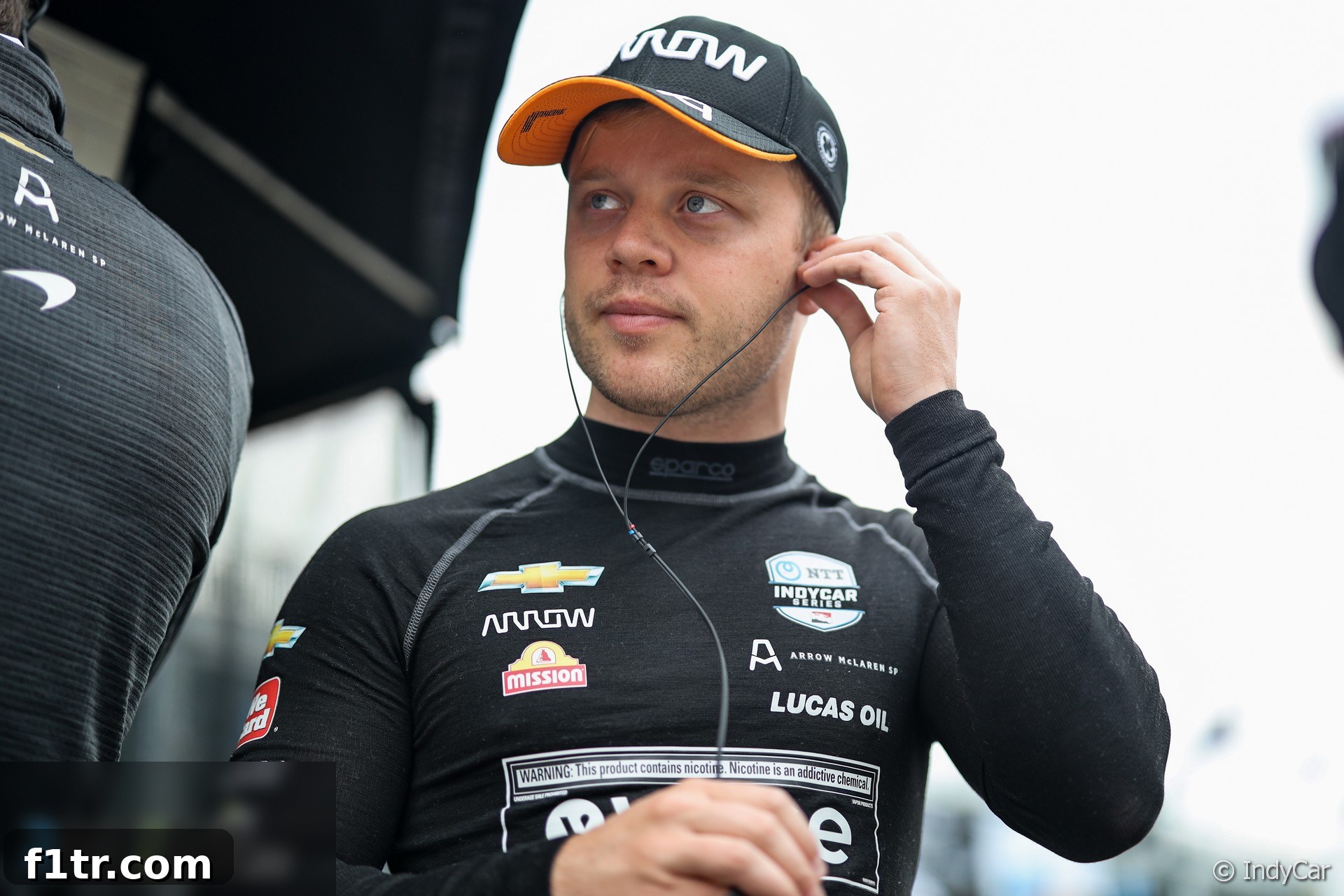
Felix Rosenqvist’s High-Impact Detroit IndyCar Crash Halts Race One: A Deep Dive into Safety and Incident Response
The exhilarating atmosphere of the Detroit Grand Prix was momentarily overshadowed by a dramatic and heavy crash involving McLaren SP driver Felix Rosenqvist during the first of this weekend’s twin IndyCar races. The incident, which occurred at the challenging Belle Isle street circuit, led to a significant stoppage, prompting immediate safety protocols and raising concerns across the motorsport community.
Rosenqvist’s Dallara race car made a violent impact with the tyre barrier at the exit of turn six, a critical corner on the demanding circuit. The force of the collision was so substantial that it not only decimated the tyre wall but also displaced the concrete blocks positioned behind it, a testament to the sheer energy absorbed during the impact. The Swedish driver’s car ultimately came to a rest precariously perched atop the remains of the barrier, its mangled state a stark visual reminder of the severity of the incident.
Immediate Response and Safety Protocols Activated
The high-speed incident unfolded on lap 24 of the scheduled 70-lap race. Race control wasted no time, immediately deploying the Safety Car to neutralize the field and allow emergency crews swift access to the scene. The IndyCar medical and recovery teams were on site within seconds, a testament to the rigorous safety planning inherent in modern motorsport. After four laps under caution, with the focus solely on assessing Rosenqvist’s condition and preparing for his extraction, the race was brought to a complete halt with a red flag, allowing the safety crews unimpeded access to the vehicle and driver.
The extrication process, a delicate operation designed to protect the driver from further injury, was executed with precision. Spectators and team members alike held their breath, but relief washed over the paddock as updates confirmed Rosenqvist was conscious and alert throughout the process. He was carefully placed on a stretcher and transported from the scene by ambulance to a nearby medical facility for comprehensive evaluation, a standard procedure following such high-impact incidents.
Medical Update: A Glimmer of Relief
IndyCar’s director of medical services, Dr. Geoffrey Billows, provided a reassuring update following the initial assessment. Dr. Billows confirmed that Felix Rosenqvist remained conscious and alert throughout the entire ordeal, never losing consciousness, which is always a positive indicator in such situations. “He’s doing fine,” Dr. Billows stated, alleviating immediate fears. “He was conscious and alert the entire time, never lost consciousness. He was talking the entire time. He was having some soreness but had no loss of sensation anywhere, no loss of function.”
This preliminary evaluation, conducted at the infield care center, found Rosenqvist to be stable with good vital signs. However, due to the nature of the crash and the forces involved, he was subsequently transported to a downtown hospital. This transfer was crucial for more advanced imaging and a definitive evaluation, ensuring that no underlying injuries, particularly those not immediately apparent, were overlooked. This meticulous approach underscores IndyCar’s unwavering commitment to driver well-being and highlights the thoroughness of their medical protocols.
The Unsettling Throttle Anomaly
Intriguing and somewhat concerning details emerged from video replays of the crash, particularly from Rosenqvist’s onboard camera. These replays suggested that the car’s throttle remained open prior to the impact. This observation is particularly critical as Turn 6 is a corner where drivers typically undergo significant deceleration, often slowing down to approximately 140 kilometers per hour (around 87 mph). If the throttle indeed remained open, it points towards a potential mechanical failure, a highly serious scenario in motorsport that demands immediate and thorough investigation by the McLaren SP team and IndyCar officials.
A stuck throttle or a similar electronic malfunction could explain the car’s trajectory and the inability of the driver to reduce speed, leading directly to the severe impact. Such an occurrence is rare in modern, highly sophisticated racing machinery but is among the most feared mechanical failures due to its direct implications for driver control and safety. Fortunately, no other cars were involved in the incident, preventing what could have been a multi-car pile-up on the tight street circuit.
Race Context and Championship Implications
Prior to his crash, Felix Rosenqvist had been enjoying a strong performance, running consistently within the top five of the race. He had made his first scheduled pit stop just four laps before the incident, indicating a competitive strategy that was unfortunately cut short. His teammate, Pato O’Ward, who started from pole position, was running in sixth place at the time of the red flag, highlighting McLaren SP’s overall strong showing before the dramatic turn of events.
The race remained under red flag conditions for a considerable period as track crews worked diligently to repair the damaged barriers and clear debris from the circuit, a complex task on any track, but particularly challenging on a temporary street circuit like Belle Isle. When the race was finally ready to resume, Scott Dixon held the lead, followed by James Hinchcliffe and Santino Ferrucci. The stoppage inevitably disrupted race strategies and momentum for all competitors, setting the stage for a tense restart.
IndyCar’s Enduring Commitment to Safety
This incident, while alarming, also serves as a stark reminder of the incredible strides made in motorsport safety. The fact that Felix Rosenqvist emerged from such a violent crash conscious and alert is a testament to the robust safety features of the Dallara chassis, the revolutionary aeroscreen cockpit protection, and the efficacy of IndyCar’s rapid response medical teams and sophisticated barrier systems. Features like the tyre barriers and, at other tracks, SAFER barriers, are designed precisely to absorb and dissipate massive amounts of kinetic energy, protecting drivers from the full force of an impact.
The Detroit Grand Prix, renowned for its challenging street circuit layout on Belle Isle, frequently tests the limits of both drivers and machinery. The close quarters, unforgiving walls, and varied track surfaces demand absolute precision. Incidents like Rosenqvist’s crash underscore the inherent risks of open-wheel racing at such high speeds but also highlight how advancements in safety engineering and medical preparedness have dramatically improved driver survival rates and reduced serious injuries over the decades.
Looking Ahead: Recovery and Investigation
For Felix Rosenqvist, the immediate future will involve focusing on his recovery and undergoing the necessary medical evaluations. His participation in the second race of the Detroit Grand Prix weekend, or any subsequent events, will naturally depend on the results of these examinations and the advice of medical professionals. For the McLaren SP team, a meticulous investigation into the suspected throttle issue will be paramount, aiming to understand the root cause of the mechanical anomaly and prevent any recurrence.
The motorsport world collectively breathes a sigh of relief for Rosenqvist’s relatively stable condition, even as the incident serves as a potent reminder of the fine line between triumph and adversity in the thrilling, yet inherently dangerous, sport of IndyCar racing. The commitment to continuous safety improvement remains a cornerstone of the sport, ensuring that even in the face of such dramatic events, driver well-being is always the top priority.
Stay Connected with IndyCar News
For the latest updates and in-depth analysis from the world of IndyCar and other motorsports, make sure to follow reputable news sources. Engaging with the community and staying informed helps keep the passion for racing alive and ensures you don’t miss any critical developments.
- Join IndyCar on Facebook
- Follow IndyCar on Twitter
- Explore More IndyCar Articles