As the Formula 1 circus returned from its traditional summer break, anticipation was palpable, not just for the exhilarating racing at the iconic Spa-Francorchamps circuit but also for the critical car updates each team brought. The Belgian Grand Prix, renowned for its high-speed straights and challenging corners like Eau Rouge and Raidillon, presents a unique aerodynamic puzzle. Teams must balance the need for immense straight-line speed with sufficient downforce for control through its flowing sections. This delicate compromise demands bespoke aerodynamic configurations, and consequently, all ten teams arrived in Belgium armed with various revisions to their challengers.
Formula 1 Teams Unveil Crucial Performance Upgrades for High-Stakes Belgian Grand Prix
The return to racing at the legendary Spa-Francorchamps circuit after the summer hiatus is always a pivotal moment in the Formula 1 season. It marks the beginning of the final push, where championship battles intensify, and midfield skirmishes become even more ferocious. For the 2022 Belgian Grand Prix, every single team on the grid capitalized on the break to introduce performance enhancements, with many focusing on optimizing their cars for the circuit’s distinctive characteristics. The FIA’s technical submissions revealed a fascinating array of changes, primarily aimed at achieving the optimal low-drag setup crucial for success on Spa’s long straights, while still maintaining aerodynamic efficiency for its demanding corners. While championship contenders Ferrari and Red Bull sought subtle refinements, teams like McLaren brought a comprehensive suite of upgrades, signaling their intent to make significant gains in the constructors’ standings.
Mercedes-AMG Petronas F1 Team: Sustained Pursuit of Performance Gains
Mercedes, having faced an uncharacteristically challenging start to the 2022 season with their W13, has been on a relentless journey of iterative improvements. Their efforts to steadily enhance the car’s competitiveness continued unabated into the Belgian Grand Prix. The focus for Spa was clearly on further refining the W13’s floor and wings, targeting both aerodynamic efficiency and drag reduction, which is paramount at this high-speed venue. The team’s engineers meticulously detailed their modifications, demonstrating a commitment to unlocking the car’s full potential.
Front Wing Endplate: Streamlining Airflow for Efficiency
Mercedes introduced a reprofiled front wing endplate, specifically modifying the wing tip elements as they integrate with the endplate. The core reason for this alteration was performance-driven, aiming for improved flow conditioning. By reshaping this critical area, Mercedes sought to reduce pressure peaks over the wing tip, thereby minimizing aerodynamic losses. This subtle yet impactful change was designed to enhance the overall airflow efficiency, ensuring a smoother journey of air towards the rear of the car, which directly contributes to better downforce generation and reduced drag.
Floor Fences: Optimizing Underfloor Aerodynamics
The W13’s floor fences also received an upgrade, with an adjustment to their alignment. This modification was primarily aimed at improving local load and overall performance. The engineers explained that a better fence alignment across various conditions would enhance the flow feeding into the floor’s vortex system. This, in turn, would lead to improved local downforce, a critical factor for increasing grip and stability, particularly through Spa’s high-speed corners and chicanes.
Floor Body: Refining the Underfloor Edge Wing
Further enhancements were made to the floor body, specifically through the introduction of a new, reduced chord floor edge wing. This change was implemented for performance reasons, focusing on flow conditioning. By reducing the chord (width) of this wing element, Mercedes aimed to decrease its load, which paradoxically improves the flow entering the diffuser. The ultimate goal of this intricate aerodynamic adjustment was to increase both floor and diffuser downforce, leading to a more stable and aerodynamically potent rear end.
Rear Wing: Tailoring for Spa’s High-Speed Nature
Perhaps the most circuit-specific update from Mercedes was to its rear wing. The team reprofiled both the flap and the wing tips. The rationale behind this modification was pure performance through drag reduction. Spa-Francorchamps demands a low-drag setup to maximize straight-line speed on its long straights, such as the Kemmel Straight. By efficiently reducing the wing load, Mercedes aimed to achieve an optimal balance that would allow the W13 to cut through the air more easily, ensuring it could compete effectively for top speed against its rivals.
Oracle Red Bull Racing: Precision Engineering for Aerodynamic Supremacy
Red Bull Racing, enjoying a dominant season with the RB18, continued its philosophy of incremental, highly effective upgrades. Their focus for Spa was on fine-tuning existing components to extract even greater efficiency, a hallmark of their aerodynamic prowess. While not as extensive as some midfield teams, Red Bull’s updates were surgical, targeting specific areas for marginal gains that can often make the difference in a championship battle.
Coke/Engine Cover: Enhanced Cooling Range and Aerodynamics
Red Bull introduced a mildly reprofiled sidepod design for their coke/engine cover, a modification driven by circuit-specific cooling requirements. While respecting the existing split lines of surrounding components, the altered sidepods aimed to gain cooling range. This means the car could operate efficiently across a broader range of ambient temperatures, with reduced aerodynamic consequences when cooling vents were opened. This adaptability is crucial for optimal performance, especially in varying conditions typical of the Ardennes circuit.
Rear Suspension: Minimizing Aerodynamic Losses
A more subtle but significant change came in the form of a reprofiled rear suspension shroud. This modification was made for performance reasons, specifically flow conditioning. Without any structural alteration to the suspension itself, the lower wishbone shroud was reshaped to reduce local aerodynamic losses downstream. In the intricate world of F1 aerodynamics, even small improvements in managing turbulent air around suspension components can lead to tangible gains in overall efficiency, contributing to lower drag and improved stability.
Scuderia Ferrari: Adapting the F1-75 for Spa’s Unique Challenge
Ferrari, locked in a fierce championship battle, brought targeted updates to ensure their F1-75 was optimally configured for Spa-Francorchamps. Understanding the track’s blend of high-speed sections and technical corners, their focus was squarely on adapting the car to the circuit’s peculiarities and achieving peak aerodynamic efficiency, primarily through drag reduction.
Rear Wing: Low Downforce for Maximum Straight-Line Speed
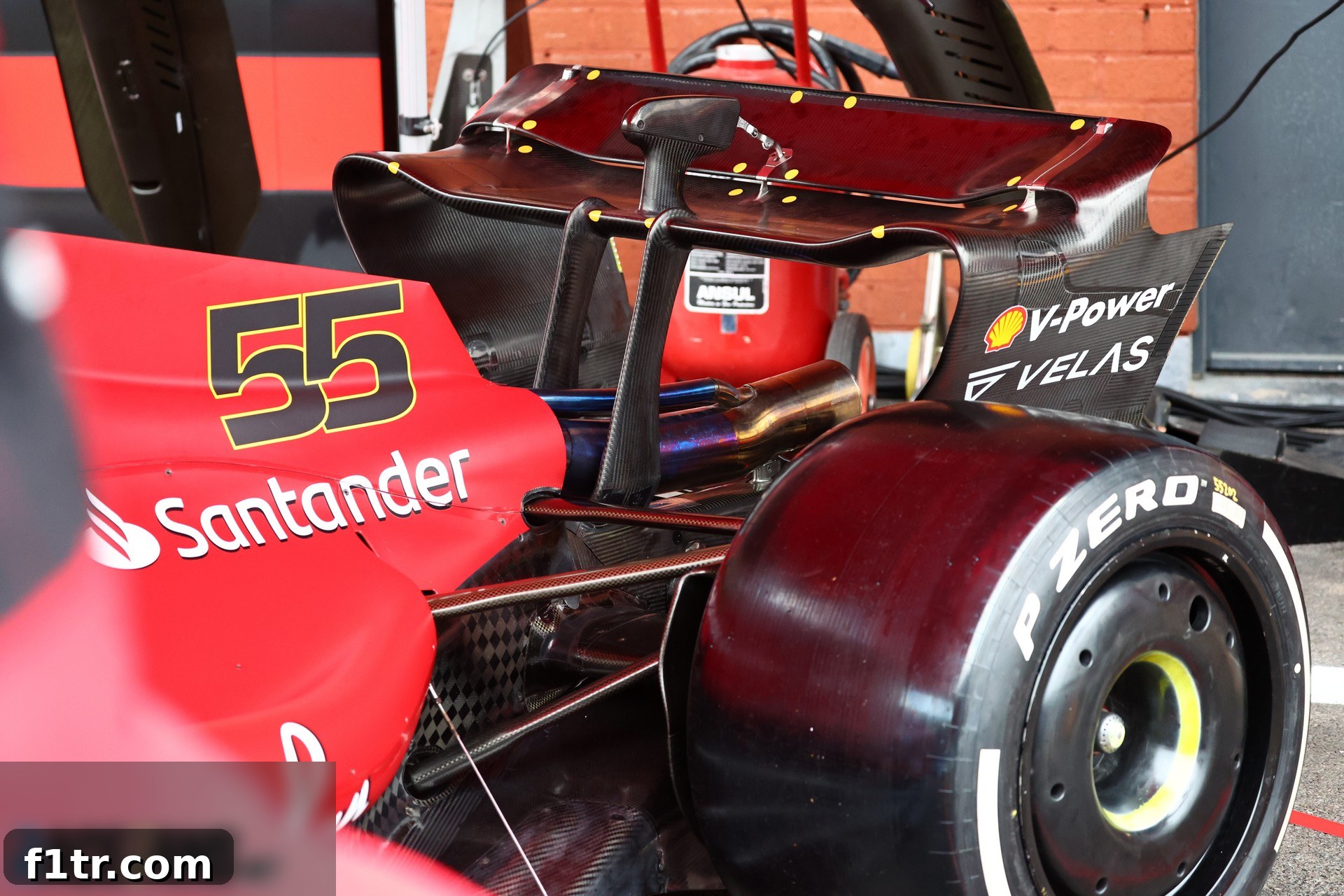
For the Belgian Grand Prix, Ferrari introduced a lower downforce top rear wing design. This circuit-specific change was explicitly aimed at optimizing the car for drag range. The depowered top rear wing profiles were a direct response to Spa-Francorchamps’ layout, where maximizing straight-line speed on the long Kemmel Straight and through Blanchimont is critical. This design allows the F1-75 to achieve higher top speeds, albeit with a slight compromise on cornering downforce, a trade-off deemed necessary for this particular track.
Beam Wing: Complementing the Low-Drag Philosophy
In conjunction with the main rear wing, Ferrari also brought a lower downforce beam wing design. This was another circuit-specific modification targeting drag range. The introduction of a single-element beam wing further contributed to the overall reduction in downforce and drag. This holistic approach to the rear aerodynamic package ensured that the F1-75 was comprehensively adapted to Spa’s unique demands for aerodynamic efficiency, working in harmony with the main rear wing to achieve the desired balance.
McLaren F1 Team: Comprehensive Upgrade Package for Midfield Ascent
McLaren arrived at Spa with arguably the most extensive update package among all teams, reflecting their determination to climb the constructors’ standings. Their MCL36 received a significant overhaul, encompassing revised floor, rear wing, beam wing, and front suspension components, signaling a major push for performance post-summer break.
Diffuser: Maximizing Underfloor Aerodynamic Performance
A key area of development for McLaren was the diffuser, with a modified rearward floor underside shape. This performance-driven change aimed to alter the aerodynamic expansion behavior of the diffuser. By refining this critical element, McLaren sought to improve the overall aerodynamic performance of the car’s underfloor, which is a significant contributor to total downforce. Optimizing the diffuser’s efficiency can yield substantial gains in grip and stability.
Rear Wing: Tailored for High-Efficiency Track Characteristics
McLaren introduced a lower drag rear wing assembly, a circuit-specific modification essential for Spa. This design was specifically chosen to suit the high-efficiency characteristics of the track, where maximizing straight-line speed is paramount. The new rear wing allowed the MCL36 to reduce aerodynamic resistance, enabling it to achieve competitive top speeds on the circuit’s long straights, a crucial factor for overtaking and defending.
Beam Wing: Furthering Drag Reduction Efforts
Complementing the main rear wing, McLaren also revised its beam wing geometry to reduce aerodynamic drag. This was another circuit-specific update aligned with the high-efficiency demands of Spa-Francorchamps. By altering the beam wing, the team aimed to further streamline the rear of the car, minimizing resistance and contributing to the overall low-drag setup.
Rear Corner (Drag Reduction): Streamlining the Rear Assembly
McLaren also focused on drag reduction at the rear corner, adapting the rear brake duct winglet configuration. This circuit-specific change aimed to reduce drag, aligning with the high-efficiency characteristics of the track. Even small aerodynamic elements like brake duct winglets can generate resistance, and by optimizing their design, McLaren sought to extract every possible ounce of straight-line speed.
Coke/Engine Cover: Optimized Cooling and Aerodynamic Efficiency
The MCL36 featured a smaller, low-cooling bodywork for its coke/engine cover. This circuit-specific update matched the lower cooling demand typically experienced at Spa-Francorchamps. By deploying a smaller bodywork with reduced cooling capacity, McLaren could simultaneously improve aerodynamic performance, creating a more streamlined profile for greater efficiency.
Cooling Louvres: Adaptive Cooling Solutions for Performance Trade-off
To support the new low-cooling bodywork, McLaren introduced a range of louvre blankings. These multiple blanking panels were designed to tune the cooling mass flow, allowing the team to trade cooling capacity for aerodynamic performance. This adaptive approach ensures the engine operates at optimal temperatures while minimizing the aerodynamic penalty associated with open cooling vents, crucial for balancing reliability with outright speed.
Rear Corner (Load Improvement): Enhancing Local Downforce and Flow
In addition to drag reduction, McLaren also focused on improving local load at the rear corner by adding an extra winglet to the assembly. This performance-driven modification aimed to improve local airflow and aerodynamic load, primarily around the wheel assembly itself. Such precise aerodynamic additions can enhance grip and stability, particularly important for managing the rear end through high-speed turns.
Front Suspension: Fine-Tuning Front-End Aerodynamics
Finally, McLaren brought a revision to the front suspension track rod fairing. This performance-focused update aimed at improving flow conditioning by adjusting the angle of the fairing to better align with the local airflow. Optimizing airflow around the front suspension can have a cascading effect on the entire car’s aerodynamics, ensuring clean air reaches the underfloor and sidepods, thus improving overall downforce and reducing drag.
BWT Alpine F1 Team: Strategic Adjustments for Midfield Supremacy
Alpine has been a consistent performer in the midfield battle, and their updates for Spa reflected a continuous drive to extract more performance from their A522. Their modifications focused on refining airflow around the rear corner and optimizing underfloor efficiency, crucial areas for unlocking lap time.
Rear Corner: Enhancing Airflow Around the Rear of the Car
Alpine made a noticeable change to its rear corner, moving the brake duct inlet outboard of the fence. This performance-driven modification aimed to improve local load. The new rear brake ducts were designed to enhance airflow around the rear corner of the car, which subsequently improves the flow to the rear wing. Better management of airflow in this complex area can significantly contribute to overall aerodynamic efficiency and downforce.
Floor Fences: Optimizing Underfloor Flow Conditioning
Several minor changes were introduced to the floor fence geometry on the Alpine A522. These performance-focused modifications aimed at improving flow conditioning. The new floor fences were designed to push the wake further outboard, thereby improving aerodynamic performance further down the car. By controlling the airflow more effectively along the car’s underside, Alpine sought to generate more consistent and powerful downforce.
Scuderia AlphaTauri: Seeking a Performance Boost with Key Revisions
AlphaTauri arrived at Spa looking to bolster their position in the competitive midfield. Their updates demonstrated a dual focus on integrating suspension components with existing bodywork and optimizing their aerodynamic package for the track’s high-speed nature.
Rear Suspension: Integrated Aerodynamic Design
AlphaTauri adjusted the incidence of the lower wishbone shroud in their rear suspension. This performance-driven change aimed at improving local load by ensuring the angle of the wishbone shroud worked better with the bodywork changes introduced earlier in the season (at Race 12). This seamless integration of mechanical and aerodynamic components is vital for maximizing airflow efficiency around the rear of the car.
Rear Corner: Enhanced Local Load and Tire Wake Control
Significant changes were made to the rear corner, with the upper cascade of winglets on the rear brake duct being reprofiled and the number of elements increased. Furthermore, a large additional winglet was introduced above the original cascade. These performance-focused modifications aimed at improving local load. The revised winglets have a positive impact on controlling the airflow around the rear tires, providing increased local downforce and better managing the disruptive wake generated by the spinning wheels.
Rear Wing: Spa-Specific Low-Drag Configuration
AlphaTauri also brought a new rear wing specifically for Spa. This circuit-specific modification targeted drag reduction, featuring a shallower depth in front view and elements with less camber. The new rear wing generates less downforce but significantly reduces drag, a trade-off considered optimal for the characteristics of the Spa-Francorchamps circuit, where straight-line speed is a priority.
Beam Wing: Complementary Low-Drag Element
In line with the low-drag rear wing, AlphaTauri introduced a new beam wing with only a single element along with a gurney flap. This circuit-specific change also aimed at drag reduction. The new beam wing generates less downforce but with a substantial reduction in drag, further optimizing the car for the high-speed nature of Spa, ensuring a cohesive low-drag aerodynamic package.
Aston Martin Aramco Cognizant F1 Team: Strategic Balance for Spa’s Demands
Aston Martin, steadily working on improving their AMR22, brought updates designed to achieve a precise aerodynamic balance for the unique challenges of Spa. Their focus was on fine-tuning the car’s downforce levels to maximize efficiency on the long straights while maintaining stability.
Front Wing: Adjusting Aerodynamic Balance for Efficiency
Aston Martin introduced a new front wing flap that reduces the chord of the final element, coupled with associated reprofiling. This circuit-specific change was made to adjust the car’s balance range. The component’s purpose is to reduce front wing load, which in turn helps achieve lower aerodynamic balances when paired with a smaller rear wing. This strategic adjustment allows the team to optimize the car’s overall aerodynamic platform for Spa’s high-speed requirements.
Rear Wing: Aggressive Low-Drag Solution for High Speed
The AMR22 also featured a new rear wing with a shorter chord flap compared to the previous low-drag version. This circuit-specific modification was focused on drag reduction. The geometric changes implemented were designed to reduce rear wing load and consequently drag, allowing the car setup to be fully optimized for the characteristics of Spa-Francorchamps, where straight-line speed is paramount.
Williams Racing: Capitalizing on Spa’s High-Speed Advantage
Williams, known for often demonstrating strong straight-line speed, aimed to capitalize on Spa-Francorchamps’ layout by bringing updates that further enhanced their car’s low-drag capabilities. Their modifications focused on adjustable components to tailor the FW44 precisely for the circuit.
Front Wing: Fine-Tuning Aero Balance for Low Downforce
Williams introduced an optional trim to the front wing flap trailing edge. This circuit-specific change was designed to adjust the balance range. Making this modification reduces front downforce, which helps complement the lower rear downforce options available. This bespoke adjustment is crucial for setting up the FW44 optimally for Spa’s high-speed characteristics.
Beam Wing: Single-Element Efficiency for Drag Reduction
An optional smaller, single-element beam wing was also brought by Williams. This was another circuit-specific option aimed at drag reduction. This choice provides the team with the opportunity to lower both downforce and drag, specifically tailored to suit the high-speed characteristics of the Spa-Francorchamps circuit.
Rear Wing: Ultimate Straight-Line Speed Configuration
Williams offered optional trims to the flap element of the upper rear wing. This circuit-specific change also targeted drag reduction. By lowering the downforce and drag, the team aimed to suit the circuit characteristics perfectly. This trim can be used independently or in conjunction with the single-element beam wing, offering flexibility in achieving the ideal low-drag setup for Spa.
Alfa Romeo F1 Team ORLEN: Maintaining Momentum with Drag Reduction
Alfa Romeo, after a surprisingly strong start to the season, focused their efforts on maintaining competitive performance through targeted drag reduction updates for their C42 at Spa. Their approach involved comprehensive revisions to both front and rear wing elements.
Front Wing: Rebalancing for Lower Drag Rear Configuration
Alfa Romeo introduced new, reprofiled flaps for their front wing. This circuit-specific change was aimed at managing the drag range. An updated front wing, with these reprofiled flaps, allows the team to effectively rebalance the car in conjunction with a low-drag rear wing level. This ensures that even with a reduced downforce rear, the car maintains a stable and predictable front-end, crucial for driver confidence through Spa’s fast corners.
Rear Wing: Comprehensive Low-Drag Design for Optimal Performance
The C42 received a redesigned rear wing, featuring low-profile flaps and reprofiled endplates. This circuit-specific modification was designed for drag reduction. This comprehensive redesign provides a dedicated low-drag option that should produce the best possible performance on the Spa-Francorchamps circuit, enabling the Alfa Romeo to compete for top speeds against its rivals.
Haas F1 Team: Efficient Drag Reduction for High-Speed Performance
Haas, known for its pragmatic and cost-efficient approach to development, focused on critical drag reduction areas for their VF-22 at Spa. Their updates aimed to maximize straight-line speed without extensive redesigns.
Rear Corner: Minimizing Drag from Brake Duct Winglets
Haas implemented trimmed brake duct winglets at the rear corner. This performance-driven change aimed directly at drag reduction. Reducing the span and chord of these brake duct winglets has a measurable effect on decreasing overall drag, a significant advantage for a high-speed circuit like Spa-Francorchamps where aerodynamic efficiency is key.
Beam Wing: Cost-Efficient Drag Reduction Strategy
A trimmed beam wing flap was also introduced by Haas. This performance-driven modification was designed for drag reduction. By reducing the chord of the baseline beam wing flap, Haas achieved a measurable effect on reducing drag for this high-speed circuit in a cost-efficient manner. This approach allows the team to gain performance without significant resource investment, aligning with their operational philosophy.
The collective effort by all Formula 1 teams to bring a multitude of updates for the Belgian Grand Prix underscored the relentless pursuit of performance in modern F1. From extensive aerodynamic overhauls by McLaren to targeted refinements by Red Bull and Ferrari, and circuit-specific drag reduction packages across the grid, every team was determined to gain an edge. Spa-Francorchamps, with its blend of breathtaking speed and technical challenges, was the perfect arena to witness the immediate impact of these engineering marvels. The battle for supremacy, both in the championship and the midfield, was set to intensify as teams aimed to validate their hard work on one of motorsport’s most revered stages.