The Baku City Circuit, renowned as the venue for the Azerbaijan Grand Prix, presents a unique and demanding challenge for Formula 1 teams. Its distinctive layout, characterized by an extraordinary blend of ultra-long straights and tight, technical corners, necessitates a highly specialized car setup. This combination forces engineers to strike a delicate balance between achieving blistering top speeds and maintaining sufficient downforce for grip through the slower sections, a compromise rarely encountered on other circuits.
Unlike conventional street circuits that typically feature a continuous succession of medium to slow-speed corners, Baku diverges significantly. While the section winding through the ancient Old City is undeniably tight and twisty, resembling a traditional street track, the newer parts of the city circuit are dominated by extensive straights punctuated by abrupt, 90-degree turns. This architectural dichotomy means teams cannot simply adopt a high-downforce, high-grip setup typical of Monaco or Singapore. Instead, they must prioritize aerodynamic efficiency.
The imperative for speed on Baku’s long straights drives teams towards a super low-drag configuration, inherently leading to reduced downforce levels. The degree to which teams can minimize wing angles to boost straight-line speed without sacrificing performance in the corners becomes a critical differentiator. An overly aggressive low-downforce setup, while maximizing top speed, risks compromising tire performance in the slower turns. Tires, cooled on the long straights, can suffer from excessive sliding, leading to graining and a significant loss of grip when forced to work hard in the low-speed sections. Furthermore, this crucial balance between top-speed potential and low-speed mechanical grip is dynamic, constantly shifting as the track surface ‘rubbers in’ and ambient temperatures fluctuate throughout the race weekend, adding another layer of complexity to setup optimization.
Mercedes
Mercedes arrived in Baku having recently faced scrutiny from the technical officials regarding their front wing design in China. In response to a newly enforced radius rule concerning front wing endplates, the team implemented further modifications. Within the tight two-week turnaround since the Chinese Grand Prix, Mercedes diligently reshaped the endplate cutout, adjusting the curve to ensure the endplate now extends over the wing tip, thereby conforming to the latest technical directive. This crucial alteration positions the wing tip behind the endplate, effectively shielding its sharp edge from potential contact with other cars’ tires, a measure primarily aimed at enhancing safety.
This marked change represented the third specification for Mercedes’ front wing endplate within a short period. The current layout (identified as spec 3) evolved from their initial design (spec 2), following an intermediate version introduced at the Bahrain Grand Prix. Beyond this significant regulatory compliance update, most other modifications on the W10 were specifically tailored for Baku’s low-drag requirements. The car featured a flatter rear wing design with a distinctly raised central section and a serrated trailing edge, optimized for minimal aerodynamic resistance. Accompanying this was a revised DRS pod and a T-wing reduced to a single element, replacing the more complex ‘coat hanger’ double element typically utilized on higher downforce tracks. These collective changes underscored Mercedes’ commitment to extracting maximum straight-line speed while navigating the technical nuances of the circuit.
Ferrari
Given the highly specific layout of the Baku City Circuit, Ferrari’s performance advantage was most pronounced on the extensive straights. Despite the SF90 demonstrating a marginal speed deficit to Mercedes through the circuit’s numerous slow corners, its exceptional straight-line velocity allowed it to dominate top speed charts. Remarkably, Ferrari achieved this feat even while running a rear wing configuration that appeared significantly larger and thus, ostensibly, higher downforce than those employed by their rivals. This seemingly paradoxical outcome highlighted the superior aerodynamic efficiency and immense power output of the Ferrari power unit, particularly when ‘turned up’ during free practice and qualifying sessions, where the biggest speed advantages were observed.
Beyond the fundamental power and aero package, Ferrari also introduced subtle yet impactful updates to its bodywork, which contributed to its overall performance. A notable detail was observed on the rear brake ducts. As part of the sophisticated fin setup on the rear duct, a long, curved vane mounted low on the side of the duct had been meticulously reshaped. This modification was part of a broader series of changes aimed at optimizing airflow along the entire car. The new fin design (marked as 1) was notably lower and angled upwards, crucially integrating with the revised aerodynamic philosophy. This new iteration discarded the endplate that had been fitted to the inner edge of the old version (marked as 2), further refining the airflow management around the rear wheels and contributing to the car’s remarkable blend of downforce and drag efficiency.
Red Bull
Red Bull approached the Azerbaijan Grand Prix with a characteristic focus on minimizing drag, evident in some of the skinniest rear wings observed on the grid. This extreme low-drag setup was a direct response to Baku’s long straights, aiming to maximize the RB15’s top speed potential. Beyond this fundamental aerodynamic choice, the team made relatively few other changes to the car. One notable modification, mirroring that of Mercedes, involved minor reshaping of the front wing tips. This adjustment was made to comply with the same technical directive issued by the FIA, ensuring that the wing’s edges met the newly specified radius rules, primarily for safety reasons to prevent tire damage in close combat.
A significant performance boost for Red Bull in Baku also came from the introduction of a new-specification Honda engine. All Honda-powered drivers, including those at Red Bull, received an updated internal combustion engine for this event. While Honda initially stated that the upgrade was primarily for reliability enhancements, team confirmations soon revealed that the updated V6 unit indeed delivered a noticeable increase in power. This power release was particularly effective in qualifying trim, allowing Red Bull to extract more performance from their already aerodynamically efficient package and better compete with their more powerful rivals on the circuit’s lengthy straights. The combination of a specialized low-drag aero setup and a more potent power unit underscored Red Bull’s strategic approach to the unique demands of Baku.
Renault
For Renault, the weekend in Baku began with a positive note: the MGU-K unit that had caused Nico Hulkenberg’s retirement in China did not require replacement, suggesting a successful resolution to the reliability issue. However, the unique characteristics of the Baku City Circuit proved particularly challenging for the RS19. The team struggled to achieve competitive top speeds relative to its more powerful rivals, highlighting a fundamental disadvantage in engine output or aerodynamic efficiency on the long straights.
In an attempt to compensate and bring the car closer to its competitors’ straight-line performance, Renault was forced to drastically reduce its wing levels. While this helped to trim drag and increase top speed, it came at a significant cost: the car suffered noticeably through the slow-speed corners, where the lack of downforce compromised grip and made tire management exceptionally difficult. The reduced downforce meant the tires were not adequately loaded, leading to increased sliding and accelerated degradation.
To try and mitigate these issues, Renault employed two distinct low-drag rear wing setups alongside revised front wing flaps. One was a simpler, flatter rear wing designed for minimal resistance. The other was a more complex wing featuring a larger change in its leading edge profile. This design saw the wing’s leading edge rise significantly higher near the middle, but paradoxically, the central section between the wing mounting pylon had a pronounced dip. This intricate profile was likely an attempt to balance drag reduction with some form of localized downforce generation, or to manage the airflow towards the rear of the car more effectively, albeit with limited success given their overall struggles in Baku.
McLaren
After the first four races of the season, McLaren’s MCL34 appeared in Baku with one subtle yet aerodynamically significant visible modification: a revised fin setup on the rear brake duct. Previously, the brake duct inlet scoop featured a simple flap. For Baku, this was upgraded to a series of four distinct fins. This change was not merely aesthetic but aimed at meticulously managing the airflow around the rear wheels. These fins play a crucial role in directing airflow to both cool the brake components and influence the car’s overall aerodynamic performance by interacting with the turbulent wake generated by the spinning tires. Better management of this turbulent air can reduce drag and improve the efficiency of the diffuser.
A notable aspect of these new components was their apparent construction: they seemed to be 3D-printed in resin and then bonded to the carbon fiber of the main brake duct. This highlights the increasing adoption of additive manufacturing technologies in Formula 1. 3D printing allows teams to rapidly prototype, test, and deploy new aerodynamic parts at the track much quicker than traditional manufacturing methods. This agility is invaluable in a fast-paced development environment like F1, enabling swift responses to track-specific demands or performance deficits, and demonstrating McLaren’s innovative approach to iterative design and continuous improvement.
Alfa Romeo
Following Antonio Giovinazzi’s power unit failure in China, Alfa Romeo undertook significant modifications to address reliability concerns. The team successfully adapted the mounting within the sidepod to accommodate updated Ferrari control electronics. These electronic updates were specifically designed to prevent a recurrence of the injector failures that had plagued the car in the two preceding races. Alfa Romeo’s original packaging setup presented a challenge, as it did not initially allow for the installation of the new unit, necessitating the fabrication of revised parts. This crucial update was expected to bring Alfa Romeo’s power unit reliability back in line with the other Ferrari-engined cars on the grid, enhancing their overall competitiveness.
Despite these electronics updates, Alfa Romeo continued to run the double waste-gate exhaust setup, diverging from Ferrari and Haas, which had already switched to a single waste-gate pipe. This decision suggested a different aerodynamic or power unit tuning philosophy, or perhaps a delay in implementing the newer configuration.
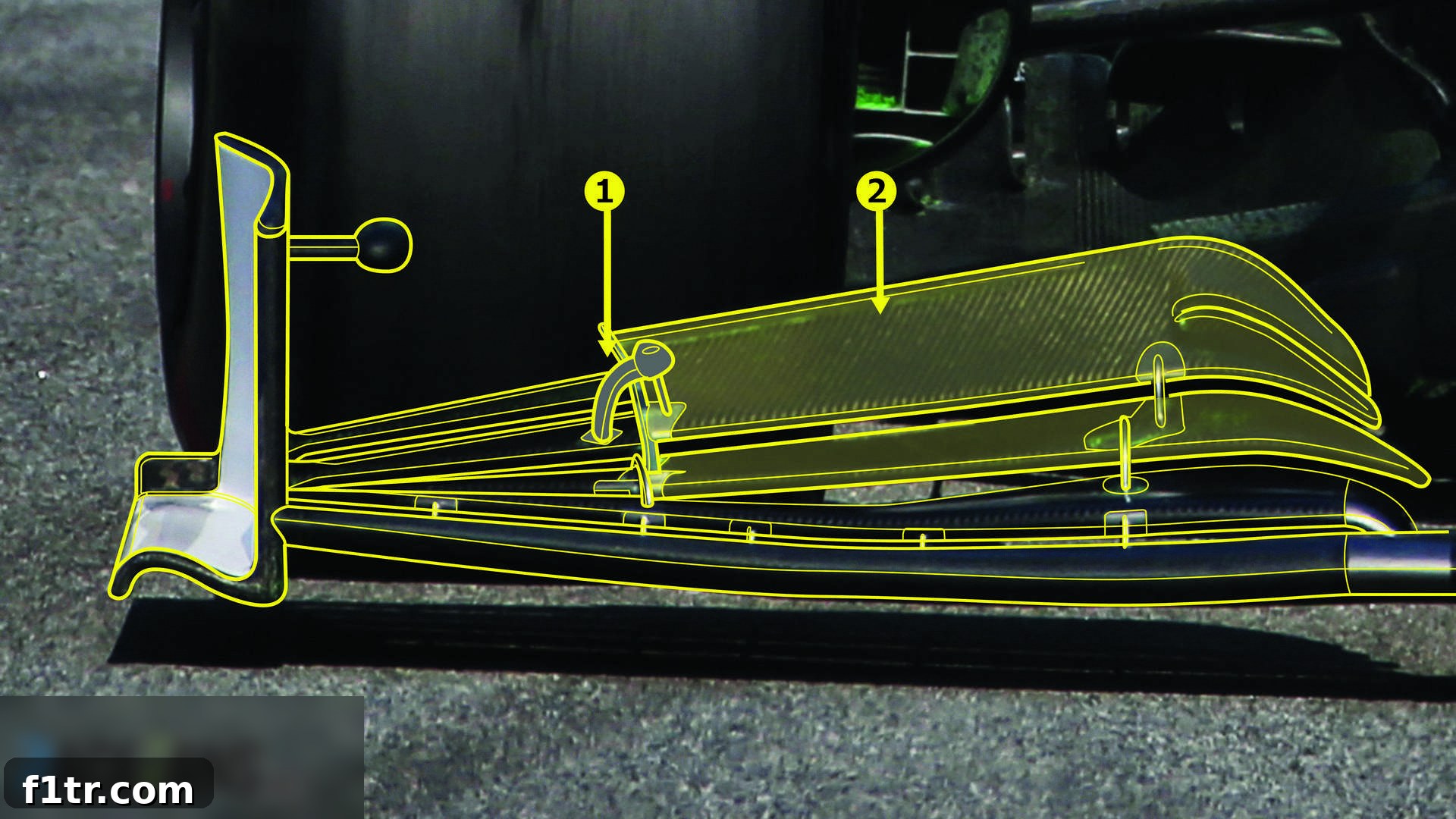
However, Alfa Romeo faced a significant setback post-qualifying in Baku. The team discovered that the front wing flap adjuster was broken, a problem that had also surfaced during the race in China. The flap adjuster (1) is a critical threaded mechanism that precisely alters the angle of attack of the front wing flap (2), allowing for fine-tuning of aerodynamic balance. The specific component that failed was the hook—an aluminum, angled part that supports the threaded adjuster. Due to a shortage of spares, this part was replaced with a different specification under parc fermé conditions.
The FIA took a keen interest in this component change and subsequently rechecked the wing’s flexibility with the new-spec part. Unfortunately for Alfa Romeo, the wing failed the standard deflection test, which involves applying a specific load to the wing’s trailing edge. With the test failed, the stewards had no option but to remove Kimi Räikkönen’s qualifying time, forcing him to start from the back of the grid. While it was highly unlikely that Alfa Romeo sought an unfair advantage with the part switch, merely being forced by circumstance due to a lack of spares, the stringent regulations meant the penalty was unavoidable, highlighting the tightrope walk teams navigate with technical compliance and spare parts management.
Williams
The 2019 season presented Williams with a myriad of deep-seated performance issues, making any additional setbacks particularly unwelcome. The damage inflicted on George Russell’s car during first practice by a dislodged drain cover was precisely such an unfortunate and ill-timed incident. The impact catastrophically wrecked the underside of the driver safety cell, primarily where the leading edge of the T-tray splitter collided with the metal cover. This was a significant blow to a team already struggling with fundamental car development.
The T-tray splitter’s leading edge represents the lowest point on the car, positioned beneath the raised section of the chassis. Teams strive to run steeper rake angles to maximize the aerodynamic efficiency of the underbody and achieve a lower front wing height, both crucial for generating downforce. However, the T-tray acts as a limiting factor due to its extremely low position. The front of the car cannot be lowered, nor can the rear be raised any further, without risking the T-tray scraping the ground. The car effectively pivots around the leading edge of the splitter and the plank beneath it. This is precisely the component that frequently causes sparks as the car traverses the track at high speeds or under heavy braking, indicating its close proximity to the ground.
To prevent teams from intentionally pushing the splitter into the track for aerodynamic gain, the FIA enforces strict rules: the plank and skid blocks located underneath the car are regularly checked for wear, and the splitter itself must pass rigorous stiffness tests. To meet these demanding tests, teams integrate a robust carbon fiber beam (1) inside the splitter, which extends backward to bolt securely to the monocoque. It was this vital splitter support beam that bore the brunt of the impact with the drain cover, pushing backward into the monocoque and subsequently damaging other surrounding hardware.
The force of the impact was so severe that it triggered the fire extinguisher (2), which is housed inside the monocoque, directly behind the splitter beam mounting. Slow-motion replays captured the DRS wing flap opening under the sudden, violent deceleration, indicating the immense forces at play. Further back, underneath the chassis, reside critical components such as the ERS control electronics and battery (4), and the fuel tank (3). Had these elements sustained damage from underneath, the incident would have undoubtedly led to far more serious consequences, potentially endangering the driver and escalating the scale of the accident. While teams always bring a spare monocoque to each race, the incident still necessitated a lengthy and arduous task of rebuilding the damaged components onto the new chassis, further straining Williams’ already stretched resources and delaying their precious track time.
F1 Technology and the Azerbaijan Grand Prix Challenge
The 2019 Azerbaijan Grand Prix served as a compelling demonstration of the intricate engineering and strategic trade-offs inherent in Formula 1. The unique demands of the Baku City Circuit, with its stark contrasts between high-speed straights and low-speed technical sections, pushed every team to the limit of their aerodynamic and power unit philosophies. From Mercedes’ meticulous front wing compliance and optimized low-drag rear package, to Ferrari’s dominant straight-line speed achieved even with higher downforce wings, and Red Bull’s reliance on ultra-skinny wings paired with a potent Honda engine upgrade, each team carved its own path to navigate the circuit’s challenges. Renault’s struggles highlighted the delicate balance between drag reduction and cornering performance, while McLaren showcased the evolving role of rapid prototyping technologies in F1 development. Alfa Romeo’s mechanical woes and subsequent front wing controversy underscored the unforgiving nature of technical regulations and the pressures of spare parts management. Finally, Williams’ unfortunate incident with a drain cover brought into sharp focus the intricate design of F1 underbodies and the critical safety features protecting drivers. Baku consistently proves to be a crucible for F1 technology, forcing teams to innovate, adapt, and meticulously manage every aspect of their car’s performance to compete at the pinnacle of motorsport.
- McLaren, Red Bull and Ferrari bring rear corner updates to Imola
- Ferrari, McLaren and Red Bull bring upgrades again for Saudi Arabian Grand Prix
- McLaren introduce major floor upgrade for Norris’ car at Mexican Grand Prix
- McLaren, Mercedes and Red Bull detail upgrade packages for United States GP
- Red Bull remove engine cover ‘cannons’ in major RB20 update – but they may return
Browse all F1 technology articles