Alpine F1 Team Capitalizes on Unplanned Break for Crucial Spare Parts and Aggressive Car Upgrades
The unpredictable nature of the Formula 1 calendar often throws curveballs at teams, but for the Alpine F1 Team, an unforeseen three-week hiatus in the schedule has become a strategic opportunity. Team Principal Otmar Szafnauer has revealed that this unplanned interlude is being intensely leveraged to bolster their inventory of essential spare parts and accelerate the development of their A523 challenger.
The Unforeseen Calendar Pause: A Strategic Advantage for Alpine
Originally, the high-octane action of the Australian Grand Prix was set to be swiftly followed by the Chinese Grand Prix on April 16th. However, persistent challenges related to the Covid-19 situation in China led to its cancellation, a decision first announced by Formula 1 in December and confirmed in January without a replacement race. This created a rare three-consecutive-weekend gap in April, a period that many F1 teams might view with frustration, but which Alpine has shrewdly identified as a critical window for operational and technical optimization.
For an F1 team, an unexpected break of this magnitude is a significant logistical event. It disrupts rhythm but also offers a chance to catch up or get ahead. As Szafnauer articulated prior to the Australian GP, “The break wasn’t planned but it is a welcome break for both getting ample car parts and spares, as well as when we bring developments. There’s a huge effort to make enough of those parts to ensure that you can really push hard – so that definitely helps.” This statement underscores the immense pressure F1 teams face to maintain a robust supply chain for hundreds of intricate components, each vital for peak performance and rapid repairs.
Critical Need for Spares: A Post-Australian Grand Prix Analysis
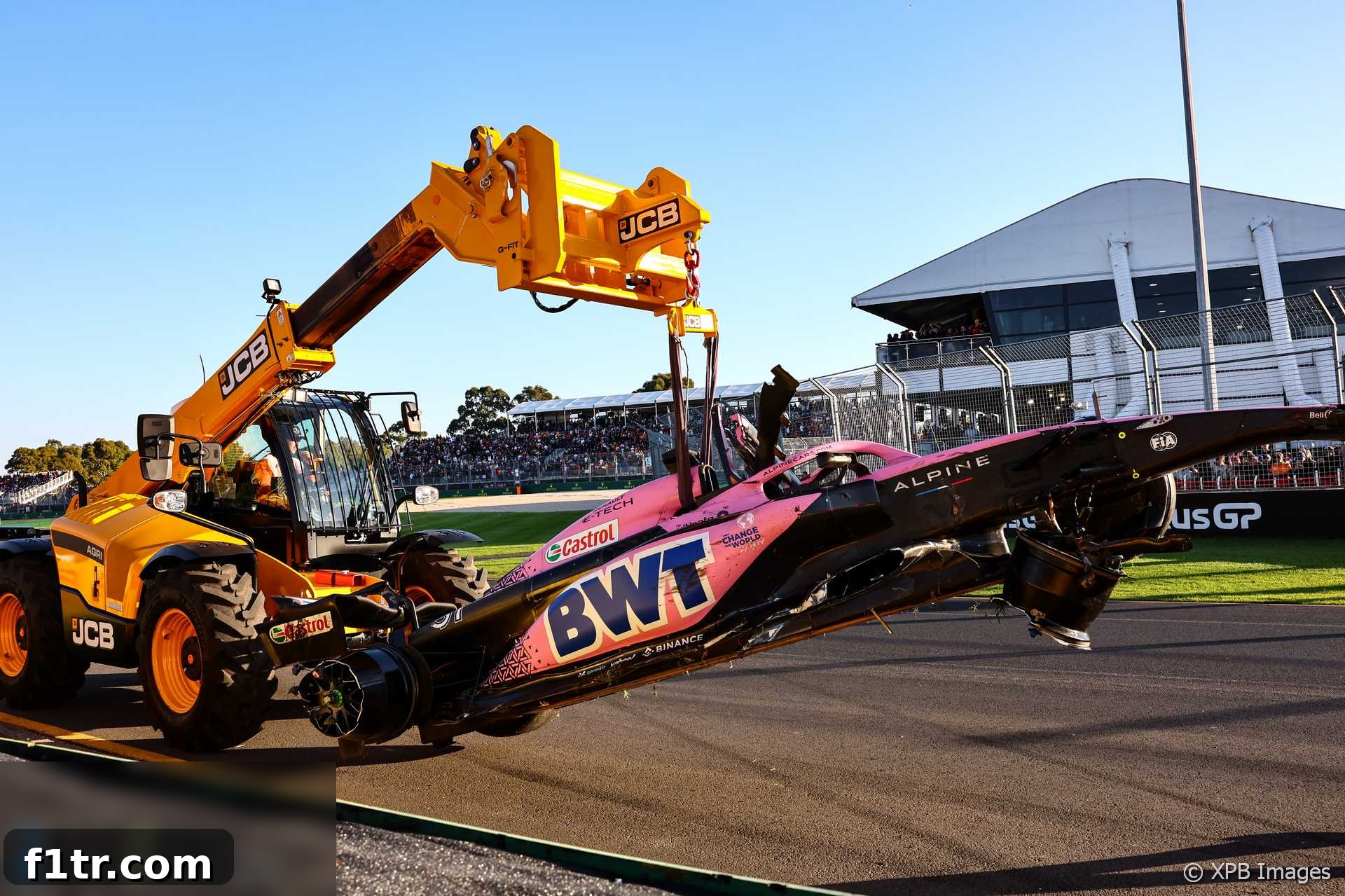
Szafnauer’s foresight proved particularly pertinent in the aftermath of the Australian Grand Prix. The race concluded with a challenging scenario for Alpine when their drivers, Esteban Ocon and Pierre Gasly, were involved in a collision during the chaotic final standing restart. Both A523 cars sustained significant damage, forcing both drivers to retire from the race. This double DNF not only impacted their championship points tally but also placed immediate and considerable strain on the team’s existing supply of spare parts.
In Formula 1, every incident, particularly those involving two cars from the same garage, translates directly into a substantial financial and logistical burden. Manufacturing intricate carbon fibre components, complex aerodynamic elements, and various mechanical assemblies is an expensive and time-consuming process. The sudden loss of two complete sets of critical parts necessitates an urgent ramp-up in production, diverting resources and potentially impacting the timeline for new developments. The three-week gap, therefore, transformed from merely “welcome” to “absolutely essential” for Alpine, allowing them to mitigate the fallout from Melbourne effectively.
Ensuring a plentiful supply of spares is not just about recovery; it’s about preparedness for the challenges ahead. Szafnauer emphasized this point, stating the team’s priority to be fully stocked for the upcoming round in Baku. This strategic focus is crucial because the nature of the next few circuits inherently carries a higher risk of damage.
Baku and Beyond: Navigating High-Risk Street Circuits with a Sprint Challenge
The Azerbaijan Grand Prix, held at the high-speed Baku City Circuit, is notoriously demanding. Its blend of long straights and tight, unforgiving street sections has led to numerous heavy impacts and safety car deployments in recent seasons. The concrete walls lining the circuit offer no margin for error, and even the slightest misjudgment can result in significant damage to the intricate F1 cars.
This year, the challenge is amplified by the addition of a sprint race to the Baku weekend format. The sprint race introduces an extra competitive session, increasing the total track time and, consequently, the statistical probability of incidents. With less practice time before qualifying and the sprint, drivers have fewer opportunities to acclimatize fully, further elevating the risk. As Szafnauer noted, “There is more jeopardy because it’s a street race and some of the walls are pretty close.” The prospect of a sprint race on such a perilous circuit makes the availability of spare parts not just a convenience, but a competitive imperative. Teams that are well-stocked can afford to push harder, knowing they have a buffer against potential damage.
The proactive approach to spare parts manufacturing during this break is designed to ensure Alpine can navigate both the sprint and the main Grand Prix in Baku without undue caution. Looking further ahead, the Miami Grand Prix, another challenging street circuit, follows closely after Baku, necessitating a continuous and robust supply chain. Szafnauer’s hope that “it’ll all be okay and we won’t suffer in Miami” reflects the constant battle against attrition in modern Formula 1.
Accelerating Development: The A523’s Evolution During the Hiatus
Beyond the immediate need for repair parts, the extensive gap between races provides Alpine with a golden opportunity to push forward with their aggressive development program for the A523. Formula 1 car development is a relentless cycle of simulation, design, manufacturing, and track testing. Every team strives to introduce upgrades as frequently as possible to gain a performance edge.
Szafnauer confirmed that this break allows for more considered and substantial upgrades. “The break allows you to plan further upgrades that you find through your simulation tools, and knowing that the break is there, you plan them a bit differently – but it definitely helps,” he explained. This implies that instead of rushing smaller, incremental updates, Alpine can consolidate several developments into a more significant package, ensuring thorough testing and integration before they hit the track.
The ability to plan developments “a bit differently” during this extended period is crucial. It gives engineers more time to validate concepts in CFD (Computational Fluid Dynamics) and wind tunnel simulations, optimize manufacturing processes, and ensure the new components are robust and reliable. This meticulous approach minimizes the risk of introducing parts that don’t perform as expected, a costly mistake in a sport where every tenth of a second counts.
The Midfield Battle: Alpine’s Confident Push for Performance
The Formula 1 grid is fiercely competitive, especially in the midfield, where teams like Alpine constantly battle for supremacy. McLaren, Alpine’s closest rival throughout the previous season, has also signaled intentions to bring significant upgrades in the coming races, setting the stage for an intense development war. However, Szafnauer remains confident in Alpine’s ability to maintain its competitive position and push ahead.
Alpine is not resting on its laurels. “We too have a decent-size upgrade coming for Baku and then a little bit more only a week later in Miami, so we continue to push the upgrades out,” Szafnauer stated. This commitment to continuous, aggressive development is a cornerstone of their strategy. The speed at which teams can introduce effective upgrades often dictates their trajectory over a season.
A critical factor for Alpine’s confidence lies in the reliability of their development process. “The important thing is that they all work when we put them on the car and we have good correlation with our simulation tools,” Szafnauer emphasized. “We had good correlation last year and if that continues and if we continue to push the upgrades, we’ll take that development fight over the season to the others around us.” Excellent correlation means that what the simulations predict closely matches the real-world performance on track, reducing wasted resources and accelerating genuine performance gains. This precision in development is what Alpine believes will give them the edge in the ongoing battle for championship points and a stronger position in the constructors’ standings.
The strategic use of this unplanned F1 calendar break highlights Alpine’s proactive and resilient approach to the challenges of modern Formula 1. By diligently stocking up on crucial spare parts and pushing forward with significant car upgrades, the team aims to transform a potential setback into a distinct competitive advantage, ready to tackle the demanding circuits of Baku and Miami, and to sustain their development fight throughout the season.
Pictures: Alpine Drivers Collide in Melbourne
Related Articles: 2023 Australian Grand Prix Insights
- Australian GP to forbid fans from entering track at end of this year’s race
- I only missed one chance to score points this year – Albon
- Formula 1’s stewards should listen to drivers less, not more
- Mercedes unsure whether gains seen in Melbourne were ‘track-specific’
- Why Ferrari saw a ‘real step forward in pure performance’ in point-less Australian GP
Browse all 2023 Australian Grand Prix articles