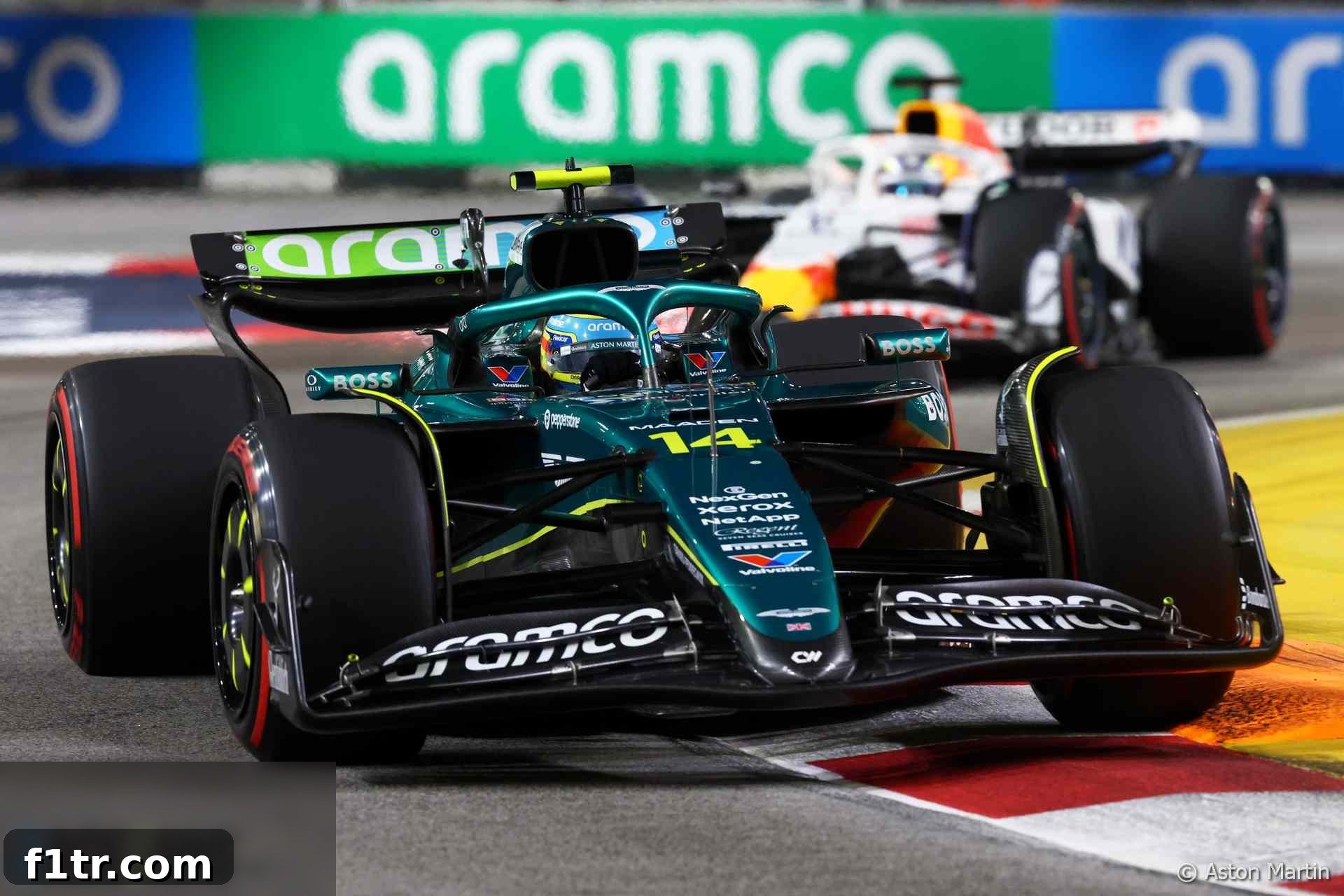
Fernando Alonso
Advert | Become a Supporter & go ad-free
Fernando Alonso’s Fiery Reaction: Hamilton’s Brake Issues and Track Limits Controversy at Singapore
The high-octane world of Formula 1 often delivers moments of intense drama, both on and off the track. One such incident that ignited a passionate debate and showcased raw driver emotion occurred at the recent Singapore Grand Prix. Aston Martin’s Fernando Alonso, a two-time world champion renowned for his fierce competitive spirit, unleashed an expletive-filled tirade over his team radio after a nail-biting finish. The Spaniard narrowly missed out on seventh place to Mercedes driver Lewis Hamilton, whose car was grappling with severe brake problems in the race’s closing stages. This contentious encounter not only highlighted the unforgiving nature of the Marina Bay Street Circuit but also brought stewarding consistency, track limits regulations, and driver safety sharply into focus, prompting widespread discussion across the F1 paddock and among fans globally.
As the Singapore Grand Prix drew to its thrilling conclusion, Alonso found himself rapidly closing the gap on Hamilton, who was visibly struggling with his ailing Mercedes. The final margin at the chequered flag was less than half a second, a testament to Alonso’s relentless pursuit and Hamilton’s valiant effort to nurse his compromised car to the finish. However, the drama was far from over, as Hamilton’s struggles had led to a series of track limit infringements, setting the stage for a post-race review and a fiery response from his long-time rival.
Lewis Hamilton’s Late-Race Brake Troubles and Resulting Track Limits Breaches
The Singapore Grand Prix is arguably one of the most physically demanding races on the Formula 1 calendar, pushing both drivers and machinery to their absolute limits. The circuit’s tight corners, high humidity, and numerous braking zones place immense stress on every component, particularly the braking system. In the final laps of the race, Lewis Hamilton’s Mercedes began to experience a significant and escalating brake problem. This technical malfunction severely hampered his ability to control the car, forcing him to reduce speed dramatically and, consequently, to run wide beyond the track boundaries on multiple occasions.
Race stewards quickly identified four separate instances where Hamilton exceeded track limits in quick succession during these critical final laps. Under the stringent regulations of Formula 1, drivers are expected to keep all four wheels within the white lines that define the track. While allowances are sometimes made for “justifiable reasons”—such as being forced off by another car or avoiding a collision—repeatedly leaving the track without such an exemption typically results in penalties. Hamilton’s situation, where a mechanical fault led to his deviations, presented a complex challenge for the stewards: how to balance the technical integrity of the car with the absolute adherence to sporting regulations. This scenario became the flashpoint for the subsequent controversy and Alonso’s vehement protest.
The Stewards’ Investigation and Application of the Five-Second Time Penalty
In the immediate aftermath of the race, the stewards promptly initiated an inquiry into Lewis Hamilton’s track limit breaches. They specifically cited him for “leaving the track without a justifiable reason, multiple times.” During the formal hearing, Hamilton openly acknowledged his repeated excursions beyond the track’s white lines. He explained that these actions were directly attributable to his efforts to manage and mitigate a significant brake issue on his Mercedes W14. His argument was clear: the car’s mechanical failing constituted a legitimate and unavoidable reason for his deviations.
However, after a thorough and meticulous investigation, the stewards ultimately concluded that Hamilton’s explanation, while factual regarding his brake problems, did not meet the criteria for a “justifiable reason” as outlined in the FIA’s comprehensive Driving Standards Guidelines. Their official statement noted: “During the hearing, the driver confirmed that he left the track at several occasions. He was trying to manage a brakes issue. This being said, after further investigation, and in accordance with the list of exemptions foreseen in the Driving Standards Guidelines, the stewards considered that this was not a justifiable reason and apply the usual penalty for such type of infringement.” Consequently, a five-second time penalty was imposed. Notably, neither the Mercedes team representative nor Hamilton himself chose to contest this decision, signifying their acceptance of the stewards’ interpretation of the regulations, even if the circumstances were born from a mechanical fault.
Advert | Become a RaceFans supporter andgo ad-free
Fernando Alonso’s Expletive-Filled Radio Rant and Claims of Inconsistency
While the stewards’ decision provided a definitive answer to Hamilton’s infringements, it was Fernando Alonso’s raw, immediate reaction over team radio that truly captured the post-race tension. Having relentlessly chased down Hamilton in the final laps, only to finish just over four tenths of a second behind, the two-time world champion’s frustration boiled over. His radio messages were a passionate, expletive-laden outpouring of disbelief and anger, painting a vivid picture of his competitive fire.
Alonso’s tirade commenced with a furious “Oh fucking hell, mate. I cannot believe it.” His primary concern quickly shifted from merely losing a position to a fundamental question of safety and fairness. He vehemently queried, “Is it safe to drive with no brakes? He should…” This line of questioning went beyond the specific track limits penalty; it challenged the very principle of allowing a car with a known, significant safety issue—like compromised brakes—to continue racing at speed, potentially endangering other competitors. His repeated exclamations of “I cannot fucking believe it” underscored the depth of his exasperation, indicating a profound sense of injustice felt in the heat of the moment.
Alonso’s critique extended beyond the immediate incident, evolving into a broader complaint about perceived inconsistencies in how the stewards apply penalties. He starkly contrasted Hamilton’s situation with past incidents, including one from the very same weekend. “No respect the red flag yesterday, today free track for them. Maybe too much,” he fumed, implying that certain drivers, or teams, might be afforded a greater degree of leniency compared to others. This sentiment, often voiced by drivers, points to a desire for absolute uniformity in race officiating, regardless of the individual or team involved.
Further strengthening his argument, Alonso brought up a personal experience from three years prior, where he faced intense scrutiny and almost a disqualification threat for a loose front wing—a component he argued was far less critical to safety than non-functioning brakes. “For me, you cannot drive when the car is unsafe, you know. Sometimes they tried to disqualify me with no mirror. And now you have no brakes and everything is fine? I doubt it.” This powerful comparison highlighted his belief that the rules, particularly those concerning car integrity and driver safety, were not being applied uniformly across the grid. He firmly advocated that an unsafe car, irrespective of its driver, should be treated with the utmost severity to safeguard all participants.
The Altered Race Result: Alonso Gains Seventh Place
Ultimately, the stewards’ decision to impose a five-second time penalty on Lewis Hamilton had a tangible and direct impact on the official race classification of the Singapore Grand Prix. Hamilton, who had provisionally finished in seventh place, dropped to eighth in the final results due to the added penalty time. Consequently, Fernando Alonso was elevated from his provisional eighth-place finish to a hard-fought seventh. While the gain of a single position might appear marginal in the context of an entire championship season, every point and every grid slot are fiercely contested in Formula 1, especially in the competitive midfield battles. For Alonso, this adjustment provided a measure of vindication for his immediate post-race complaints, confirming that his concerns regarding Hamilton’s infringements were indeed valid and in accordance with the established sporting regulations.
This incident vividly underscores the critical role of race control and stewarding in upholding the integrity and fairness of Formula 1. Every decision, whether concerning track limits, safety, or sporting conduct, carries significant weight and can influence championship points, team standings, and driver morale. The stewards are tasked with the delicate balance of rigorously enforcing a complex rulebook while considering the unique circumstances of each incident—a challenge that frequently sparks passionate debate among drivers, teams, and the global fanbase.
Fernando Alonso’s Radio Messages from the End of the Singapore Grand Prix
| Vizard | Approaching turn 10 Strat five now, strat five now. |
| Alonso | Alonso takes the chequered flag behind Hamilton Oh fucking hell, mate. I cannot believe it. |
| Vizard | Yeah, he knew it. |
| Alonso | I cannot fucking believe it, I cannot fucking believe it! I mean, I cannot fucking believe it. I cannot fucking believe it. Is it safe to drive with no brakes? He should… |
| Vizard | Yeah, no, no. We are looking into it, we agree. We’re checking track limits and stuff as well. Let’s see, he took some margin there. Run switch warm-up, mate, run switch warm up. That is P8 anyway, so good recovery. |
| Alonso | Yeah, but this should be fucking P7. I mean, you cannot drive… |
| Vizard | Yeah, it may well be. |
| Alonso | …like if you are alone on track. Yeah, I mean. no respect the red flag yesterday, today free track for them. Maybe too much. |
| Vizard | Run switch warm-up, run switch warm-up. MFB blue override position 12. MFB blue override, position 12. Hamilton does have over four strikes for track limits anyway. I don’t know if that’s the brake issue. |
| Alonso | Yeah, five seconds minimum. |
| Vizard | Yeah so at least we did our best there, mate. P8, sorry we made it difficult for you. |
| Alonso | For me, you cannot drive when the car is unsafe, you know. Sometimes they tried to disqualify me with no mirror. And now you have no brakes and everything is fine? I doubt it. |
| Vizard | His last two laps were a 2 minute 09.147s. Good overtaking, that was good to watch. Hamilton has been reported for track limits and for the dangerous car as well, mate. We’ll see soon. |
| Alonso | Yeah, man, it’s clear. |
| Vizard | Just so you know. |
| Alonso | Thank you, guys. |
| Vizard | So when you pull up, just P1 and then P0, please. See you back here. |
Advert | Become a RaceFans supporter andgo ad-free
The Enduring Debate on F1 Officiating and Consistency
The incident at the Singapore Grand Prix is far from an isolated occurrence in the storied history of Formula 1. Debates surrounding stewarding decisions, particularly concerning the interpretation of track limits, car safety, and the consistent application of penalties, are a perennial feature of the sport. While the FIA endeavors to ensure uniformity in its rulings through comprehensive guidelines and a dedicated team of experienced officials, the dynamic and often chaotic nature of motor racing frequently presents unique scenarios that challenge blanket interpretations.
Drivers, with their careers and championship aspirations on the line, naturally advocate for the strictest and most uniform enforcement of rules. Their arguments often draw upon personal past penalties or perceived leniency towards rivals to highlight what they believe are discrepancies in judgment. Fernando Alonso’s passionate radio messages serve as a potent reminder of this ongoing tension between the pursuit of absolute fair play and the inherent complexities of regulating a high-speed, multi-million dollar competitive sport where fractions of a second can decide fortunes.
The outcome of this particular incident – a penalty for track limits, despite the mitigating factor of a technical fault – reinforces the FIA’s uncompromising stance that drivers ultimately bear the responsibility for keeping their cars within the defined track boundaries. This holds true even when confronted with unforeseen mechanical challenges, unless specific and predefined exemptions are met. It also underscores the critical importance of effective communication and strategic decision-making between a team and its driver, especially when technical issues arise that could lead to sporting infringements.
As the Formula 1 season continues its relentless pace, incidents such as these will undoubtedly persist in fueling spirited discussions among fans, pundits, and participants alike. They serve to highlight not only the extraordinary skill, courage, and resilience of the drivers but also the intricate web of rules, regulations, and human judgment that forms the bedrock of this thrilling sport. For Fernando Alonso, the 2023 Singapore Grand Prix will be remembered as a moment of profound frustration, but also one where his vocal advocacy for what he perceives as fair and consistent stewarding ultimately led to a rectified race result, even if the primary cause was a rival’s mechanical misfortune.
Miss nothing from RaceFans
Get a daily email with all our latest stories – and nothing else. No marketing, no ads. Sign up here:
2025 Singapore Grand Prix
- What are McLaren’s “repercussions” for Norris and why did they wait to apply them?
- Hamilton “had no choice” about cutting corners when brakes failed in Singapore
- Norris reveals he faces ‘repercussions to the end of the season’ over Piastri clash
- Russell denies Verstappen a ‘full set’ of wins, Hamilton breaks Schumacher record
- ‘Good shout on staying out’: Did Verstappen consider a second pit stop in Singapore?
Browse all 2025 Singapore Grand Prix articles