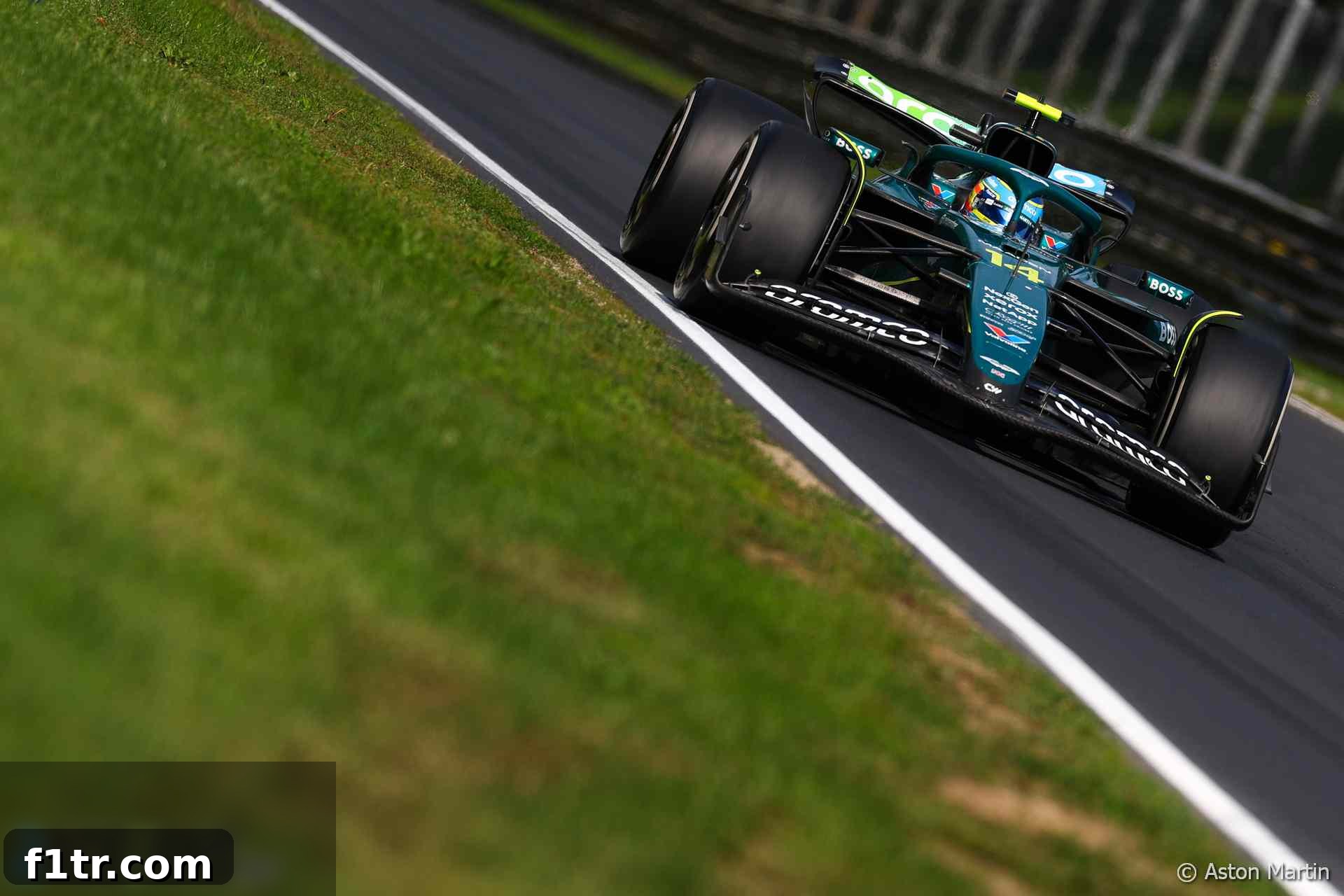
Fernando Alonso’s Monza Heartbreak: A Frustrating Retirement and the Shadow of Bad Luck
The Italian Grand Prix at Monza, a circuit steeped in motorsport history and synonymous with speed, delivered its usual dose of drama in the 2025 season. However, for Fernando Alonso and the Aston Martin Aramco F1 Team, the drama unfolded into another chapter of frustration, as the veteran driver was forced to retire from the race due to a suspension failure. This incident, occurring as he navigated the challenging Ascari chicane, cast a pall over what had been, up to that point, a commendably executed race.
Alonso, a two-time world champion renowned for his precision and ability to extract every ounce of performance from his machinery, was quick to dismiss the notion that his aggressive kerb riding was the root cause of the failure. “We were using the kerbs the same all weekend,” Alonso stated emphatically after his untimely exit. “So, I think it’s bad luck that we ended up having to retire.” His comments underscore a growing sentiment of misfortune that has plagued his 2025 campaign, with mechanical reliability issues persistently thwarting his efforts to secure valuable championship points.
The Critical Moment at Ascari: Suspension Failure Strikes Again
The high-speed Autodromo Nazionale Monza is famous for its demanding chicanes and long straights, pushing Formula 1 cars to their absolute limits. The Ascari chicane, a rapid left-right-left sequence, requires drivers to ride the kerbs aggressively to maintain momentum and shave crucial tenths off their lap times. It was at the exit of this very corner that Alonso’s Aston Martin suffered its critical suspension failure, rendering his car undriveable and forcing him to pull off the track.
While the initial assessment from some quarters might point to the arduous nature of kerb usage, Alonso’s long-standing experience and meticulous approach to racing suggest a deeper underlying issue. His consistency in using the kerbs throughout the practice sessions, qualifying, and the race itself, without prior incident, lends credence to his claim that this was an unfortunate confluence of circumstances rather than a direct consequence of driver error or overly aggressive driving. Modern Formula 1 cars are designed to withstand the stresses of track limits and kerb contact, implying that the failure could point to a material defect or a cumulative stress point within the suspension system.
A Season Plagued by Mechanical Woes: Alonso’s Mounting Frustration
The retirement at Monza marked a deeply frustrating pattern for Fernando Alonso in the 2025 season. It was not an isolated incident but rather the third time this year that a mechanical failure has prematurely ended his race. Previous race-ending car failures in the Chinese Grand Prix and the Monaco Grand Prix have already cost the Spaniard significant points, directly impacting his standing in the Drivers’ Championship.
“It is frustrating, but I’m getting used to it, unfortunately,” Alonso remarked with a hint of weariness after the Italian Grand Prix. His words convey the psychological toll that repeated reliability issues can take on a driver, especially one as competitive and driven as Alonso. At Monza, he was poised to secure his seventh points finish in eight races, having skillfully navigated his way into a strong seventh position. This consistent points-scoring capability highlights his enduring performance despite the car’s intermittent vulnerabilities.
“It’s very frustrating because, again, we were in seventh place, another six points for the championship, and we lost again,” Alonso lamented to the official Formula 1 channel. He drew a stark comparison to earlier misfortunes: “I remember Monaco, retiring the car with an engine problem being P6. Today, having a suspension problem being in P7. So the luck definitely is not with us this year, and we are losing a lot of points.” This litany of mechanical failures, always striking when he is in a prime scoring position, paints a clear picture of a season where potential is consistently undermined by unforeseen technical glitches.
A “Well-Executed Race” Before Disaster Struck
Despite the bitter disappointment of the retirement, Fernando Alonso was keen to highlight the positives of his performance leading up to the incident. His analysis revealed a strategically astute and expertly executed race, which saw him making crucial overtakes and demonstrating strong race craft.
“But it was a well-executed race,” Alonso affirmed. “We overtook Gabriel Bortoleto through the pit stops and everything was looking good.” He also mentioned an overtake on Antonelli at the start of the race, showcasing his ability to gain positions both on track and through strategic pit stops. These maneuvers are characteristic of Alonso’s seasoned racing intellect, where he maximizes every opportunity to advance. The fact that he was running in P7, ahead of several rivals and firmly within the points-scoring positions, speaks volumes about his driving prowess and the team’s operational strategy before the mechanical issue brought his charge to an abrupt halt.
The Italian Grand Prix had presented a complex challenge for Aston Martin, requiring a fine balance between outright speed and tire management. Alonso’s ability to extract competitive pace while making progress through the field suggested a robust understanding of the car and the track conditions. The frustration, therefore, is compounded by the knowledge that the team had, for the most part, done everything right on their end to put him in a strong position, only to be let down by hardware.
Impact on Championship Standings and Team Dynamics
The consequence of this latest retirement for Fernando Alonso is significant for his individual standing in the 2025 Drivers’ Championship. The lost points mean he now sits 12th in the standings, a position that hardly reflects his on-track performances and potential. Compounding this disappointment is the fact that he is now one place and two points behind his teammate, Lance Stroll.
This internal team battle, while secondary to overall team performance, can be an important psychological benchmark. Alonso, known for his relentless pursuit of excellence, will undoubtedly be keen to reverse this trend. The cumulative effect of these reliability issues isn’t just felt by Alonso; it also impacts Aston Martin’s position in the Constructors’ Championship. Every point lost by one driver directly affects the team’s standing against fierce rivals, making the push for reliability an even more critical concern for the Silverstone-based squad.
Meanwhile, Lance Stroll’s race at Monza presented a stark contrast to Alonso’s dramatic exit. Starting from 16th on the grid, Stroll finished the race as the last runner to cross the line in 18th place. When asked about his race afterwards, Stroll offered a terse, “it was okay,” a response that offered little insight into his performance or the challenges he faced. This brevity highlights a potential disparity in the team’s overall pace or Stroll’s ability to maximize the car’s potential on a demanding circuit like Monza, particularly when compared to Alonso’s ability to climb into points-paying positions.
Aston Martin’s Reliability Challenge and the Road Ahead
The recurring mechanical failures faced by Fernando Alonso throughout the 2025 season underscore a critical challenge for the Aston Martin Aramco F1 Team: reliability. While the team has shown flashes of strong performance, particularly in Alonso’s hands, the inability to consistently finish races due to technical issues is a significant impediment to their championship aspirations.
Formula 1 is a brutal proving ground for engineering and technology. The high demands placed on every component mean that even the slightest weakness can lead to catastrophic failure. For Aston Martin, the focus must now intensify on understanding the root causes of these recurring problems, whether they are design flaws, manufacturing inconsistencies, or material limitations. Addressing these issues is paramount not only for driver morale but also for the team’s reputation and its long-term competitiveness.
Monza, with its unique blend of high-speed straights and heavy braking zones, combined with aggressive kerb usage, often exposes the weakest links in a car’s design. The fact that the suspension failure occurred at Ascari, a corner where load transfer and structural integrity are heavily tested, might provide valuable data for the engineers to analyze. The immediate future for Aston Martin will involve a deep dive into the telemetry and physical remnants of Alonso’s car to pinpoint exactly what went wrong and implement preventative measures for the remaining races of the season.
For Fernando Alonso, a driver who has consistently demonstrated his unwavering commitment and exceptional talent, the continued mechanical setbacks are undoubtedly taxing. However, his veteran experience also means he understands the ebb and flow of Formula 1. The challenge now is for the team to rally, address the reliability demons, and provide him with a car that can consistently translate his raw speed and strategic brilliance into valuable championship points.
Conclusion: A Season of Unfulfilled Potential
The 2025 Italian Grand Prix retirement for Fernando Alonso was more than just a single race incident; it was a potent symbol of a season characterized by unfulfilled potential due to persistent mechanical failures. While Alonso demonstrated his customary skill and strategic acumen to put himself in a strong points-scoring position, fate, or rather, engineering shortcomings, intervened once again. The frustration is palpable, not just for the driver but for the entire Aston Martin team who are striving to climb the Constructors’ Championship ladder.
As the season progresses, the onus will be firmly on Aston Martin to improve their car’s reliability. For Alonso, a driver who continues to defy age with his performance, the hope remains that the “bad luck” he describes will soon give way to the consistent, trouble-free running that his talent truly deserves. Only then can he, and the team, fully realize their ambitions in what has proven to be a challenging 2025 Formula 1 season.
More from the 2025 Italian Grand Prix:
- No change to McLaren’s team orders after Monza review – Stella
- Bearman did not deserve penalty for Sainz collision at Monza, says Vowles
- Transcript: Hamilton seeking final tenths as he closes gap to Leclerc
- McLaren can clinch F1’s earliest title win since 1988 with as little as fifth place
- How did Verstappen know about Norris’ slow stop in Italy? Red Bull told him
Browse all 2025 Italian Grand Prix articles