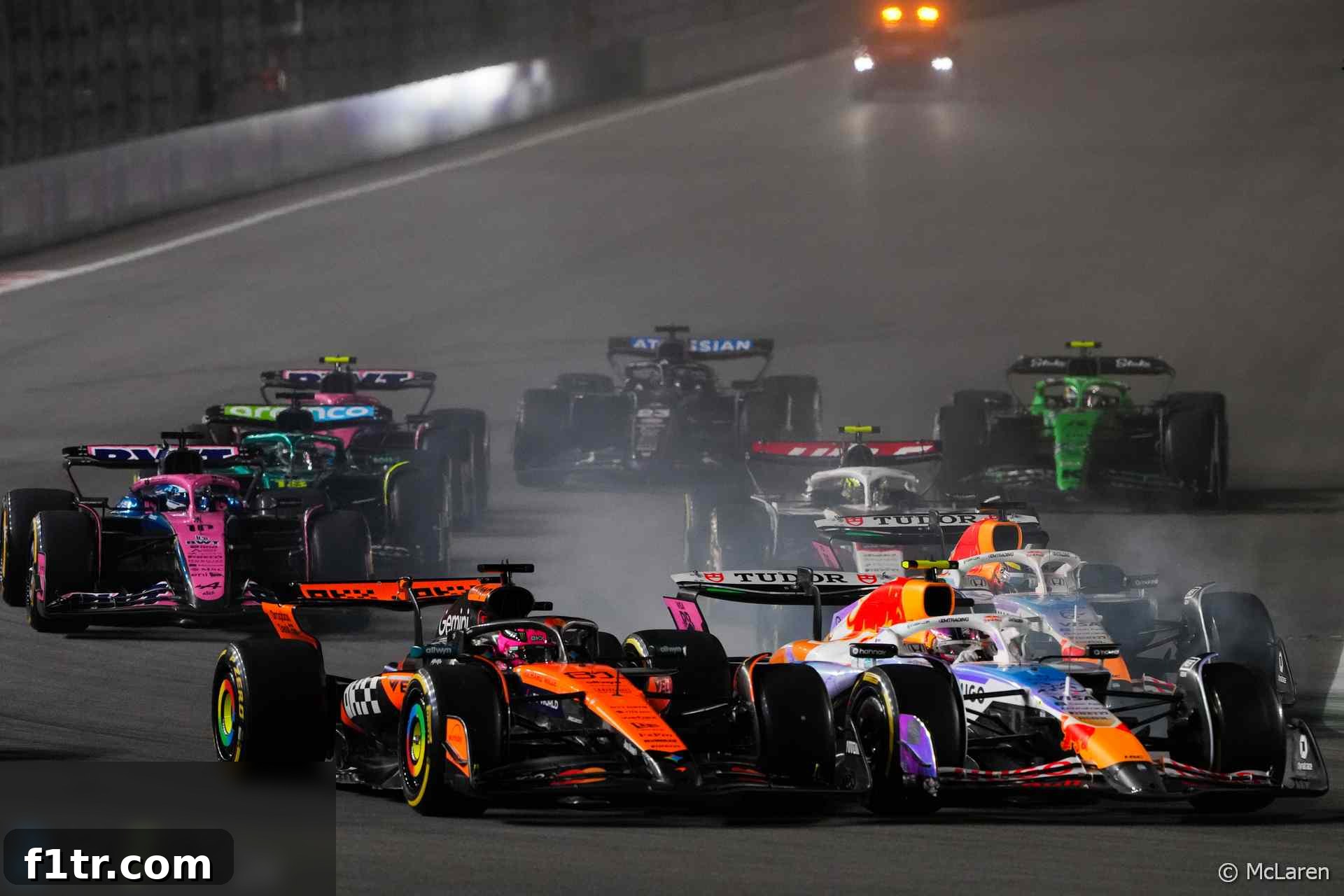
In the high-octane world of Formula 1, the opening lap of any race is often a crucible of raw speed, strategic positioning, and inevitable close encounters. A recent Saturday race, however, saw veteran driver Fernando Alonso embroiled in an early-race controversy, expressing strong dissatisfaction after being significantly impacted by a first-corner collision involving Racing Bulls driver Liam Lawson. Alonso’s frustrations highlight the fine line between aggressive racing and punishable incidents, especially when the consequences ripple through the field, affecting multiple competitors and altering race dynamics from the outset.
The incident unfolded dramatically at Turn 1, a notoriously challenging section for drivers as they jostle for position with cold tires and full fuel loads. Liam Lawson, in a bid to gain crucial track position, ran deep into the corner, executing a maneuver that ultimately led to an unavoidable collision with McLaren’s Oscar Piastri. This initial contact, while seemingly minor, created a ripple effect that immediately disadvantaged several drivers. Chief among them was Fernando Alonso, who had secured his highest grid position in eight races and started the event directly behind both Piastri and Lawson. Alonso, known for his incisive racecraft and keen eye for detail, was left fuming, his carefully laid race plan thrown into disarray within mere seconds of the lights going out.
Advert | Become a Supporter & go ad-free
For Alonso, the promising start quickly dissolved into a nightmare scenario. The collision ahead forced him to take immediate evasive action, scrubbing off crucial speed and compromising his racing line. This involuntary slowdown allowed competitors like Isack Hadjar and Oliver Bearman to capitalize swiftly, passing the two-time world champion with relative ease. The loss of positions so early in the race, particularly from a strong starting slot that offered genuine points potential, was a bitter pill for Alonso to swallow. It underscored the fragile nature of a Formula 1 race, where one incident can undo an entire weekend’s worth of preparation.
His immediate reaction was unmistakable and voiced with characteristic directness over the team radio. At the end of the opening lap, a clearly agitated Alonso communicated his perspective to race engineer Andrew Vizard: “Lawson, in turn one, he needs maybe a penalty.” This direct call for a penalty underscored the severity of the incident in Alonso’s eyes, suggesting a clear breach of racing etiquette that warranted immediate intervention from the race stewards.
Alonso’s frustration was palpable, echoing a sentiment often heard when a promising start is jeopardized by the actions of another driver. He characterized Lawson’s move as reckless, exclaiming, “Unbelievable turn one man. One time we start at the front and there’s a kamikaze in the inside.” The term “kamikaze” vividly illustrates his belief that Lawson’s dive into Turn 1 was overly ambitious and dangerously aggressive, showing a blatant disregard for the positions and safety of other drivers. Such incidents on the opening lap are frequently scrutinized, as the pack is incredibly tight, and the potential for significant damage or early retirements is exceptionally high.
Vizard confirmed that the stewards were indeed reviewing the incident, relaying the message: “We have reported Lawson for that first lap so they are looking at it.” However, the situation took a peculiar turn when Lawson’s race was effectively over shortly after. He pitted on lap two to replace a front wing damaged in the collision, and his subsequent performance issues meant he was effectively out of contention for points. Alonso’s subsequent response highlighted a common sentiment among drivers and fans: a penalty, while corrective, loses much of its punitive effect if the offending driver’s race is already compromised. “Yeah, but he’s out of the race now, so I mean there is no penalty to serve,” Alonso retorted, concluding with a simple, yet profoundly frustrated, “Crazy.” This exchange brought to light the challenge of applying retrospective penalties when the immediate consequences for the driver involved are already severe, sparking debate about the true purpose and impact of such sanctions.
Advert | Become a RaceFans supporter andgo ad-free
Adding to Alonso’s woes on that chaotic opening lap, he also reported contact with Charles Leclerc. As the Ferrari driver went wide alongside him on the outside of the first corner, Alonso explicitly felt a hit. “Also I think I’ve been hit by Leclerc on the outside, but there was a mess, everything,” he added, painting a vivid picture of a truly tumultuous start where multiple incidents converged. This made it difficult to discern clear fault in the immediate aftermath, suggesting the opening moments were a free-for-all, with drivers jostling aggressively for track position—a common, albeit dangerous, characteristic of Formula 1 race starts.
Stewards’ Verdict: A Closer Look at the No-Action Decision
In a move considered unusual by many, the race stewards issued a detailed explanation for their mid-race decision to take no further action regarding the Lawson-Piastri collision. This proactive communication aimed to clarify their rationale, especially given the visible impact on Alonso and Piastri’s initial laps and the subsequent public debate. Their statement emphasized the context of the incident: it occurred at Turn 1 on the very first lap of the race, a scenario often treated with greater leniency in F1 stewarding due to the inherent chaos, tight packing of the cars, and the cold tires and brakes that often contribute to unpredictable behavior.
The stewards’ explanation meticulously highlighted a chain of events that, in their view, ultimately mitigated Lawson’s culpability. They acknowledged the direct contact, stating that “Car 30 [Lawson] made a move to the right and collided with car 81 [Piastri].” However, they immediately introduced a crucial mitigating factor: “in mitigation car 30 made the move to avoid colliding with the rear of car 63 [Russell] whose driver locked up to avoid a collision with car 55 [Sainz].” This explanation painted Lawson not as the sole instigator but as a participant in a larger, unavoidable chain reaction. According to the stewards, he was caught in a concertina effect caused by George Russell’s need to avoid Carlos Sainz, thereby presenting the incident as a racing incident rather than a deliberate or negligent act by Lawson. This multi-car chain reaction is a frequent justification for a ‘no further action’ verdict on lap one, aimed at allowing aggressive racing without undue intervention for every minor contact.
However, this decision did not sit well with all parties involved, particularly Oscar Piastri, who was directly involved in the contact. Piastri openly expressed his discontent after the race, his frustration particularly poignant given he had recently been penalized for his role in a similar first-corner collision following a rolling restart at a previous event. Piastri felt that there was an undeniable inconsistency in the application of rules, noting, “I felt like I was one of the only people that actually braked to make the corner and got barged out of the way and that’s [apparently] fine.” His statement implied that despite his efforts to navigate the corner safely and in accordance with racing rules, he was unfairly compromised, and the lack of a penalty for Lawson felt unjust, especially against the backdrop of his own recent experience with similar penalties. This highlighted the often-subjective nature of stewarding decisions and the impact on driver morale when perceived inconsistencies arise.
Liam Lawson, for his part, offered a candid explanation for his actions, attributing the incident to challenging track conditions rather than intentional aggression. He admitted to being caught out by the distinct lack of grip leading into Turn 1, a common issue at the start of races. “It was extremely slippery into turn one and once I committed to brake, the cars in front started checking up and I didn’t have anywhere to go,” he stated in a team press release. This account suggests a momentary misjudgment combined with adverse conditions and the unpredictable behavior of the cars ahead, rather than a malicious or overtly reckless move. Such explanations are common in motor racing, where the margins for error are incredibly fine, and split-second decisions made under immense pressure can lead to unintended consequences, often beyond a driver’s full control.
Advert | Become a RaceFans supporter andgo ad-free
The Ongoing Debate: F1 Stewarding and First-Lap Incidents
The incident involving Lawson, Piastri, and the collateral damage to Alonso reignited the perennial debate surrounding Formula 1 stewarding, particularly concerning first-lap incidents. The inherent chaos of Turn 1 on the opening lap often prompts stewards to adopt a more lenient stance, classifying many contacts as “racing incidents.” The philosophy behind this approach is that drivers are jostling intensely for position, tires are cold, fuel loads are heavy, and the risk of incidental contact is significantly higher. Penalizing every minor touch could stifle aggressive, exciting racing and potentially lead to a procession rather than a true competition for positions.
However, critics argue that such leniency, while aiming to promote racing, can inadvertently encourage overly aggressive driving, as drivers might feel they can push the limits further on the first lap without fear of immediate sanction. Piastri’s palpable frustration, stemming from his own recent penalty for a similar situation, perfectly encapsulates this perception of inconsistency. If one driver is penalized for a first-lap contact, but another is not, it creates a perception of unfairness and confusion regarding the established rules of engagement. For seasoned drivers like Alonso, whose race is directly compromised by such incidents, the lack of a penalty can feel like a profound injustice, potentially influencing future driving behaviors and eroding trust between competitors on the track.
The stewards’ detailed explanation, citing a complex chain reaction involving Russell and Sainz as mitigation for Lawson, offers a rare glimpse into the complex decision-making process. They are not merely looking at the immediate contact but attempting to trace the root cause and understand the drivers’ intentions and reactions in a high-pressure, low-grip environment. This holistic approach, while intended to be fair and comprehensive, often leaves ample room for interpretation and disagreement among drivers, teams, and fans alike. The delicate balance between allowing hard, wheel-to-wheel racing and ensuring fair play and driver safety remains one of the most challenging and frequently debated aspects of Formula 1 governance. Each incident serves as a crucial test case for the sport’s officiating body.
Ultimately, the Lawson-Piastri collision at Turn 1 of the Saturday race serves as a compelling case study in modern F1 stewarding. It underscores the profound challenges of adjudicating fast-paced, complex incidents within the high-stakes environment of Formula 1 and the far-reaching consequences of such decisions on championship battles, driver morale, and the perception of fairness. While the stewards ultimately concluded no action was warranted, the strong reactions from prominent drivers like Alonso and Piastri indicate that the debate over what truly constitutes a “racing incident” versus a penalty-worthy offense is far from settled, continually evolving with each new race weekend.
Penalty Box: Your Verdict on the Collision
The controversy surrounding the first-corner incident at the recent Saturday race prompted significant discussion among fans and pundits across the Formula 1 community. Was a penalty truly warranted for Liam Lawson, or was it a genuine racing incident as the stewards ultimately concluded? The collision, which heavily impacted Fernando Alonso’s race and left Oscar Piastri visibly frustrated, sparked a poll among RaceFans readers to gauge public opinion on whether the stewards should have issued a penalty in this hotly contested scenario.
Should the stewards have penalised Piastri or Lawson for their collision?
- No opinion (5%)
- Strong penalty for Lawson (16%)
- Light penalty for Lawson (33%)
- No penalty for either driver (44%)
- Light penalty for Piastri (1%)
- Strong penalty for Piastri (0%)
Total Voters: 73
The poll results reflect a divided but notably leaning opinion among the voting public. A plurality of voters, 44%, believed that no penalty should have been issued for either driver, aligning with the stewards’ ultimate decision to classify it as a racing incident. However, a significant portion of the audience held a contrasting view: 33% felt that Liam Lawson deserved a light penalty, and another 16% advocated for a strong penalty against him. This combined 49% favoring some form of penalty for Lawson suggests a substantial segment of the audience disagreed with the stewards’ leniency. Only a very small fraction thought Piastri deserved a penalty. These results collectively underscore the inherent complexity of judging racing incidents and the wide range of interpretations even among informed and passionate fans of the sport.
A RaceFans account is required in order to vote. If you do not have one, register an account here or read more about registering here. When this poll is closed the result will be displayed instead of the voting form.
Miss nothing from RaceFans
Get a daily email with all our latest stories – and nothing else. No marketing, no ads. Sign up here:
2025 Las Vegas Grand Prix
- Losing win through strategy error “hurts more” than Las Vegas disqualification – Piastri
- FIA feels McLaren’s Las Vegas GP disqualification is “draconian”, claims Brown
- Why did McLaren’s messages to Norris and Piastri not mention plank problems?
- McLaren explain Las Vegas disqualifications – including their “counterproductive” reaction
- McLaren’s first double disqualification ended their second-longest points streak
Browse all 2025 Las Vegas Grand Prix articles