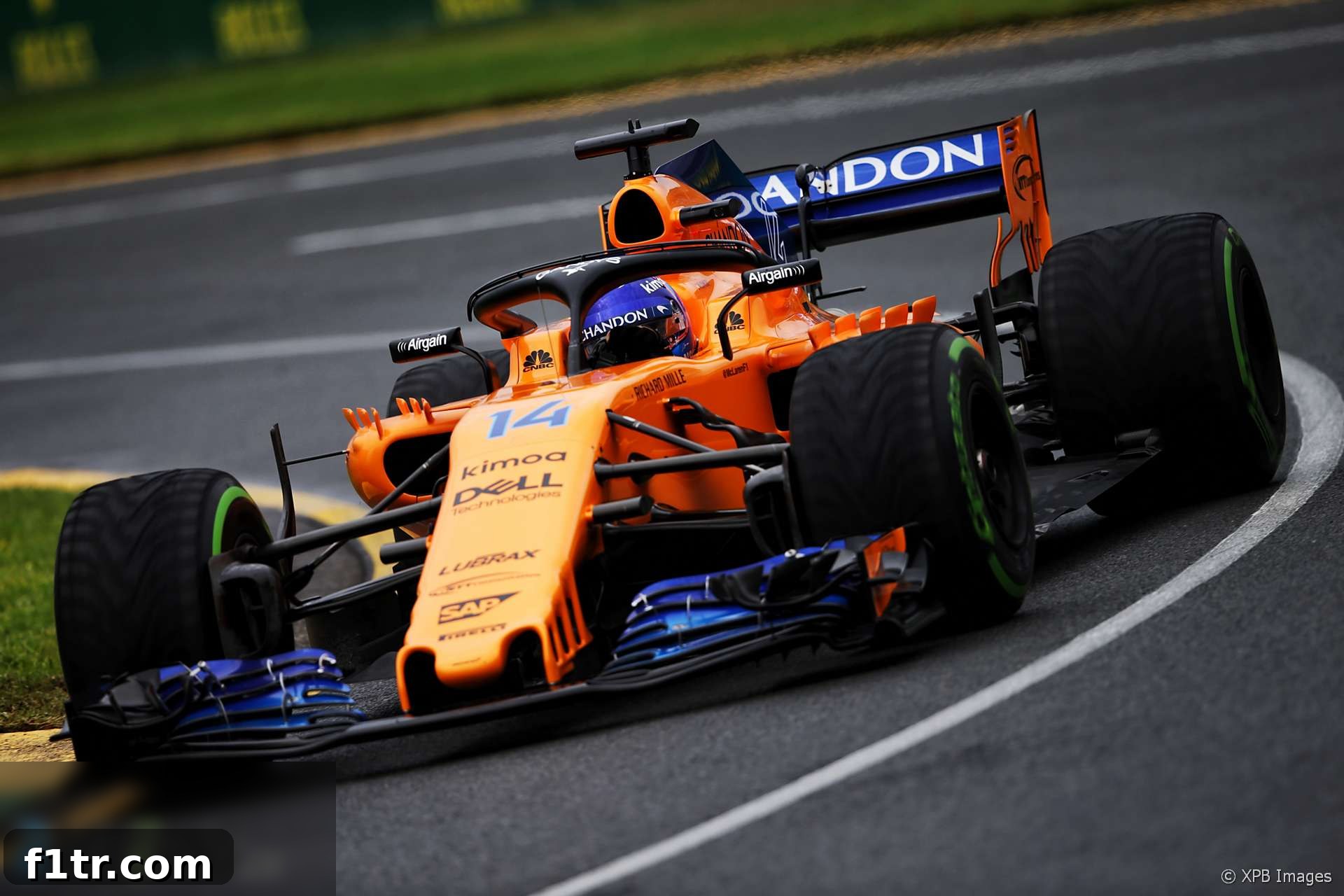
Fernando Alonso Highlights McLaren’s “Huge Potential” with New Renault Power
Fernando Alonso expressed a clear sense of optimism regarding McLaren’s prospects, despite narrowly missing out on a coveted Q3 spot during the 2018 Australian Grand Prix qualifying session. The seasoned Spanish driver, who placed 11th on the grid, conveyed satisfaction with the team’s initial performance, underscoring the significant improvements anticipated throughout the nascent season. His comments provided a glimpse into the strategic shift and heightened ambitions within the Woking-based squad as they embarked on a new chapter with Renault engines.
A Promising Start: Navigating the Challenges of Q2
Alonso’s 11th place in qualifying, while not a top-ten finish, was viewed by the two-time world champion as a fair reflection of their current standing. “It’s what we have today and what we deserve,” he stated, indicating a pragmatic approach to the early stages of the season. However, this acknowledgment was immediately tempered with a forward-looking perspective. The McLaren MCL33 had already demonstrated flashes of encouraging performance, particularly during the damp conditions of free practice earlier that morning. Such glimmers of pace suggested an underlying strength that the team was eager to fully exploit, hinting at a broader window of operational effectiveness for the car.
The transition from Honda to Renault power units marked a pivotal moment for McLaren, aiming to leave behind years of frustrating underperformance. Alonso’s confidence stemmed from the belief that the team had merely scratched the surface of the car’s true capabilities. “We have huge potential to unlock in the car,” he affirmed, pointing towards the intricate process of fine-tuning and development inherent in Formula 1. This “unlocking” involves a meticulous assessment of aerodynamic efficiencies, chassis balance, suspension setup, and crucially, the seamless integration and optimal mapping of the new power unit. The initial races were always anticipated to be a learning curve, and Alonso’s comments suggested this process was well underway, with significant gains yet to be realized.
Tapping into Latent Performance: The Renault Power Unit Advantage
One of the most compelling aspects of Alonso’s optimism revolved around the new Renault power unit. He highlighted a unique opportunity for McLaren to gain performance “for free,” simply by improving their understanding and optimization of the engine package. McLaren, along with Toro Rosso (now AlphaTauri/RB), were the only teams on the grid in 2018 to integrate a brand-new power unit into their existing systems. This fresh start meant a steep learning curve but also a wealth of untapped potential that other, more established Renault users (such as the factory Renault team and Red Bull) had already explored and optimized in previous seasons.
The “free performance” Alonso spoke of refers to gains achieved not through costly upgrades or new parts, but through enhanced software mapping, improved energy recovery system (ERS) deployment strategies, better cooling solutions, and a more harmonious overall chassis-engine package. These refinements, while technically challenging, often yield substantial lap time improvements without requiring significant hardware changes. For McLaren, this represented a crucial advantage. While competitors with more mature engine partnerships had already squeezed much of the inherent performance out of their units, McLaren still had considerable headroom to improve, simply by adapting more effectively to their new powerplant. This ongoing process of adaptation and optimization was expected to bring tangible benefits as the season progressed, setting the stage for a more competitive outlook in the subsequent races.
Shifting Gears: From Defence to Attack
Perhaps the most telling sign of McLaren’s renewed ambition was Alonso’s declaration that their first race with Renault power would be “one of the first races in the last couple of years that probably we don’t need to defend.” This stark contrast to the Honda era, where races often involved managing engine limitations and fending off slower cars, signaled a profound shift in mindset. McLaren was preparing to go into “attacking mode,” a strategy that resonates deeply with Alonso’s aggressive driving style and competitive spirit.
This aggressive stance was not just a hope but a tangible strategic direction. The ability to attack rather than defend implies a car capable of sustaining pace, making overtakes, and genuinely competing for positions, rather than merely holding on. Such a transformation would be a huge psychological boost for the entire team, validating their decision to switch engine suppliers and reigniting the fighting spirit that has long been synonymous with McLaren. Furthermore, Alonso acknowledged the potential influence of external factors, specifically mentioning the weather. “Also the weather factor that is still a risk for tomorrow, some showers. If that arrives the race will be great,” he commented. Rainy conditions in Formula 1 often level the playing field, introducing unpredictability and rewarding driver skill and strategic acumen – elements where Alonso traditionally excels. A chaotic, wet race could present ideal opportunities for McLaren to capitalize and further demonstrate their latent potential.
An Optimistic Outlook for the 2018 Season
Alonso’s concluding remarks painted a picture of guarded but genuine optimism for the 2018 season. “I think the next coming races we can look forward to the season very optimistic,” he stated. This sentiment was not based on a single qualifying performance but on the understanding of the development curve ahead. The initial race in Australia was merely the first step in a long journey of integration and optimization. As McLaren engineers and strategists continued to delve deeper into the nuances of the Renault power unit and the MCL33 chassis, the expectation was that performance would steadily improve, allowing the team to climb up the pecking order.
For Fernando Alonso, a driver renowned for his relentless pursuit of victory, this renewed sense of competitiveness was invigorating. After years of struggling at the back of the grid, the prospect of fighting for points and even podiums would be a welcome change. The 2018 season was poised to be a critical year for McLaren, testing their resolve and validating their strategic choices. Alonso’s comments at the Australian Grand Prix qualifying served as an early declaration of intent, signaling that McLaren was back on a trajectory to reclaim its position among Formula 1’s elite, fueled by untapped potential and a revitalized attacking spirit.
Go ad-free for just £1 per month>> Find out more and sign up
2018 F1 season
- F1 feared “death knell” for Drive to Survive after Ferrari and Mercedes snub
- McLaren staff told us we were “totally crazy” to take Honda engines in 2018 – Tost
- ‘It doesn’t matter if we start last’: How Red Bull’s junior team aided Honda’s leap forward
- Honda’s jet division helped F1 engineers solve power unit problem
- McLaren Racing losses rise after Honda split
Browse all 2018 F1 season articles