The 2009 Hungarian Grand Prix qualifying session at the Hungaroring proved to be one of the most dramatic and unforgettable in recent Formula 1 history. What began as a tense battle for pole position culminated in a shocking incident involving Ferrari’s Felipe Massa and a bewildering technical failure that left everyone, including the drivers, guessing the final results. Ultimately, it was two-time world champion Fernando Alonso who claimed his first pole position in nearly two years, a remarkable achievement overshadowed by the day’s events.
Advert | Become a Supporter & Go Ad-Free
The conclusion of qualifying was particularly surreal, as a complete failure of the timing systems in the crucial final moments meant that neither the teams nor the drivers knew who had secured the top spots. This unprecedented breakdown added another layer of confusion to an already emotionally charged afternoon, creating a strange mix of triumph and uncertainty at the pinnacle of motorsport.
Q1: Rising Temperatures and Rookie Debuts
Following a relatively cool final practice session, the track temperature at the Hungaroring began to rise steadily before qualifying commenced. This increase was particularly significant, as warmer conditions were generally considered more favorable for the Brawn GP cars, which had shown exceptional pace throughout the 2009 Formula 1 season. As the first cars ventured onto the circuit, the asphalt temperature had climbed to a balmy 41°C, setting the stage for a gripping session and indicating potential shifts in car performance.
Among the initial wave of cars to set competitive laps were the Toro Rossos. All eyes were on rookie Jaime Alguersuari, making his Formula 1 debut at a tender age of 19. His baptism by fire began on one of the most physically demanding tracks on the calendar, known for its tight, twisty layout and lack of overtaking opportunities, which places immense pressure on qualifying performance. His seasoned teammate, Sébastien Buemi, set an early benchmark with a time of 1’21.813. The STR4s, equipped with the revised front wing and diffuser designs first introduced by their sister team Red Bull Racing at Silverstone, were clearly benefiting from these aerodynamic upgrades, demonstrating promising speed and stability.
The practice sessions had hinted at an exceptionally tight field, with a mere second separating nineteen cars on Friday afternoon. This trend continued into qualifying, emphasizing the razor-thin margins and the immense pressure on every F1 driver to extract maximum performance from their machines. With such close competition, no driver could afford to rest on their laurels; staying in the pits for even a moment too long after their final run was simply not an option. Consequently, all twenty cars flooded the circuit in the dying minutes of the session, creating a frantic scramble for a precious spot in Q2 and highlighting the intense competitiveness of the 2009 season.
Unfortunately, Alguersuari’s debut took a disappointing turn towards the end of Q1 when his car ground to a halt on track. This incident not only cut short his session but also guaranteed him a challenging start from the very back of the grid for Sunday’s race, a tough lesson for any rookie. The stoppage briefly triggered yellow flags, sending a momentary scare through several drivers who were on crucial flying laps, potentially preventing them from posting improved times. However, the interruption was brief enough for most to complete their runs, narrowly avoiding significant disruption to the leaderboard.
Among those who successfully navigated the yellow flag period and pulled themselves out of the drop zone were Timo Glock, who surged from 18th to a commendable eighth in his final attempt for Toyota. His teammate Jarno Trulli also secured his progression, as did both Renaults, showcasing impressive late-session pace to avoid early elimination. This demonstrated the crucial importance of a strong final lap in such a closely contested session.
Conversely, it was a dismal start to the weekend for BMW Sauber, as both Nick Heidfeld and Robert Kubica were unexpectedly eliminated. Heidfeld’s strong second-place showing in final practice proved to be a deceptive indicator of their true qualifying pace, suggesting their car struggled to adapt to the hotter track conditions or find outright speed. The two Force India-Mercedes cars also failed to advance, with Adrian Sutil having only managed a brief stint on track after his earlier practice crash, which undoubtedly hampered his preparations and rhythm for qualifying.
Advert | Become a RaceFans Supporter andGo Ad-Free
Drivers Eliminated in Q1:
- 16. Nick Heidfeld, BMW – 1’21.738
- 17. Giancarlo Fisichella, Force India-Mercedes – 1’21.807
- 18. Adrian Sutil, Force India-Mercedes – 1’21.868
- 19. Robert Kubica, BMW – 1’21.901
- 20. Jaime Alguersuari, Toro Rosso-Ferrari – 1’22.369
Q2: Drama, Disaster, and Delays
The second qualifying session ignited with even more intense competition, as the Red Bull Racing duo of Sebastian Vettel and Mark Webber initially set the pace, showcasing their RB5 car’s formidable performance and excellent traction through the Hungaroring’s demanding corners. However, Nico Rosberg of Williams quickly responded, posting an impressive 1’20.895 to challenge their dominance. But it was Fernando Alonso who truly surprised the paddock, first by narrowly edging Rosberg by a mere hundredth of a second, and then by finding an additional 0.05 seconds on his subsequent run, firmly establishing his Renault R29 at the top. This exceptional display of speed from Alonso, considering Renault’s often inconsistent form that season, raised eyebrows and underscored his talent.
With just five minutes remaining, the pressure mounted considerably for those on the cusp of elimination. Alonso’s teammate, Nelson Piquet Jnr, who notably did not have the benefit of the latest specification front wing that Alonso’s car was equipped with, found himself languishing in the bottom five. He was joined by both Toyotas (Trulli and Glock), Sébastien Buemi, and Ferrari’s Kimi Räikkönen, all fighting desperately to escape elimination and secure a spot in the final Q3 shootout.
In a bold move that demonstrated his confidence, Alonso was the only driver who opted not to undertake a final flying lap, believing his earlier time was sufficient to advance. Everyone else, recognizing the extreme competitiveness of the session, poured onto the track for one last desperate attempt. Rubens Barrichello, driving for the championship-leading Brawn GP team, was pushing hard to secure his passage into Q3 when disaster struck: part of his rear suspension catastrophically failed, sending significant debris onto the circuit. This mechanical failure would have far-reaching and terrifying implications for his fellow countryman, Felipe Massa.
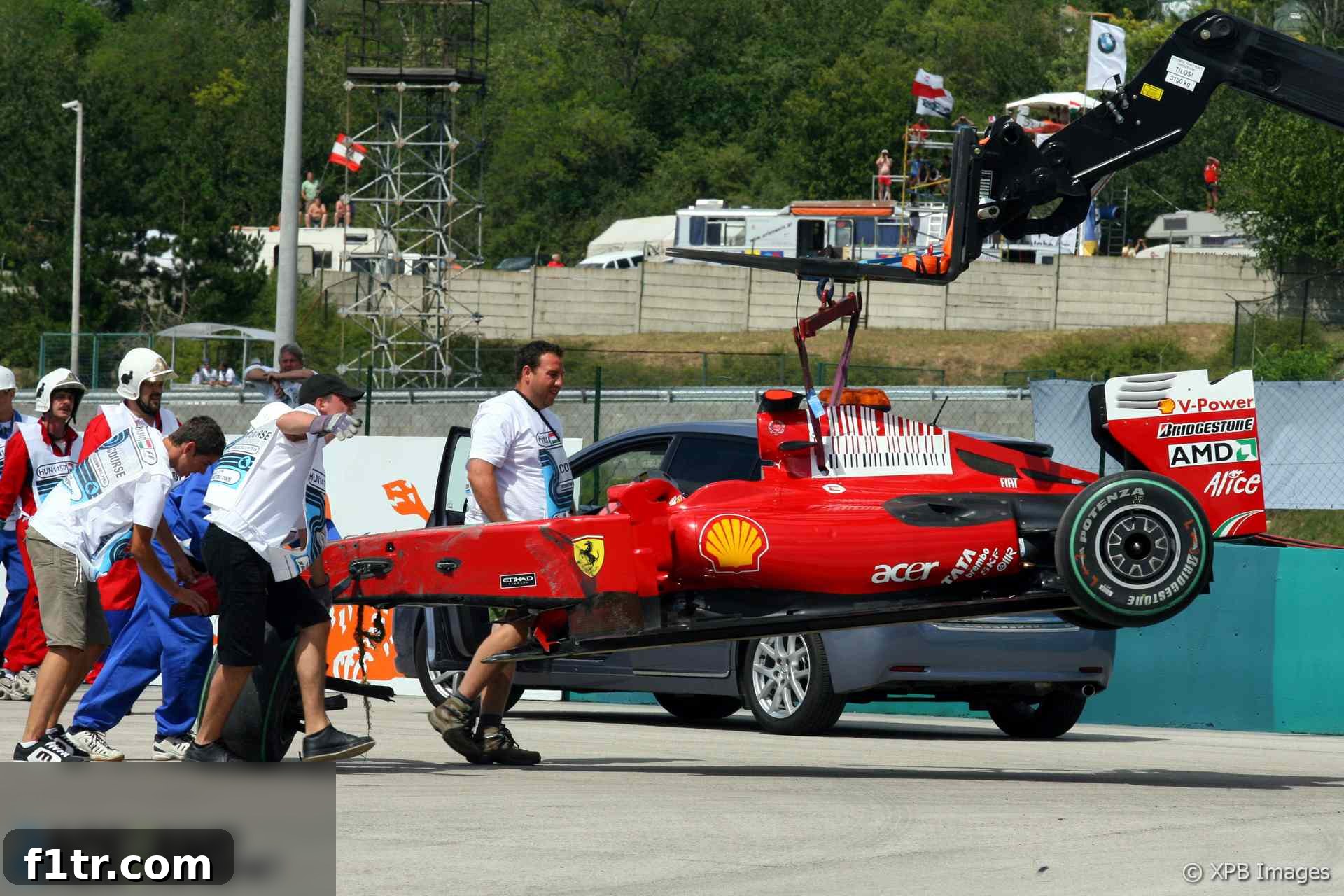
As the Ferrari driver, Massa, arrived at Turn 4, a crucial component of Barrichello’s suspension — a spring — tragically struck his crash helmet. The impact was immediate and devastating, occurring at high speed. Massa’s car veered violently off track, crashing forcefully into the barriers. The sight was horrific; television replays showed the spring had torn a significant gash in the side of his helmet, dislodging the visor from the left side and leaving his face visibly bloodied. While the injury was gory and deeply disturbing, the outcome could have been far worse had the debris struck a different part of his head or if the helmet’s structural integrity had failed completely. It was a stark and chilling reminder of the ever-present dangers in Formula 1, even with advanced safety measures.
The session was immediately red-flagged and subsequently delayed for a significant twenty minutes as medical personnel attended to Massa at the scene. He was swiftly transported to the circuit’s medical centre for initial assessment before being airlifted by helicopter to a local hospital in Budapest for urgent specialized treatment. The entire paddock held its breath, awaiting news on the popular Brazilian driver’s condition. The incident cast a somber pall over the Hungaroring, instantly making the sporting competition secondary to human safety and highlighting the inherent risks drivers face.
Watch: Felipe Massa Crashes After Being Struck by Debris During Qualifying
Advert | Become a RaceFans Supporter andGo Ad-Free
Drivers Eliminated in Q2:
- 11. Sebastien Buemi, Toro Rosso-Ferrari – 1’21.002
- 12. Jarno Trulli, Toyota – 1’21.082
- 13. Rubens Barrichello, Brawn-Mercedes – 1’21.222
- 14. Timo Glock, Toyota – 1’21.242
- 15. Nelson Piquet Jnr, Renault – 1’21.389
Q3: Confusion at the Climax
After a prolonged and tense delay, the third and final qualifying session eventually resumed. The atmosphere was palpable, with the gravity of Felipe Massa’s incident weighing heavily on everyone in the paddock. Ferrari opted not to send Massa’s car back out, effectively ending his qualifying. Significantly, Jenson Button’s Brawn GP car initially remained in the garage. His team meticulously inspected its rear suspension, undertaking thorough checks to ensure there was no similar risk of mechanical failure following Barrichello’s earlier incident. This proactive measure prioritized driver safety above all else, underscoring the seriousness of the debris strike.
As if the session hadn’t already delivered enough drama, events took yet another bizarre and unprecedented turn as Q3 approached its climax. Suddenly, all timing screens around the circuit and in the pit lane went completely blank. This left everyone in a state of utter confusion, with no clear indication of which driver had set the fastest time or who was provisionally on pole position. Spectators, teams, and commentators alike were left bewildered, desperately trying to piece together the leaderboard in the final, crucial minutes of the session.
Before the inexplicable timing blackout, Mark Webber had reportedly been leading the session, showing strong pace in his Red Bull. As the drivers returned to parc fermé, the designated area where cars are held after qualifying, their expressions were a mixture of quizzical bemusement and frustration. They congregated, asking each other about their lap times in an effort to manually reconstruct the results and ascertain who had truly claimed pole position. It was an extraordinary scene, highlighting the chaotic end to a truly chaotic session that had already seen so much emotional strain.
Eventually, after a period of uncertainty and meticulous manual verification by officials, it was officially announced that Fernando Alonso had indeed set the fastest time, narrowly clinching pole position. His sensational lap, a 1’21.569, put him just ahead of Sebastian Vettel, who secured second place for Red Bull with a 1’21.607. This anticlimactic conclusion felt strangely appropriate for a session that had seen all the joy and excitement drained out of it by the harrowing crash involving Felipe Massa. The mix of relief for Alonso’s achievement and lingering concern for Massa made for a profoundly emotional end to qualifying.
Despite the initial confusion caused by the technical glitch, there were no immediate doubts raised regarding the accuracy of the final, manually verified times. This outcome meant that, unlike a contentious incident from two years prior where Alonso had controversially lost a pole position, he would definitively keep his hard-earned top spot for the Hungarian Grand Prix grid. It was a significant moment for the Spaniard and for Renault, offering a glimmer of hope and a much-needed boost in what had been a challenging season for the team.
Mark Webber secured an excellent third place, positioning his Red Bull strongly for the race, ahead of Lewis Hamilton in the McLaren-Mercedes. Jenson Button, surprisingly, found himself languishing in eighth position, a rare blip for the championship leader and his dominant Brawn GP team, suggesting they might have struggled more with the conditions or setup. This unexpected grid order promised an intriguing race on Sunday, with many questions about strategy and performance still unanswered. A clearer picture of each team’s genuine competitiveness and race strategy would only emerge later that afternoon, once the crucial fuel weights for the start of the race were officially published, adding another layer of anticipation to an already unforgettable Hungarian Grand Prix weekend.
Top Ten Drivers in Q3:
- Fernando Alonso, Renault – 1’21.569
- Sebastian Vettel, Red Bull-Renault – 1’21.607
- Mark Webber, Red Bull-Renault – 1’21.741
- Lewis Hamilton, McLaren-Mercedes – 1’21.839
- Nico Rosberg, Williams-Toyota – 1’21.890
- Heikki Kovalainen, McLaren-Mercedes – 1’22.095
- Kimi Räikkönen, Ferrari – 1’22.468
- Jenson Button, Brawn-Mercedes – 1’22.511
- Kazuki Nakajima, Williams-Toyota – 1’22.835
- Felipe Massa, Ferrari – No Time (Withdrew)
Full 2009 Hungarian Grand Prix Grid
2009 Hungarian Grand Prix Fuel Loads: Alonso Very Light, Button Heavy
Go Ad-Free for Just £1 Per Month>> Find out more and sign up