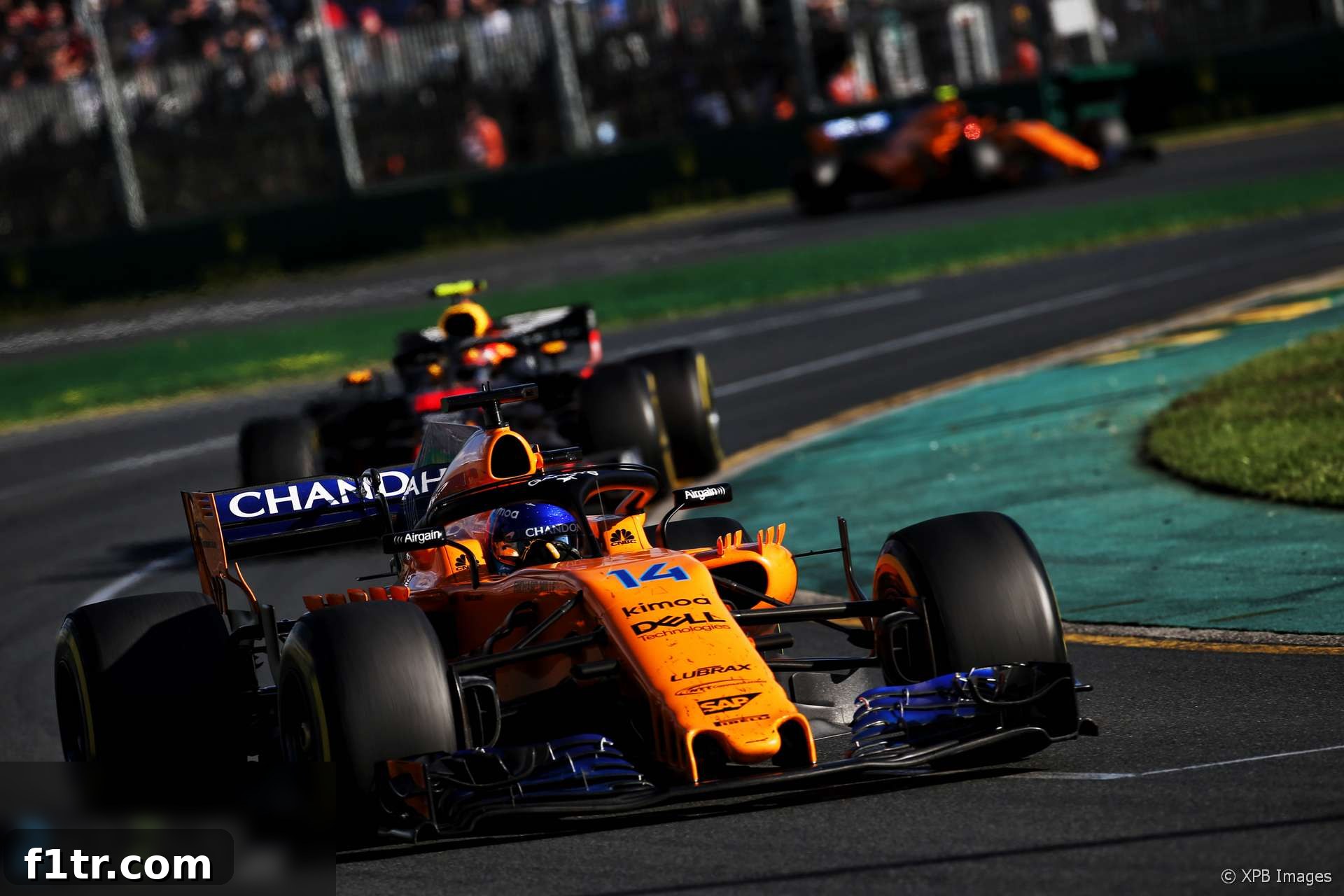
The 2018 Formula 1 season kicked off with high expectations at the Australian Grand Prix in Melbourne, and while Sebastian Vettel ultimately claimed victory, a nuanced battle for fifth place between two of the sport’s titans, Fernando Alonso and Max Verstappen, provided a significant talking point. This wasn’t just a simple on-track overtake; it was a testament to the fine margins, strategic acumen, and the often-complex application of regulations that define modern Formula 1. Alonso, driving for McLaren, managed to secure fifth position ahead of Red Bull’s Max Verstappen, a feat primarily achieved through a perfectly timed pit stop under Virtual Safety Car conditions and an intricate understanding of the sporting regulations.
The Strategic Gamble: VSC and Pit Stop Timing
The incident unfolded during a crucial phase of the race. Alonso’s strategic advantage stemmed from his decision to pit under a Virtual Safety Car (VSC) period, which offered a significant time-saving opportunity compared to a regular pit stop under green flag racing. The VSC procedure mandates that all drivers maintain a delta time to the Safety Car, effectively slowing the entire field and neutralising gaps. For drivers already on track, this means a controlled pace. For those entering the pits, however, the time loss in the pit lane relative to the slower pace on track is considerably less than during full-speed racing. This strategic window allowed Alonso to ‘jump’ Verstappen, who, unfortunately for him and his Red Bull team, had pitted earlier under conventional green flag conditions. The difference in effective pit stop time under these contrasting scenarios proved to be the pivotal factor.
When Alonso rejoined the track following his VSC-aided stop, the situation became immediately tense. The McLaren emerged from the pit exit just one-tenth of a second ahead of Verstappen’s Red Bull. Such miniscule margins are commonplace in Formula 1, but this particular instance led to immediate confusion on track and in the respective team garages. Initially, Verstappen moved back ahead of Alonso, as the precise application of the rules regarding rejoining the track during a Safety Car period (which followed the VSC) was not immediately clear to the drivers. This fleeting moment of uncertainty highlighted the high-stakes environment where every millisecond and every rule interpretation can make or break a race result.
The Crucial FIA Ruling and Safety Car Lines
The crux of the matter lay in the intricate regulations governing overtaking and positioning during Safety Car periods. Specifically, the rule states that drivers who are rejoining the track from the pit lane may overtake or be overtaken by other cars before they reach the second Safety Car line. This line acts as a critical demarcation point; once a driver crosses it, their position relative to cars already on track, and the order they maintain, becomes fixed until further instructions or the Safety Car period ends. In this particular instance, the FIA timekeepers meticulously confirmed that Fernando Alonso had indeed reached this crucial second Safety Car line one-tenth of a second before Max Verstappen. This infinitesimal lead, imperceptible to the human eye in real-time, was the definitive factor that legally placed Alonso ahead.
The immediate ambiguity on track prompted the Red Bull Racing team to seek clarification from the FIA. Race director Charlie Whiting, a revered figure in Formula 1 for his comprehensive understanding and fair application of regulations, provided the decisive explanation. “Red Bull said ‘we think Fernando was in front’,” Whiting recounted, acknowledging the initial uncertainty. “I wanted to check because it wasn’t completely clear. I asked the timekeepers to confirm at the Safety Car line which car was first, and they said Alonso by a tenth of a second.” This reliance on precise timing data underscores the technological sophistication of Formula 1 and the impartiality required in its officiating. Whiting further elaborated on the visual difficulty: “Hence, that’s why it was difficult to see with the naked eye unless you’ve got the facility to replay it slowly, that sort of thing.” This comment highlights the inherent challenges faced by drivers, teams, and even officials in making split-second judgments without the aid of advanced telemetry and video analysis.
Communication Challenges Under Pressure
Adding another layer of complexity to the unfolding drama was a temporary breakdown in communication channels, or rather, a staggered notification process. Red Bull received the instruction that Verstappen needed to concede the position to Alonso before McLaren had been officially notified. This led to a brief, yet significant, moment of confusion on track. As Verstappen, having received the directive, slowed down and gestured for the McLaren driver to pass, Alonso did not immediately respond. From Alonso’s perspective, without official confirmation from his own team, he likely remained unsure of the exact situation and the validity of Verstappen’s actions.
Charlie Whiting openly discussed this communication lapse, providing valuable insight into the pressures and protocols involved. “I said to Red Bull Max has got to let Fernando past. Before I could then get onto McLaren and say ‘we’ve told Max to let Fernando past’, Max was sort of saying ‘come on, then’. We hadn’t got around to getting the message to Fernando.” This situation perfectly illustrates the rapid-fire decision-making and communication networks required in Formula 1, where even a slight delay in relaying crucial information can lead to on-track misunderstandings between highly competitive drivers.
Ultimately, the correct order was established, with Fernando Alonso retaining his hard-fought fifth position. Whiting further clarified that the principle of the ruling was absolute, independent of race conditions. He added that the drivers would have been given the same instruction to restore the correct order even if the race had returned to green flag running. This reinforces the FIA’s commitment to consistent rule enforcement, ensuring that a driver’s legitimate gain or loss of position due to strategic timing and precise adherence to regulations is upheld, regardless of the dynamic state of the race. The incident served as a potent reminder of the intricate interplay between strategy, rules, and technology in the pursuit of victory, or in this case, a crucial fifth place, in the pinnacle of motorsport.
Beyond the Race: The Impact of Precision
The 2018 Australian Grand Prix incident between Alonso and Verstappen, while seemingly minor in the grand scheme of the season’s championship fight, perfectly encapsulated the essence of Formula 1 racing. It demonstrated that success isn’t solely about raw speed or aggressive overtaking; it’s also about meticulous strategy, the exploitation of every regulatory nuance, and the incredibly tight margins that separate triumph from disappointment. For Fernando Alonso and McLaren, securing fifth place was a vital result, especially in a season where points were hard-won. It showcased McLaren’s strategic capabilities and Alonso’s ability to capitalize on every opportunity. For Max Verstappen and Red Bull, it was a harsh lesson in the absolute precision required under safety car rules, highlighting how even a fraction of a second can alter a race outcome and ultimately, championship standings.
This episode also served to underscore the critical role of race control and the FIA’s detailed timekeeping systems. Without the ability to accurately measure and verify positions down to tenths of a second at specific points on the track, such disputes would be impossible to resolve fairly. Charlie Whiting’s clear and concise explanation, alongside the FIA’s data-driven decision, brought clarity to a potentially contentious situation. It reinforced the importance of clear communication channels between race control and teams, especially during rapidly evolving race scenarios involving safety cars or virtual safety cars. Such incidents, while causing temporary confusion, ultimately contribute to the integrity of the sport, ensuring that results are determined by fair competition and strict adherence to the established rules, no matter how intricate they may seem to the casual observer.
Go ad-free for just £1 per month>> Find out more and sign up
2018 F1 season
- F1 feared “death knell” for Drive to Survive after Ferrari and Mercedes snub
- McLaren staff told us we were “totally crazy” to take Honda engines in 2018 – Tost
- ‘It doesn’t matter if we start last’: How Red Bull’s junior team aided Honda’s leap forward
- Honda’s jet division helped F1 engineers solve power unit problem
- McLaren Racing losses rise after Honda split
Browse all 2018 F1 season articles