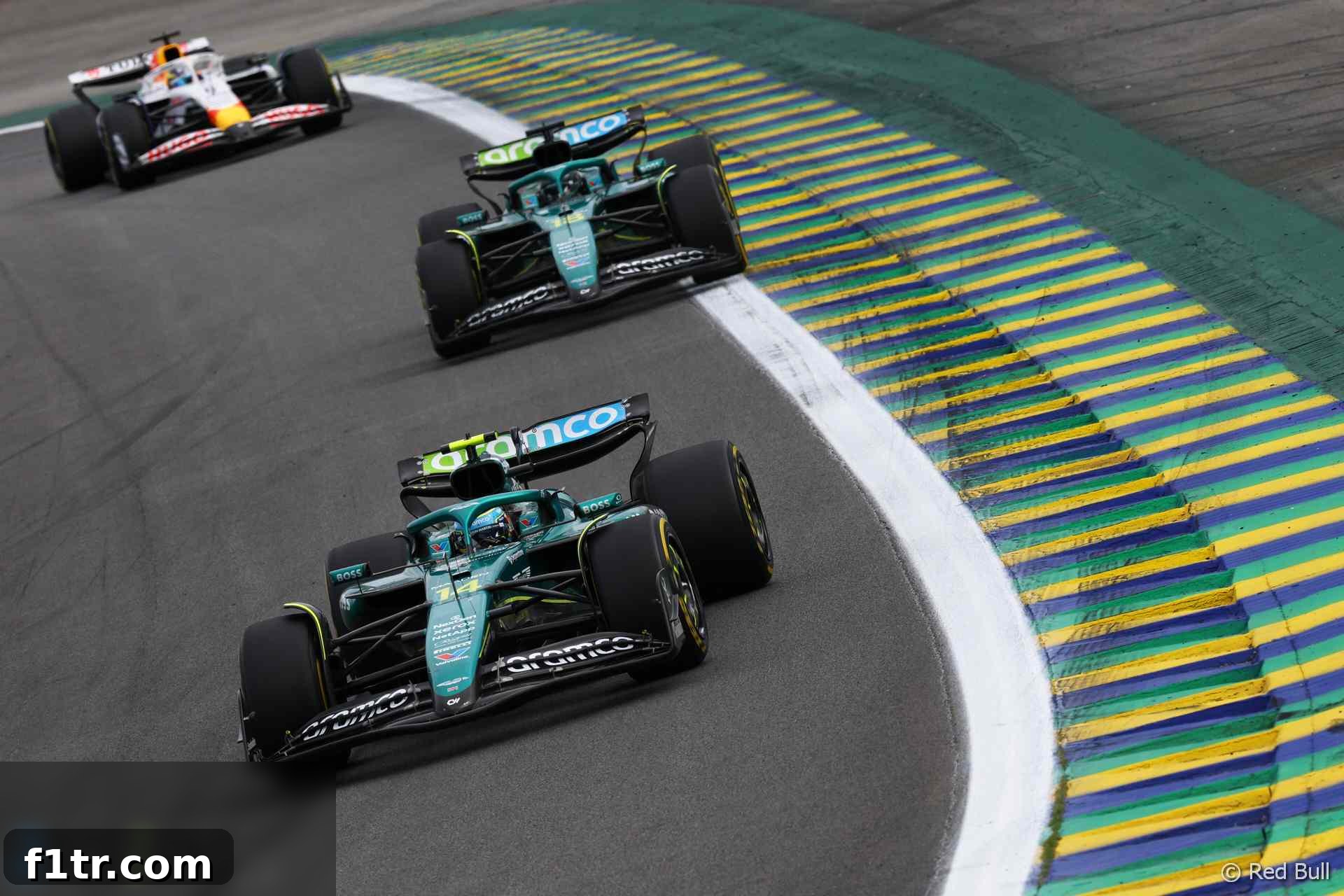
Fernando Alonso Reflects on F1’s 2022 Regulations: A Critical Assessment of Racing Quality
Formula 1’s ambitious overhaul of its technical regulations in 2022, designed primarily to enhance the quality of racing, has come under scrutiny from one of the sport’s most experienced voices. Two-time world champion Fernando Alonso, known for his incisive observations and unparalleled longevity in the sport, believes these new rules ultimately failed to deliver on their promise. As F1 prepares for another significant regulatory shift in 2026, Alonso’s candid assessment prompts a deeper look into the efficacy of the current generation of ground effect cars and their impact on the spectacle of Grand Prix racing.
Alonso’s Critical Assessment: Did the 2022 Rules Fail to Deliver?
Advert | Become a Supporter & go ad-free
From the outset, the 2022 regulations were heralded as a game-changer, intended to allow cars to follow each other more closely and, consequently, foster more on-track action. The series poured immense resources into developing these ‘ground effect’ rules, a concept that fundamentally alters how cars generate downforce. However, four years into this regulatory cycle, Alonso, a driver who has witnessed countless technical evolutions in Formula 1, harbors significant doubts about their overall success.
“The expectations of these regulations, which were to follow [more] closely and to have better action on track, were not really a success,” Alonso stated unequivocally. He conceded that there might have been a brief period of improvement in the initial year, but this effect quickly waned. “Maybe in the first year a little bit, but not after that. So I don’t think we will miss too much of this,” he added, indicating a clear lack of enthusiasm for the outgoing era of cars.
Alonso’s perspective is particularly valuable given his extensive career. He is the most experienced F1 driver of all time, having navigated through eras defined by V10 engines, then V8s, witnessing significant aerodynamic simplifications in 2009, and subsequent complexities and widened cars in 2017. This rich historical context allows him to critically evaluate the current machinery against a broad spectrum of Formula 1 design philosophies. For Alonso, the current cars represent a departure from what he finds enjoyable and effective for racing.
He identifies several key issues with the present specification: “I think these cars are definitely too heavy. They are too big and [with] the ground effect and the ride heights we are racing in a way that is not really fun to drive and probably not even to follow cars.” The combination of increased weight, larger dimensions, and the specific demands of ground effect aerodynamics, which often necessitate a very stiff and low ride height, appears to detract from the driving experience and the ability to engage in close combat on track.
The Vision Behind the 2022 Rule Change: A Quest for Closer Racing
The genesis of the 2022 regulations was rooted in a genuine desire to improve the spectacle of Formula 1. Following extensive research and development, F1’s governing bodies and technical experts aimed to create cars that generated less ‘dirty air’ – the turbulent wake left by a car that significantly hinders a following car’s aerodynamics. By relying more heavily on ground effect, where downforce is created by shaping the car’s underfloor, rather than complex front and rear wings, it was hoped that the turbulent air would be directed upwards and away from the following car.
Improving the quality of racing was a key goal, a sentiment echoed by designers and engineers across the paddock. There was considerable optimism; some designers even expressed hope that F1’s Drag Reduction System (DRS) overtaking aid could potentially be rendered obsolete following the introduction of these new machines. The idea was that with naturally closer racing, artificial aids would no longer be necessary, allowing for purer, more organic battles for position.
The investment in these rules was monumental, signifying a serious commitment from Formula 1 to address concerns about processional races and to put the focus back on driver skill in close-quarters combat. The technical blueprint sought to balance outright performance with raceability, believing that a fundamental shift in aerodynamic philosophy was the key to unlocking a new era of thrilling competition.
On-Track Reality: Mixed Results and Evolving Driver Views
When the new cars debuted in 2022, the initial feedback from drivers was, predictably, a mixed bag. While some drivers reported an immediate improvement in their ability to follow other cars, allowing for closer battles through corners and a reduction in the severe aerodynamic disadvantage previously experienced, others remained skeptical. The phenomenon of ‘porpoising’ – an aggressive vertical oscillation caused by the ground effect stalling and reattaching – became a major talking point and an unforeseen challenge for teams and drivers alike, impacting both performance and comfort.
As teams gained experience with the new regulations and refined their designs, the narrative began to shift. Over the subsequent seasons, many drivers observed that passing had, in fact, become more difficult again. This unexpected development can be attributed to several factors. As teams optimized their packages, they inevitably found ways to maximize downforce, often pushing the limits of the ground effect concept. This led to cars becoming more sensitive to ride height and aero balance, making it harder to maintain optimal performance in turbulent air, even if the ‘dirty air’ effect was theoretically less pronounced.
Furthermore, one of the touted successes of the 2022 regulations was the closing of the performance gap between teams, particularly mid-pack. While this has undoubtedly led to greater strategic depth and more varied podium finishers across seasons, it also has an interesting side effect on overtaking. When cars are very closely matched in terms of lap times, the opportunity for a significant performance differential that enables a clean pass diminishes. Drivers are then forced into more aggressive, opportunistic moves, or rely heavily on DRS, which undermines the original intent of the regulations to reduce reliance on such aids. The paradox emerged: closer competition, but not necessarily easier overtaking.
A Contrasting View: Team Principals Defend the Current Era
Advert | Become a RaceFans supporter andgo ad-free
Despite Alonso’s reservations and the evolving driver sentiments, F1 team principals have largely defended the current regulations, highlighting different aspects of their impact. Laurent Mekies, the Red Bull team principal, articulated a commonly held view earlier this year, stating that the regulations produced “incredible racing” after their introduction. He reflected on the initial skepticism within the paddock: “I think if you ask Stefano [Domenicali, F1 CEO], he’ll probably remind you that we were all criticising these cars before they came out. And in the end, we got incredible racing.”
Mekies admitted to being among the ‘bad guys’ group who initially doubted the regulations. “I was in the ‘bad guys’ group – we were all thinking that the cars would all be the same, that there would be too much standardisation, and that performance levels would be too close. It turned out not to be exactly true. We got four years of incredible competition,” he explained. This perspective emphasizes the overall competitive landscape rather than just the ease of following. The regulations have indeed fostered a dynamic period, with different teams challenging for wins and constructors’ titles, even if one team eventually established dominance.
He continued, pointing to the blend of speed and spectacle: “Up to now, you still have one team dominating, and another team has been dominating in the past. So I think, when you combine that with the fact that these cars are the fastest ever, or nearly so, I think they’ve given us quite a great show. We’ve seen a lot of overtaking this year.” This view suggests that the sheer pace of the cars, combined with intense engineering challenges, contributed to an exciting era for the sport. The ground effect cars certainly presented a steep learning curve for all teams in 2022, with the infamous porpoising issue catching many off guard, yet it also led to rapid innovation and adaptation.
Mekies concluded by highlighting the technological advancement and high bar set by this generation of cars: “So personally, I feel good about these cars. They brought something great to Formula 1: technologically very advanced, it was a challenge for everyone. The ground effect cars caught nearly all the teams out in 2022, with the bouncing and everything, but I think we had a great show. And combined with this engine, I think it raised the bar to a very high level.” This perspective underscores the engineering triumph and the overall entertainment value, even if the specific goal of easier following might not have been fully realized to every driver’s satisfaction.
The Future of F1 Regulations: Lessons Learned and Hopes for 2026
As the Formula 1 circus looks towards another monumental regulatory overhaul in 2026, the discussions surrounding the current ground effect era become even more pertinent. Fernando Alonso’s comments serve as a crucial data point in evaluating what worked and what didn’t. His expectation that the next generation of cars will be slower highlights a perennial tension in F1: the quest for absolute speed versus the desire for better racing. While drivers inherently crave the fastest machinery, regulatory bodies often sacrifice a degree of pace for improved competition and safety.
“I will not miss this generation of cars, I think,” said Alonso, reinforcing his general dissatisfaction with their current characteristics. However, he admitted, “But I think next year, probably, we will go slower, and we will miss them when we drive the next cars because we always want to be as fast as possible.” This candid reflection captures the bittersweet nature of F1 evolution; even disliked cars can be missed once even slower ones arrive. The challenge for the 2026 regulations will be to address concerns about car size and weight, potentially reducing reliance on extreme ground effect, while still delivering a technologically advanced and thrilling racing package that genuinely fosters closer, more engaging on-track battles.
The feedback from drivers like Alonso, coupled with the insights from team principals and the observable dynamics of the past four seasons, will be vital in shaping the next chapter of Formula 1. The goal remains constant: to balance cutting-edge technology and peak performance with a racing product that excites fans and truly rewards driver skill in wheel-to-wheel combat. The legacy of the 2022 ground effect regulations will undoubtedly be a complex one, marked by both successes in technological advancement and competitive balance, yet also by ongoing debates about the ultimate quality of racing it delivered.
Miss nothing from RaceFans
Get a daily email with all our latest stories – and nothing else. No marketing, no ads. Sign up here:
Please check your junk email folder to ensure you receive our emails
Email address (required)
First name (optional)
Last name (optional)
Subscribe
2025 Las Vegas Grand Prix
- Losing win through strategy error “hurts more” than Las Vegas disqualification – Piastri
- FIA feels McLaren’s Las Vegas GP disqualification is “draconian”, claims Brown
- Why did McLaren’s messages to Norris and Piastri not mention plank problems?
- McLaren explain Las Vegas disqualifications – including their “counterproductive” reaction
- McLaren’s first double disqualification ended their second-longest points streak
Browse all 2025 Las Vegas Grand Prix articles