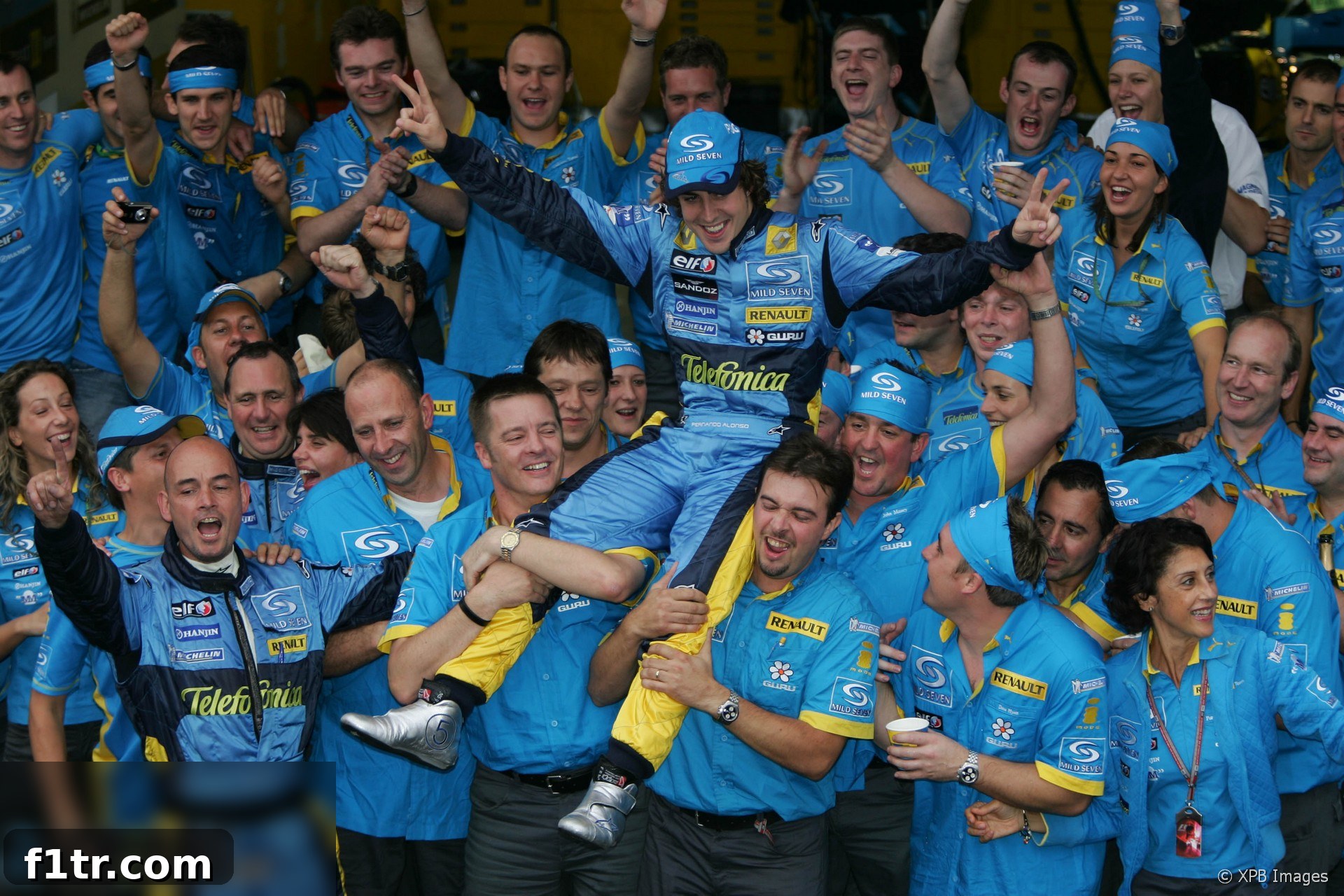
The roar of the engines faded, replaced by the collective sigh of a sport witnessing a seismic shift. At the iconic Autódromo José Carlos Pace, better known as Interlagos, a new legend was crowned. On that momentous day at the Brazilian Grand Prix, Fernando Alonso etched his name into the annals of Formula 1 history, becoming the sport’s youngest-ever Drivers’ Champion. His remarkable achievement was secured with a calculated and consistent performance, culminating in his 13th podium finish in an extraordinary 17 races, a testament to his unwavering skill and the reliability of his Renault R25.
Advert | Become a Supporter & go ad-free
The championship aspirations of his closest rival, Kimi Raikkonen, officially drew to a close at Interlagos. Despite a valiant effort, the Finn could only manage a second-place finish, trailing his McLaren Mercedes teammate Juan Pablo Montoya. In truth, the outcome of the 2005 Drivers’ Championship had been anticipated by many for several races. Raikkonen, while possessing blistering pace, had simply run out of opportunities to bridge the points gap to the incredibly consistent Alonso, who had meticulously built his lead throughout the grueling season. While Alonso’s title-clinching drive in Brazil might not have been the most spectacular race of his career, his entire championship campaign was replete with highlights and demonstrated a maturity beyond his years.
A Season of Unforgettable Battles and Ascendant Talent
The 2005 Formula 1 season was a truly captivating spectacle, largely defined by the fierce rivalry between Fernando Alonso and Kimi Raikkonen. It was a year that saw the shifting of power away from the seemingly invincible Michael Schumacher and Ferrari, ushering in a new era. Alonso’s season was punctuated by several iconic moments that underscored his championship pedigree. Who could forget his masterful defensive driving at the San Marino Grand Prix at Imola, where he fended off a relentless Michael Schumacher for lap after lap, showcasing incredible composure and car control under immense pressure? Equally memorable was his last-lap victory over Raikkonen at the Nurburgring, a dramatic win that perfectly encapsulated his fighting spirit and ability to seize opportunities.
These victories, alongside a string of consistent podium finishes, were the bedrock of his championship. The Renault R25, a marvel of engineering, proved to be both quick and incredibly reliable, a crucial factor in a season where rival McLaren often struggled with mechanical issues despite its raw speed. Alonso leveraged this combination perfectly, transforming potential into palpable success across diverse tracks and conditions, ultimately laying the foundation for his historic triumph in Brazil.
The Interlagos Weekend: Pressure, Pole, and Unforeseen Challenges
The atmosphere at Interlagos was charged with anticipation. Fernando Alonso, ever the epitome of coolness under pressure, navigated the treacherous demands of qualifying with characteristic precision. Piloting an updated version of his R25, which had received strategic enhancements for the critical final races, he skillfully secured pole position for the Brazilian Grand Prix. This placed him ahead of Juan Pablo Montoya, who faced a slight handicap, having to run earlier in the qualifying session. This early slot was a direct consequence of an unfortunate incident at the preceding Belgian Grand Prix, where Antonio Pizzonia had controversially taken him out of the race, impacting his qualifying order for Brazil.
The capricious weather of Interlagos often plays a significant role, and this weekend was no exception to the strategic gambles. Several teams, recalling recent events like the chaotic Belgian Grand Prix, had prepared their cars with extra downforce in anticipation of a wet race day. However, much to their tactical misfortune, the rain never materialised. Drivers like Jenson Button, whose BAR Honda sported extra wing elements, found themselves sacrificing crucial straight-line speed on a dry track, failing to reap any benefits from their cautious setup choices. Meanwhile, Kimi Raikkonen, under immense pressure to keep his title hopes alive, made a rare but costly error in qualifying, fluffing his entry into Turn One. This mistake relegated him to fifth place on the grid, further complicating his challenge. Lining up ahead of an inspired Christian Klien, who delivered arguably his qualifying performance of the year – and perhaps even his entire Formula 1 career – Raikkonen knew he had a significant fight ahead.
Race Day Drama: A Frantic Start and Early Incidents
As the lights went out, the Brazilian Grand Prix erupted into a symphony of roaring engines and wheel-to-wheel combat. The start was nothing short of frantic, an immediate testament to the high stakes of the race. Juan Pablo Montoya, starting alongside Alonso on the front row, immediately jostled for position with the championship leader. Despite his aggressive intentions, the Colombian couldn’t find a way past the resolute Renault. Behind them, chaos unfolded. Kimi Raikkonen, determined to make up for his qualifying deficit, swiftly overtook Giancarlo Fisichella for third position at Turn Three, demonstrating McLaren’s formidable pace. Not to be outdone, Michael Schumacher, ever the master opportunist, launched his Ferrari with breathtaking aggression at the Renault of Fisichella at Turn Five, scrambling ahead in a truly scintillating and audacious move that sent a clear message of his enduring competitive spirit.
Advert | Become a RaceFans supporter andgo ad-free
Tragically, just behind the front-runners, the race was marred by an early incident involving the two Williams cars and David Coulthard’s Red Bull. In a desperate squeeze for track position, the three cars became inextricably sandwiched, leading to a multi-car collision. All three were forced off track, though Mark Webber, showing remarkable tenacity, managed to limp his damaged Williams back to the pits, eventually rejoining the race on lap 29 after extensive repairs. This opening lap drama necessitated a brief safety car intervention, bringing the field together and setting the stage for a dramatic restart.
Strategic Reshuffles and Mid-Race Dynamics
The safety car period concluded, and as the race restarted, the tension was palpable. Fernando Alonso, perhaps momentarily caught off guard or misjudging his braking point, ran slightly deep at Turn One. Juan Pablo Montoya, sharp and opportunistic, pounced immediately, seizing the advantage and reversing the move that Alonso had defended just moments earlier. Faced with a determined Montoya and with Kimi Raikkonen firmly in third place, Alonso made a pragmatic decision, opting not to fight aggressively and allowing Montoya through into Turn Three. With the championship firmly in his sights, there was no need to take unnecessary risks. In a similar display of immediate repositioning, Fisichella managed to reverse Michael Schumacher’s earlier pass at the restart, regaining his fourth spot. Consequently, the constructors’ championship leaders, Renault and McLaren, now held the top four positions, underscoring their dominance in the 2005 season.
Although Montoya began to eke out a lead, his advantage over Alonso hovered around a modest three seconds, suggesting a tightly contested battle. However, lap 22 offered a crucial insight into the Renault’s ultimate performance and Alonso’s strategic brilliance. Alonso pitted five laps before Montoya and a significant eight laps before Raikkonen, indicating a lighter fuel load in the Renault, allowing him to push harder in the earlier stints. Meanwhile, Christian Klien, having justified the high praise for his qualifying lap, made his first stop on lap 24. On the other hand, Felipe Massa’s early stop on lap 17, covering a staggering 18 fewer laps than his Sauber teammate Jacques Villeneuve, clearly revealed a bold, possibly showboating, but ultimately unsustainable, strategy.
When Raikkonen eventually pitted, his stop was efficient enough to slot him into second place, directly behind Montoya. Yet, much like in the 2004 season, he consistently lacked the raw pace to truly challenge and push the Colombian for the lead. Surprisingly, it was Raikkonen who began to show the first signs of neck fatigue around the physically demanding, high-G loading Interlagos track. This was particularly unexpected given that his teammate, Montoya, was reportedly still recovering from a shoulder injury. Alonso, meanwhile, settled comfortably into third position. His race strategy was clear: maintain a watchful eye on the gap to Michael Schumacher (who had managed to re-pass Fisichella during the pit stops) and let the metronomic reliability and consistent performance of his Renault carry him safely to the championship title. His disciplined approach perfectly encapsulated his campaign, prioritising the bigger picture over individual race glory.
The Final Chapters: Stalemate and Points Allocation
As the race progressed through its second and final round of fuel stops, a strategic stalemate descended upon the front of the field. None of the top three drivers – Montoya, Raikkonen, or Alonso – displayed any particular inclination or necessity to push aggressively to catch the others. Their positions were largely consolidated, and the risk-reward calculation leaned heavily towards maintaining the status quo. Michael Schumacher, in fourth, simply lacked the outright pace in his Ferrari to meaningfully close the gap to the leaders, resigning him to a watching brief. Once again, question marks lingered over the performance of Giancarlo Fisichella, who finished fifth. Many felt he should not have ended up behind the Ferrari, especially given the Renault’s competitive advantage. This perception of underperformance was one of the underlying reasons why McLaren ultimately managed to seize the initiative from Renault in the constructors’ championship towards the season’s end. Rounding out the points-scoring positions were Rubens Barrichello, Jenson Button, and Ralf Schumacher, each securing valuable points for their respective teams.
However, by this point, the Drivers’ Championship was a foregone conclusion. All that remained was the formal confirmation.
Advert | Become a RaceFans supporter andgo ad-free
On lap 71 of the Brazilian Grand Prix, with a mixture of relief, elation, and historic significance, Fernando Alonso officially became the youngest ever Formula 1 World Champion. He broke a revered record that had stood for 33 years, previously held by the legendary Emerson Fittipaldi. This momentous achievement set a new benchmark in the sport, a standard that even the unparalleled Michael Schumacher, with all his records, could never surpass given his age.
Beyond breaking specific records, Alonso’s triumph marked a profound moment in Formula 1 history. He became the sport’s first new champion since Mika Hakkinen claimed his second title in 1999, effectively ending a period dominated by established champions. Alonso’s ascent made him only the 27th individual driver to ever win the prestigious F1 World Championship. For Michael Schumacher, the season concluded with the symbolic end of his extraordinary five-year reign as champion, a testament to the inexorable march of time and the emergence of a new generation of talent. Fernando Alonso’s victory in Brazil wasn’t just a race win; it was the dawn of a new era in Formula 1, solidifying his status as a formidable force and a future icon of the sport.
Formula 1 Insights
- Controversies, Norris, Newey and more: Five new motorsport books reviewed
- One of F1’s greatest races happened 15 years ago today. Or did it?
- “Overtaking is overtaking”: Domenicali denies F1’s yo-yo racing is “artificial”
- The crashes F1 is trying to prevent may be rare – but the danger is obvious
- F1 returning to India soon after 2027 sounds like wishful thinking
Browse all Formula 1 articles