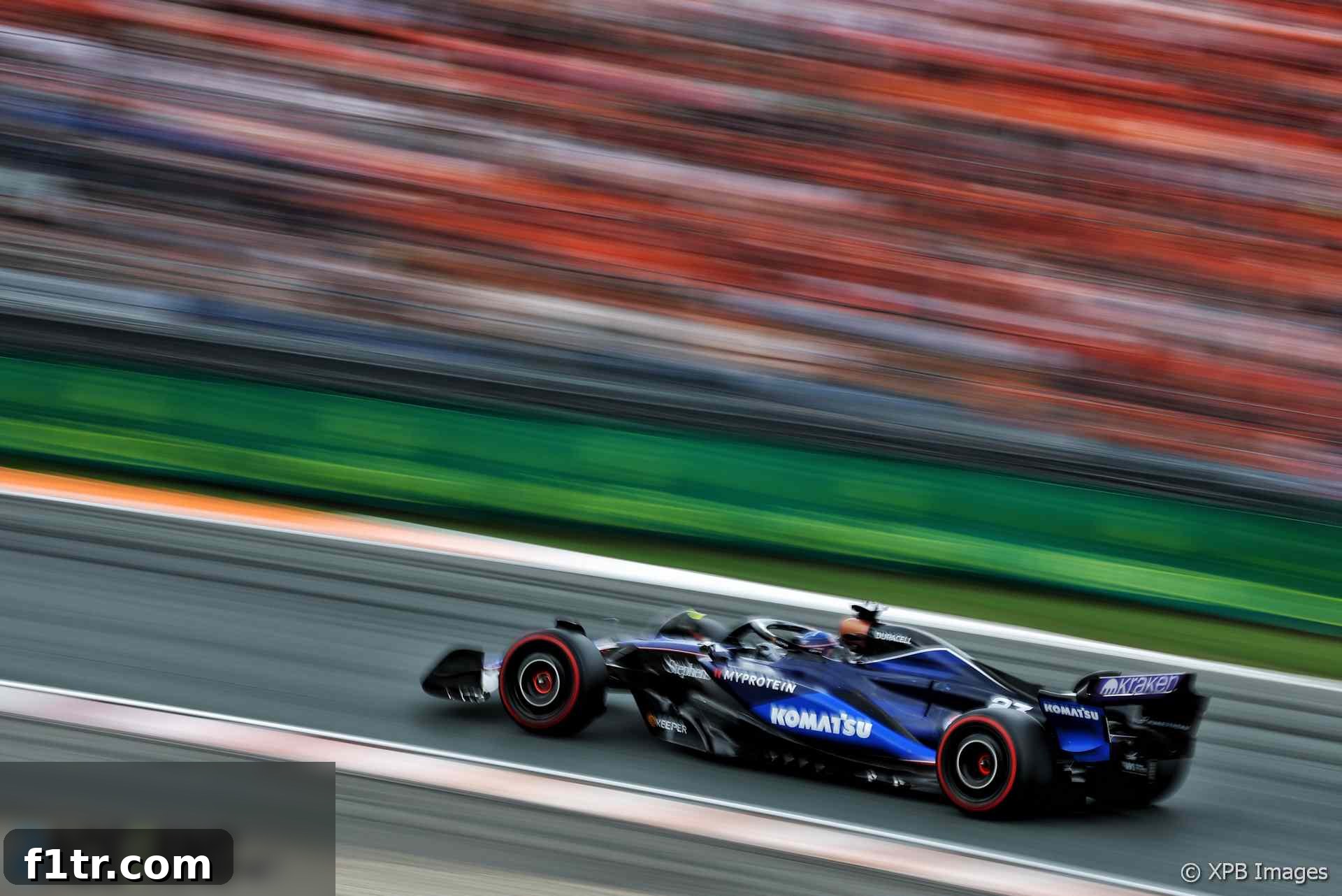
In a remarkable display of skill and the burgeoning potential of the Williams Racing team, Alexander Albon delivered his strongest qualifying performance of the Formula 1 season at the Dutch Grand Prix. Securing an impressive eighth place on the grid, Albon not only showcased his undeniable talent behind the wheel but also underscored the tangible progress made by the Grove-based outfit with their recent car upgrades. This significant achievement at the challenging Zandvoort circuit marks a pivotal moment for Williams, signaling their intent to consistently compete for points in the highly competitive midfield.
The Dutchman’s success didn’t come without its challenges. Albon described the treacherous and unpredictable windy conditions during qualifying as akin to a “lottery,” a sentiment echoed by many drivers navigating the coastal circuit. Despite the fluctuating gusts and the inherent difficulties they posed for car balance and aerodynamics, Albon expertly guided his Williams FW45 through Q1, Q2, and into the crucial Q3 session for the fourth time this year. This consistency in reaching the final qualifying stage is a testament to both his growing confidence and the underlying performance improvements of the Williams car, especially after the summer break.
Albon’s Gripping Battle Against Zandvoort’s Unpredictable Winds
Starting Sunday’s race between the two Aston Martin cars of seasoned veteran Fernando Alonso and Canadian driver Lance Stroll, Alexander Albon’s P8 position firmly places Williams in contention for valuable championship points. His personal best time in Q3 was just under a second slower than Lando Norris’s pole-winning effort, a margin that highlights the closing gap between Williams and the established front-runners on a good day. Albon candidly shared his struggles with the high winds that swept across the Zandvoort track, creating a dynamic and often frustrating environment for all competitors.
“It’s been very windy, very gusty – I think in some weird ways,” Albon explained to the official F1 channel after his qualifying session. His comments painted a vivid picture of the unique difficulties faced by drivers. “If you were ten or 20 seconds behind another car, they could have completely different wind to you. It’s not tenths, it’s halves of seconds that was in wind.” This observation points to the extreme localized nature of the gusts, where microclimates around the circuit could drastically alter the car’s behavior from one lap to the next, or even from one corner to the next.
Albon further elaborated on the unpredictable nature, stating, “I did all my laps feeling quite good. I knew it was tricky out there for my car, then the wind died for one lap and I went seven, eight tenths quicker. So it felt a little bit like a lottery, in some ways. You’d turn in to turn nine, turn ten every lap – totally different.” Such conditions demand exceptional adaptability and intuition from drivers, making Albon’s consistent performance even more commendable. He humorously acknowledged the seemingly perfect lap from McLaren’s Lando Norris, quipping, “Lando’s lap was pretty mighty – maybe he got no wind!” This lighthearted comment underscores the fine margins and elements of chance that can influence qualifying results in such challenging circumstances.
Williams’ Strategic Leap: Unveiling Significant Car Upgrades
The impressive upturn in Williams’ performance at the Dutch Grand Prix is largely attributable to a substantial package of upgrades introduced to the FW45 for this weekend’s race. This marks the first major development push by the team following the crucial summer break, signaling a renewed commitment to climbing the Constructors’ Championship ladder. Alexander Albon himself described the new package as a “big step” for the team, a testament to the hard work and strategic planning undertaken by the engineering and design departments at Grove. These upgrades represent more than just incremental gains; they reflect a concerted effort to enhance the car’s overall competitiveness across various facets.
Detailing the nature of these enhancements, Albon explained, “We’ve done a good step with the weight as well – it’s not just aero, it’s another step of weight.” This insight reveals a multi-pronged approach to car development. While aerodynamic efficiency is often the headline focus in Formula 1, weight reduction is equally, if not more, critical for lap time improvement. Shedding weight allows for better ballast distribution, optimizing the car’s balance and handling characteristics, and ultimately leading to faster cornering speeds and improved tire management. The combination of aerodynamic refinements and significant weight savings creates a powerful synergy, contributing to the “big step” Albon referenced.
Crucially, Albon also hinted at further developments on the horizon. “It’s not the complete package either, so hopefully we can get that coming in a few more races’ time.” This forward-looking statement suggests that Williams has a clear development roadmap, with additional performance enhancements slated for introduction in the near future. This phased approach allows the team to thoroughly evaluate each upgrade package, gather valuable data, and fine-tune subsequent developments, ensuring optimal integration and performance gains. The confidence exuded by Albon in the team’s ongoing progress is a strong indicator of Williams’ positive trajectory. He also noted the track-specific advantage, adding, “Obviously we went well here last year as well, so it is a bit of a track for us, but still very positive.” While Zandvoort might inherently suit the FW45’s characteristics, the magnitude of the performance improvement confirms the efficacy of the new parts.
The Broader Impact: Williams’ Ascending Trajectory in F1
Alexander Albon’s stellar qualifying at Zandvoort, backed by significant car upgrades, is more than just a single race achievement; it signifies Williams’ determined climb back towards consistent competitiveness in Formula 1. Under the leadership of Team Principal James Vowles, the team has been systematically addressing its structural and performance deficiencies. This P8 grid slot, following a season of consistent points scoring by Albon, reinforces the notion that Williams is no longer just making up the numbers but is actively positioning itself as a credible threat in the midfield battle. Every point secured is crucial for their standing in the Constructors’ Championship, where marginal gains can translate into significant financial and developmental advantages for future seasons. Albon’s ability to extract maximum performance from the car, even under challenging conditions, has become a hallmark of his driving, and it’s precisely what Williams needs as they continue their rebuilding phase.
The strategic introduction of these upgrades post-summer break is also telling. It indicates that the team is not just focusing on immediate results but is planning for sustained development. By bringing significant parts now, they can gather crucial data for the remaining races of the season, which will be invaluable for the design and development of their 2024 challenger. This forward-thinking approach is essential for any team aiming to break away from the lower echelons of the grid. Williams’ commitment to both aero efficiency and weight reduction highlights a holistic understanding of performance, suggesting a mature development program that is beginning to bear fruit. The team’s improved pace, particularly in qualifying, offers a strong platform for strategic race execution, allowing them to fight for points more regularly and solidify their position amongst the established midfield teams.
Logan Sargeant’s Unfortunate Setback and Race Day Outlook
While Alexander Albon celebrated a personal best, the Dutch Grand Prix weekend took a dramatic turn for his rookie teammate, Logan Sargeant. The young American driver will start Sunday’s race from the very back of the grid, a direct consequence of a heavy crash during a practice session. The incident left his car too extensively damaged to participate in the critical qualifying session, a significant blow for a driver still finding his feet in the demanding world of Formula 1. Sargeant openly admitted it had been “not an ideal day” for both himself and the entire Williams team, acknowledging the disappointment and the extra workload his mistake created for the mechanics.
Despite the severity of the shunt, Sargeant provided a reassuring update on his physical condition. “I feel okay, which is most important,” he stated. “A little bit sore, but I’m good to go for tomorrow.” This swift recovery is crucial for his mental and physical readiness for the race. Taking full responsibility for the accident, he added, “It’s my mistake, so I’ll take that. All we can do is look forward.” This mature response from the rookie demonstrates his resilience and understanding of the high-stakes environment he operates within. Learning from such incidents is a critical part of a young driver’s development, and Sargeant’s focus immediately shifted to the upcoming race.
Looking ahead to race day, Sargeant expressed a degree of optimism despite his challenging starting position. “I think we have a decent car this weekend, so we’ll see what conditions come up tomorrow, see what we can do.” His belief in the car’s underlying performance, especially with the new upgrades, suggests that a comeback drive might not be entirely out of the question, depending on race strategy and potential weather changes. Starting from the back at Zandvoort, a circuit notoriously difficult for overtakes, will be an immense challenge. However, with the possibility of varied weather conditions and the potential for safety cars, Sargeant will be aiming to keep his car on track, learn from every lap, and capitalize on any opportunities that arise to climb through the field. His focus will be on gaining crucial experience and demonstrating his ability to manage a race from a difficult position.
Anticipating an Electrifying Race at Zandvoort
As the grid prepares for the Dutch Grand Prix, the contrasting fortunes of the Williams drivers set the stage for an intriguing race. Alexander Albon, starting from a career-best P8, will be aiming to convert his strong qualifying performance into valuable points, solidifying Williams’ position in the Constructors’ Championship. His main objective will be to maintain track position against formidable rivals and execute a flawless race strategy. On the other hand, Logan Sargeant faces an uphill battle from the rear of the field, but with the upgraded FW45 and his determination to learn, he will be looking for any opportunity to make progress. The unpredictable nature of Zandvoort, coupled with potential weather variations, promises an exciting and strategic race where both Williams drivers will play their part.
The team’s ongoing development, highlighted by the “big step” upgrades and the promise of more to come, suggests a bright future for Williams Racing. Alexander Albon’s consistent ability to perform at a high level provides a strong foundation, while Logan Sargeant’s learning curve, though steep, is part of the journey. The Dutch Grand Prix serves as a critical indicator of Williams’ progress, showcasing their potential to consistently challenge in the midfield and reminding everyone of their storied history and ambitious plans for the future of Formula 1.
2024 Dutch Grand Prix
- Previous technical hires no obstacle to Newey joining Aston Martin – Krack
- Mercedes still unsure whether Spa floor upgrade is working
- McLaren’s Dutch GP upgrade “nowhere near” as significant as Miami package
- “Very hard to pinpoint” why car has become harder to drive – Verstappen
- Only one F1 driver is making worse starts than Norris in 2024
Browse all 2024 Dutch Grand Prix articles