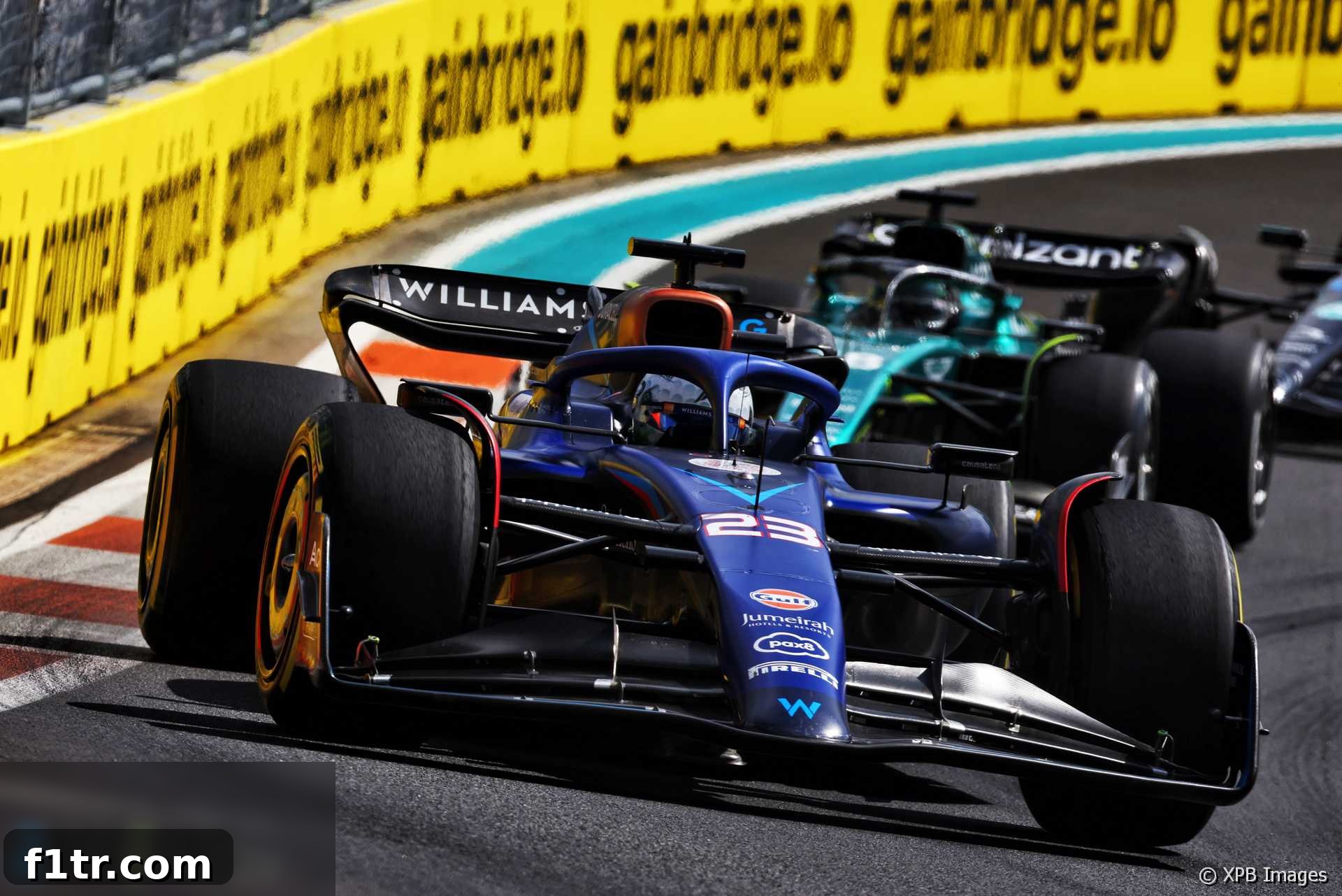
Alexander Albon’s Unwavering Conviction: Maximizing Williams’ Potential in a Ferociously Competitive F1 Season
In the high-stakes world of Formula 1, where the difference between success and obscurity can be measured in mere milliseconds, Alexander Albon embodies a profound dedication to his craft. Despite Williams Racing’s challenging position in the 2023 Constructors’ Championship, having secured only a solitary point thus far, Albon expresses an unwavering conviction: he is extracting every available ounce of performance from their FW45 challenger. This belief, articulated amidst the vibrant atmosphere of the Miami Grand Prix, not only highlights his personal driving excellence but also underscores the team’s relentless pursuit of marginal gains against an exceptionally competitive field.
The 2023 Formula 1 season has proven to be a demanding test for all teams, and Williams is certainly no exception. While the storied British outfit has infrequently managed to break into the top 10 on either Saturdays or Sundays, Albon’s consistent performances have often been a beacon of their potential. His remarkable achievement of guiding the Williams car into Q3 during the Australian Grand Prix stands as the team’s sole appearance in the final qualifying segment to date. This exceptional drive was pivotal in elevating his average starting position to 12.6, a considerable feat when set against the car’s inherent performance level. In contrast, rookie teammate Logan Sargeant has navigated his way to Q2 only once in conventional qualifying sessions, averaging a starting position five places further back than Albon. This disparity emphasizes the high benchmark Albon has established within the team, showcasing his ability to consistently punch above the car’s perceived weight.
Navigating the Grid: Williams’ 2023 Season – Glimmers and Challenges
The initial races of the season provided tantalizing glimpses of Williams’ capabilities, albeit fleetingly. Albon initiated his and the team’s points tally with a commendable tenth-place finish at the Bahrain season-opener, which remains their only championship point. The subsequent Baku sprint race saw Albon demonstrate impressive one-lap pace, qualifying an outstanding seventh. Although he ultimately finished ninth in the sprint, just outside the points, it further demonstrated his capacity for peak performance. Following that early success in Bahrain, the team’s best Sunday result has been Albon’s twelfth-place finish in Baku, a clear indicator of the ferociously competitive midfield where even securing a top-10 position demands a perfect confluence of strategic brilliance, flawless driver execution, and a touch of racing fortune.
“We still think we’re the ninth-quickest car,” Albon candidly admitted during the Miami Grand Prix weekend. This pragmatic assessment forms the foundational understanding from which he operates. Nevertheless, his personal conviction remains steadfast: “We’re in a position now where I’m in my second year, I know exactly what I need in the car, I know all the limits of the car and I feel like I’m driving well, if I’m being totally honest.” This statement is far more than mere self-praise; it offers critical insight into the mental and physical state of a seasoned driver who has achieved a deep symbiosis with his machine. He is operating at a heightened level of performance, intuitively understanding and exploiting every characteristic and limitation of the FW45.
Albon’s confidence extends beyond his individual driving performance, encompassing the collective efforts of the Williams team. He firmly believes that the entire squad has consistently maximized the potential of its technical package throughout the season. “We are putting ourselves constantly in good positions, always doing the right strategies in qualifying,” he elaborated. “You see us always being up at the front, staying away from all the issues that everyone keeps facing in qualifying. We have clean runs, always semi-happy with my laps, and we are in a good place.” This disciplined and meticulous approach to qualifying, which prioritizes avoiding penalties, optimizing tire usage, and maximizing track time, has been a defining feature of their weekends. It has consistently positioned them to contend for the periphery of the points, even with a car widely acknowledged to be among the slower contenders on the grid.
The Microcosm of Miami: A Frustratingly Close Encounter with Points
The Miami Grand Prix served as a quintessential example of the performance ceiling that Williams and Albon frequently encounter. In a thrilling qualifying session, Albon agonizingly missed a coveted spot in Q3 by a slender margin of just 0.053 seconds – an almost imperceptible difference in the context of a Formula 1 lap. This demonstrates the incredibly fine margins that define the midfield battle, where fractions of a second can dictate substantial grid position changes. On race day, Albon completed the challenging 57-lap event less than 10 seconds adrift of a points-paying position, ultimately crossing the finish line in 14th. While not yielding any championship points, the sheer proximity to the top 10 underscored the team’s enduring ability to remain in contention and capitalize on any potential attrition, strategic gambles, or unforeseen circumstances during the race.
This year’s performance trajectory presents a noteworthy contrast to the 2022 season, a period when Williams generally appeared less competitive. Yet, paradoxically, Albon managed to secure two of the team’s total eight points by brilliantly finishing ninth at the previous Miami Grand Prix. He offered an insightful explanation for this intriguing difference, providing a nuanced perspective on the car’s behavior and the evolving competitive landscape of Formula 1.
The Fine Margins: Deciphering F1’s Hyper-Competitive Environment
“Qualifying on new tyres hides limitations in the car,” Albon astutely observed. He elaborated on this crucial point: “When you’ve got a little bit more grip, the front’s working a little bit better in low-speed, the rear is working a little bit better in high-speed.” This fundamental insight highlights how the temporary boost provided by fresh tires can effectively mask underlying aerodynamic or mechanical weaknesses, allowing a skilled driver to push closer to the car’s absolute theoretical limit for a single, blistering lap. However, the true crucible of performance always manifests during the race. “In the race we are falling back a little bit, but it’s close. And that’s the thing. What I would say is there’s two tenths where the car can or we can overperform and underperform. And that two tenths is what puts you into Q2, on the brink of Q3, or last.”
This “two-tenths” window is a profoundly critical metric in the analysis of modern Formula 1. It vividly illustrates the incredibly tight clustering of teams in the midfield, where an almost infinitesimal performance differential can translate directly into several crucial grid positions. A car and driver combination operating at the absolute zenith of their combined potential might find themselves fiercely challenging for a spot in Q3, while a slight misstep, a less-than-optimal setup choice, or a minor driver error could swiftly relegate them to the back of Q2 or even an early exit in Q1. “Compare it to last year where we do a really good job, we barely scraped through to Q2 because there was almost a half-a-second gap to chase. This year, it’s like every team is basically maximising or not maximising, and that’s where I feel like we’ve maximised most races this year,” Albon concluded, eloquently emphasizing the amplified impact of every fractional gain or loss in the current hyper-competitive Formula 1 environment.
James Vowles’ Endorsement: Reinforcing the Maximized Performance Narrative
Williams Team Principal James Vowles, a seasoned strategist with a deep understanding of F1 performance, strongly echoed Albon’s sentiments. His crucial management perspective aligned perfectly with his driver’s assessment of their current capabilities. Vowles’ detailed analysis of their Miami performance unequivocally underscored the reality that there was very little, if any, room for improvement on Albon’s 14th-place finish, given the car’s intrinsic performance level. “We would have finished in the same position, irrespective of starting on that medium compound or on the hard, because it was dominated by race performance – by race pace and degradation,” Vowles definitively stated.
This candid and analytical assessment from the team principal illuminates the fundamental challenge confronting Williams: the car’s inherent pace and its tire degradation characteristics are the primary determinants of its ultimate race day potential. While astute strategy can undoubtedly play a significant role in optimizing outcomes, it simply cannot fundamentally alter the car’s competitive standing over a full race distance when pitted against inherently faster machinery. Vowles further quantified the precise gap to the points-paying positions, explaining, “Where we ended up filtering to is approximately where the car was on performance. The extra point would have required a car that was just a little bit faster than what we had. We only finished ten seconds behind that, but that still translates to a tenth or so of performance that we didn’t have available to us at the time.” This precise quantification of performance reinforces Albon’s earlier “two-tenths” commentary, serving as a powerful demonstration of just how narrow the margins are in modern F1 and how profoundly significant even a fraction of a second can be in the grand scheme of a race weekend.
The Road Ahead: Sustaining and Elevating Maximized Performance
As the demanding 2023 Formula 1 season progresses, Williams Racing, under the strategic leadership of James Vowles and powered by the remarkably consistent performance of Alexander Albon, is unwavering in its focus on continuous improvement. While candidly acknowledging their current classification as the “ninth-quickest car” on the grid, the team’s overarching strategy appears to be meticulously centered on flawless execution, optimizing every single race weekend, and ensuring their drivers possess the tools and confidence to extract the absolute maximum from the FW45 package at hand. Albon’s exceptional ability to consistently challenge for Q2, occasionally break into Q3, and perpetually hover on the periphery of the points, is an invaluable asset. It not only serves as a powerful motivator for the entire team but also provides crucial, high-fidelity data and indispensable feedback for ongoing and future car development.
The profound lessons gleaned from races such as Miami, where the team’s ultimate potential was clearly delineated by their race pace and tire management capabilities, will be instrumental in shaping their future upgrade path and long-term development strategies. The overarching objective remains clear: to incrementally close that “tenth or so of performance” gap that currently separates them from more regular points finishes and a higher standing in the championship. For Alexander Albon, the focus remains acutely sharp: to continue driving at the absolute peak of his formidable abilities, to deepen his already profound understanding of the FW45’s nuanced characteristics, and to be perpetually ready to seize any opportunity that may arise in what promises to be an intensely competitive and unpredictable remainder of the Formula 1 season. His unwavering conviction that he is already maximizing the car’s potential is an exceptionally powerful psychological and performance asset for Williams as they strive with fierce determination to climb the championship standings and re-establish their competitive pedigree.