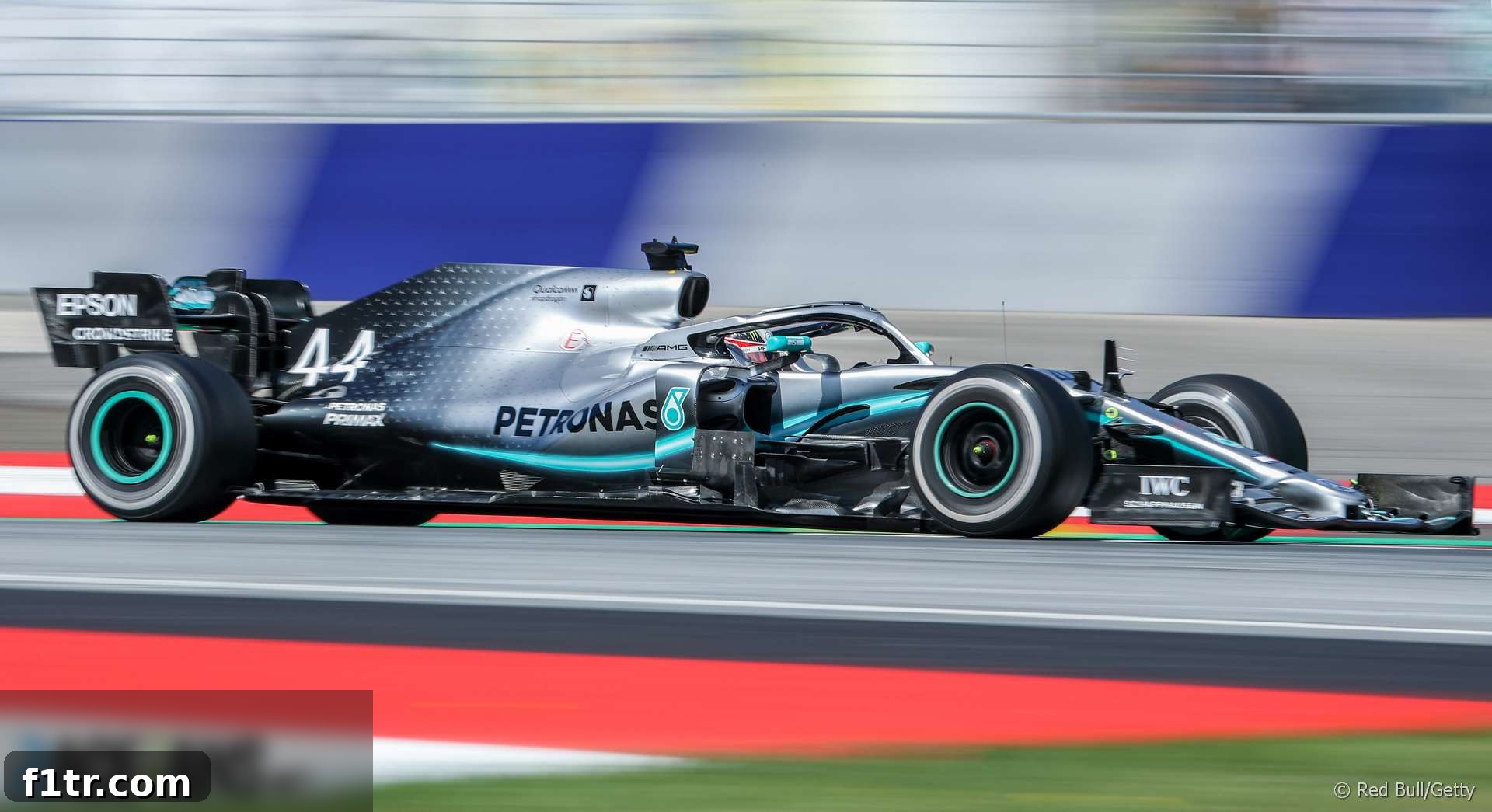
Lewis Hamilton Handed Grid Penalty for Impeding Kimi Raikkonen at 2019 Austrian Grand Prix Qualifying
The 2019 Formula 1 season was largely characterized by the dominant performance of Mercedes and its lead driver, Lewis Hamilton. However, even during periods of apparent supremacy, the unpredictable nature of top-tier motorsport often delivers unexpected twists. One such moment unfolded dramatically during the qualifying session for the 2019 Austrian Grand Prix at the challenging Red Bull Ring. A seemingly minor misjudgment led to a significant consequence for Hamilton: a three-place grid penalty, issued after race stewards concluded he had impeded Kimi Raikkonen.
This penalty was not just a statistical footnote; it was a decision that reverberated throughout the paddock, setting the stage for an altered race dynamic and highlighting the unforgiving precision required at the pinnacle of motorsport. The incident, occurring during the critical Q2 segment, involved Hamilton, fresh out of the pits, inadvertently hindering Raikkonen’s flying lap. The stewards’ subsequent ruling underscored the stringent regulations governing driver conduct and track awareness during competitive sessions, ensuring fair play for all competitors vying for crucial grid positions.
The Incident Unfolds: A Critical Moment at Turn 3
Qualifying in Formula 1 is an intense spectacle where drivers push their machinery to the absolute limit across a series of flying laps. Optimal tyre temperature, a clear track, and precise timing are paramount. Any interruption, however brief, can derail a driver’s attempt to set a competitive time, potentially costing them valuable grid places or even a spot in the next qualifying segment. It was precisely this delicate balance that was disrupted at Turn 3 of the Red Bull Ring.
The sequence of events began with Lewis Hamilton’s Mercedes, designated car 44, exiting the pit lane. As is standard practice, teams continually monitor traffic and communicate vital information to their drivers. Hamilton was informed by his pit wall about approaching cars, specifically mentioning Kimi Raikkonen’s Alfa Romeo (car 7) closing in rapidly. Raikkonen was on a “push lap,” meaning he was attempting to set his fastest possible time, a crucial part of securing a strong starting position.
Despite the warnings, and Hamilton’s subsequent attempts to take evasive action once he became fully aware of Raikkonen’s high-speed approach, the stewards deemed his efforts insufficient. Raikkonen, having to react to Hamilton’s presence on the racing line, was forced to lift off the throttle and abandon his flying lap. This act of impedance, even if unintentional, directly compromised Raikkonen’s qualifying performance, prompting an immediate investigation by the race stewards.
Such incidents are viewed seriously because they undermine the fairness of the qualifying process. Drivers not on flying laps are expected to make every reasonable effort to stay clear of those who are, often moving off the racing line to allow faster cars through unimpeded. The stewards’ assessment focused not on intent, but on the outcome – the fact that Raikkonen’s lap was unequivocally affected.
Stewards’ Verdict: Applying the F1 Rulebook
Following the session, both drivers were summoned to the stewards’ office. This is a standard procedure allowing officials to gather all relevant information, including detailed video replays from multiple camera angles, telemetry data showing speed and throttle inputs for both cars, and first-hand accounts from the drivers themselves. After careful deliberation, the stewards released their official statement, confirming the penalty.
Their ruling explicitly stated that Hamilton “unnecessarily impeded car 7 [Raikkonen] at turn three.” The key phrase “unnecessarily impeded” highlights that while Hamilton may have attempted to move out of the way, his actions were not timely or effective enough to prevent Raikkonen from being forced off his optimal line and abandoning his lap. The official report further detailed that “although car 44 tried to take evasive action when he became aware of car seven approaching on a fast lap, it was not sufficient to avoid impeding car seven, which had to then abort the lap.” This comprehensive review left little room for doubt regarding the impact of the incident.
The penalty itself—a three-place grid demotion—is a consistent application of the FIA Formula 1 Sporting Regulations concerning impeding. It serves as a deterrent and a measure to correct the disadvantage caused to the impeded driver. This decision underscored the strict enforcement of rules designed to ensure a level playing field, even when the incident involves a high-profile driver like Lewis Hamilton.
The Reshaped Grid: Impact on the Starting Lineup
The immediate effect of Hamilton’s penalty was a significant reshuffling of the top end of the starting grid for the Austrian Grand Prix. Originally, Ferrari’s Charles Leclerc had clinched a magnificent pole position. Hamilton had qualified second, but his demotion created openings for others to move up. The revised grid for Sunday’s race now looked remarkably different:
- Max Verstappen, who had delivered a strong performance to qualify third for Red Bull Racing, was promoted to an invaluable second place. This placed the popular Dutch driver alongside pole-sitter Charles Leclerc on the front row, setting up an electrifying prospect for the start of his home team’s race.
- Hamilton’s Mercedes teammate, Valtteri Bottas, also benefited, moving up from fourth to third on the grid. This ensured that Mercedes still had a strong presence in the top three, capable of challenging from the outset.
- Lewis Hamilton himself, initially slated to start from second, would now begin the race from fourth position. This was a direct result of his three-place penalty. It’s also worth noting that this position was further influenced by another competitor, Kevin Magnussen, who had originally qualified fifth but also incurred a separate grid penalty. Therefore, Hamilton’s final starting spot of fourth was a combination of his own penalty and the overall grid adjustments.
This revised grid promised a more unpredictable and potentially action-packed start to the Austrian Grand Prix, with key championship contenders now starting in different strategic positions. The altered lineup forced teams to adapt their race strategies, anticipating different challenges and opportunities from the moment the lights went out.
Hamilton’s Candid Admission: Taking Full Responsibility
One of the more commendable aspects of the aftermath was Lewis Hamilton’s swift and unreserved acceptance of the stewards’ decision. Known for his competitive spirit and fierce determination, Hamilton nevertheless demonstrated a profound sense of sportsmanship and responsibility. He promptly used his social media platform to address the situation, stating, “I totally deserved the penalty today and have no problem accepting it. It was a mistake on my behalf and I take full responsibility for it. It wasn’t intentional.”
This transparent and honest admission stood out. In a sport where drivers often contest rulings, Hamilton’s immediate acknowledgment of fault garnered respect across the motorsport community. His emphasis that the impedance “wasn’t intentional” highlighted that while the action itself was accidental, he understood its impact and the necessity of upholding the sporting regulations. This self-accountability is a testament to his character as a champion.
Adding context to the incident, radio messages from the qualifying session confirmed that Hamilton’s Mercedes team had indeed provided him with warnings regarding Kimi Raikkonen’s approach. These communications included an initial alert as he left the pit lane and a second, more urgent notification just as Raikkonen’s Alfa Romeo was closing in on Turn 3. Despite these warnings, the situation developed too quickly, or the message was not processed with enough time to take sufficient preventative action. This critical detail, coupled with Hamilton’s acceptance, underscored the comprehensive nature of the stewards’ investigation and the integrity of the process.
Broader Implications for the 2019 F1 Season and Race Dynamics
While the 2019 season saw Lewis Hamilton and Mercedes often enjoying a significant performance advantage, every point and every grid position held importance in the relentless pursuit of championship glory. A three-place penalty, though not catastrophic, certainly presented an added challenge. Starting from fourth instead of second meant Hamilton would face a more congested midfield in the opening laps, increasing the risk of incidents and demanding more aggressive overtaking maneuvers, which can lead to increased tire wear or potential damage.
From a strategic standpoint, starting further back means potentially needing to deviate from an optimal race strategy to clear traffic. This can affect tire management, fuel consumption, and the overall race pace. For Hamilton, a driver who thrives on being in clean air and dictating the race from the front, this penalty forced a re-evaluation of his Sunday plan. It also elevated the strategic importance of the drivers around him, particularly Max Verstappen and Valtteri Bottas, who now had clearer paths to challenge Leclerc for the lead.
This incident served as a potent reminder of the high stakes in Formula 1 and the critical importance of every detail, from driver awareness to clear team communication. It underscored that even the most decorated drivers are not immune to the rules and that the meticulous application of the FIA sporting regulations is fundamental to maintaining the integrity and competitive balance of the sport. The altered grid ultimately set the stage for an even more compelling Austrian Grand Prix, promising a fierce battle from the very first corner, a narrative shaped by a moment of inadvertent impedance and its profound consequences.
Stay Connected with F1 Insights and News
To ensure you don’t miss out on any of the thrilling action, in-depth analysis, and breaking news from the world of Formula 1, we invite you to connect with us. Follow RaceFans on social media and subscribe to our updates for comprehensive coverage throughout the racing season:
- Join RaceFans on Facebook
- Follow RaceFans on Twitter
- Get daily email updates from RaceFans
Explore More from the 2019 F1 Season
Dive deeper into the memorable moments, key events, and significant stories that defined the 2019 Formula 1 season. Our extensive archives provide a rich resource for fans looking to relive or discover more about this exciting year in motorsport:
- Crying in the Melbourne car park at 2019 grand prix was my career low – Ocon
- McLaren Racing reports reduced £71 million loss in 2019
- Kvyat: Hockenheim podium last year was “my biggest achievement” so far
- How the FIA’s new encrypted fuel flow meter targets Ferrari’s suspected ‘aliasing’ trick
- “He smashed my office door”: 23 must-see moments from ‘Drive to Survive’ season two
Browse all 2019 F1 season articles