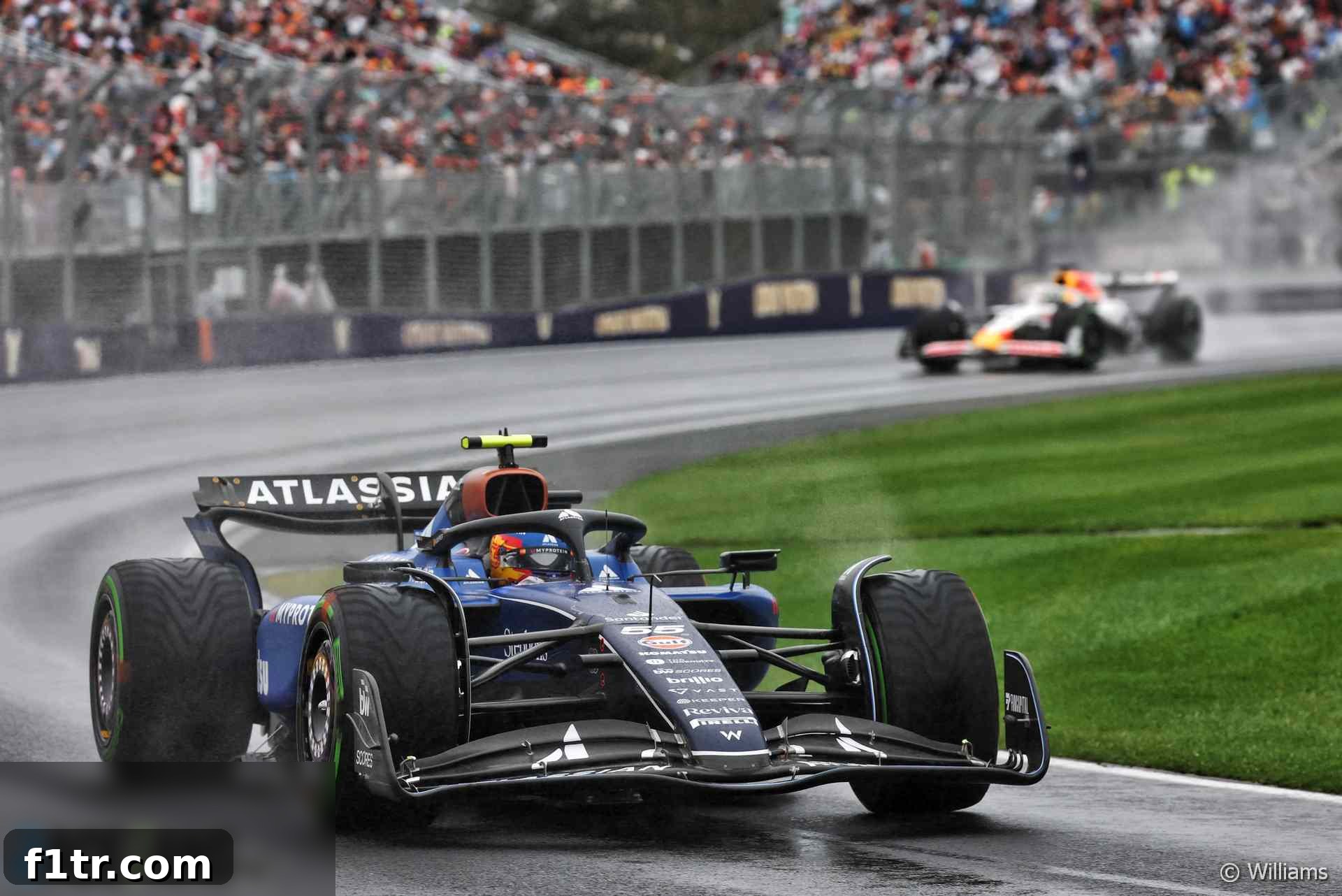
Unraveling the Mystery: Carlos Sainz Jnr’s Australian Grand Prix Crash Analysis
The thrilling opening laps of the Australian Grand Prix are often filled with drama, and the recent incident involving Carlos Sainz Jnr was no exception. His unexpected exit from the race on the very first racing lap at Albert Park sparked immediate debate and a thorough investigation into what precisely led to his Williams FW47 snapping out of control at the challenging Turn 14. While Sainz himself attributed the crash to a “combination of factors,” both his own team and rival outfits quickly formed their own theories, highlighting the complex interplay of car dynamics, driver input, and track conditions in top-tier motorsport.
The incident unfolded in damp conditions, adding an extra layer of peril to an already demanding circuit. As Sainz approached the penultimate corner, Turn 14, his car veered sharply, making contact with the barrier and prematurely ending his race. This high-profile crash immediately raised questions, not just for Williams Racing but for every team looking to understand the limits of grip and vehicle control under such challenging circumstances.
Williams’ Internal Investigation: The Role of Car Systems
Following the unfortunate retirement, Williams Racing promptly launched an internal investigation to pinpoint the exact cause of Sainz’s spin. Team principal James Vowles, known for his methodical approach, indicated that the team would meticulously examine the car’s systems, particularly focusing on the role an up-shift might have played as Sainz navigated the crucial Turn 14. The initial assessment from the team’s data suggested a possible interaction between driver input and car behavior.
“We need to look into it more,” Vowles stated in a video released by Williams. “It was just a simple up-shift on a very difficult point in time on a slippery track that seemed to bring the car around with a little bit more power or torque than we expected. Now, it’s fine margins, but we need to make sure that as a team we’re providing stable platforms to all of our drivers in all circumstances.”
This statement underscores the incredibly precise engineering and calibration required in Formula 1. Even a minor deviation in power delivery during an up-shift, especially on a track with reduced grip, can have significant consequences. For Williams, ensuring a “stable platform” for their drivers is paramount, indicating a commitment to analyzing every nuance of the car’s performance to prevent similar incidents in the future. Their focus will likely be on optimizing engine mapping, gearbox settings, and traction control systems to offer maximum predictability and control, even under the most adverse conditions. This level of detail in performance analysis is standard for F1 teams, who leave no stone unturned in their pursuit of competitive advantage and driver safety.
Rival Teams’ Theories: The Treacherous Black Line
While Williams delved into their own car’s telemetry, rival teams developed a different theory, sharing critical insights with their drivers during the Safety Car period that followed Sainz’s crash. Both Ferrari and Mercedes identified a specific, seemingly innocuous, feature of the track surface as a potential culprit: a black painted line at Turn 14.
Ferrari’s Warning to Charles Leclerc
Ferrari, Sainz’s former team, was quick to analyze the incident and relayed their findings to Charles Leclerc. Leclerc’s race engineer, Bryan Bozzi, specifically warned him about the area, suggesting a distinct lack of grip on this particular painted section.
“Carlos spun in Turn 14 on the black line,” Bozzi communicated to Leclerc while he was circulating behind the Safety Car as Sainz’s wrecked Williams was being cleared. “At the turn-in of Turn 14 there is a black line and he spun on the black line.”
Leclerc, keen to avoid a similar fate, sought clarification as he passed the crash scene. “So the black line is the one a metre and a half or two metres on the outside of the track, right? If you take the limit of the track on the left it’s two metres more inside than that and it’s a big black line, right, at the last corner?” he asked, attempting to visualize the precise location. Bozzi confirmed, “Yes, it’s about two metres from the left-hand side of the track, just before you’re turning into 14. So yeah, it could be that one.” This dialogue highlights the immediate in-race data analysis and communication crucial for driver safety and performance.
Mercedes’ Similar Caution to Lewis Hamilton
The concern about the painted line wasn’t limited to Ferrari. Mercedes also picked up on this potential hazard and issued a similar warning to Lewis Hamilton. Hamilton’s race engineer, Ricardo Adami, provided a direct and unequivocal instruction: “Avoid the black paint line inside 14. That’s why Sainz spun. Avoid the black paint.” The consistent advice from two top rival teams lends significant weight to the ‘black line’ theory, suggesting a universally recognized hazard that might not have been immediately obvious to all drivers under the specific conditions.
Painted lines on race tracks, while essential for marking track limits and safety zones, can become incredibly slippery, especially when wet. The aggregate in the paint offers significantly less friction than the asphalt, and in damp or wet conditions, it can become akin to driving on ice. If a driver hits such a patch mid-corner, particularly when applying power or undergoing an up-shift, the sudden loss of grip can be instant and irrecoverable. The fact that multiple teams identified this specific detail post-incident underscores the collective knowledge and immediate reactive analysis that takes place in an F1 paddock.
Carlos Sainz Jnr’s Perspective: A Combination of Factors
Reflecting on the incident, Carlos Sainz Jnr himself offered a nuanced perspective, acknowledging that his error was likely not attributable to a single cause but rather a confluence of events. This self-assessment is typical of top-tier athletes who constantly analyze their performance and the circumstances surrounding any mistake.
“We managed to spot it on the data and see exactly what happened and what caused the situation,” Sainz explained. His ability to review telemetry and match it with his own sensory experience is a testament to the sophisticated tools available to F1 drivers and engineers. While he didn’t explicitly endorse either the ‘up-shift’ or ‘black line’ theory as the sole reason, his statement about a “combination of factors” suggests that both elements—the tricky up-shift and the reduced grip on the painted line—could have contributed simultaneously or sequentially to the loss of control.
“Obviously it’s not the way you want to start the year and a bit of an unfortunate situation,” he added, expressing the natural disappointment of a driver who has his race ended prematurely. However, his forward-looking mindset was clear: “But we move on, not the first race we wanted, but at the same time I’m quick, I feel comfortable in the car and now we need to get the year started.” This positive outlook, despite the setback, highlights his confidence in his own abilities and the potential of his new car, focusing on turning the page and delivering strong performances in upcoming races.
Broader Implications for F1 Racing and Safety
This incident, irrespective of the precise cause, brings several important aspects of Formula 1 racing into focus. It highlights the razor-thin margins that separate success from failure, particularly in challenging conditions. The Albert Park circuit, known for its street-circuit characteristics, can be especially unforgiving, and painted lines becoming slippery in the wet is a recurring safety concern across many tracks.
For track designers and governing bodies like the FIA, incidents like Sainz’s serve as critical data points for continuous improvement in track safety and design. While painted lines are necessary, their placement and the type of paint used, particularly in critical braking or cornering zones, could come under renewed scrutiny to mitigate potential hazards, especially in variable weather conditions.
Furthermore, the rapid communication between engineers and drivers during the Safety Car period underscores the vital role of real-time data analysis and teamwork in modern F1. The ability of rival teams to quickly identify a potential hazard and warn their own drivers is a testament to the advanced telemetry and analytical capabilities now standard in the sport, contributing directly to enhanced safety for all competitors.
The Art of Driving in Damp Conditions
Driving an F1 car in damp conditions is arguably one of the most challenging feats in motorsport. The unpredictable grip levels, combined with the immense power and aerodynamic sensitivity of these machines, demand unparalleled skill and precision from drivers. Patches of standing water, changing grip levels from corner to corner, and the reduced effectiveness of slick tires on a drying or damp track all contribute to a highly dynamic and often treacherous environment.
The Australian Grand Prix crash serves as a stark reminder of these challenges. Drivers must constantly adapt their racing lines, braking points, and throttle application, often relying on their innate feel for the car and the track. An up-shift in a high-torque scenario, as suggested by Williams, coupled with finding a low-grip surface like a painted line, creates a perfect storm for loss of control. It demonstrates that even the world’s best drivers, operating at the peak of their abilities, can be caught out by the intricate dance between car, track, and conditions.
Conclusion: Learning from Every Incident
While the exact sequence of events leading to Carlos Sainz Jnr’s Australian Grand Prix crash might remain a subject of ongoing debate, the incident provides invaluable lessons for Williams Racing, the wider F1 community, and track designers. Whether it was primarily an issue with the car’s power delivery during an up-shift, an unexpected lack of grip on a track’s painted line, or indeed a combination of both, such occurrences are meticulously analyzed to enhance safety, improve car performance, and refine driving techniques.
Sainz’s resilience and focus on future races are commendable. His crash, though unfortunate, will undoubtedly contribute to the collective knowledge base of Formula 1, pushing the boundaries of engineering, data analysis, and driver preparation even further. As the season progresses, both Williams and Sainz will be keen to put this incident behind them and demonstrate their full potential on the track, undoubtedly learning from every data point collected from the Albert Park weekend.
Experience F1 Ad-Free for Just £1 per month>> Discover more and join our community
Stay Informed: Get Daily F1 Updates from RaceFans
Never miss a story. Receive our latest articles directly in your inbox every day – no marketing, no ads. Sign up below:
More from the 2025 Australian Grand Prix
- F1 rules change to prevent repeat of Verstappen-Bearman Australian GP confusion
- Contact with team mate may have led to Bortoleto’s Australian GP crash
- Hamilton dismisses ‘negativity’ over his radio calls. ‘Other drivers are almost abusive’
- Antonelli “got really scared” when he made “big save” on first lap of Australian GP
- Williams explain role played by car’s systems in Sainz’s race-ending crash
Browse all 2025 Australian Grand Prix articles