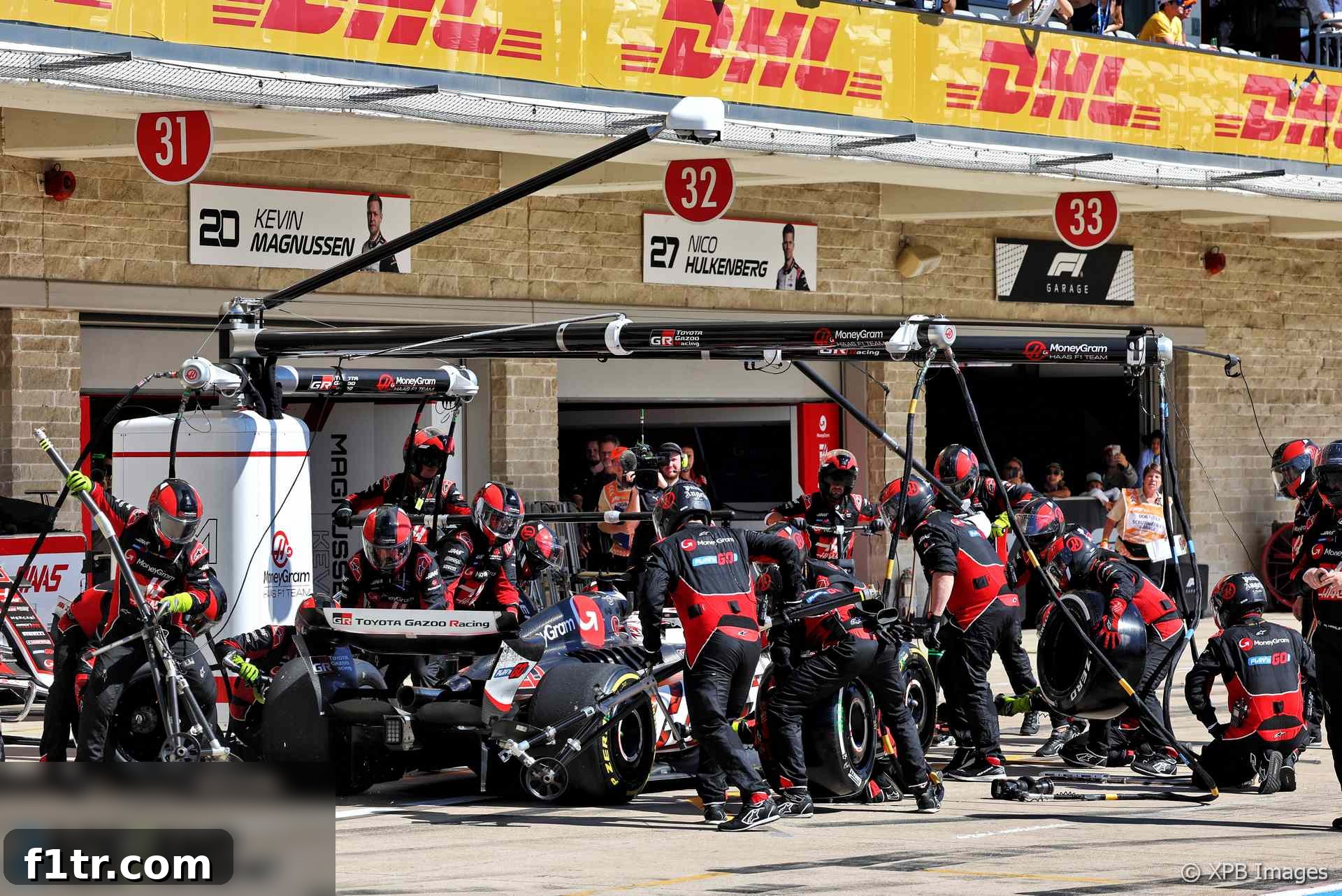
The exhilarating world of Formula 1 often boils down to split-second decisions and flawless execution, where a single misstep can unravel an entire race weekend. For the Haas F1 Team at the United States Grand Prix in Austin, this stark reality was brought into sharp focus by a critical strategic error during the main race. While the team celebrated a strong points finish in the sprint race with both cars, the grand prix presented a contrasting narrative, particularly for Kevin Magnussen, whose promising run was derailed by a contentious second pit stop call.
The Haas contingent had reason to be optimistic heading into Sunday. The team had showcased commendable pace and strategic acumen during the shorter sprint event, demonstrating their potential to challenge for points on the challenging Circuit of the Americas (COTA). However, the longer grand prix demanded a different approach, particularly concerning tire management and pit stop timing, factors that would ultimately dictate the outcome for Magnussen.
Advert | Become a Supporter & go ad-free
Magnussen’s Race: A Promising Run Derailed by Strategic Miscalculation
Kevin Magnussen had been meticulously managing his race, holding a strong ninth position, firmly within the coveted points-scoring zone. His performance up to that point was a testament to both his driving skill and the team’s initial strategic plan. The Circuit of the Americas is known for its demanding layout and varying track temperatures, which can make tire degradation a significant challenge. Maintaining pace while preserving the tires is a delicate balance, and Magnussen appeared to be executing this flawlessly.
The majority of his competitors, particularly those he was directly battling with for position, had opted for a single pit stop strategy. This one-stop approach had proven to be the most efficient path to the chequered flag for many, allowing drivers to minimize time spent in the pit lane and maximize track position. Magnussen’s sustained performance on his initial set of tires suggested that he too was on course to successfully complete the race with a single stop, potentially securing a valuable championship point or two for Haas.
However, the race took a dramatic turn on lap 38. With little warning, Magnussen was called into the pits for a second tire change. This sudden directive stood in stark contrast to the prevailing one-stop trend among his rivals and immediately raised questions about the rationale behind such a late-race strategic shift. Upon rejoining the track, Magnussen found himself further down the order, his hard-fought ninth position evaporated. He ultimately crossed the finish line in 11th place, just outside the points, a frustrating outcome given his earlier strong showing. Every car that finished ahead of him, save for those who had retired, had successfully completed the race on a single stop.
Following the race, a visibly disappointed Magnussen was reticent when pressed for details about what had transpired. “Not sure you can call it unlucky, but that’s the way it is,” he commented to the official Formula 1 channel, hinting at an internal issue rather than mere misfortune. “Didn’t get any points today, I think we had a good chance to do that but didn’t manage to.” He added, with a desire to first understand the situation internally, “It’s hard, you come out of the car, you go straight to talk to you guys, it’s better I go talk to the team first.” This brief exchange underscored the palpable frustration and the implicit acknowledgment of a strategic error from the team’s side.
The Fateful Radio Call: A Strategic Misjudgment Unfolds in Real-Time
The sequence of events leading to Magnussen’s second pit stop offers a fascinating, albeit concerning, glimpse into the pressures and rapid decision-making processes inherent in Formula 1 strategy. On lap 38, Magnussen’s racing engineer, Mark Slade, initiated the critical radio exchange that would alter the course of the Dane’s race. The initial communication suggested a degree of apprehension within the team regarding Magnussen’s tire wear, but not an immediate, unequivocal order.
| Slade | So, Kev, the situation is we are concerned about the drop-off on your tyres at the end and that’s why we were making the suggestion we did. We think it will be the same or a better outcome. We’re going to have to swap with Nico when he gets in your DRS. He’s not quite there yet. |
| Slade | Lawson 12 seconds behind on fresh tyres. |
| Magnussen | What’s his lap time? |
| Slade | He’s only just come out of the pits. |
| Slade | Sector two was three tenths quicker than yours. Correction, five tenths quicker than yours. |
| Slade | Box, Kev box, you must box now. Box. Box. |
| Magnussen | Box, box. |
| Slade | Mode… |
| Magnussen | What happened? |
| Slade | It’s okay. We’re in good shape. Mode RS, mode RS for the start. You’re in good shape, Kev. |
Slade’s initial message articulated the team’s concern about “drop-off” on Magnussen’s tires and presented the second stop as a “suggestion” that might lead to a “same or a better outcome.” He also introduced the possibility of a swap with teammate Nico Hulkenberg, who was reportedly closing in. This cautious tone, however, dramatically shifted. The mention of Liam Lawson, 12 seconds behind on fresh tires, and his significantly faster sector times, appeared to trigger a sudden panic or a re-evaluation within the strategy room. The perceived threat from Lawson, perhaps combined with an overestimation of Magnussen’s tire degradation or a miscalculation of the time loss in the pits, led to an abrupt and non-negotiable command: “Box, Kev box, you must box now. Box. Box.”
The urgency and immediacy of this final command left Magnussen no room for discussion or clarification, forcing him to react instinctively. His subsequent “What happened?” plea, even after acknowledging the pit call, powerfully conveyed his confusion and lack of understanding regarding the drastic and sudden change in strategy. Slade’s immediate reassurance, “It’s okay. We’re in good shape,” felt somewhat hollow in the context of a decision that would ultimately cost Magnussen points. This radio exchange is a classic example of how intense pressure and rapidly evolving race conditions can lead to hurried decisions that, in retrospect, prove costly.
Advert | Become a RaceFans supporter andgo ad-free
Team’s Acknowledgment: Komatsu’s Candid Admission and the Aftermath
In the aftermath of the race, Haas team principal Ayao Komatsu offered a refreshingly candid assessment of the situation, openly admitting that the team had made a significant error. His acknowledgment that they “slipped up” and “should have left him out” was a direct confirmation of the strategic misjudgment that cost Magnussen valuable points. Komatsu’s honesty reflects a team willing to scrutinize its decisions, even if it means publicly accepting fault.
The subsequent radio exchanges between Magnussen and Slade further underscore the confusion and the team’s awareness of the mistake. Later in the race, Magnussen sought clarification on Slade’s earlier “good shape” comment, a question that hinted at his lingering bewilderment and the discrepancy between the engineer’s reassurance and the actual outcome of the pit stop.
| Magnussen | Can you just explain what you mean by ‘good shape’? |
| Slade | Sorry Kev, that was earlier. |
Slade’s brief and almost apologetic response, “Sorry Kev, that was earlier,” speaks volumes. It suggests that the engineer himself realized, in hindsight, that the “good shape” assessment was no longer applicable, or perhaps, was an overly optimistic reassurance given the evolving race dynamics. This brief exchange highlights the immediate tension and the difficult position both driver and engineer found themselves in following the questionable call.
The post-race debrief further emphasized the team’s reluctance to discuss the specifics over the radio, preferring an in-person discussion, which is common practice but in this context, also indicated the sensitivity of the issue.
| Slade | Okay, Kev. Leclerc… |
| Magnussen | Interrupting No, no, no. It’s okay. It’s okay. |
| Slade | Yeah. I was going to give you the run-down. |
| Slade | I’m sure you’re confused about what happened at the end. We will obviously go through it with you at the end when you get back. |
Magnussen’s interruption, while appearing dismissive, was likely an attempt to avoid discussing sensitive strategic errors on an open channel, preferring to handle it internally. Slade’s acknowledgment of Magnussen’s confusion and the promise of a full debrief further confirmed that the team knew the driver had been left in the dark about a critical decision that impacted his race.
Advert | Become a RaceFans supporter andgo ad-free
Hulkenberg’s Contrasting Success: The One-Stop Masterclass
The contrast between Magnussen’s outcome and that of his teammate, Nico Hulkenberg, starkly illustrated the impact of the differing strategies. While Magnussen was forced onto a two-stop, Hulkenberg executed a flawless one-stop strategy, ultimately crossing the finish line in a commendable eighth position, securing valuable points for Haas. Hulkenberg’s race was a testament to effective tire management, clear communication, and a well-executed plan. His ability to extend the life of his tires while maintaining competitive pace allowed him to avoid additional pit stops, thus preserving track position and minimizing time loss. This divergence in outcomes highlights the precision required in Formula 1 strategy and how even small deviations can lead to vastly different results.
Komatsu further elaborated on the team’s assessment, drawing a clear line between the two drivers’ races: “It was a bit of a mixed result, but it was good to get P8 with Nico. He executed a very good one-stop strategy, and considering the situation he managed the tyres very well and communicated well.” This praise for Hulkenberg underscores the success of the simpler, more conventional approach.
Conversely, for Magnussen, Komatsu admitted, “On Kevin’s side, it was almost the opposite as our baseline was a two-stop strategy and then there was some messy communication towards the end of the race. I feel that we should’ve scored points with both cars today, although Kevin may have struggled to hang on to P10, at least he would’ve had a chance.” This candid admission is crucial. It confirms that the two-stop strategy was indeed the team’s ‘baseline’ for Magnussen, suggesting it wasn’t a sudden, reactive decision but perhaps a pre-planned, yet ultimately flawed, default. The “messy communication” then compounded the issue, leading to a point-less finish where a point was, according to the team principal, definitely achievable.
The Cost of Communication: Points Lost and Lessons Learned
The incident at the United States Grand Prix serves as a powerful reminder of the intricate dance between strategy, communication, and execution in Formula 1. For Haas, a single misjudgment and the “messy communication” surrounding it cost Kevin Magnussen a crucial point, as he lost out to Franco Colapinto for the final scoring position. In the cutthroat world of the Constructors’ Championship, where every point can mean millions in prize money and a higher standing, such errors are particularly painful.
The implications extend beyond just the lost point. Such incidents can erode trust between a driver and their race engineer or the wider strategy team, necessitating thorough debriefs and clear adjustments to regain confidence. The pressure on strategists and engineers in real-time F1 races is immense, with countless variables to consider and fractions of a second separating triumph from disappointment. However, the ability to clearly communicate, to trust data, and to stick to a well-reasoned plan (or deviate with absolute certainty) is paramount.
The Haas team, through Komatsu’s honest appraisal, demonstrated a willingness to learn from their mistakes. The incident at COTA will undoubtedly prompt an internal review of their real-time strategy decision-making processes and communication protocols. While the immediate outcome was frustrating for Magnussen and the team, the valuable lessons learned from this strategic misfire could prove instrumental in refining their approach for future races, ensuring that such “slip-ups” are minimized and that both cars consistently capitalize on their point-scoring potential.
Miss nothing from RaceFans
Get a daily email with all our latest stories – and nothing else. No marketing, no ads. Sign up here:
2024 United States Grand Prix
- McLaren insist stewards made ‘provable error’ after losing bid for review of Norris’ penalty
- Why McLaren’s focus on Verstappen’s driving failed to overturn Norris’ penalty
- Stewards reject McLaren’s request to review Norris’ United States GP penalty
- McLaren know Norris’ penalty is likely to stand – so what do they hope to gain?
- McLaren request review of Norris’ penalty for off-track pass on Verstappen
Browse all 2024 United States Grand Prix articles