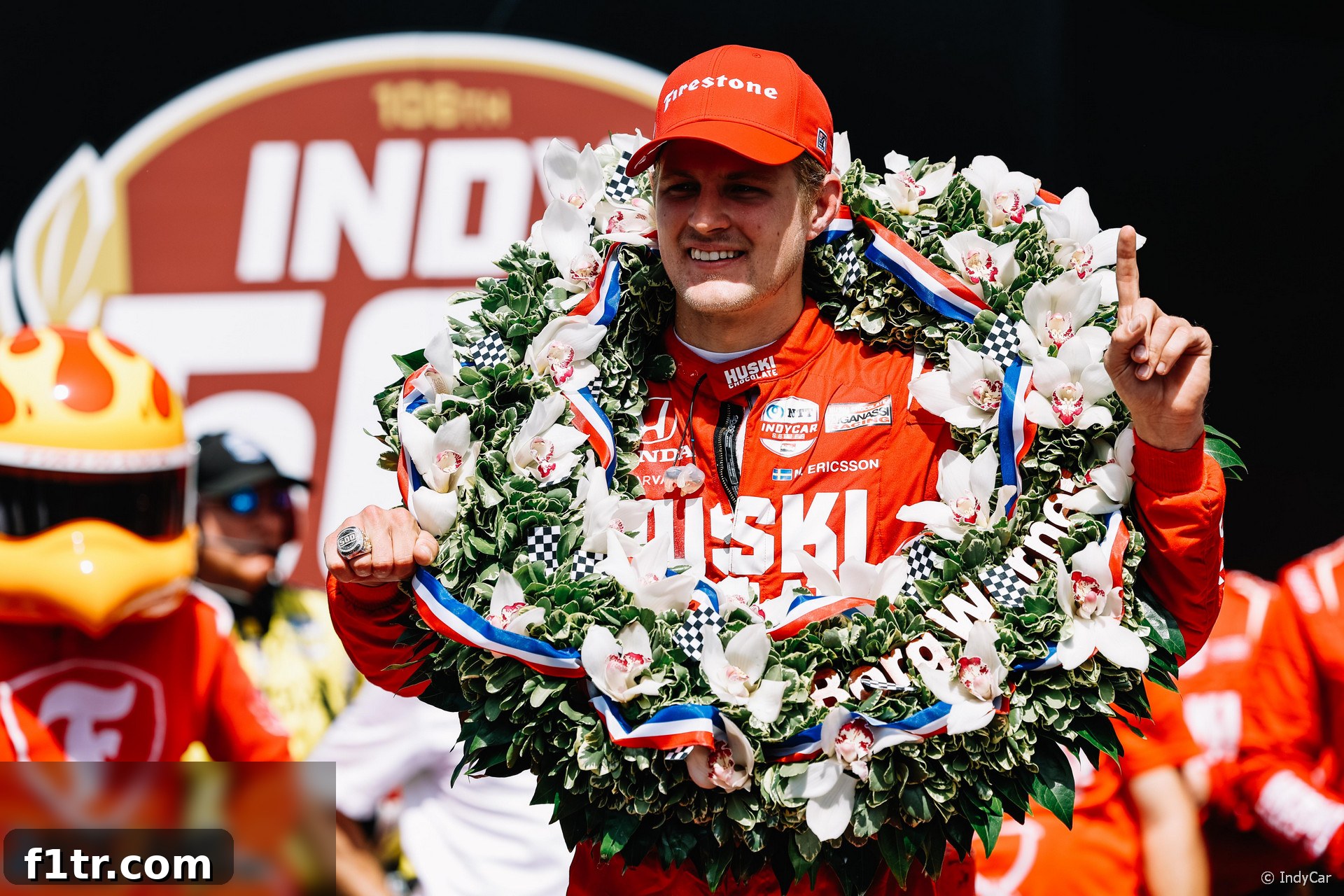
Marcus Ericsson etched his name into racing history, surviving a heart-stopping, two-lap shootout against the formidable Pato O’Ward to clinch the most monumental victory of his distinguished career in the Indianapolis 500. This hard-fought win at the iconic Indianapolis Motor Speedway wasn’t just a race triumph; it was the culmination of years of dedication, strategic brilliance, and sheer grit, securing his place among the legends of “The Greatest Spectacle in Racing.”
Ericsson’s Ascendancy: From Mid-Pack to Master Strategist
The 200-lap race, a grueling test of endurance, speed, and strategy, saw Ericsson emerge as a genuine contender in its critical final quarter. For much of the event, the narrative had been dominated by his Chip Ganassi Racing teammate, Scott Dixon. Dixon, a two-time pole sitter and a previous Indy 500 winner, appeared destined for a second triumph, having led an astonishing 95 laps, showcasing unparalleled dominance across the first three-quarters of the race. However, the unforgiving nature of the Indy 500 often reserves its most dramatic twists for the closing stages. Dixon’s hopes were dashed by a costly drive-through penalty for speeding upon entering the pit lane during his final stop, a heartbreaking error that once again denied him a second coveted victory.
As Dixon faltered, Ericsson seized his moment. With just 20 laps remaining, he found himself trailing the McLaren SP duo of Felix Rosenqvist and Pato O’Ward. Displaying both pace and precision, Ericsson meticulously began his charge. On lap 181, he expertly overtook O’Ward, demonstrating the competitive edge that would define his eventual victory. Two laps later, on lap 183, he surged past his compatriot Rosenqvist, effectively claiming the virtual lead of the race. This series of perfectly timed overtakes, including navigating through lapped backmarkers with masterful execution, allowed Ericsson to establish a crucial three-second advantage over O’Ward once all competitors had completed their final pit stops. The Swede’s strategic prowess and cool demeanor under pressure were undeniable, setting the stage for an unforgettable climax.
The Dramatic Climax: Red Flag and Two-Lap Shootout
Just when Ericsson seemed to have the race under control, the unpredictable nature of the Indy 500 delivered another seismic shift. With only five laps left, another Chip Ganassi Racing teammate, rookie sensation Jimmie Johnson, crashed out at Turn 2. This incident triggered the fifth full-course caution of the race, compressing the field and erasing Ericsson’s hard-earned lead. The tension escalated further when race officials made the crucial decision to deploy a red flag, halting the action to allow for track clear-up and ensuring a thrilling, two-lap sprint to the finish – a true shootout to determine the winner of IndyCar’s biggest race.
The restart presented Ericsson with the ultimate challenge: defending his position against an incredibly fast and determined Pato O’Ward. For the final five miles, Ericsson executed a flawless defensive drive, meticulously blocking O’Ward’s every attempt to make a move. As the leaders roared past the white flag, signaling the final lap, O’Ward launched a ferocious assault, gaining momentum out of Turn 4 and sizing up a decisive overtake. Yet, Ericsson, unwavering under immense pressure, slammed the door shut, denying the Mexican driver even a sliver of an opening. The drama didn’t end there; a last-lap crash involving Sage Karam, outside the top ten, brought out the yellow flag one final time, effectively neutralizing the race and securing Marcus Ericsson’s incredible victory.
A Career Transformed: Ericsson’s Road to Immortality
Marcus Ericsson’s journey to Indy 500 glory is a remarkable tale of perseverance and adaptation. Often overlooked among the star-studded Chip Ganassi Racing lineup, Ericsson, a former protégé of 1999 Indy 500 winner Kenny Brack, proved his mettle on the biggest stage. His racing career has spanned continents, from Europe to Japan, encompassing four seasons in the highly competitive GP2 series and five often challenging, largely fruitless years in Formula 1. The transition to IndyCar marked a significant turning point, culminating in a breakthrough season in 2021 that hinted at his true potential. Now, with the Indy 500 title in hand, Ericsson’s name and likeness will forever be etched onto the fabled Borg-Warner Trophy, a testament to his resilience and ultimate triumph. This victory is not merely a win; it is the defining moment of a career, solidifying his status as an elite driver.
Pato O’Ward’s Persistent Pursuit and Other Standout Performances
Pato O’Ward, despite narrowly missing out on victory, delivered another stellar performance, finishing a commendable second. This result marks a continuous upward trajectory for the young Mexican driver, who placed sixth in the 2020 race and fourth in 2021. His second-place finish comes on the heels of confirming a contract extension with McLaren SP, signaling a bright future and his undeniable talent as a perennial contender in the IndyCar Series.
The race also saw a strong showing from veteran Tony Kanaan, the 37-year-old one-time winner. In what could potentially be his final Indianapolis 500, Kanaan surged past Felix Rosenqvist in the final 20 laps, securing a well-deserved third-place finish. This marks his best result at the 500 since his triumphant win in 2013, adding another memorable chapter to his illustrious career. Rosenqvist, who finished fourth, achieved his best result since joining McLaren SP at the start of the 2021 season, a much-needed boost as he approaches the end of his current contract.
2016 winner Alexander Rossi mounted an impressive recovery drive, climbing from 20th position to finish fifth. His charge was fueled by a series of brave overtakes and strategic moves, particularly during the restarts. Rossi led home his long-time friend and Indiana native Conor Daly, whose sixth-place finish represents his best-ever result at the Indy 500. Daly’s climb through the field was significantly aided by a perfectly timed pit stop, executed just before the second caution flag for Callum Ilott’s incident at Turn 2, highlighting the critical role of strategy in this demanding race.
Four-time and defending winner Helio Castroneves, known for his “Spiderman” celebrations, demonstrated his enduring skill by navigating from 27th on the grid to finish a respectable seventh, ahead of his Meyer Shank Racing teammate Simon Pagenaud in eighth. Alex Palou, another Ganassi driver, finished ninth, though he had shown potential for victory earlier in the race. Palou was trading the lead with teammate Dixon in the first quarter but was unfortunately caught out by the second caution for Ilott’s accident, forcing him to take an emergency refuelling service in a closed pit lane and restarting at the tail end of the field. Santino Ferrucci, driving for the part-time independent team Dreyer & Reinbold Racing, delivered a strong performance to round out the top ten.
The top rookie honor went to Dale Coyne Racing/HMD driver David Malukas, who impressed with a 16th-place finish, showcasing promising talent for the future.
Cautions, Crashes, and Resilience on Track
The 2022 Indianapolis 500 was punctuated by six full-course cautions, all triggered by single-car accidents. Thankfully, all drivers involved were confirmed to be not seriously injured, a testament to the safety advancements in modern racing. The first caution occurred early on lap 39 when front-row starter Rinus VeeKay crashed at Turn 2. This same treacherous corner would claim Callum Ilott on lap 69, bringing out the second caution. Romain Grosjean’s highly anticipated debut in the race ended prematurely with a crash on lap 106, also at Turn 2. On lap 151, Scott McLaughlin’s race concluded with a frightening crash at Turns 3 and 4, where he narrowly avoided collecting Ed Carpenter after the initial impact.
It was also a brutal day for Colton Herta, who had to retire after 129 laps due to a mechanical failure, having rapidly dropped off the pace. Herta was already driving a backup car following a heavy crash during Friday’s Carb Day practice sessions, adding to a challenging weekend for the talented American driver.
Chip Ganassi Racing’s Enduring Legacy
Marcus Ericsson’s victory marks the sixth Indianapolis 500 triumph for legendary car owner Chip Ganassi, further solidifying his team’s revered status in American motorsport. This illustrious list of Ganassi winners includes Emerson Fittipaldi (1989, in a joint entry with Pat Patrick), Juan Pablo Montoya (2000), the aforementioned Scott Dixon in 2008, and Dario Franchitti in both 2010 and 2012. Ericsson’s win adds another brilliant chapter to Ganassi’s incredible legacy at the Brickyard, highlighting the team’s consistent excellence and strategic brilliance in the most demanding of races.
2022 Indianapolis 500 Results
| Position | Car | Driver | Team | Engine |
|---|---|---|---|---|
| 1 | 8 | Marcus Ericsson | Ganassi | Honda |
| 2 | 5 | Pato O’Ward | McLaren SP | Chevrolet |
| 3 | 1 | Tony Kanaan | Ganassi | Honda |
| 4 | 7 | Felix Rosenqvist | McLaren SP | Chevrolet |
| 5 | 27 | Alexander Rossi | Andretti | Honda |
| 6 | 20 | Conor Daly | Carpenter | Chevrolet |
| 7 | 6 | Helio Castroneves | Meyer Shank | Honda |
| 8 | 60 | Simon Pagenaud | Meyer Shank | Honda |
| 9 | 10 | Alex Palou | Ganassi | Honda |
| 10 | 23 | Santino Ferrucci | DRR | Chevrolet |
| 11 | 66 | Juan Pablo Montoya | McLaren SP | Chevrolet |
| 12 | 11 | JR Hildebrand | Foyt | Chevrolet |
| 13 | 2 | Josef Newgarden | Penske | Chevrolet |
| 14 | 15 | Graham Rahal | RLL | Honda |
| 15 | 12 | Will Power | Penske | Chevrolet |
| 16 | 18 | David Malukas | Coyne/HMD | Honda |
| 17 | 14 | Kyle Kirkwood | Foyt | Chevrolet |
| 18 | 33 | Ed Carpenter | Carpenter | Chevrolet |
| 19 | 29 | Devlin DeFrancesco | Andretti Steinbrenner | Honda |
| 20 | 30 | Christian Lundgaard | RLL | Honda |
| 21 | 9 | Scott Dixon | Ganassi | Honda |
| 22 | 98 | Marco Andretti | Andretti/Herta | Chevrolet |
| 23 | 24 | Sage Karam | DRR | Chevrolet |
| 24 | 45 | Jack Harvey | RLL | Honda |
| 25 | 51 | Takuma Sato | Coyne/RWR | Honda |
| 26 | 4 | Dalton Kellett | Foyt | Chevrolet |
| 27 | 25 | Stefan Wilson | DragonSpeed/Cusick | Chevrolet |
| 28 | 48 | Jimmie Johnson | Ganassi | Honda |
| 29 | 3 | Scott McLaughlin | Penske | Chevrolet |
| 30 | 26 | Colton Herta | Andretti | Honda |
| 31 | 28 | Romain Grosjean | Andretti | Honda |
| 32 | 77 | Callum Ilott | Juncos Hollinger | Chevrolet |
| 33 | 21 | Rinus VeeKay | Carpenter | Chevrolet |
Related IndyCar Articles
- IndyCar driver McLaughlin cleared of injury after crashing through barrier at Barber
- Schumacher says his IndyCar feels like ‘an F2 car, just with better tyres’
- IndyCar “way faster than Formula 1” in some corners, says Grosjean
- FIA to award more F1 superlicence points to IndyCar drivers from 2026
- Schumacher to race full-time in IndyCar with RLL in 2026
Browse all IndyCar articles