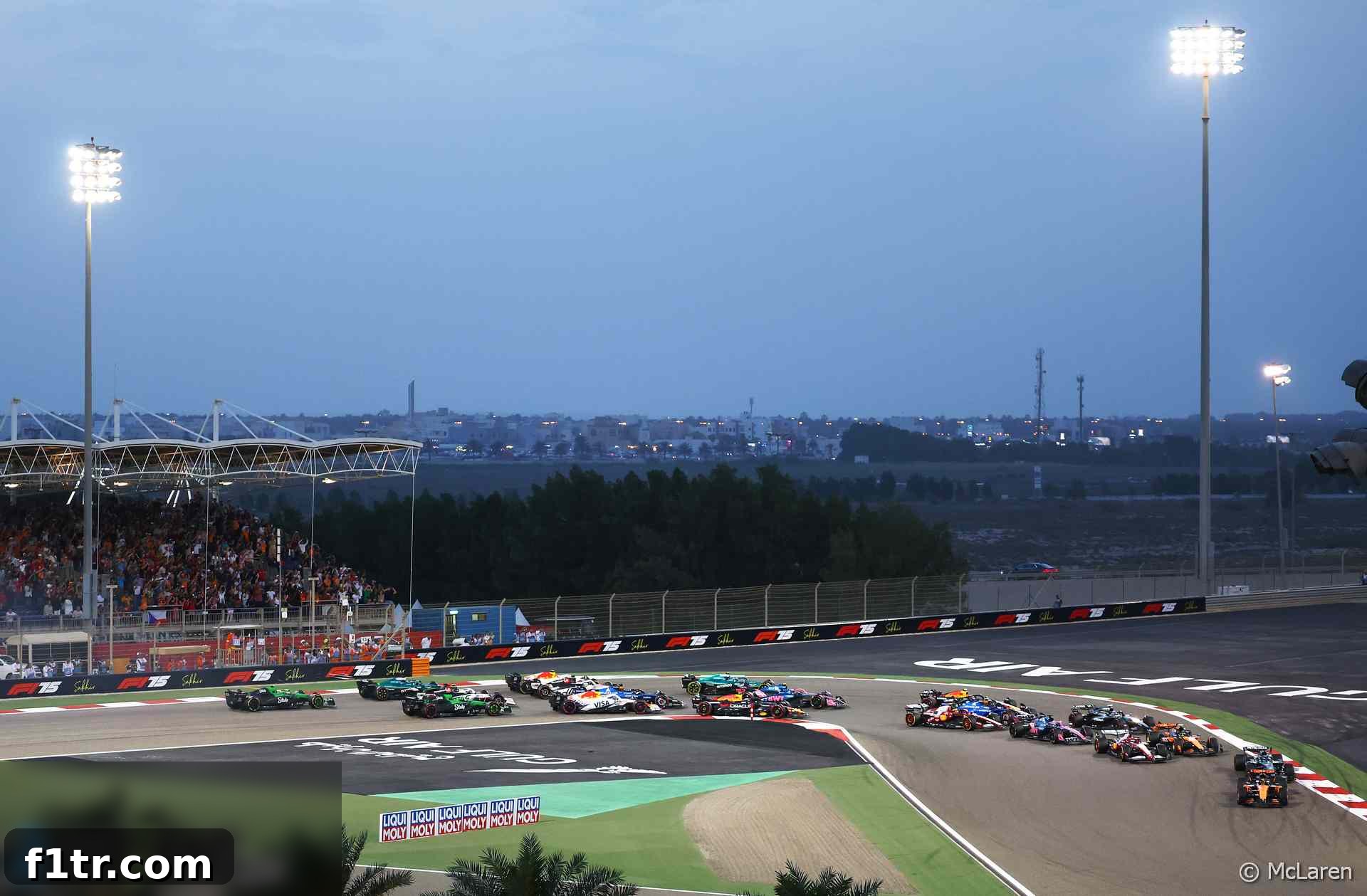
Oscar Piastri Secures Emphatic Bahrain Grand Prix Victory Amidst DRS Drama and Intense Battles
The 2025 Formula 1 season delivered a captivating spectacle at the Bahrain International Circuit, with the Bahrain Grand Prix unfolding into a strategic masterpiece for some and a challenging ordeal for others. McLaren’s Oscar Piastri demonstrated unparalleled dominance, driving to an emphatic victory that firmly established him as a front-runner for the championship. This triumph marks his second Grand Prix win of the year, underscoring both his exceptional talent and McLaren’s formidable car package. However, the race was far from a simple procession, featuring a host of dramatic incidents, most notably a post-race investigation into George Russell’s DRS usage and a series of breathtaking on-track battles that kept fans on the edge of their seats.
Piastri’s Masterclass: Unchallenged Dominance from Pole to Flag
From the moment the lights extinguished, Oscar Piastri commanded the Bahrain Grand Prix with an air of controlled authority. Starting from pole position, he executed a flawless getaway, expertly fending off any immediate challenges to maintain his lead into the tight confines of Turn 1. What followed was a masterclass in race management. Piastri meticulously managed his tires on the notoriously abrasive Bahrain track, a circuit renowned for its high degradation, extracting consistent pace while preserving his crucial rubber. His strategic decisions in the pit stops were equally precise, allowing him to stay ahead of his rivals throughout the entire race. This impressive performance not only showcased Piastri’s growing maturity and confidence but also highlighted McLaren’s significant progress, proving their car’s capability to excel under demanding conditions. His second victory of the season is a strong statement of intent, positioning him as a serious contender in the early stages of the 2025 championship.
The Lingering Shadow of DRS: George Russell Under Intense Scrutiny
One of the most significant and contentious storylines of the Bahrain Grand Prix revolved around George Russell and a post-race investigation into his alleged illegal DRS usage. The Mercedes driver, who secured an impressive second place, found himself under the watchful eye of the FIA stewards for deploying his Drag Reduction System outside of the designated activation zones. This scenario is highly unusual, as F1 cars are typically equipped with sophisticated systems designed to prevent such activations. However, a critical technical malfunction was identified: a problem with Russell’s car’s timing transponder. This issue, which Mercedes later revealed left the transponder “frazzled and charred,” appeared to feed incorrect data to the car’s systems, potentially allowing the DRS to activate when it should not have.
The ramifications of this technical glitch extended beyond the investigation. Mercedes engineers were observed warning Russell throughout the race about potential dash display malfunctions and troublesome gearshifts, indicating a broader electrical issue impacting his car’s performance. The team even radioed Lando Norris, advising extreme caution with his own DRS activation due to Russell’s timing problems, stating: “We can only use DRS when we’re 100% sure we’re within it.” This level of concern underscores the critical nature of the issue. The ongoing investigation carries significant weight and could potentially alter the final race classification, adding a dramatic layer of uncertainty to Russell’s well-earned podium finish.
Intense Battles Ignite the Mid-Pack: A Showcase of F1 Prowess
Norris vs. Leclerc: A Ferocious Fight for the Podium
While Oscar Piastri enjoyed a relatively serene drive at the front, the battle for the remaining podium positions and crucial championship points was nothing short of ferocious. Lando Norris, after incurring an early five-second time penalty for being out of position on the grid, found himself embroiled in a thrilling, wheel-to-wheel contest with Ferrari’s Charles Leclerc for third place. This duel was a highlight of the race, featuring multiple overtakes, defensive masterclasses, and heart-stopping moments that showcased the drivers’ exceptional skill and bravery.
On Lap 49, the tension peaked as Leclerc skillfully defended his position, forcing Norris wide at Turn 4. This maneuver was deemed legitimate by the stewards, as Norris was not fully alongside at the point of entry. However, Norris, spurred on by his team urging him to maximize his tire pace, continued his relentless pursuit. Just three laps later, on Lap 52, the McLaren driver launched a superb attack. Getting a powerful run out of Turn 1, Norris finally made the move stick, overtaking Leclerc on the outside of Turn 4. Despite the exhilaration, Norris received a further warning for exceeding track limits during his charge, putting him on thin ice regarding potential future penalties.
Sainz’s Eventful Race and Costly Penalties
Carlos Sainz, driving for Williams, endured an action-packed Grand Prix that saw him involved in multiple incidents and accrue significant penalties. Early in the race, a contentious moment on the exit of Turn 1 prompted Sainz to voice his frustration over Yuki Tsunoda’s driving, exclaiming: “They should investigate Yuki because what he did to me was just stupid.” Later, Sainz himself faced the stewards’ wrath, receiving a 10-second penalty for an incident where he was judged to have forced Andrea Kimi Antonelli off the track, compounding his challenges.
Despite these setbacks, Sainz displayed remarkable tenacity and aggressive driving, making an uncompromising pass on Antonelli for 14th place at Turn 10. While his assertive approach sometimes led to infractions, it undoubtedly added to the spectacle and demonstrated his relentless fighting spirit throughout a difficult race weekend.
Verstappen’s Uncharacteristic Struggles: A Rare Sight for Red Bull
One of the most astonishing narratives of the Bahrain Grand Prix revolved around Max Verstappen, who, after a period of near-uninterrupted dominance, experienced an uncharacteristically challenging race. Plagued by persistent brake issues that had troubled him throughout the weekend, his struggles intensified on race day. Red Bull had made extensive adjustments to his car since qualifying, including replacing the right-hand-side front brake infrared sensor, the left-hand-side rear brake caliper cooling spat, and making changes to both front and rear brake friction material, alongside other related parameters. Yet, the problems persisted, severely hampering his performance.
Verstappen’s frustration was palpable, as evidenced by his radio message on Lap 22: “I can’t even brake any more, it’s ridiculous,” he complained, a stark departure from his usual composed demeanor. This lack of confidence in his braking system saw him uncharacteristically lose positions to both Lewis Hamilton and Andrea Kimi Antonelli. His early second pit stop on Lap 27 further compounded his woes; a critically slow stop lasting over six seconds occurred because he reportedly did not receive a green signal to exit the Red Bull pit box. This prolonged stop dropped him to the very back of the field, rejoining behind Bortoleto. Running on hard compound tires, Verstappen found it particularly difficult to generate pace, a rare sight for the usually dominant Dutchman. On Lap 20, Antonelli managed to pass him for seventh, a testament to Verstappen’s struggles rather than Antonelli’s outright speed.
An incident between Verstappen and Sainz at Turn 4 on Lap 11 also caught the stewards’ attention, investigating whether Verstappen had completed a pass outside track limits. Replays, however, indicated that Verstappen had remained within the newly extended limits, despite his complaint that the Williams driver had not left him a car’s width.
Strategic Pit Stops, Safety Car Drama, and Critical Repercussions
The Bahrain Grand Prix was significantly influenced by crucial strategic decisions and a pivotal Safety Car deployment. On Lap 32, the Safety Car was deployed due to debris scattered across the track. This debris originated from Yuki Tsunoda’s Red Bull, after he made contact with a Williams while battling Carlos Sainz, resulting in a part detaching from his car. This intervention presented a critical strategic window for many teams to execute their pit stops, creating a fascinating mix of tire compounds on track for the impending restart.
At the restart, race leader Piastri opted for medium tires, Russell for softs, Leclerc for hards, and Norris for mediums. Lewis Hamilton, now in fifth, also chose mediums. The Lap 35 restart was immediate and chaotic, with Norris quickly challenging Leclerc. Hamilton shrewdly capitalized on the commotion, briefly snatching fourth place, only for Norris to immediately retake the position, albeit potentially with all four wheels off-track at Turn 4 – an incident that could have drawn further scrutiny. The varied tire strategies set the stage for a dynamic second half of the race, with drivers needing to manage different levels of grip and degradation.
A String of Penalties
Beyond Norris’s five-second penalty for a false start, other drivers also faced penalties throughout the race. Liam Lawson received a five-second penalty for causing contact with Nico Hulkenberg, and Carlos Sainz, as previously mentioned, was handed a 10-second penalty for his aggressive maneuver on Andrea Kimi Antonelli. These penalties highlighted the stringent enforcement of racing rules and the high stakes involved in every on-track maneuver.
Pre-Race Buzz: Expectations, Technical Preparations, and Track Conditions
Even before the roaring engines signaled the start, the 2025 Bahrain Grand Prix was brimming with anticipation and intriguing storylines. The starting grid itself presented a fascinating picture, with four different teams occupying the top four positions – a remarkable feat, especially considering that last week’s dominant winners, Red Bull, were notably absent from the front row. McLaren had emerged as strong favorites, consistently demonstrating excellent tire management on the circuit’s high-degradation surface during practice and qualifying.
The confirmed starting grid incorporated penalties for George Russell and Andrea Kimi Antonelli, setting the stage for their respective recovery drives. Max Verstappen’s ongoing struggles with his brakes were a major talking point throughout the paddock, with Red Bull implementing extensive changes to his car in a desperate bid to resolve the lingering issues. Meanwhile, Esteban Ocon’s Haas, meticulously repaired after a significant shunt in Q2, was ready to take its place on the grid, a testament to the tireless work of his team.
Pirelli’s pre-race insights further influenced strategy, highlighting that a set of soft tires could gain approximately 3.13 meters under acceleration from 0-150kph compared to mediums. This critical data shaped the initial tire choices, with most drivers opting for softs at the start. However, a significant contingent, including Charles Leclerc, Lewis Hamilton, Fernando Alonso, Liam Lawson, and Gabriel Bortoleto, chose to begin on mediums, setting the stage for diverse strategies from the outset. With track temperatures at a scorching 33°C and air temperatures at 27°C, tire degradation was always destined to be a defining factor in the race’s outcome.
The pre-race national anthem ceremony also carried its own unique tension. Drivers were acutely aware of the potential for hefty fines, up to €60,000, for arriving late – a lesson Carlos Sainz had unfortunately learned earlier in the season, adding a touch of humor and urgency to the pre-race formalities.
Conclusion: A Memorable Start to the 2025 Season in Bahrain
The 2025 Bahrain Grand Prix delivered a truly captivating spectacle, showcasing the pinnacle of motorsport with its blend of raw talent, strategic depth, and high-stakes drama. Oscar Piastri’s dominant victory was a testament to his exceptional skill and McLaren’s strong development, setting an exciting precedent for the season ahead. The race was enriched by the intense wheel-to-wheel battles that raged throughout the field, particularly the thrilling contest between Lando Norris and Charles Leclerc, which kept fans enthralled until the very end. The unexpected struggles of Max Verstappen and the post-race investigation into George Russell’s DRS usage added layers of intrigue and controversy, highlighting the fine margins and technical complexities that define Formula 1. As the championship unfolds, the early form demonstrated by McLaren and the challenges faced by traditional front-runners suggest an enthralling and unpredictable season. The Bahrain Grand Prix proved to be a truly memorable start, leaving fans eager for the next chapter in this thrilling 2025 campaign.
Related Stories from the 2025 Bahrain Grand Prix
- Hamilton making “drastic shift” in driving style to master Ferrari’s car
- Leclerc revealed Ferrari strategy details to Gasly before Bahrain Grand Prix
- Lawson made “very significant step forward” in Bahrain – Mekies
- Russell’s transponder was ‘frazzled and charred’ after Bahrain Grand Prix DRS drama
- “Don’t give me too much now”: Hamilton’s search for speed at Ferrari continues
Browse all 2025 Bahrain Grand Prix articles