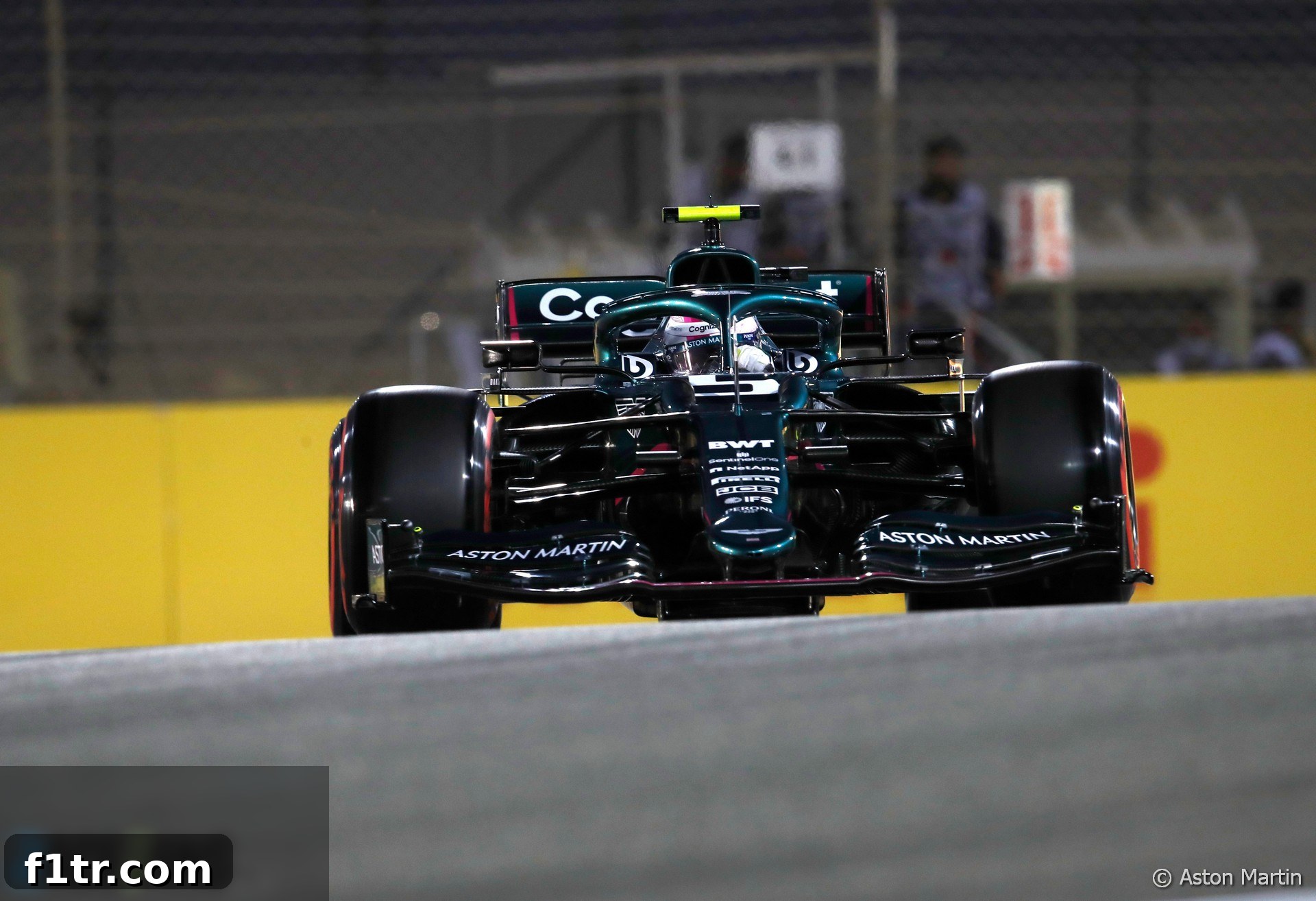
Sebastian Vettel, the revered four-time Formula 1 World Champion, faced an unexpectedly challenging start to his tenure with Aston Martin at the 2021 Bahrain Grand Prix. In what was a highly anticipated debut for both driver and team, Vettel found himself eliminated in Q1, a rare occurrence for a competitor of his calibre. The seasoned German driver openly expressed his frustration, attributing his early exit to a “mess in the last sector” and the untimely deployment of yellow flags during his crucial final qualifying attempt. This unfortunate chain of events effectively thwarted his aspirations for a strong grid position, leaving him with a mountain to climb on race day.
The qualifying session at the Sakhir International Circuit is always a demanding affair, pushing drivers and machinery to their absolute limits. With tight margins and intense competition, every millisecond counts, and a clear run is paramount. Teams meticulously plan their strategies, aiming to get their drivers out on track at the optimal moment, seeking clear air and the perfect tyre temperatures to extract maximum performance. For Vettel, the final moments of Q1 proved to be a crucible of unforeseen complications, unfolding in a series of unfortunate circumstances that conspired against him. His preparation for the decisive flying lap, already a delicate balance of tyre temperature management and finding clear track, was severely compromised by the chaotic scene ahead.
The initial disruption occurred when Nikita Mazepin, the rookie driver for Haas F1, spun his car at the tricky Turn 1. This incident immediately triggered yellow flags in that section of the track. Under Formula 1 regulations, drivers are mandated to slow down significantly and be prepared to stop when yellow flags are displayed, thereby effectively invalidating any potential improvement on their lap time in that sector. The necessity to lift off the throttle and maintain a safe speed under these conditions means a flying lap is instantly compromised, as the car cannot be pushed to its absolute limits. As Vettel navigated this initial obstacle, hoping to salvage the remainder of his lap, fate dealt him another blow. Further along the circuit, Carlos Sainz Jnr of Ferrari encountered an engine problem, causing his car to slow dramatically and bringing out additional yellow flags in another crucial segment of the lap. This meant that even if Vettel had managed to regain momentum after Mazepin’s spin, Sainz’s issue presented yet another insurmountable barrier to a competitive lap time, effectively destroying any chance of improving his position.
Adding to the complexity of the situation, Vettel’s warm-up routine for his final Q1 run was severely hampered even before he began his flying lap. As cars jostled for position and clear air in the final sector – a common challenge in crowded qualifying sessions – Mazepin unexpectedly overtook Vettel and several other drivers. While such manoeuvres are not strictly against the rules, there is often an informal understanding, or “gentleman’s agreement,” among drivers to maintain a certain decorum during out-laps. This allows everyone to adequately prepare their tyres and create sufficient gaps for a clean flying lap. This unexpected overtaking disrupted Vettel’s rhythm and crucial tyre temperature management, critical elements for extracting maximum performance from the car on a flying lap. The nuanced art of preparing for a qualifying lap involves precise throttle inputs, braking points, and careful management of tyre pressures and temperatures, all of which were thrown into disarray by the traffic congestion and Mazepin’s unpredicted actions, leaving Vettel at a distinct disadvantage even before he truly began his timed effort.
Reflecting on the session, Vettel articulated his frustration with characteristic candor: “It was a mess in the last sector warming up. I just made it across the flag by less than a second and then I had two yellow flags, so not much you can do at that stage.” His words painted a clear picture of a driver who felt helpless against circumstances beyond his control. The slim margin by which he crossed the start/finish line to begin his final lap highlighted the frantic scramble for track position, only for his efforts to be immediately undermined by the necessary safety interventions. This combination of heavy traffic, untimely yellow flags, and disruptions to his pre-lap routine proved to be an insurmountable hurdle, leading to an outcome few would have predicted for a driver of Vettel’s calibre.
Despite the significant setback, Vettel, ever the professional, chose not to explicitly criticise the rookie Mazepin for the overtaking manoeuvre during the warm-up. Instead, he directed his comments towards the inherent challenges of modern Formula 1 qualifying, particularly with the specific demands of tyre preparation. “In the end I think the trouble is that we have to run so slow to get the tyres where we want them to be,” he explained. “So with that amount of cars on the track, it’s going to be a mess. Obviously, nobody expected it to be that bad.” This insight points to a systemic issue within F1, where the delicate operating window of Pirelli tyres often forces drivers to drive unusually slowly on their out-laps to generate the necessary heat and pressure, creating bottlenecks and increasing the likelihood of traffic-related incidents. This delicate dance of tyre management and track position is a constant source of tension in qualifying, and on this occasion, it manifested in the worst possible way for the Aston Martin driver, highlighting a broader problem that often affects the integrity of qualifying sessions.
The stark contrast in performance within the Aston Martin garage underscored the depth of Vettel’s disappointment. While the German veteran was relegated to a Q1 exit, his teammate, Lance Stroll, demonstrated the potential of the AMR21 by successfully navigating through to Q3. Stroll’s impressive performance saw him secure 10th position on the grid for Sunday’s race, offering a tantalizing glimpse of what might have been possible for Vettel had his runs not been compromised. The four-time champion certainly believed he had more to offer: “Certainly I think there was potential to be a lot faster,” he stated, hinting at the untapped pace that remained due to the qualifying disruptions. This internal comparison added another layer of frustration, as it confirmed the car had the speed to be much higher up the grid.
Speaking to the media while the qualifying session was still ongoing, a visibly phlegmatic Vettel maintained a composed exterior, yet beneath the surface, the disappointment was palpable. He candidly admitted to feeling a profound sense of upset and anger about the outcome, even if his immediate demeanour suggested otherwise. “If I panicked now, would it help? Or if I was really upset? For sure, I’m upset and angry that it wasn’t our fault, in a way, not to make it through,” he revealed. This reflection showcased a driver grappling with external factors costing him a fair shot, while simultaneously exhibiting the mental fortitude required to quickly shift focus. His immediate priority was to channel this frustration into constructive preparation for the demanding race ahead, emphasising the importance of taking stock, understanding what went wrong, and moving forward with a clear strategy for Sunday. This mindset is a hallmark of a true champion, even when facing adversity.
Crucially, the stewards of the event confirmed that Sebastian Vettel had reacted appropriately to the yellow flag incidents. Following a thorough review of telemetry and video evidence, they were satisfied that he had lifted off the throttle and slowed down as required, ensuring safety protocols were observed rigorously. Consequently, no action was taken against him for his response to the flags. This clearance also extended to Lance Stroll, Esteban Ocon of Alpine, and George Russell of Williams, all of whom also encountered and correctly responded to the same yellow flags in the crucial final minutes of Q1. This clearance reaffirmed Vettel’s adherence to the rules, highlighting that his Q1 elimination was purely a consequence of unfortunate timing and external factors, rather than any procedural infringement or lack of pace from his side. It underscored the bad luck that befell him in a session where a fraction of a second could mean the difference between progressing and being eliminated.
For Aston Martin, Vettel’s Q1 exit was an unwelcome start to their much-hyped return to Formula 1 as a works team. The outfit, backed by Canadian billionaire Lawrence Stroll, has ambitious goals, aiming to challenge at the front of the grid in the coming years. Securing a driver of Vettel’s calibre was a significant statement of intent, bringing with him a wealth of experience, technical feedback, and championship-winning pedigree. While Lance Stroll’s Q3 performance offered some solace and demonstrated the car’s underlying capability, the team would undoubtedly have hoped for both drivers to progress further, especially with the strategic advantages that come from higher grid positions. This challenging debut serves as a stark reminder of the cutthroat nature of F1, where even the slightest misstep or stroke of bad luck can have profound consequences, potentially impacting race strategy and points accumulation from the very first Grand Prix.
Looking ahead to the Bahrain Grand Prix race, Sebastian Vettel faces a formidable challenge starting from the back of the grid. However, his extensive experience and proven ability to navigate through the field will be a critical asset for Aston Martin. The Sakhir circuit, with its long straights and heavy braking zones, offers several overtaking opportunities, and with a car that Lance Stroll has shown to possess Q3 pace, there is certainly potential for Vettel to make progress. His focus will undoubtedly be on a clean start, strategic tyre management, and exploiting any safety car periods or incidents to claw his way up the order. A points finish from such a lowly grid position would be a remarkable recovery and a testament to his enduring skill and the team’s race strategy, providing a much-needed morale boost after a difficult Saturday.
The 2021 Formula 1 season promises to be one of the most competitive in recent memory, and while Vettel’s first qualifying session with Aston Martin was undeniably disappointing, it is merely the opening chapter of a long campaign. The team will be keen to learn from this experience, refine their procedures, and ensure their star driver has every opportunity to showcase his talent unhindered. For Vettel, the setback will fuel his determination, reinforcing the idea that resilience and adaptability are as crucial as raw pace in the unforgiving world of Formula 1. The journey has just begun, and the four-time champion will be eager to demonstrate his true capabilities in the races to come, proving that this Q1 exit was just a minor stumble, not a defining moment, in his new, exciting chapter with Aston Martin. His experience will be vital in guiding the team through the inevitable ups and downs of a demanding season.
2021 Bahrain Grand Prix
- Why one driver says there’s no easy solution to F1’s ‘messy’ track limits problem
- Verstappen: Lost win in Bahrain “is not going to matter” if we have fastest car
- The classic rivalry for ‘best of the rest’ and six more Imola talking points
- Ocon: We need to extract the maximum from the car to score points
- Vettel feeling “not at home in the car yet” after tough weekend
Browse all 2021 Bahrain Grand Prix articles