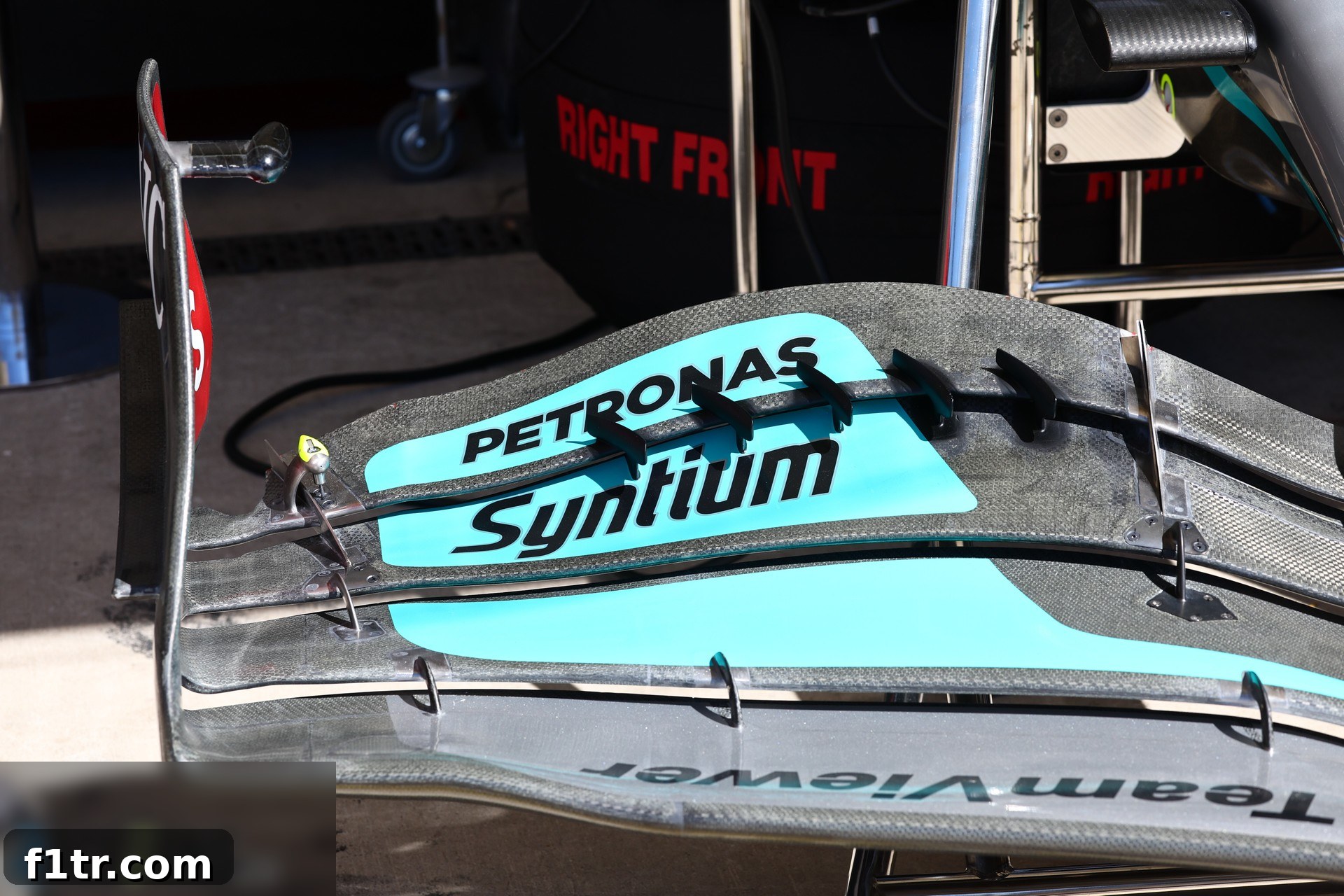
FIA Bans Mercedes’ Controversial 2022 Front Wing Design: A Deep Dive into F1’s Aerodynamic Battleground
The relentless pursuit of aerodynamic supremacy in Formula 1 often pushes the boundaries of technical regulations, leading to intricate interpretations and sometimes, outright bans. One such instance emerged from the 2022 season, where a specific front wing design conceptualized and produced by the Mercedes-AMG Petronas Formula 1 Team was ultimately deemed non-compliant by the FIA, the sport’s governing body. While Mercedes debuted this innovative design as part of a significant upgrade package at the United States Grand Prix, it never saw competitive action in its original form, a testament to the ever-present scrutiny and the meticulous nature of F1’s regulatory framework.
Mercedes had arrived at the Circuit of the Americas with high hopes, bringing a comprehensive suite of upgrades intended to unlock more performance from their challenging W13 chassis. Among these revisions was a novel front wing assembly, which the team itself characterized as featuring a “reduced camber front wing tip and additional slot gap separators.” The design quickly caught the attention of rival teams and, crucially, the FIA’s technical delegates. Despite the palpable excitement surrounding potential performance gains, the wing’s unique interpretation of aerodynamic principles soon raised questions about its legality, ultimately prompting Mercedes to make a tactical decision to avoid a potential protest from their competitors.
The Grey Area of Slot Gap Separators: A Fine Line Between Structure and Aerodynamics
At the heart of the controversy surrounding Mercedes’ 2022 front wing were the “slot gap separators.” In Formula 1, front wings are complex, multi-element structures designed to generate downforce and manage airflow around the car. The various elements are often separated by small gaps (slots) to optimize aerodynamic efficiency. To maintain the structural integrity of these delicate components, particularly under the immense forces experienced at high speeds, technical regulations permit the use of “slot gap separators.” These small brackets connect consecutive wing profiles, ensuring they remain rigid and prevent excessive flexing or vibration.
The 2022 technical regulations stipulated that such separators were permissible primarily for “mechanical, structural or measurement reasons.” This clause aimed to prevent teams from exploiting these structural elements for purely aerodynamic gain, thereby creating movable aerodynamic devices – a concept largely outlawed in modern F1 to ensure fair competition and driver skill remain paramount. However, the design implemented by Mercedes for their new front wing appeared to offer a significant aerodynamic benefit that went beyond mere structural support. Observers and rival teams quickly inferred that these specific separators were engineered in a way that could manipulate airflow more effectively, potentially enhancing the wing’s performance in a manner not explicitly intended by the regulations’ spirit.
The subtle distinction between a structural component and an aerodynamic device is a constant battleground in Formula 1. Teams constantly push the boundaries, seeking clever interpretations of the rules that can grant even a fraction of a second advantage. Mercedes’ design, with its additional slot gap separators, ventured into this grey area, sparking immediate debate within the paddock. The potential for the separators to act as miniature guide vanes, influencing the air’s path over and under the wing, was a clear concern for both the FIA and rival engineering departments.
Consultation, Concern, and Concession: Mercedes’ Proactive Response
Aware of the fine line they were treading, Mercedes had proactively engaged with the FIA regarding the design of their new front wing well before its physical introduction at the circuit. Mike Elliott, Mercedes’ Technical Director, openly discussed the team’s process, explaining: “We go through a CAD [computer-aided design] review process with the FIA before we come to the circuit, that happens all the time. So it was something that was seen there and then they came back and said, ‘we’re not so sure about this’.”
This pre-emptive consultation is a standard procedure in Formula 1, allowing teams to present their proposed designs to the FIA for initial feedback and to preempt any potential legality issues. While the initial review might have offered some level of assurance, the FIA’s subsequent reservations highlighted the evolving nature of technical interpretations once a design moves from CAD models to real-world application, especially when under the intense scrutiny of competitors. The governing body’s “not so sure about this” comment was a clear indication that the design, particularly the slot gap separators, might not pass muster if a formal protest were lodged.
Facing the prospect of a contentious protest and the potential for a formal investigation, which could lead to disqualification or sanctions, Mercedes opted for pragmatism over confrontation. Rather than risking a significant legality row that could overshadow their weekend and potentially derail their championship aspirations (however faint they might have been by that point in 2022), the team decided against running the wing in its original, controversial configuration. Consequently, the contentious slot gap separators were removed from the front wing assembly before it was finally run for the first time at the subsequent Mexican Grand Prix.
The Formal Ban: FIA’s 2023 Technical Regulation Clarification
The incident surrounding Mercedes’ front wing design at the tail end of the 2022 season served as a catalyst for a definitive clarification in the Formula 1 technical regulations for the subsequent 2023 season. Recognizing the potential for ongoing ambiguity and the exploitation of loopholes, the FIA acted swiftly to tighten the definition of slot gap separators, thereby formally banning designs that primarily served an aerodynamic purpose.
The revised technical regulations for 2023 explicitly altered the definition of these components. While up to eight separator brackets are still permitted on each side of the car – acknowledging their legitimate structural necessity – the rules now unequivocally state that they must “provide a structural connection between consecutive [front wing] profiles.” This seemingly minor wording change carries significant weight. It effectively eliminates any design where the primary function of the separator is aerodynamic rather than structural. Any future design that fails to demonstrably fulfill a purely structural role will be deemed illegal, closing the specific loophole that Mercedes’ 2022 wing had seemingly explored.
This regulatory adjustment underscores the FIA’s commitment to ensuring fair competition and preventing the proliferation of “trick” aerodynamic devices. It also highlights the dynamic and iterative nature of F1 rule-making, where incidents of technical innovation pushing the limits often lead to immediate and precise clarifications to maintain the integrity of the sport.
The Broader Implications: A Constant Tug-of-War in F1 Design
The Mercedes front wing saga of 2022 is more than just an isolated incident; it’s a microcosm of the perpetual tug-of-war between Formula 1 teams and the governing body. Teams are driven by an insatiable hunger for performance, constantly investing vast resources into research and development to find innovative solutions within the complex regulatory framework. This often leads to ingenious interpretations of the rules, designs that are technically compliant on paper but potentially violate the “spirit” of the regulations.
The FIA, on the other hand, bears the responsibility of maintaining a level playing field, ensuring fair competition, and upholding the safety and sporting integrity of Formula 1. This requires constant vigilance, thorough technical inspections, and, crucially, the agility to adapt and clarify regulations in response to new design interpretations. The banning of Mercedes’ specific front wing design, albeit one that never raced in its controversial form, sends a clear message to all teams: while innovation is encouraged, any design perceived to exploit loopholes for an unfair aerodynamic advantage will eventually be clamped down upon.
For Mercedes, the 2022 season was already a challenging one, as they grappled with the severe porpoising issues of their W13 car under the new ground effect regulations. Their attempts to introduce performance-enhancing upgrades, like this front wing, were part of a desperate effort to claw back competitiveness. While this particular innovation was ultimately unsuccessful in its original form, it demonstrates the team’s relentless drive to innovate, even when facing significant hurdles.
In conclusion, the FIA’s decision to ban Mercedes’ 2022 front wing design, specifically its controversial slot gap separators, serves as a compelling reminder of the intricate dance between innovation and regulation in Formula 1. It showcases how technical creativity, when it pushes the boundaries too far, can lead to swift regulatory responses, ultimately shaping the future landscape of car design in the pinnacle of motorsport.
Don’t miss anything new from RaceFans
Follow RaceFans on social media to stay updated with the latest F1 news and analysis:
- Join RaceFans on Facebook
- Follow RaceFans on Twitter
- Get daily email updates from RaceFans
Become a RaceFans supporter and go ad-free for an uninterrupted experience.
Explore more from the 2022 F1 season
Delve deeper into the events and stories that shaped the 2022 Formula 1 World Championship:
- Mercedes told me “you’re wrong” about 2022 car’s problems – Hamilton
- FIA confirms all 10 F1 teams complied with 2022 cost cap
- Steiner “not ashamed” of panning “slow” Schumacher in Drive to Survive
- Albon believes year out of F1 improved him as a driver
- Hamilton sees diversity gains in F1 years on from his ‘traumatising’ experience of racism
Browse all 2022 F1 season articles