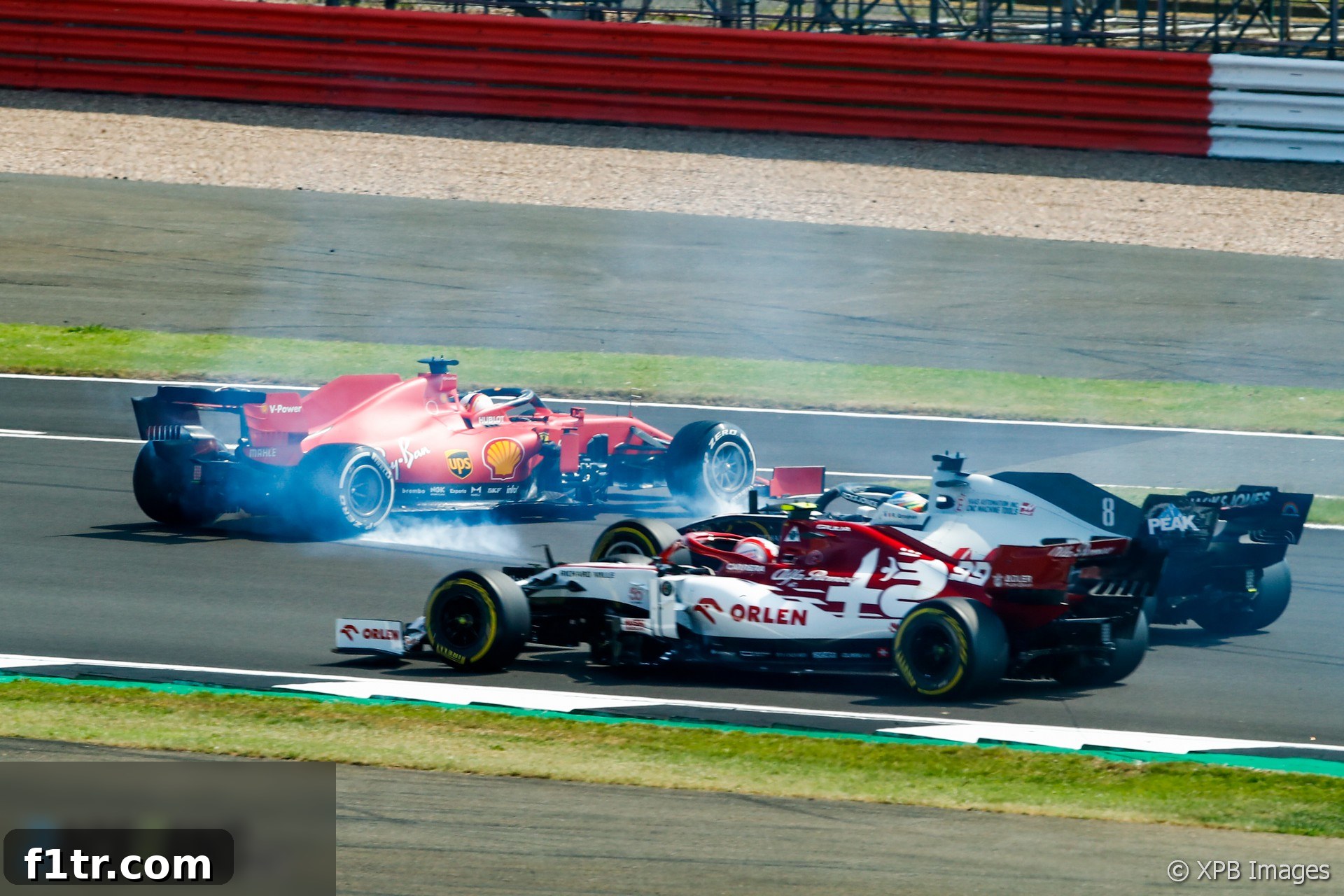
The 2020 Formula 1 season, marked by unprecedented challenges and a condensed calendar, presented a particularly trying period for four-time world champion Sebastian Vettel. The renowned German driver found himself in an increasingly difficult situation at Silverstone, enduring a second consecutive weekend plagued by frustrating incidents and a perplexing lack of pace. The most striking moment of his recent struggles unfolded during today’s race, where a solitary spin at the first corner of the British Grand Prix left the Ferrari driver expressing deep frustration and questioning the very nature of his current predicament.
Advert | Become a Supporter & go ad-free
Vettel’s Unforced Error: A Race Compromised from the Start
The dramatic incident occurred at Abbey corner, a high-speed right-hander that demands unwavering commitment and precise car control from the drivers. As the lights went out and the field roared into the opening lap, Vettel, aiming to keep out of trouble, positioned his Ferrari SF1000 on the inside line. However, as he rounded the challenging turn, control of the car was abruptly lost. In the immediate chaos, the German initially suspected contact from another competitor, a common occurrence in the packed opening stages of an F1 race where drivers jostle for position. Yet, post-race analysis and Vettel’s own candid reflections revealed a different, more concerning truth: the spin was entirely self-inflicted, an unforced error that instantly derailed his race.
Recounting the unsettling moment, Vettel provided valuable insight into his experience. “I had a very good start and then I wanted to stay out of trouble,” he explained, detailing his cautious approach to the first corner scrum. “I hugged a little bit the inside and initially it felt like somebody touched me.” This natural assumption, born from the close quarters of F1 racing, soon gave way to a stark realization. “I haven’t checked it again, but I think I got surprised by the kerb and lost the car there. I compromised my race a lot and from there I had to come back. So it could have been obviously a bit better day without that.” His admission of being “surprised by the kerb” underscores the razor-thin margins in Formula 1, where even a momentary lapse or an unexpected nuance of the track surface can lead to significant consequences for a driver’s entire race strategy and outcome.
The Prolonged Agony at Silverstone: A Pattern of Underperformance
The first-lap spin was not an isolated misfortune but rather the pinnacle of a deeply frustrating two-weekend stint for Sebastian Vettel at the iconic Silverstone circuit. His performance across both the British Grand Prix and the subsequent 70th Anniversary Grand Prix was consistently below expectations, leaving both the driver and the Ferrari Scuderia searching for elusive answers. Vettel’s candid admission, “From Saturday morning last week I was not able to make any progress,” highlighted the persistent and baffling nature of his struggles. For a driver of his experience and championship pedigree, known for his acute technical feedback and ability to fine-tune a car to his preferences, this inability to improve his comfort or pace with the SF1000 was particularly alarming and demoralizing.
Silverstone, with its demanding layout of high-speed sweeps and technical sections, appeared to amplify the inherent weaknesses of the Ferrari SF1000, or perhaps its compatibility with Vettel’s driving style. While rivals, and even his own teammate, managed to extract competitive performance, Vettel’s side of the garage grappled with setup issues, struggling to unlock the car’s full potential. This prolonged period of underachievement not only dented his personal confidence but also fueled intense speculation within the Formula 1 paddock regarding his future with Ferrari, particularly given the team’s broader struggles and his impending departure at the end of the season. The inability to make meaningful setup changes or gain ground on his rivals became a recurring narrative, suggesting a deeper incompatibility that extended beyond mere bad luck or a single poor session.
Advert | Become a RaceFans supporter andgo ad-free
The Stark Contrast with Charles Leclerc: A Tale of Divergent Fortunes
Compounding Vettel’s woes was the striking disparity in performance between him and his teammate, Charles Leclerc. While Vettel wrestled with his car and battled at the back, Leclerc consistently managed to elevate the SF1000’s performance, securing valuable points for Ferrari. The young Monegasque driver showcased remarkable talent, achieving a commendable third-place finish at the British Grand Prix and following it up with a solid fourth place in today’s race. This significant gap in results naturally prompted observers to question the root causes of the divergent fortunes within the same team.
Vettel acknowledged the complexities in directly comparing their performances. “Around the lap this weekend it’s a bit more difficult to judge because we ran slightly different downforce levels on the cars,” he explained. Differences in aerodynamic setup can indeed influence car behavior and suitability for various driving styles or track conditions. However, even with these variations, Vettel’s consistent struggle pointed to a specific area of concern: “Mostly I struggle in the slower speed and medium speed corners. That’s something that we didn’t get on top of.” This recurring weakness in critical cornering phases suggests a fundamental issue with how Vettel is able to extract grip and confidence from the car, particularly where mechanical grip and driver feel are paramount. Leclerc, in contrast, appeared to find a way to confidently push the SF1000 through these sections, maintaining crucial momentum and lap time, thereby maximizing the car’s potential despite its overall limitations.
Furthermore, the race dynamics themselves created disparate scenarios. “Today in the race obviously, also last weekend, our races were very different. I was always stuck in traffic, starting further back,” Vettel elaborated. His early spin today, combined with qualifying difficulties in the preceding weekend, meant he was frequently engaged in battles within the congested midfield. This inherently limits a car’s true performance potential and makes it arduous to demonstrate clear pace. Leclerc, benefiting from higher starting positions, often enjoyed cleaner air, allowing him to execute more optimized strategies. This illustrates how an initial incident can create a cascading effect of disadvantages, making direct race pace comparisons challenging and often misleading.
Resilience and Trust: Looking Ahead with an Open Mind
Despite the mounting frustrations and the undoubtedly challenging personal situation, Sebastian Vettel maintained a remarkably professional and resilient outlook. His post-race comments, while tinged with resignation, also conveyed a profound sense of trust in his team. “It’s obviously not the best run for me at the moment but I trust the team that I have around me,” he affirmed, extending his vote of confidence to “Everybody in the garage as well.” This emphasis on collective effort and camaraderie highlights Vettel’s understanding of the collaborative nature of Formula 1 success, even amidst individual struggles and intense scrutiny.
The swift transition to the next race offers a vital opportunity for redemption and a mental reset. “We have obviously the next race coming in a week, not here again but somewhere else so we’ll see what we can do,” Vettel remarked with a pragmatic optimism. The change of venue might bring track characteristics that better suit the SF1000 or allow for a more effective setup for the German driver. His hope is clear: “But hopefully we can be back on a more normal pace.” A smoother weekend, free from incidents and the persistent challenge of battling in traffic, would be invaluable for him to regain confidence and provide a clearer assessment of the car’s true performance. “So hopefully the next one is a smoother race and therefore should be straightforward.”
Perhaps the most telling comment, one that encapsulates his current state of mind and suggests a potential psychological turning point, was his assertion: “I’m fairly open-minded for the next race, and I don’t think it can get much worse from where I am.” This stark, almost defiant declaration, while seemingly pessimistic, can also be interpreted as a cathartic moment – a recognition that hitting rock bottom often precedes an ascent. For a driver of Vettel’s distinguished pedigree, a champion known for his fighting spirit, this candid vulnerability could well be the prelude to a renewed determination to overcome the significant hurdles currently in his path. The Formula 1 world will undoubtedly be watching with keen interest to see if this shift in perspective, coupled with the relentless efforts of the Ferrari team, can indeed bring about the much-needed turnaround for Sebastian Vettel.
Advert | Become a RaceFans supporter andgo ad-free
2020 F1 Season Related Articles
- Grosjean to make F1 test return tomorrow for first time since Bahrain horror crash
- Pictures: Wrecked chassis from Grosjean’s Bahrain fireball crash to go on display
- Bottas vs Rosberg: Hamilton’s Mercedes team mates compared after 78 races each
- F1 revenues fell by $877 million in Covid-struck 2020 season
- Hamilton and Mercedes finally announce new deal for 2021 season
Browse all 2020 F1 season articles