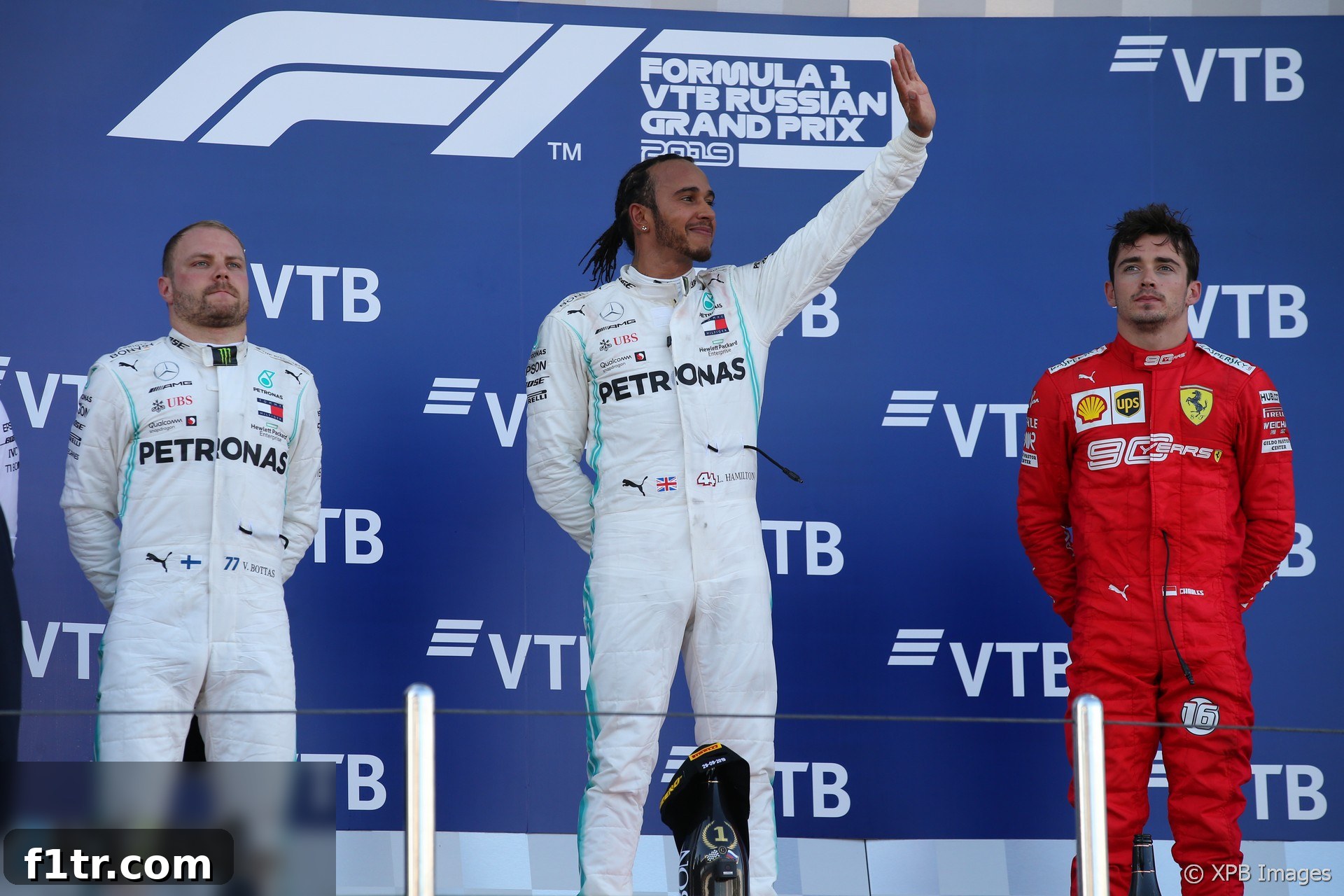
In a candid admission following his impressive victory at the Russian Grand Prix in Sochi, Lewis Hamilton revealed that he believed Ferrari had deployed the fundamentally correct strategy, despite his Mercedes team ultimately clinching the top spot. The race, which saw both Mercedes drivers starting on the medium compound tyres while their Ferrari rivals opted for the softer rubber, proved to be a tactical masterclass, with an outcome far from guaranteed until the final laps.
Hamilton’s remarks underscore the intense strategic chess match that often defines Formula 1, particularly when different tyre compounds are brought into play from the start. “We knew that we were obviously on a different tyre,” Hamilton explained, reflecting on the pre-race decisions. “We put ourselves on a slightly different strategy in that respect and I was hoping that was going to give us an opportunity to dice and fight with them at some stage in the race.” This sentiment highlights Mercedes’ proactive approach, aiming to create strategic flexibility rather than simply mirroring their competitors.
The Tyre Gamble: Medium vs. Soft in Sochi
The choice between the medium and soft tyres at the Sochi Autodrom was the critical strategic crossroads for all teams. The soft compound typically offers superior grip and faster lap times in the initial phase but is prone to higher degradation over a longer stint. Conversely, the medium compound provides greater durability, allowing for extended first stints, but often lacks the outright pace of the softs. Ferrari, with Sebastian Vettel and Charles Leclerc, chose to capitalise on the soft tyre’s immediate performance advantage, aiming to build a significant lead early on.
Mercedes, on the other hand, committed to a longer first stint on the more robust medium tyres. Their initial plan was likely to out-strategise Ferrari through an overcut or by having fresher tyres towards the end of the race. However, Hamilton admitted that their pre-race assessments of the soft tyre’s longevity proved to be off the mark. “I think ultimately they were right because the soft tyre was much stronger than we anticipated,” he confessed, acknowledging the unexpected resilience of Ferrari’s chosen compound.
This misjudgment put Mercedes under immense pressure in the early stages of the race. Hamilton elaborated on the challenge: “There was that difference between the compounds so keeping up with the softs with their consistency and their speed was, oh god it was so hard, so I wasn’t expecting that.” The Sochi track, known for its smooth surface and relatively low tyre degradation, seemed to favour the soft compound more than anticipated, allowing Ferrari to maintain a scorching pace for longer than Mercedes had predicted. Hamilton noted, “There was obviously that slight tail-off towards the end where I was able to start closing the gap but it wasn’t massive chunks that I was taking out of them.” This paints a vivid picture of the sheer effort required for Hamilton to stay within striking distance on his mediums.
Strategic Disruptions: The Impact of the Virtual Safety Car
Mercedes’ carefully constructed strategy hinged on running an extended first stint on the medium tyres. This plan, however, was dramatically altered by unforeseen circumstances, specifically the intervention of the Virtual Safety Car (VSC). “We were planning to extend for like 15-plus laps or something like that, hoping that when we came back out the soft we would have a chance to be able to fight with one of them who was on a different tyre,” Hamilton revealed. The VSC, triggered by Sebastian Vettel’s unfortunate retirement due to an MGU-K failure, created a window for relatively ‘free’ pit stops under reduced speed limits.
While Vettel’s retirement was a significant blow to Ferrari’s challenge, the subsequent VSC and Safety Car periods profoundly reshaped the strategic landscape. Charles Leclerc, who had pitted earlier for hard tyres, found himself disadvantaged. The VSC allowed Hamilton to make his pit stop and emerge ahead of Leclerc. Later, a full Safety Car period, prompted by George Russell’s crash, enabled Ferrari to bring Leclerc in for an extra pit stop for fresh soft tyres, hoping to attack in the final stages. However, this move put him behind Valtteri Bottas, who had also benefited from the Safety Car timings and was now tasked with defending against the rapid Ferrari.
Valtteri Bottas’s Crucial Defensive Role
In the aftermath of the Safety Car interventions and Vettel’s retirement, the focus shifted to the battle for the podium, with Leclerc fiercely pursuing Bottas. Hamilton was quick to praise his teammate’s pivotal performance, acknowledging the immense pressure Bottas faced. “Valtteri did an exceptional job because it’s not easy keeping the Ferraris behind and Charles has been driving so well,” Hamilton stated. Bottas’s defensive masterclass was instrumental in securing Mercedes’ one-two finish.
Bottas, now on older medium tyres compared to Leclerc’s fresh softs, showcased incredible resilience and strategic positioning. He successfully fended off multiple attacks from the Ferrari, acting as a crucial barrier that protected Hamilton’s lead and ensured Leclerc couldn’t challenge for the top spot. This display of teamwork and individual skill highlighted the strength in depth within the Mercedes-AMG Petronas Formula One Team, demonstrating that a Grand Prix victory is often a collective effort, not solely dependent on the lead driver’s performance.
Team Triumph Amidst Challenges and Breakthroughs
Looking beyond the tyre strategy and Safety Car drama, Hamilton reflected on the broader context of Mercedes’ weekend. “Ultimately [it’s] just an incredible day for the team considering the challenges that we’ve had,” he mused. The 2019 season had seen Ferrari making significant strides, particularly in qualifying pace and straight-line speed, posing a formidable threat to Mercedes’ long-standing dominance.
The team had been working tirelessly to unlock more performance from their W10 car. “I think this weekend we knew that we had to pull more out of this car and there was more potential there, but we didn’t know where it was,” Hamilton admitted. This suggests a period of intensive analysis, setup experimentation, and fine-tuning by the engineers and drivers. The Sochi victory, therefore, wasn’t just a result of fortunate timing but a testament to Mercedes’ unwavering dedication to continuous improvement and their ability to adapt under pressure.
Hamilton concluded his reflections with a summary of the tight competitive margins in modern Formula 1: “I think we pulled ourselves a little bit closer to the Ferraris this weekend and it was just enough to get ahead of them.” This nuanced perspective underscores that while Ferrari might have had a theoretically stronger initial strategy, Mercedes’ adaptability, opportunistic driving, and flawless execution during critical race moments allowed them to convert potential defeat into a hard-fought victory.
The Russian Grand Prix served as a compelling reminder that success in Formula 1 is a complex interplay of strategy, driver skill, team execution, and an element of fortune. Despite conceding Ferrari’s superior initial tyre gamble, Lewis Hamilton and Mercedes ultimately demonstrated why they were champions, proving their mettle when it mattered most and snatching victory from the jaws of a challenging strategic position.
Related: 2019 F1 Season Insights
- Crying in the Melbourne car park at 2019 grand prix was my career low – Ocon
- McLaren Racing reports reduced £71 million loss in 2019
- Kvyat: Hockenheim podium last year was “my biggest achievement” so far
- How the FIA’s new encrypted fuel flow meter targets Ferrari’s suspected ‘aliasing’ trick
- “He smashed my office door”: 23 must-see moments from ‘Drive to Survive’ season two
Browse all 2019 F1 season articles