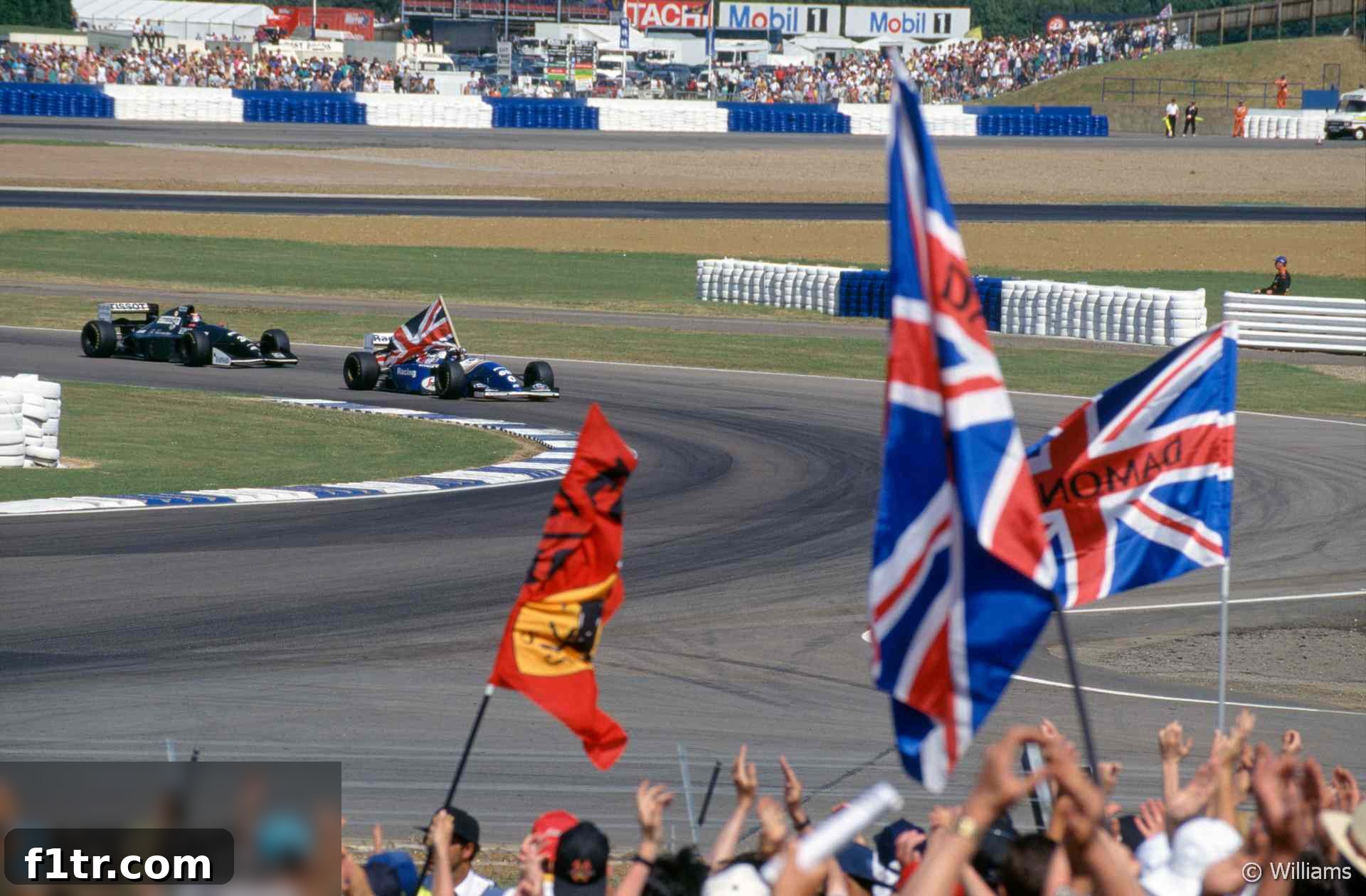
The 1994 Formula 1 season was a tumultuous and transformative period, marked by tragedy, intense rivalry, and contentious rule changes. Halfway through the 16-round championship, the British Grand Prix at Silverstone held particular significance, not just as a pivotal moment in the title fight but also due to the ongoing scrutiny of driver safety and racing regulations. At this juncture, the dominance of Michael Schumacher seemed almost insurmountable, with the young German prodigy having asserted a commanding lead in the drivers’ standings.
Schumacher’s relentless pursuit of victory had seen him win six of the first seven races, a testament to his raw talent and the competitive edge of his Benetton-Ford. His only missed victory came in Spain, where a gearbox glitch forced him to limp home in second place, still securing valuable points. This phenomenal run meant he arrived at Silverstone with a formidable 66 points out of a possible 70, placing immense pressure on his rivals.
Leading the charge for Williams after the tragic death of Ayrton Senna earlier in the season was local hero Damon Hill. Despite a strong effort, Hill’s points tally was less than half of Schumacher’s, highlighting the vast chasm that had opened up in the championship. However, the previous race in France offered a glimmer of optimism for Williams and Ferrari, suggesting that Schumacher’s absolute supremacy might finally be challenged. Hill had secured a front-row lock-out for Williams, and Ferrari’s newly revised chassis showed promising performance on its debut. The stage was set for an epic confrontation at the home of British motorsport.
A Thrilling Qualifying Session Sees Hill Secure Pole at Silverstone
The build-up to the British Grand Prix was fraught with anticipation, not least because of significant circuit revisions. Following JJ Lehto’s pre-season crash and, more urgently, the fatal incidents at Imola, Silverstone had undergone extensive modifications to enhance safety. Key corners like Copse and Stowe were tightened, while kerbs at Maggotts and Becketts were lowered. The most drastic change was the installation of a chicane at Abbey, the site of Pedro Lamy’s major crash. These alterations, coupled with broader F1 regulatory changes aimed at reducing car performance, led to lap times being considerably slower—up to six seconds off the previous year’s pace. The British Grand Prix of 1994 would also be the last race for flat-bottomed F1 cars, which famously produced dramatic showers of sparks as they scraped the tarmac – a spectacle modern F1 has sought to artificially replicate years later.
Despite the reduced speeds, Saturday’s qualifying session delivered a gripping spectacle, proving to be the highlight of the weekend for many. Throughout the final hour, Schumacher, Hill, and Gerhard Berger’s Ferrari traded fastest times, each driver pushing their machinery to the absolute limit. Berger momentarily held pole position until a last-gasp effort from Hill edged him out by a mere two-hundredths of a second. Berger’s subsequent attempt to reclaim pole was thwarted by traffic, as he was held up by Row 11.Damon Hill1’24.960Williams-Renault2.Michael Schumacher1’24.963Benetton-FordRow 23.Gerhard Berger1’24.980Ferrari4.Jean Alesi1’25.541FerrariRow 35.Mika Hakkinen1’26.268McLaren-Peugeot6.Rubens Barrichello1’26.271Jordan-HartRow 47.David Coulthard1’26.337Williams-Renault8.Ukyo Katayama1’26.414Tyrrell-YamahaRow 59.Martin Brundle1’26.768McLaren-Peugeot10.Jos Verstappen1’26.841Benetton-FordRow 611.Mark Blundell1’26.920Tyrrell-Yamaha12.Eddie Irvine1’27.065Jordan-HartRow 713.Heinz-Harald Frentzen1’27.284Sauber-Mercedes14.Pierluigi Martini1’27.522Minardi-FordRow 815.Olivier Panis1’27.785Ligier-Renault16.Gianni Morbidelli1’27.886Footwork-FordRow 917.Michele Alboreto1’28.100Minardi-Ford18.Andrea de Cesaris1’28.212Sauber-MercedesRow 1019.Alessandro Zanardi1’28.225Lotus-Mugen-Honda20.Christian Fittipaldi1’28.231Footwork-FordRow 1121.Johnny Herbert1’28.340Lotus-Mugen-Honda22.Erik Comas1’28.519Larrousse-FordRow 1223.Eric Bernard1’28.955Ligier-Renault24.Olivier Beretta1’29.299Larrousse-FordRow 1325.David Brabham1’30.690Simtek-Ford26.Jean-Marc Gounon1’30.722Simtek-FordRace Day Controversy: Schumacher’s “Gamesmanship” Leads to DisqualificationRace day promised significant British interest, and the crowd, having enjoyed a support programme featuring domestic Formula Three and touring car championships, was ready. However, several local drivers encountered trouble early on.David Coulthardstalled his Williams and was forced to start from the back. This necessitated a second formation lap, during whichEddie Irvine’sHart engine failed, eliminating him before the race even began. Moments after the eventual start,Martin Brundle’sPeugeot V10 engine dramatically exploded, adding to the early chaos.Despite these incidents, a British driver led the field. Damon Hill, determined to convert his pole position into victory, made a clean start, successfully fending off Michael Schumacher at the first corner. This was a crucial moment, especially after Schumacher’s rather unsporting tactics during the formation laps. The German driver had deliberately overtaken Hill and maintained his position for several corners during both the first and second formation laps, an act of “gamesmanship” that drew the ire of the stewards. They rightly viewed this as a breach of the rule requiring drivers to maintain their grid order and issued a five-second stop-go penalty to Schumacher.The penalty, announced on lap 13, ignited a significant controversy. Benetton claimed they misinterpreted the penalty, believing it meant five seconds would be added to Schumacher’s overall race time, rather than a mandatory pit stop. This distinction was vital. The rules at the time clearly stipulated that time penalties were only applicable in the final 12 laps of a race, a fact Benetton, and especially Schumacher, should have been well aware of, given a similar stop-go penalty had previously benefited Schumacher in Monaco the year prior, helping him take the lead fromAlain Prost. Despite the announcement, Schumacher continued to race, only entering the pits on lap 17 for a routine refuelling stop, further exacerbating the situation.While some television commentators, like the BBC, quickly understood the “stop-go” nature of the penalty, others, such as Eurosport, were initially left in the dark. The confusion escalated dramatically when, on lap 22, a message appeared on screens indicating Schumacher’s disqualification. As Schumacher passed the pits, the ominous black flag, accompanied by his race number, was displayed. It remained out for two more laps, yet Schumacher defiantly stayed on track.Furious remonstrations between FIA race director Roland Bruynseraede and Benetton team principal Tom Walkinshaw ensued. Under mounting pressure, the black flag was eventually withdrawn, and on lap 27, Schumacher finally entered the pits to serve his long-overdue five-second stop-go penalty, with Bruynseraede personally observing the process. This entire episode overshadowed what had been developing into one of the most closely fought battles between Hill and Schumacher, where their on-track performance was closely matched until Schumacher began struggling with down-shifts towards the end.Hill Secures Emotional Home Victory Amidst Race IncidentsThe race distance was shortened by one lap due to the extra formation lap. When Damon Hill crossed the finish line, he was initially unaware of his monumental victory. He collected a Union Jack flag in triumph, clinching a win at Silverstone, a feat his legendary two-time world champion father,Graham, had never achieved. The FIA later cleared Hill of any transgression for stopping to collect the flag on his slowing-down lap, allowing his emotional celebration to stand.Behind Hill, the race continued to deliver drama. Gerhard Berger’s challenge ended prematurely on lap 32 when his engine failed, promotingJean Alesito a well-deserved third place. A tense battle for fourth position was decided on the final corner, involvingRubens Barrichelloand Mika Hakkinen. Barrichello, making an optimistic lunge down the inside of Hakkinen at the second part of Luffield, inadvertently spun the McLaren into the gravel. Adding to his woes, Barrichello, not realizing it was the final lap, then pulled into the pits. Meanwhile, marshals quickly assisted Hakkinen, who managed to cross the finish line ahead of the Jordan driver, salvaging a crucial third place.David Coulthard, despite his hydraulic failure on the initial start, put in an impressive recovery drive, working his way back into the points. His efforts were made all the more remarkable by a humorous distraction: his radio system was picking up interference from a local taxi firm, even asking him to make a collection from the nearby village of Towcester. These incidents, however, would all be overshadowed by the FIA’s impending review of Michael Schumacher and Benetton’s conduct.1994 British Grand Prix resultPos.#DriverTeamLapsTime / gap / reason10Damon HillWilliams-Renault601:30’03.640227Jean AlesiFerrari601’08.12837Mika HakkinenMcLaren-Peugeot601’40.659414Rubens BarrichelloJordan-Hart601’41.75152David CoulthardWilliams-Renault591 lap63Ukyo KatayamaTyrrell-Yamaha591 lap730Heinz-Harald FrentzenSauber-Mercedes591 lap86Jos VerstappenBenetton-Ford591 lap99Christian FittipaldiFootwork-Ford582 laps1023Pierluigi MartiniMinardi-Ford582 laps1112Johnny HerbertLotus-Mugen-Honda582 laps1226Olivier PanisLigier-Renault582 laps1325Eric BernardLigier-Renault582 laps1419Olivier BerettaLarrousse-Ford582 laps1531David BrabhamSimtek-Ford573 laps1632Jean-Marc GounonSimtek-Ford573 laps5Michael SchumacherBenetton-Ford60Disqualified24Michele AlboretoMinardi-Ford48Engine28Gerhard BergerFerrari32Engine4Mark BlundellTyrrell-Yamaha20Gearbox20Erik ComasLarrousse-Ford12Engine29Andrea de CesarisSauber-Mercedes11Engine10Gianni MorbidelliFootwork-Ford5Engine11Alessandro ZanardiLotus-Mugen-Honda4Engine8Martin BrundleMcLaren-Peugeot0Engine15Eddie IrvineJordan-Hart0Did not startSchumacher Banned: The FIA’s Hammer BlowFor Michael Schumacher, the disappointment of the British Grand Prix was just the beginning of his troubles. Later that evening, news of Bulgaria knocking Germany out of the Football World Cup added insult to injury, but the real storm was yet to break. Despite his egregious infraction of ignoring the black flag – a clear instruction to pit and cease racing – the Silverstone stewards initially allowed his second-place finish to stand, levying only a $25,000 fine. This lenient stance, however, would not hold.The FIA’s World Motor Sport Council (WMSC) took a far dimmer view of the situation, summoning Schumacher and Benetton to account for their actions. The council was particularly displeased with both Benetton’s conduct and the stewards’ handling of the incident. In a stark indication of the FIA’s severity, Clerk of the Course Pierre Aumonier had his superlicence suspended for the remainder of the year. Schumacher’s defence, claiming he hadn’t seen the black flag, was dismissed out of hand – a familiar excuse previously used by Nigel Mansell five years earlier, which had resulted in his exclusion from the following race.Ignoring stewards’ instructions was just one of several charges Benetton faced at the WMSC hearing on July 26th, but it was the one that delivered the most significant blow. In a dramatic pronouncement, FIA President Max Mosley issued a crushing verdict: Schumacher and Benetton team principal Flavio Briatore were fined an astonishing $500,000. Furthermore, Schumacher was excluded from the next two races, and the six points for his Silverstone finish were stripped away. This tough justice mirrored a previous three-race ban forEddie Irvine earlier in the yearand was widely seen as a significant rebalancing of a championship that had, until then, been heavily skewed in Schumacher’s favor. It also hinted at retribution forBriatore’s public denouncement of Mosley’s safety initiativesin the wake of Imola.”My impression at the time was that it was a set-up and I was the scapegoat,” Schumacher reflected years later, though he conceded, “the way Flavio Briatore dealt with it didn’t really help either.” The ruling meant Schumacher would face a ban from the crucial next round of the championship, his home grand prix at Hockenheim, leaving an indelible mark on an already controversial season.Grand Prix flashback40 years ago today: How a tyre war prompted Senna’s unfinished Monaco masterpieceSchumacher seals record-breaking 10th constructors championship for FerrariStrategic superiority clinches Schumacher’s first Ferrari titleDisaster for Hakkinen brings title within Schumacher’s graspSchumacher turns the tide against McLaren on tragic day at MonzaBrowse all Grand Prix flashbacks1994 F1 seasonVettel to demonstrate Senna’s last McLaren during Imola race weekendImola to mark 30 years since Senna and Ratzenberger’s deaths at grand prix“He died and we didn’t even know”: How one fan witnessed the 1994 San Marino GPNewey gives new insight into Senna’s death and why he feels guilty over itSchumacher’s first title tainted by clash with HillBrowse all 1994 F1 season articles