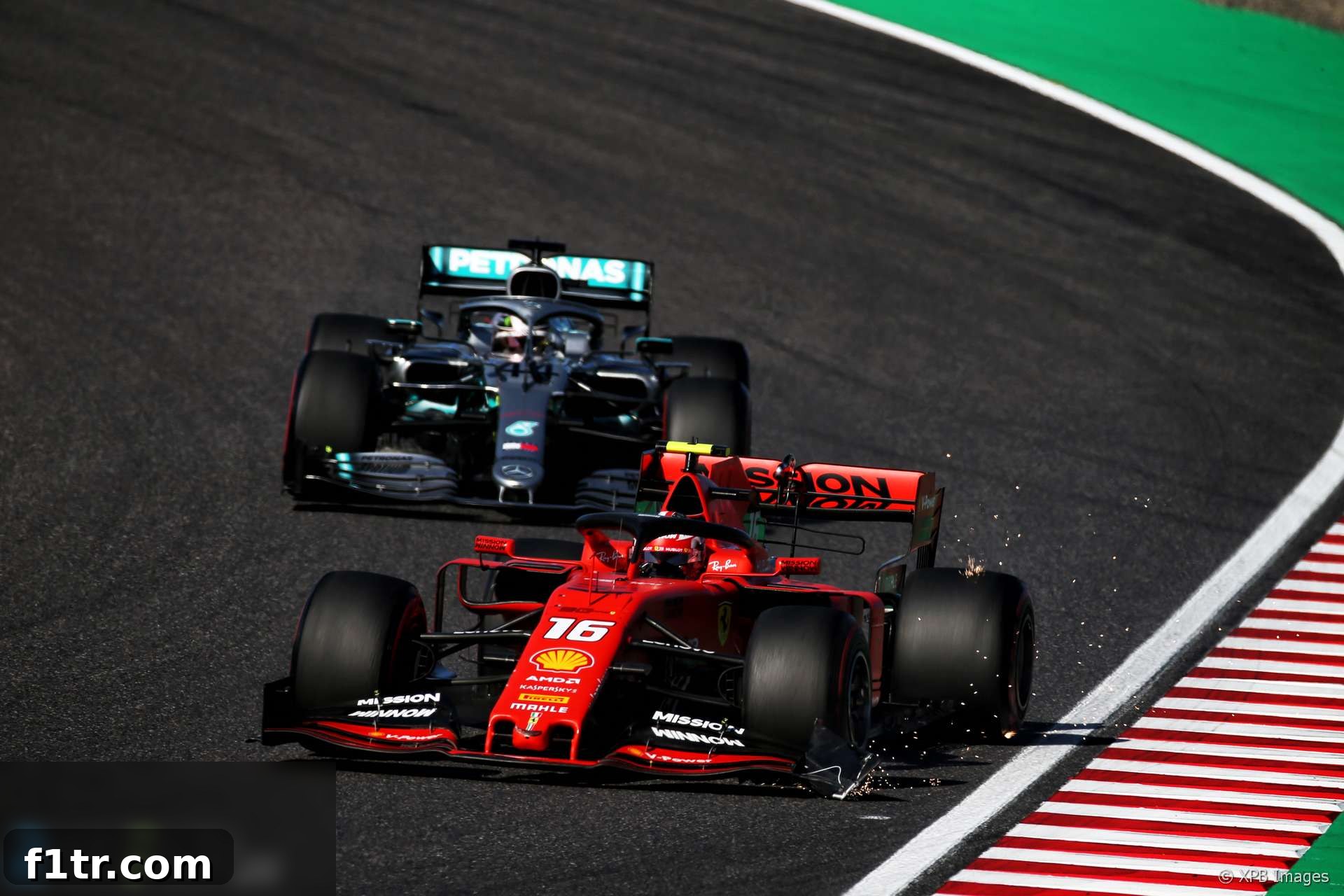
In the high-stakes world of Formula 1, every decision, especially concerning driver and track safety, is meticulously scrutinized. The 2019 Japanese Grand Prix served as a stark reminder of these uncompromising standards when Charles Leclerc and his Ferrari team faced penalties for a critical lapse in judgment. Leclerc, a prodigious talent, found himself accepting accountability for failing to bring his significantly damaged car into the pits following a dramatic first-lap collision. This incident at Suzuka not only impacted his own race but also jeopardized the safety and performance of his competitors, drawing the swift attention of the sport’s governing body, the FIA.
The sequence of events unfolded rapidly during the opening moments of the Grand Prix. Leclerc, starting from the front row, made contact with Red Bull’s Max Verstappen. While racing incidents are a common occurrence in F1, the critical error occurred in the immediate aftermath. Leclerc’s front wing suffered substantial damage, with pieces visibly detaching from the car as he continued on track. The decision, or rather the indecision, to keep the car running became the central point of contention. Debris from Leclerc’s compromised Ferrari became a hazardous projectile, striking Lewis Hamilton’s Mercedes and causing damage to one of his mirrors. Even more concerning, fragments entered Lando Norris’s brake ducts, leading to critical overheating issues that threatened the McLaren driver’s race.
Advert | Become a Supporter & go ad-free
The FIA’s regulations are unequivocally clear on matters of safety, especially when a car poses a danger to other competitors or track personnel. Ferrari was subsequently fined a substantial €25,000 for their team’s oversight in allowing Leclerc to remain on track with a dangerously damaged car. This penalty underscored the gravity of the situation and the sport’s commitment to preventing avoidable hazards. Beyond the team’s sanction, Leclerc himself received a 10-second time penalty for the incident involving the damaged car. While this penalty was a direct consequence of his failure to pit, its impact on his final classification was nullified by the subsequent disqualification of both Renault cars for unrelated fuel flow irregularities. This peculiar turn of events meant that while the penalty stood as a judgment against his actions, it didn’t ultimately alter his championship points for that specific race. However, the message from the stewards was unmistakable: safety infractions carry serious consequences, regardless of their immediate impact on race results.
Leclerc’s reaction to the penalties was remarkably candid and mature. He revealed that once he had the opportunity to review the incident footage, he fully anticipated the penalty. “Actually, I was quite expecting it,” he stated, demonstrating a clear understanding of the rules and the dangerous nature of his actions. He further admitted, “Once I arrived in stewards room and I saw the images, it would have been wrong to not get a penalty for that.” This admission highlights a crucial aspect of professional motorsport: the ability to objectively assess one’s own actions post-race, often with the benefit of hindsight and various camera angles unavailable in the heat of the moment. It speaks to his character that he did not dispute the ruling but rather acknowledged the undeniable evidence of the hazard created.
However, Leclerc’s honest self-assessment also offered a window into the intense pressures and split-second decisions inherent in Formula 1 racing. He conceded that during the actual race, in the throes of competition, he “was not thinking about” the severity of the incident or the flying debris. This point is further corroborated by the radio messages exchanged between him and the Ferrari pit wall during the race. Initially, Leclerc was instructed to come into the pits, a sensible decision given the visible damage. Yet, inexplicably, the Ferrari pit wall then reversed its instruction, telling him to stay out. This internal communication breakdown within the team played a pivotal role in exacerbating the situation and ultimately led to the substantial penalties. The confusion on the radio, the conflicting directives, and the driver’s focus purely on racing underscore the complex interplay of human factors and technical decision-making at the highest level of motorsport. Such incidents serve as critical learning opportunities for teams to refine their communication protocols and emergency response strategies.
Beyond the penalties for the damaged car, Leclerc was also handed a separate five-second time penalty for the initial collision with Max Verstappen. This penalty directly addressed the racing incident itself, deeming Leclerc primarily at fault for the contact. In a display of sportsmanship and mutual respect often seen among top drivers, Leclerc confirmed that he spoke with the Red Bull driver after the race. “We had a small discussion before we went into the stewards room,” Leclerc recounted. “He knew I had done a mistake and these things happen.” This exchange, while brief, illustrates the professional courtesy that underpins rivalries in F1. Despite the fierce competition on track, there’s often an understanding that mistakes can occur, and acknowledging them is a key part of maintaining respect within the paddock.
Advert | Become a RaceFans supporter andgo ad-free
The incident at the 2019 Japanese Grand Prix served as a significant case study in Formula 1, highlighting not only individual driver accountability but also the collective responsibility of teams to uphold safety standards. The penalties levied against both Charles Leclerc and Ferrari sent a clear message across the paddock: while championship aspirations are paramount, they must never overshadow the fundamental principles of safety. The FIA, as the sport’s governing body, plays a crucial role in enforcing these regulations, ensuring that all participants operate within defined safety parameters. Events like this reinforce the continuous evolution of safety protocols in F1, from car design to race management. Every flying piece of carbon fibre or debris on the track represents a potential hazard, and the swift response by race control and subsequent penalties are designed to deter any complacency. The robust system of stewards’ investigations, review of telemetry, and driver/team interviews ensures that incidents are thoroughly analyzed and appropriate sanctions are applied. This meticulous approach is vital for maintaining the integrity and, most importantly, the safety of Formula 1, ensuring that the sport continues to push the boundaries of technology and human endurance without compromising the well-being of its participants.
In conclusion, Charles Leclerc’s acceptance of his penalties at the 2019 Japanese Grand Prix was a moment of mature reflection for the young driver. It underscored the critical balance between aggressive racing and responsible decision-making, particularly concerning vehicle integrity and track safety. Ferrari’s fine further emphasized the team’s crucial role in this equation, showcasing that team strategy must always be subordinated to safety protocols. While the immediate impact of Leclerc’s 10-second penalty was mitigated by other race events, the precedent set was clear. The incident served as a potent reminder for all teams and drivers of the severe repercussions for compromising safety, reaffirming Formula 1’s unwavering commitment to the well-being of its competitors and the integrity of the sport.
2019 F1 season
- Crying in the Melbourne car park at 2019 grand prix was my career low – Ocon
- McLaren Racing reports reduced £71 million loss in 2019
- Kvyat: Hockenheim podium last year was “my biggest achievement” so far
- How the FIA’s new encrypted fuel flow meter targets Ferrari’s suspected ‘aliasing’ trick
- “He smashed my office door”: 23 must-see moments from ‘Drive to Survive’ season two
Browse all 2019 F1 season articles