The F1 paddock often witnesses moments of intense joy and profound despair, but for Williams Racing, the Brazilian Grand Prix at Interlagos delivered an unforgettably dire experience. Team Principal James Vowles grimly summarized the weekend as featuring “three incredibly large crashes in just a few hours,” plunging the historic outfit into a critical predicament as the 2024 Formula 1 season draws to a close.
Advert | Become a Supporter & go ad-free
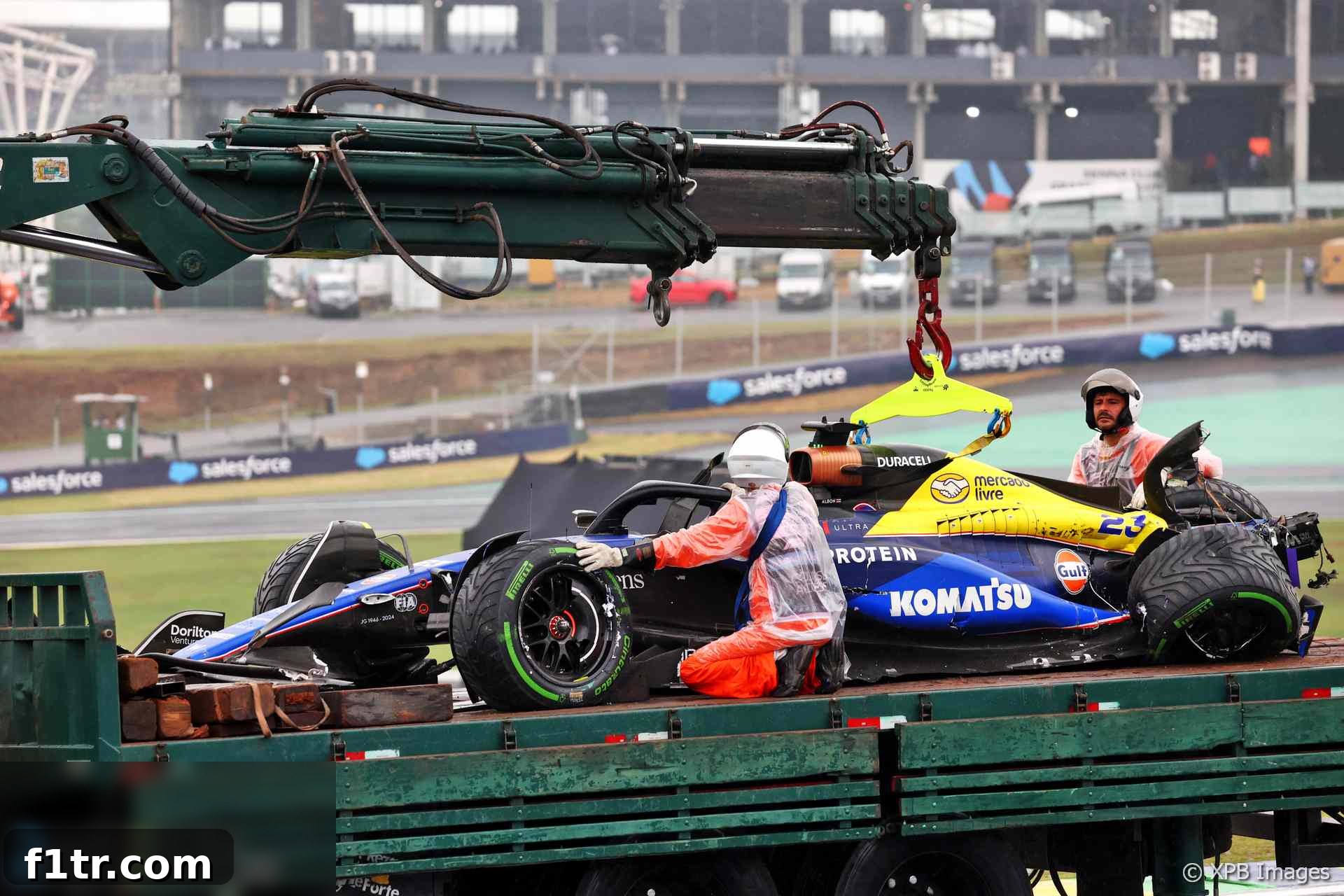
The weekend began under a cloud of misfortune, with both Williams drivers enduring significant incidents. Alexander Albon, a pivotal figure in the team’s recent trajectory, suffered a particularly severe crash during qualifying. The damage inflicted upon his FW46 chassis was so extensive that it rendered his car irreparable for the main race, forcing him to watch from the sidelines. This early setback was not merely a disappointment; it was a devastating blow to the team’s hopes of scoring vital points and a stark premonition of the challenges yet to come.
A Nightmare at Interlagos: Williams’ Triple Collision Catastrophe
Albon’s Qualifying Calamity and Its Immediate Aftermath
Interlagos, known for its undulating layout and unpredictable weather, once again proved to be a formidable adversary. During the crucial qualifying session, Alexander Albon’s car lost control, resulting in a high-speed impact that left his machine in tatters. The sight of the extensively damaged car being recovered sent immediate shivers through the Williams garage. Engineers quickly assessed the wreckage, concluding that the chassis had sustained irreparable structural damage, effectively ruling Albon out of the Grand Prix. For a team battling tooth and nail in the Constructors’ Championship, losing a car before the race even began was an unmitigated disaster, not just in terms of potential points, but also due to the sheer financial and logistical burden of replacing major components.
Colapinto’s Race Day Crash: Adding Insult to Injury
With Albon sidelined, all hopes rested on Franco Colapinto, who took the start of the Brazilian Grand Prix. The team had worked tirelessly, demonstrating incredible dedication and skill, to prepare Colapinto’s car for the race after his own incident. However, their efforts were tragically undermined during a Safety Car period when Colapinto himself suffered another heavy crash. The young driver, pushing to generate tire temperature on intermediate tires amidst treacherous track conditions, encountered what he described as a “big river” on the circuit, leading to a loss of control.
“They did an amazing job to put the car back on track on the race and I destroyed it again,” Colapinto expressed with profound regret to the official F1 website. “So I’m very sorry for them. It was a very tough day for us, honestly, things didn’t go our way today. I think we had a quick car and we boxed to put the inters on and there was a lot of rivers. I was pushing to get the tyre temps up and I just lost the car on that big river. So not a good day for us.” His heartfelt apology underscored the immense pressure and the emotional toll such incidents take on drivers, particularly when they witness the Herculean efforts of their team.
The Looming Spare Parts Crisis: A Familiar F1 Dilemma
Advert | Become a RaceFans supporter andgo ad-free
The triple whammy of major accidents at Interlagos exacerbated an already precarious situation for Williams. Earlier in the season, the team had openly discussed their struggles with a shortage of spare parts, a common challenge for independent teams operating under the sport’s restrictive budget cap. James Vowles minced no words about the gravity of the current predicament. “We’ve had three incredibly large crashes in just a few hours from one another and have a tremendous amount of work to get ourselves back on top of our spares situation before we go to Las Vegas in just a few weeks’ time,” he stated. This isn’t merely about repairing cars; it’s about a race against time, resources, and the financial implications of manufacturing complex F1 components.
The Realities of F1 Logistics and Budget Constraints
The Formula 1 budget cap, while promoting financial sustainability, presents unique challenges for teams like Williams. Producing high-performance spare parts—from intricate aerodynamic elements to robust suspension components and critical chassis sections—requires significant investment in materials, advanced manufacturing processes, and skilled labor. With less than ideal financial buffers compared to their larger rivals, every major crash can derail a team’s entire development plan and even impact future performance. The damage sustained in Brazil likely includes multiple wings, floor assemblies, suspension arms, and possibly even gearbox casings, each costing hundreds of thousands of dollars and weeks to fabricate and test. The tight turnaround between races, especially with the inaugural Las Vegas Grand Prix looming, intensifies the pressure on the Grove-based factory to work miracles.
This situation also raises concerns about the team’s ability to operate without compromise in the upcoming races. A shortage of spare parts can force drivers to adopt a more conservative approach, hindering their ability to extract maximum performance from the car. In extreme cases, it could even lead to a lack of sufficient components for testing or in-season development, impacting their competitiveness not just in the short term, but potentially carrying over into the next season if resources are diverted from 2025 preparations.
A Devastating Blow to the Constructors’ Championship Battle
As if the physical damage and logistical headaches weren’t enough, the Brazilian Grand Prix delivered a brutal blow to Williams’ standing in the Constructors’ Championship. Heading into Interlagos, Williams held a slender three-point advantage over their closest rivals, Alpine, in a fiercely contested battle for seventh place. This position is not merely symbolic; it translates directly into significant prize money, crucial for the team’s operational budget and future development.
However, Alpine capitalized spectacularly on Williams’ misfortunes, delivering a phenomenal performance at Interlagos. Their drivers scored a massive windfall of 35 points, a haul that dramatically reshaped the championship landscape. This incredible performance propelled Alpine from behind Williams all the way up to sixth in the standings, demoting Williams back down to ninth. The swing was monumental, transforming a hopeful outlook into a challenging uphill battle with only two races remaining.
Vowles acknowledged Alpine’s superior pace. “Our rivals, Alpine, were quick in the race, no doubt about it,” he conceded. “They deserved those positions, but they scored a huge bag of points putting them back up into a very high championship position and demoting us back down to ninth.” The financial implications of this shift are profound, as each position in the Constructors’ standings is worth millions of dollars in prize money, directly impacting a team’s ability to invest in personnel, research, and development for future seasons.
James Vowles’ Defiant Stance: “Never Give Up”
Despite the immense disappointment and the seemingly insurmountable challenges, James Vowles maintained a resilient and defiant stance, a characteristic often associated with the spirit of Formula 1. “[But] I never give up until it’s time to give up and that won’t be until we’re in Abu Dhabi and the chequered flag has dropped,” he declared. This sentiment encapsulates the relentless fighting spirit required in the pinnacle of motorsport. It’s a testament to the fact that even in the face of the lowest moments, as Vowles described the Brazilian Grand Prix, the pursuit of performance and the hope for a turnaround persist until the very end of the season.
“The nature of Formula 1 is that you can have some of the most incredible feelings and results, as well as some of the lowest moments that you can feel within a sport,” Vowles reflected. “I think it’s fair to say this weekend is the second of those two.” His words resonate deeply, illustrating the brutal emotional spectrum of F1, where elation and despair often sit side-by-side. For Williams, Interlagos was a stark reminder of the latter, but Vowles’ resolve points towards a team determined to fight for every last point, every last position, irrespective of the odds.
Miss nothing from RaceFans
Get a daily email with all our latest stories – and nothing else. No marketing, no ads. Sign up here:
Advert | Become a RaceFans supporter andgo ad-free
The Road Ahead: Las Vegas and Abu Dhabi
With the Brazilian Grand Prix firmly behind them, Williams Racing faces an incredibly daunting task in the final two races of the season: the inaugural Las Vegas Grand Prix and the traditional season finale in Abu Dhabi. Both circuits present unique challenges. Las Vegas, a brand-new street circuit under the lights, is an unknown quantity where potential incidents lurk around every corner, particularly given its tight confines and high-speed sections. Abu Dhabi’s Yas Marina Circuit, while more familiar, still demands absolute precision and reliability. For Williams, these races will be less about pushing for bold victories and more about strategic damage limitation and maximizing any available opportunities, however slim.
The engineering and mechanical teams back at Grove will be working around the clock to ensure sufficient spare parts are manufactured and shipped to the next venues. Their ingenuity and resilience will be severely tested, as they endeavor to provide Albon and Colapinto with competitive and robust machinery. Every point gained in these final outings will be crucial in their renewed fight to climb back up the Constructors’ Championship standings, even if reaching P7 now seems a distant dream.
Conclusion: Resilience in the Face of Adversity
The 2024 Brazilian Grand Prix will undoubtedly be etched into Williams Racing’s history as one of its most challenging weekends. From Alexander Albon’s qualifying heartbreak to Franco Colapinto’s unfortunate race incident, compounded by the critical shortage of spare parts and the significant loss in the Constructors’ Championship battle, Interlagos delivered a full spectrum of adversity. However, the defiant words of James Vowles encapsulate the enduring spirit of Formula 1: a commitment to fighting until the very last flag falls. As Williams looks towards Las Vegas and Abu Dhabi, their focus will be on demonstrating resilience, learning from their setbacks, and continuing to build towards a more stable and competitive future, proving that even the lowest moments can fuel the fire of ambition in motorsport.
2024 Brazilian Grand Prix
- “I didn’t really want to come back” – Hamilton explains cryptic Brazil radio message
- Ocon’s role in Gasly’s Q2 exit was almost another ‘flare-up’ at Alpine – Oakes
- Interlagos must improve “very bad” new track surface for 2025, say F1 drivers
- “That’s how we silence them”: Verstappen’s stunning Brazil win from start to finish
- Verstappen now has as many wins as F1s first six world champions combined
Browse all 2024 Brazilian Grand Prix articles