Mercedes’ Potential Unlocked? Toto Wolff on Austrian GP Pace and Unforeseen Obstacles
Mercedes-AMG Petronas F1 Team Principal Toto Wolff has offered a candid assessment of his team’s performance at the recent Austrian Grand Prix, asserting a strong conviction that both Lewis Hamilton and Valtteri Bottas possessed the underlying pace to genuinely compete against Max Verstappen for victory. However, Wolff pointed to two critical factors that ultimately prevented them from mounting a sustained challenge: being strategically impeded by Lando Norris in the early stages of the race and subsequent car damage sustained by Hamilton.
The Red Bull Ring witnessed another commanding display from Red Bull Racing’s Max Verstappen, who secured an emphatic victory, further solidifying his championship lead. McLaren’s Lando Norris impressed by qualifying on the front row alongside Verstappen, while the Mercedes duo of Lewis Hamilton and Valtteri Bottas lined up fourth and fifth. This grid positioning, coupled with Norris’s astute race craft, created a bottleneck that left Mercedes pondering what might have been had circumstances unfolded differently.
Advert | Become a Supporter & go ad-free
The Initial Hurdle: Lando Norris and Mercedes’ Lost Momentum
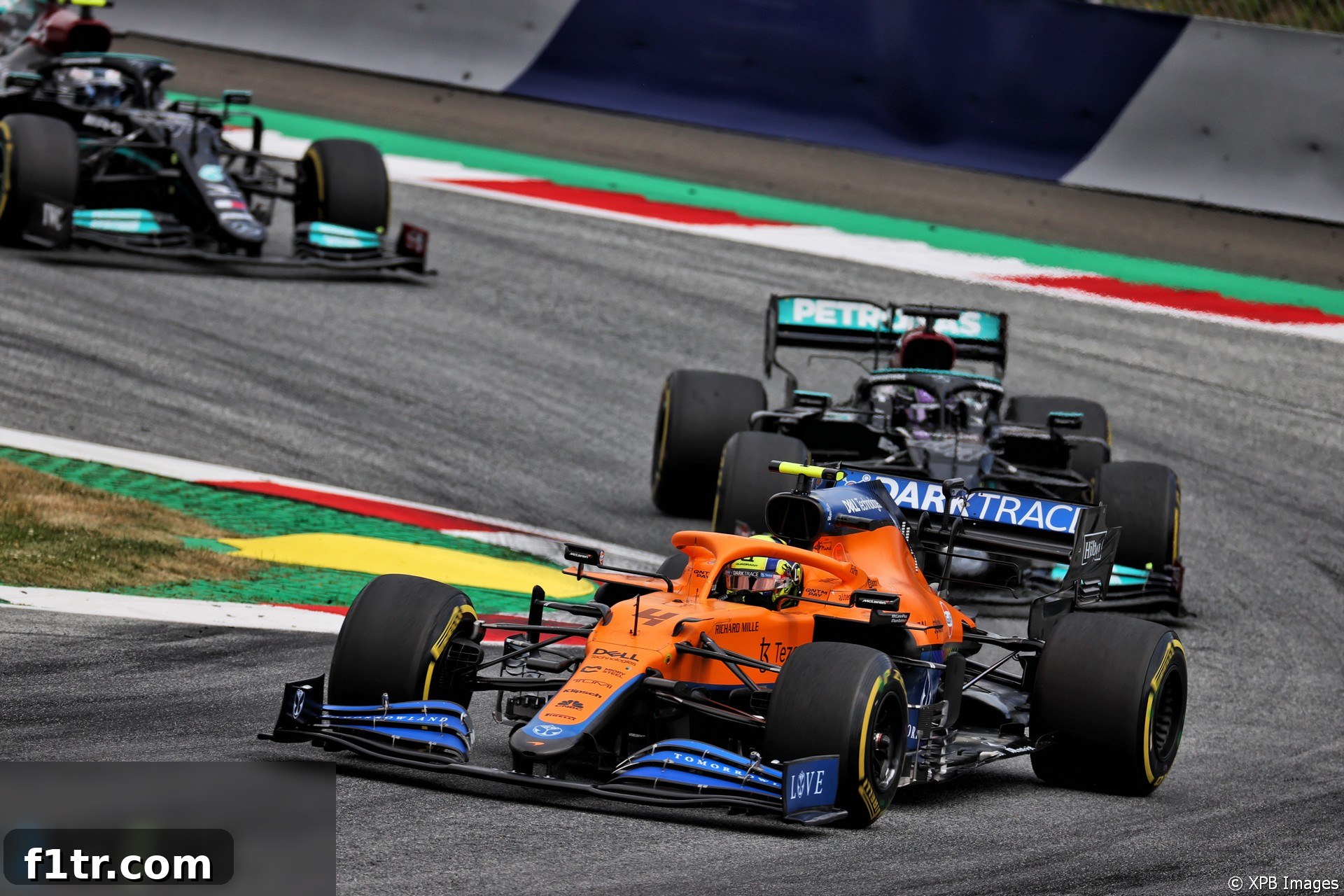
The opening phase of the 71-lap Austrian Grand Prix proved to be a defining moment for Mercedes’ aspirations. Lando Norris, starting from P2, executed a phenomenal defensive drive, effectively holding his position and creating a significant obstruction for the faster Mercedes cars behind him. For the first twenty laps of the race, Norris skillfully kept both Lewis Hamilton and Valtteri Bottas at bay, costing Mercedes precious seconds that, in Wolff’s view, were critical in their inability to engage Verstappen directly.
Wolff articulated the frustration over this early congestion: “I think it is a good result because I think if we wouldn’t have been stuck behind the McLaren at the beginning, where we lost chunks of time, we would have been racing him.” This statement powerfully conveys the team’s belief in the W12 car’s inherent speed. The Red Bull Ring, despite its high-speed nature, presents limited clear-cut overtaking zones without a substantial pace advantage, and Norris, capitalizing on McLaren’s strong form, adeptly exploited this to maintain his position and inadvertently aid Verstappen in building an unassailable lead.
Lewis Hamilton eventually found a way past Norris on lap 20, a testament to his persistent pressure, but by this point, Verstappen had already established a commanding lead. Valtteri Bottas, demonstrating sharp strategic execution, managed to get ahead of Norris during their respective first pit stops, utilizing an effective undercut strategy. While Bottas subsequently unleashed an impressive turn of speed, at times matching or even exceeding Verstappen’s lap times, Hamilton’s race trajectory took an unfortunate and unforeseen turn.
Hamilton’s Critical Damage: A Downforce Dilemma
Soon after clearing Norris, Lewis Hamilton reported a significant issue with his car. Subsequent analysis by Mercedes confirmed that the seven-time world champion had sustained a loss of approximately “30 points” of downforce. This substantial aerodynamic degradation was a critical blow, severely compromising the W12’s performance. The damage profoundly impacted the car’s balance, handling characteristics, and crucially, its ability to manage tyre wear efficiently throughout the demanding Austrian circuit.
The loss of downforce meant Hamilton was compelled into “pushing the tyres in a direction that wouldn’t have made it to the end” on a single pit stop, rendering the optimal strategy unfeasible. This mechanical setback effectively ended his realistic chances of challenging for a podium finish, let alone outright victory. Battling an increasingly uncooperative car, Hamilton eventually dropped back behind Norris once again. A late second pit stop was necessitated to fit fresh tyres and implement a balance adjustment, aiming to mitigate the adverse effects of the damage and allow him to salvage a fourth-place finish.
Valtteri Bottas’s Untapped Potential and Team Strategy
In stark contrast to Hamilton’s escalating struggles, Valtteri Bottas was demonstrating remarkably strong performance once he had clear air. Freed from the traffic, Bottas showcased a consistent and highly competitive pace that did not go unnoticed by the Mercedes pit wall. Toto Wolff himself acknowledged this, stating, “You can see that particularly also with Valtteri’s pace once Lewis lost downforce. The pace was there, there was never any risks from the back.” Bottas’s impressive stint underscored the potential that Mercedes believed was inherent in their car package, even if not fully realized in the overall race result.
Initially, as Hamilton’s performance deteriorated due to the damage, Bottas was instructed to maintain his position behind his struggling teammate. This decision, seemingly counterintuitive given Bottas’s superior pace at that moment, was later clarified by Wolff as a calculated tactical move. The team was actively evaluating “whether it was possible that Valtteri could have protected against Lando,” assessing if Bottas could act as a defensive barrier against Norris, who still posed a threat behind Hamilton. However, this protective strategy was eventually deemed impractical, and Bottas was subsequently given the green light to overtake his teammate.
Once Bottas moved ahead, he quickly solidified his position a few seconds clear of Norris and successfully executed a strategic one-stop race, making him the highest-placed finisher among drivers who opted for that particular strategy. He ultimately crossed the finish line 17.9 seconds behind the dominant race winner, Max Verstappen. While this gap was substantial, it was considerably smaller than Lewis Hamilton’s 46.4-second deficit, further illustrating the impact of the damage on Hamilton’s race.
Wolff’s Perspective: Finding Positives Amidst Challenges
Despite the race outcome, which saw Mercedes miss out on a podium finish for Hamilton and a direct challenge for victory, Toto Wolff chose to focus on the discernible silver linings. He expressed a notable degree of satisfaction with the underlying performance metrics, particularly when contrasting it with the team’s showing at the previous Styrian Grand Prix, also held at the Red Bull Ring. “So in a way, that Sunday was much better than last Sunday in what we would expect in terms of performance of the car,” Wolff remarked, indicating a clear improvement in the team’s understanding and optimization of their current package.
The Mercedes team principal’s comments strongly suggest that without the early strategic impediment from Norris and Lewis Hamilton’s subsequent unfortunate car damage, Mercedes genuinely believed they possessed the speed to exert significantly more pressure on Red Bull and Max Verstappen. The tantalizing “what if” scenario of an unimpeded race remains a key takeaway for the team, highlighting critical areas for improvement, particularly their qualifying performance, to secure better track position and proactively avoid similar compromising situations in future high-stakes races.
The Austrian Grand Prix served as a poignant reminder of the razor-thin margins that define success and failure in Formula 1. A robust qualifying performance, exceptional race craft from rival teams, and unforeseen mechanical issues can collectively conspire to derail even the most meticulously planned strategies. For Mercedes, the weekend was a complex tapestry of genuine pace intertwined with external and internal challenges that ultimately dictated their final positions on the scoreboard.
Strategic Implications and The Intensifying Championship Battle
The results from the Austrian Grand Prix carry significant weight for the intensely competitive 2021 Formula 1 season. With Max Verstappen’s continued dominant run, Red Bull Racing further solidified its advantage in both the Drivers’ and Constructors’ Championships. For Mercedes, the immediate focus must shift to consistently maximizing their performance in qualifying to ensure their drivers are not starting from positions where they can be held up by midfield contenders, even those as formidable and competitive as McLaren.
The critical damage to Lewis Hamilton’s car, and the subsequent necessity for a second pit stop, not only cost him valuable championship points but also underscored a potential vulnerability of their current package under duress. Mercedes will undoubtedly be investing considerable resources and effort into understanding and mitigating such mechanical issues in the future, as every single point becomes absolutely critical in this tightly contested championship battle against a relentless Red Bull outfit.
Toto Wolff’s post-race analysis, while acknowledging the defeat, projects an underlying sense of optimism regarding Mercedes’ inherent potential. The team clearly maintains the belief that their car, when operating without external interferences or internal technical setbacks, possesses the capability to challenge Red Bull at the absolute front of the grid. The overarching challenge lies in consistently unlocking that full potential and ensuring both drivers have an unobstructed, clear run at the front of the pack. With many races still to come, the season is long, and every grand prix offers new opportunities for Mercedes to refine their strategies, overcome technical hurdles, and reassert their championship credentials.
Advert | Become a RaceFans supporter andgo ad-free
Explore More 2021 Austrian Grand Prix Insights
- Vasseur on Alfa’s “huge step forward” and why he’s vexed by technical directives
- How Ricciardo “got some enjoyment back” after “really low” first race in Austria
- F1’s penalty points are not “harsh” and won’t be reviewed this year – Masi
- Austrian double showed Sainz found his feet faster than 2021’s other big-name moves
- 2021 Austrian Grand Prix Star Performers
Browse all 2021 Austrian Grand Prix articles