Mercedes F1’s W15 Struggles: Hopes Pinned on Crucial Miami Upgrade
The Mercedes-AMG Petronas Formula 1 team is once again navigating turbulent waters, with another challenging weekend at the Chinese Grand Prix underscoring the ongoing difficulties with their W15 challenger. Both star drivers, George Russell and Lewis Hamilton, finished outside the top five, a clear indication that the team’s current performance falls short of its championship aspirations. Consequently, Mercedes is now placing immense hope on a substantial upgrade package for the W15, which is anticipated to be introduced at the upcoming Miami Grand Prix.
Advert | Become a Supporter & go ad-free
Chinese Grand Prix: A Reality Check for the Silver Arrows
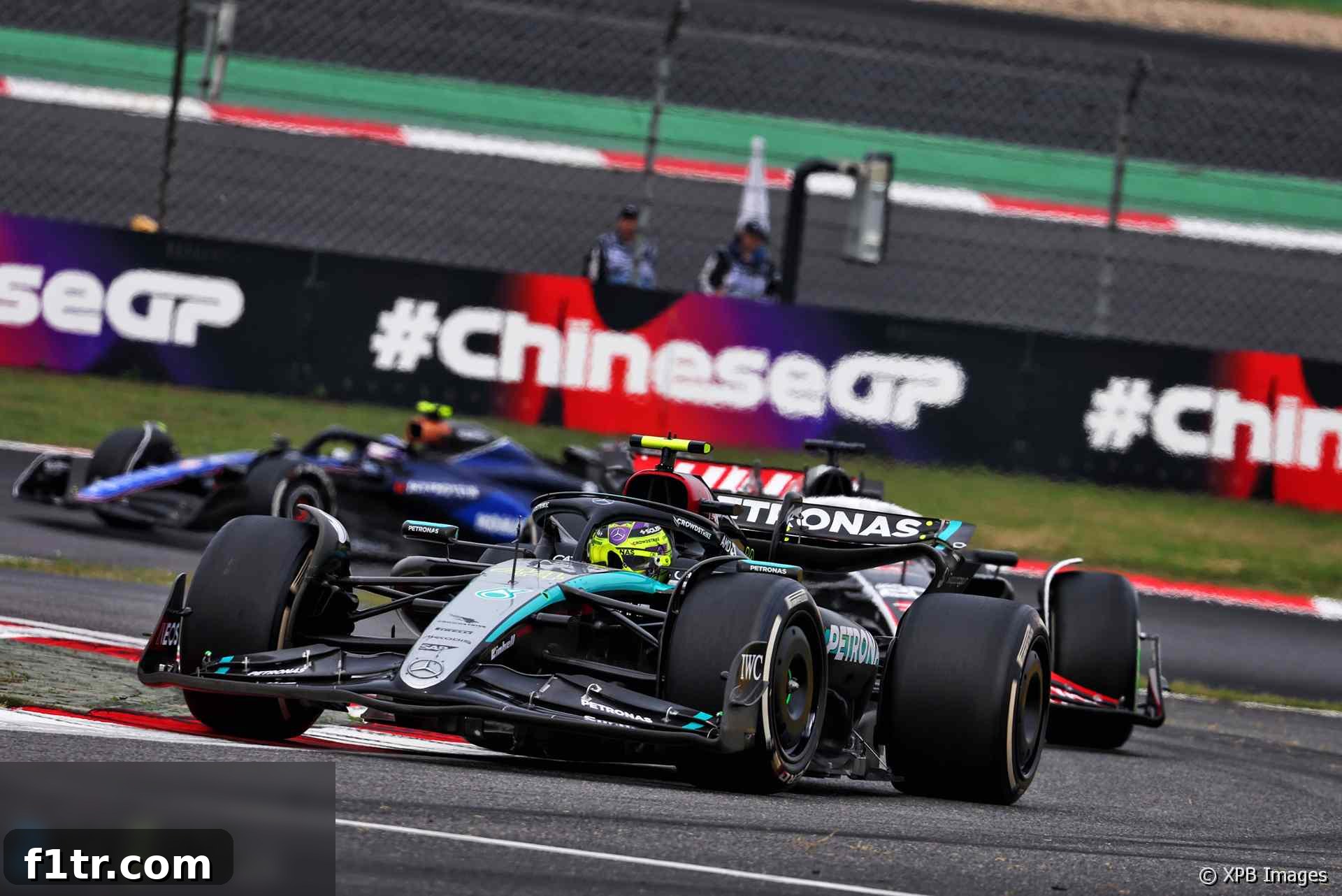
The Chinese Grand Prix served as a stark reminder of Mercedes’ current standing in the competitive Formula 1 landscape. George Russell managed to secure a sixth-place finish, a result that, while salvaging some points, also highlighted the W15’s consistent inability to challenge for podium positions or race victories. His teammate, Lewis Hamilton, endured a particularly frustrating weekend. After a valiant effort in the Sprint Race, Hamilton suffered a devastating qualifying session, failing to progress beyond Q1 and ultimately starting the Grand Prix from a lowly 18th position. His race was then an uphill battle, largely spent fighting through the midfield to eventually finish ninth.
Team principal Toto Wolff did not shy away from a candid assessment of their performance, openly admitting that their showing was unequivocally “not good enough.” His comments reflect the mounting pressure and the deep-seated frustration pervasive within the Brackley-based outfit.
“I think considering where we put the cars altogether, drivers and team, was not a good position for today,” Wolff elaborated in an interview with Sky Sports after the race. “Overall P6 I think it was, and [ninth], but lacking pace. So we’ve got to dig deep.” Wolff’s remarks underscore the urgency for a significant improvement, acknowledging that the W15 currently lacks the fundamental speed required to compete at the sharp end of the grid.
The W15’s Design Philosophy and Persistent Performance Gap
Since the commencement of the 2024 Formula 1 season, Mercedes has opted for a conservative approach regarding car development, introducing only minor updates up until the recent Chinese Grand Prix. The W15 itself was conceived with a distinct design philosophy, a deliberate pivot from its two problematic predecessors, the W13 and W14. Those cars were infamous for their ‘porpoising’ issues, unpredictable handling, and overall lack of consistent performance, pushing Mercedes away from the dominant form they enjoyed during the hybrid era. The W15 was meant to embody a fresh start, promising a more stable, predictable, and ultimately faster platform.
However, despite this ambitious re-design, the W15 has yet to deliver on its promise. It continues to exhibit a noticeable performance deficit compared to rival front-running teams. The car’s struggles often manifest in inconsistent cornering performance, suboptimal tyre management across different compounds, and an overall lack of aerodynamic efficiency that prevents it from fully exploiting its potential. Wolff’s frank admission, “No, it’s not an okay car. I think we can see what the mistakes were that we put on the car,” speaks volumes about the team’s internal analysis. This level of self-critical assessment is crucial for a team of Mercedes’ calibre, indicating that they are actively pinpointing the fundamental errors in their current design and development path.
Miami Upgrade: A Pivotal Moment for Mercedes F1
All eyes are now fixed on the upcoming Miami Grand Prix, where Mercedes plans to introduce what Toto Wolff describes as the “first significant upgrade” for the W15. This eagerly anticipated development package is being seen as a critical juncture for the team, a potential turning point that could redefine their season. Wolff expressed a degree of cautious optimism regarding the imminent changes, stating, “We have something coming for Miami that looks like a good step. Let’s see where that brings us out.”
While the precise details of this upgrade remain under wraps, it is widely expected to target core areas of the W15’s performance. Given the car’s well-documented issues, these updates are likely to focus on improving aerodynamic efficiency, particularly around the floor and diffuser, which are paramount under the current ground-effect regulations. Enhancements to the suspension system to improve mechanical grip and handling predictability could also be part of the package. The team’s engineers have been working tirelessly at their factory in Brackley, meticulously analysing vast quantities of data collected from the initial races to precisely identify the W15’s weakest points. This isn’t merely an incremental adjustment; it signifies a more substantial effort to recalibrate and optimize the car’s overall performance envelope, hoping to unlock a significant step in pace.
The success of this Miami upgrade is not only vital for Mercedes’ hopes of salvaging a respectable 2024 season but also for maintaining morale within the team. A strong performance improvement would validate their development direction and inject much-needed confidence. Conversely, a failure to deliver a tangible step forward could deepen existing frustrations and necessitate a more radical re-evaluation of their strategic approach for both the remainder of this season and the critical development phase for the 2025 car.
Lewis Hamilton’s Strategic Gamble and Future Implications
Lewis Hamilton’s challenging Chinese Grand Prix weekend was further complicated by an aggressive car setup gamble. Following the Sprint Race, the Mercedes team, in a desperate bid to unlock more speed from the W15, decided to implement a more radical car configuration for Hamilton’s qualifying session. This bold strategic move, however, did not pay off. The experimental setup severely compromised the car’s balance and performance, leading directly to Hamilton’s unexpected and disappointing Q1 exit, leaving him battling from the back of the grid for the main race.
Toto Wolff openly reflected on this decision, acknowledging the risk involved. “I think we wanted to go a bit more aggressive to see is [there] something that is so different that we need to do on the car,” Wolff explained. “You can see Lewis today, who took it on him also, that was maybe a step too far.” Hamilton’s own radio communications during the Grand Prix painted a vivid picture of his struggles, repeatedly stating that “the car doesn’t turn.” This feedback perfectly aligned with the team’s telemetry data, confirming that the chosen setup was fundamentally ill-suited for the Shanghai International Circuit and the inherent characteristics of the W15.
This incident highlights the precarious tightrope Mercedes is walking in its relentless pursuit of performance. For Lewis Hamilton, in what is his final season with Mercedes before his monumental move to Ferrari in 2025, these repeated struggles are particularly poignant. He is undoubtedly eager to conclude his illustrious tenure with the Silver Arrows on a high note, or at the very least, with a genuinely competitive package. The consistent disappointments only heighten the urgency for the upcoming Miami upgrades to deliver a significant and tangible improvement, providing him with a capable platform to fully showcase his legendary talent.
The Road Ahead: Immense Pressure on Mercedes F1
The Chinese Grand Prix served as yet another stark reminder of the immense challenge facing Mercedes. After an unprecedented era of dominance where they secured eight consecutive Constructors’ Championships, the team has struggled to adapt to the new ground-effect regulations introduced in 2022. They have consistently found themselves playing catch-up to rivals like Red Bull, Ferrari, and even McLaren, with the W15, despite its revised design philosophy, failing to be the transformative car they desperately needed.
The team’s focus is now squarely on Miami. This impending upgrade is not merely about accumulating more championship points or achieving individual race results; it is fundamentally about validating their chosen development direction, rebuilding confidence within their highly skilled workforce, and demonstrating to the broader Formula 1 community that Mercedes still possesses the innovative prowess and engineering capability to design and develop a winning car. The pressure on Toto Wolff, Technical Director James Allison, and the entire operations across Brackley and Brixworth is immense. Their ability to thoroughly diagnose the W15’s complex intricacies and translate those insights into tangible, on-track performance improvements will undoubtedly define their 2024 season and lay crucial groundwork for their long-term competitiveness in Formula 1.
Advert | Become a RaceFans supporter andgo ad-free
2024 Chinese Grand Prix Related Articles
- Alonso and Sainz incidents prompt changes to Formula 1’s rules
- Aston Martin fail in bid to have Alonso’s Shanghai penalty reviewed
- Mercedes cleared over Hamilton pit stop infraction as ‘nearly all teams in breach’
- Aston Martin petitions FIA to review Alonso’s penalty for Sainz collision
- “You need to be more on it”: 12 unheard radio exchanges from the Chinese GP
Browse all 2024 Chinese Grand Prix articles