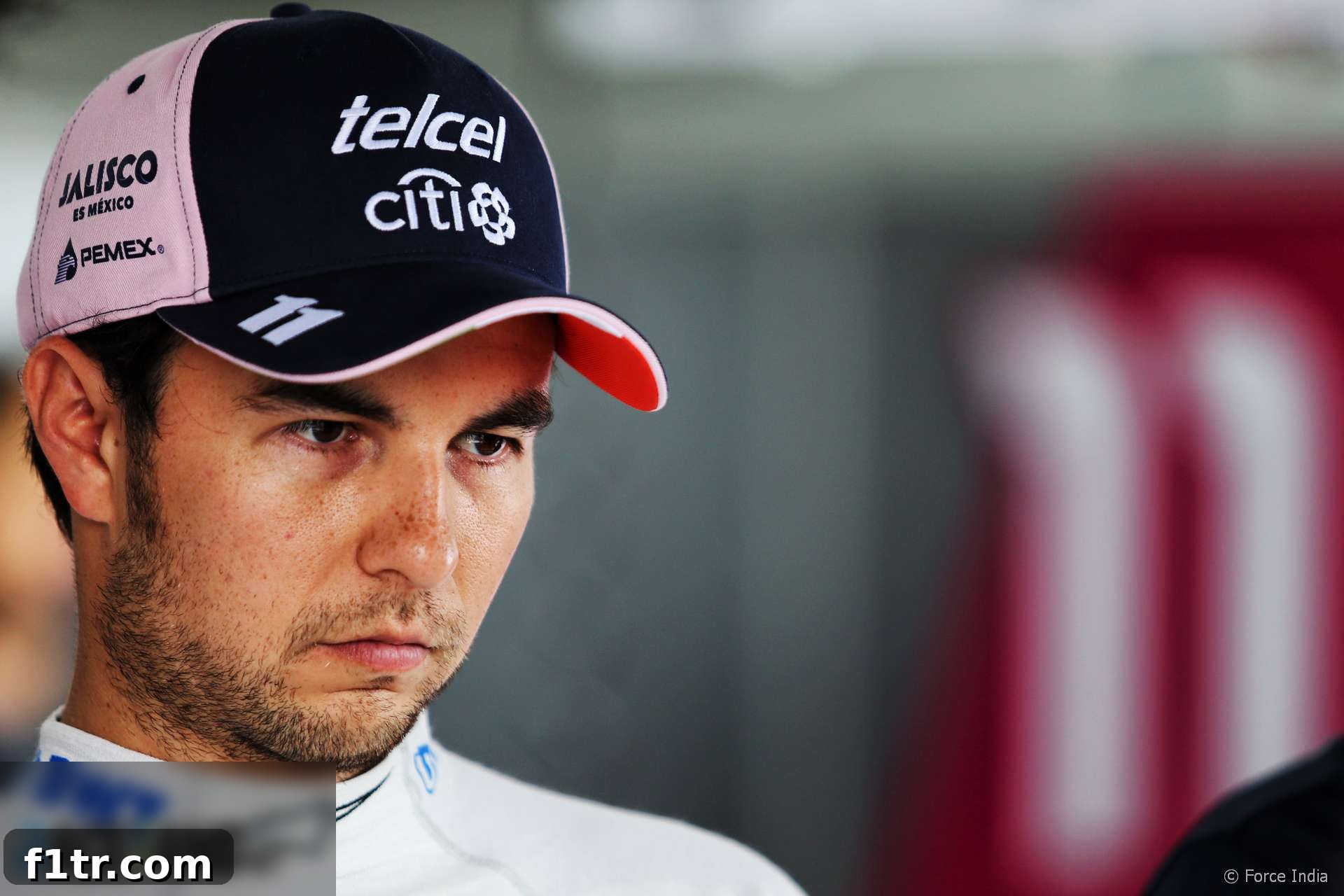
The Formula 1 paddock reeled in disbelief when it was exclusively revealed that Sergio Perez, a driver for Force India, was instrumental in initiating the administration proceedings for his own team. This unprecedented move sent shockwaves through the sport, raising immediate questions about the true nature of the team’s financial struggles and the complex web of relationships that define modern Formula 1.
Vijay Mallya, the embattled co-owner of Force India, found himself facing the imminent loss of control over the team he had nurtured for years. Among those whose actions contributed to this dramatic turn of events was Perez, a driver Mallya had signed five years prior, a partnership that had yielded five of the team’s six remarkable podium finishes. The irony was palpable: a driver celebrated for his on-track success now played a pivotal role in the team’s uncertain future.
But beyond the surface-level shock, a more profound question emerged: what, or more precisely, who, was the actual orchestrator behind this extraordinary sequence of events? This exclusive report delves into the intricate details, providing an inside account of the forces at play.
The Unraveling: Mallya’s Last Lifeline Slips Away
For Vijay Mallya, the end became undeniably clear with a critical phone call on Thursday evening. Force India’s final, desperate attempt at salvation – a substantial loan from Canadian billionaire Lawrence Stroll (father of Williams F1 driver Lance Stroll), secured against 51 percent of the team’s assets – had been abruptly withdrawn. This crushing blow came after the fashion mogul received legal advice indicating that any such financial transaction could potentially violate restrictions imposed by the Indian government on Mallya’s assets, which were subject to ongoing extradition proceedings.
Advert | Become a Supporter & go ad-free
A sliver of hope still existed in the form of a potential cash injection from Rich Energy, an aspiring high-end beverage brand. This investment, it was hoped, could temporarily placate the most urgent creditors. However, after months of self-promotional media noise, yet with minimal or non-existent product presence on supermarket shelves, Rich Energy’s credibility had significantly eroded. More importantly, it seemed they lacked the immediate financial liquidity to provide the necessary capital, leaving Mallya with rapidly dwindling options.
Facing insurmountable odds, the besieged Mallya ran out of practical solutions. The team was burdened by an estimated internal debt pile of £150 million, mathematically apportioned among Mallya (42.5%), the equally troubled Sahara Group (42.5%), and the Dutch Mol family (15%), all shareholders in the holding company Orange India Holdings. In addition to this substantial internal debt, the team owed approximately £25 million to various external creditors, having recently sustained itself largely through advance payments from the Formula One Management (FOM).
A Closer Look at Force India’s External Debts
The external debt, totaling around £25 million, comprised several significant obligations. Mercedes, the team’s power unit supplier, was owed a substantial £10 million for hardware. BWT, a key sponsor, was allegedly due £5.6 million. A company with direct links to driver Sergio Perez was owed £4.1 million, while Formtech, a Bavarian supplier of composite components to the motorsport industry, was owed approximately £2 million. Beyond these major creditors, numerous sundry creditors, including HMRC, the British revenue service, had initiated winding-up proceedings over unpaid employee contributions, underscoring the severity of the financial crisis.
The specifics of BWT’s alleged debt proved particularly complex. Ostensibly, their sponsorship agreement involved an upfront “loan,” which was designed to reduce proportionally with each passing race. Consequently, a witness statement presented to the court by BWT’s lawyer, Stevie Loughrey, asserted an outstanding debt of £5.6 million. Logically, however, Force India could honor its obligations to BWT simply by continuing to participate in races, raising questions about the immediate urgency of this claim.
The Austrian water treatment company, BWT, had long been rumored to have aspirations for an equity stake in the team. Their close ties with Mercedes Motorsport further thickened the plot, hinting at a potential strategic maneuver rather than a simple debt recovery.
These stark financial realities sharply contrasted with Mallya’s prior assertions that Force India was not disastrously burdened by debt. While it is true that companies frequently owe money to shareholders, and in Formula 1, internal sponsorships are often creatively structured as loans (or vice versa), and a debt equivalent to 30 percent of the annual budget is not typically considered catastrophic in F1, Force India’s core issue was not solely the amount of debt. Rather, it was Mallya and his co-owners’ demonstrated inability, or perhaps refusal, to inject fresh capital into the struggling operation.
Formtech is widely believed to have initiated the winding-up proceedings on the preceding Wednesday (Matter: CR-2018-004624 Force India Formula One Team Limited). However, these proceedings were reportedly delayed until August 22nd, ostensibly to grant Mallya a crucial window of opportunity to raise £2 million or negotiate a viable repayment schedule with the creditors. Winding-up orders, by their very nature, are considered absolutely final and are typically issued by courts only as a last resort, highlighting the direness of Force India’s situation.
The fate of the team formerly known as Lotus F1 Team provides an illuminating historical parallel. Between July 2015 and its eventual acquisition by Renault nearly six months later, the Witney-based operation endured a relentless series of winding-up petitions from various parties. All these threats were successfully fended off until the sale could be finalized. Mallya had harbored similar hopes, recognizing that the proposed Stroll loan was absolutely fundamental to Force India’s continued survival under the Orange India umbrella.
Advert | Become a RaceFans supporter andgo ad-free
As Mallya previously outlined in interviews, his strategic objective was to steer the team through the next two years. He anticipated that the introduction of budget caps and a more equitable, performance-based revenue structure in 2021 would not only significantly enhance the team’s attractiveness to potential buyers, investors, or sponsors but also perfectly align with Force India’s inherent strengths and operational structure. In his own poignant words, he foresaw the team facing “another two years of pain…”
However, Force India’s on-track performance and its very future were severely hampered by Mallya’s fundamental inability to secure new sponsorship deals. It was an undeniable reality that no major international brand would willingly associate itself with a team controlled by a high-profile entrepreneur facing protracted extradition proceedings on billion-dollar fraud charges, regardless of whether these charges would ultimately be proven or dismissed.
Concurrently, the Sahara Group’s own myriad legal entanglements rendered its owner, Subrata Roy, incapable of injecting the much-needed capital into the team. The Mol family, holding a minority and silent stake, bore no direct responsibility for the substantial portion of Force India’s mounting debts. Consequently, the team’s precarious survival became heavily reliant on FOM advances, coupled with the urgent and pressing need to develop and construct a competitive 2019 car, complete with all its associated aerodynamic complexities and challenges.
Lawrence Stroll’s Play: A Father’s Ambition and F1’s Shifting Sands
It appeared that the pace of events was simply too slow for Lawrence Stroll Sr. Having successfully built global brands such as Tommy Hilfiger, Ralph Lauren, and Michael Kors, his recent focus had shifted almost entirely to advancing his son, Lance’s, Formula 1 career. In the contemporary landscape of F1, drivers with significant financial backing are increasingly likely to secure more competitive seats. Lance Stroll, thanks to his father’s astute business dealings aimed at offsetting the considerable cost of an F1 drive, possessed ample sponsorship from prominent names like Bombardier, JCB, and Canada Life.
The prevailing issue was that Williams, Lance’s current team, had entered a period of severe decline from which a quick recovery seemed highly improbable. In Formula 1, time is a relentlessly critical factor, both on the track and off it. Stroll Sr. meticulously scrutinized F1’s entry list: Mercedes, Ferrari, Red Bull Racing, Toro Rosso, and Renault were unequivocally out of Lance’s immediate reach. Haas, meanwhile, operated with a distinct identity and at its own pace, making it an unlikely target. This left three primary contenders: Williams (as discussed), McLaren (but who would willingly go head-to-head with a formidable Fernando Alonso?), and critically, Force India.
On paper, Force India presented the ideal progression for Lance’s career. The team had consistently finished fourth in the constructors’ championship for the previous two seasons, thereby outperforming Williams (which used the same Mercedes power unit) on both occasions. Widely regarded as Formula 1’s most efficient “bang for buck” team, Force India’s only significant impediments that year had been its financial instability and Vijay Mallya’s unwavering refusal to sell the team for anything less than the perceived value of shareholder receivables.
Mercedes’ Dilemma: Financial Risk and Political Fallout
Force India’s precarious situation simultaneously presented a complex set of problems for Mercedes. As the long-term supplier of complete “back-ends” – encompassing engines, associated hybrid components, transmissions, and crucial electronics/hydraulics – Mercedes held significant contractual obligations. However, the potential collapse of Force India not only jeopardized their outstanding payments but also risked tarnishing Mercedes’ brand by association, particularly as both of their customer teams were steadily sliding down the grid. Where once six of the top ten cars were routinely Mercedes-powered, now only the factory team’s own entries consistently made it into Q3, highlighting a growing performance disparity.
Go ad-free for just £1 per month>> Find out more and sign up
Compounding the financial ramifications, a wound-up Force India carried adverse political implications for Mercedes. With delicate negotiations underway with Liberty Media regarding F1’s post-2020 landscape, both Mercedes and Ferrari required a full complement of cards to play. This effectively meant maintaining “control” over three teams each, allowing them to present a formidable bloc of six (out of ten) teams. The closure of Force India would reduce this crucial balance to a precarious 50/50 split, weakening their collective bargaining power.
Meanwhile, Renault, acutely aware of the strategic advantages of strength in numbers – and having lost Toro Rosso and Red Bull Racing to Honda for the foreseeable future, while gaining only McLaren as a customer – was actively scouting for a second customer team. With Sauber firmly committed to Alfa Romeo (and thus Ferrari technology) and Haas operating under a “listed parts” deal with Maranello, only two viable prospects remained: Force India and Williams. The stakes for all parties were incredibly high.
The Perez Enigma: A Heroic Act or a Calculated Maneuver?
This intricate situation set the stage for a decisive and controversial intervention. Enter Sergio Perez, or more precisely, Brockstone Limited, the company linked to him, into this unfolding drama. In his own words, uttered in a direct response to a pointed question, Perez stated that he was explicitly asked by “a couple of members of the team to go ahead and save the team and protect the 400 people that were working there.” He further elaborated, “Therefore I was asked to basically save the team, to pull the trigger and put the team into administration.” On the surface, this narrative painted Perez as a selfless hero, acting to safeguard livelihoods.
However, several critical questions immediately arose, casting a shadow of doubt over the purely altruistic interpretation. Why, for instance, was a “Certificate of Urgency” sought before the court if the team had already been granted a reprieve until August 22nd? If Perez’s primary concern truly lay with the welfare of the team members, would he then donate the £4.1 million owed to his linked company into the employees’ salary pot? These questions hinted at a more complex motivation.
Rereading Perez’s quotation, one is prompted to deeply consider the identity of these “couple of team members” and their true reasons for urging such a drastic course of action. More critically, one must question Perez’s ultimate motivation for complying. It is highly improbable that these influential “team members” were merely truck drivers, cleaners, or gardeners. Furthermore, why would Perez so publicly stake his professional reputation without concrete guarantees of securing a racing seat with the team for 2019? To undergo such a public and potentially damaging process only to see his seat go to a competitor would defy all logical sense, suggesting a pre-arranged understanding or a powerful incentive.
Once it became unequivocally clear that Rich Energy lacked the immediate financial capacity to rescue Force India, the Silverstone-based team was formally placed into administration following the urgent application filed by Brockstone. FRP Advisory LLP, a firm with prior experience in managing the administrations of former F1 teams Marussia and Manor, swiftly took charge of the team’s assets on Friday evening, initiating the formal restructuring process.
On Saturday afternoon, Mercedes team boss Toto Wolff made a notable public statement to the media: “Now that process has been kicked off by the administrator there are many potential buyers with great interest, with deep pockets, with an understanding of what kind of spending levels are needed in order to perform in Formula 1.” This assertion, made within 18 hours of the administration order being handed down, prompted a significant question: how could Wolff possess such detailed knowledge about numerous “deep-pocketed” potential buyers so rapidly?
Advert | Become a RaceFans supporter andgo ad-free
Yet, when directly confronted on Sunday about his frequent “Oxford breakfasts” with Force India COO Otmar Szafnauer, and asked if “everything was going to plan,” Wolff offered a dismissive reply: “You are always having this perspective of somebody plotting in the background.” However, as the saying goes, if it walks like a duck and quacks like a duck, it’s probably a duck. The implications of these interactions, particularly given Wolff’s own admission of regular informal meetings with Szafnauer, who “walks the dog and comes for breakfast in Oxford, [at] in my place,” become difficult to ignore. It is inconceivable that their conversations revolved solely around mundane topics. Moreover, Wolff, an Austrian deeply rooted in the tight-knit business world, was widely credited with brokering the complex BWT deal. One is left to draw their own conclusions about the true nature of the events.
The Path Forward: Rescuing Force India and F1’s Future
So, what unfolds next for Force India? The paramount priority for FRP Advisory and for Formula 1 itself is to preserve Force India as a viable going concern. This involves salvaging as much of the team’s inherent value as possible while simultaneously settling with its myriad internal creditors. Only after this initial phase will the complexities of shareholder receivables come into play, further complicating the financial landscape.
In the interim, the motorsport world anxiously awaits news regarding the team’s future direction. Will Lawrence Stroll ultimately submit a bid, stepping in as an angel investor, a significant shareholder, or even as the outright proprietor? Will Otmar Szafnauer, Mercedes, and BWT be directly or peripherally involved in this new structure? Crucially, will Lance Stroll find himself accommodated in a pink Force India car, facilitated by strategic loans extended by his father, Lawrence? These questions hang heavy over the team’s future.
Alternatively, will the team fall into foreign hands, potentially under Russian or American ownership? If the latter, will it be the consortium meticulously assembled by Michael Andretti, or perhaps an investment company eager to capitalize on the lucrative world of Formula 1? Reports suggest that there are allegedly five genuinely interested parties, and only the passage of time – and the diligence of FRP Advisory – will ultimately reveal Force India’s true destiny.
The Systemic Flaw: Why Independent F1 Teams Struggle to Survive
Unlike many of the approximately 50 casualties Formula 1 has suffered throughout its long history, Force India is a team too formidable and too competently run to simply cease to exist. Its current predicament stemmed not from sporting ineptitude or a loss of strategic focus, but rather from a confluence of challenging circumstances playing out thousands of miles away from its Silverstone base. These external pressures were then compounded by Vijay Mallya’s steadfast refusal to sell the team, even in the face of what were arguably fair and reasonable offers. He held a firm, almost desperate, belief that if he could just hold out until the 2021 regulatory changes, all would eventually stabilize and prove worthwhile.
The true tragedy, however, lies deeper: even without Mallya’s personal legal battles, Force India was arguably destined for failure. The team, like many other independents, was battered and beaten by a systemic structure meticulously devised by F1’s previous commercial owners, CVC Capital Partners. This structure, inherited by Liberty Media, was inherently designed to afford independent teams virtually no realistic chance of long-term survival. Its unspoken aim was to gradually force them into the welcoming, yet ultimately controlling, arms of the sport’s major players: Ferrari and Mercedes. These two giants, along with Red Bull, collectively aimed to “control” six teams – Ferrari with three, Mercedes with three, and Red Bull with its two entries – thereby dominating the grid’s political and financial landscape.
Only Renault and McLaren currently operate somewhat outside of what could reasonably be described as a cartel, with all other teams somehow reliant on one of the three major powerhouses. Crucially, these top three teams collectively stood to share bonuses amounting to an staggering $250 million (£190 million) in the current year alone. This figure represents a staggering billion pounds paid to these three dominant teams since the structure was initially introduced in 2013, payments they receive simply for participating, entirely separate from any performance-related prize money!
Is it any wonder, then, that these three teams alone have consistently won races since this skewed payment structure was implemented, and have invariably locked out the top six finishing positions, barring only the most extraordinary and unexpected circumstances? The correlation is undeniable.
Extrapolating these massive bonuses over the entire 2013-2020 period (inclusive), the total Formula 1 money “pot” – the collective amount disbursed in performance payments to all teams – would have been bolstered by an astonishing £1.6 billion. Over these years, Force India, on average, would have legitimately qualified for approximately 10 percent of that pot, equating to around £160 million. Intriguingly, this figure closely mirrors its current estimated total debt pile, including shareholder receivables. This stark comparison vividly illustrates the profound financial disadvantage suffered by independent teams under the prevailing system.
Consider the harsh fate of independent teams under CVC’s deeply flawed payment structure, a system unfortunately inherited by Liberty Media. These teams, excluded from the lucrative bonuses paid to the top three, faced immense pressure. Their destinies, and in some cases, their ultimate demise, paint a grim picture:
- McLaren – Received a bonus approximately 40 percent of that paid to the top three teams, still significantly less.
- Caterham – Entered administration, ultimately wound up.
- Marussia/Manor – Faced administration twice, underwent a change of ownership, and was eventually wound up.
- Lotus – Successfully staved off three winding-up attempts before being sold to Renault.
- Williams – Received a flat heritage bonus of £8 million, yet clearly experienced exceptionally hard times.
- Force India – Currently in administration.
- Toro Rosso – Wholly owned by Red Bull, thus not truly independent.
- Sauber – Underwent a change of ownership after being unable to meet its financial obligations.
- Haas – Incorporated in 2015, operating a unique business model reliant on close technical partnerships.
This list makes for undeniably painful reading, and the situation is rendered even more poignant by a comment made by Toto Wolff on Sunday: “We are actually one of the creditors, one of the suppliers that has helped the team over the last god knows how many years in competing.” While technically true, such a statement offers little to no genuine consolation to the 400 dedicated employees and their families who now confront a summer break clouded by profound uncertainty and discontent.
Go ad-free for just £1 per month>> Find out more and sign up
Follow Dieter on Twitter: @RacingLines
RacingLines: Further Insights into Formula 1’s Complexities
- The year of sprints, ‘the show’ – and rising stock: A political review of the 2021 F1 season
- The problems of perception the FIA must address after the Abu Dhabi row
- Why the budget cap could be F1’s next battleground between Mercedes and Red Bull
- Todt defied expectations as president – now he plans to “disappear” from FIA
- Sir Frank Williams: A personal appreciation of a true racer
Browse all RacingLines columns