Max Verstappen’s Controversial Japanese GP: Unpacking the Collisions with Raikkonen and Vettel
The 2018 Formula 1 Japanese Grand Prix at Suzuka was a pivotal race, not just for the championship battle, but also for highlighting the fiery driving style of Max Verstappen. The young Red Bull driver found himself embroiled in two significant on-track incidents, first with Kimi Raikkonen and then with Sebastian Vettel, both of which resulted in widespread debate, penalties, and damaged reputations. Verstappen’s interpretation of events, particularly his penalty for colliding with Raikkonen, underscored a fundamental tension between aggressive racing, corner-cutting rules, and the consistency of stewarding decisions.
The Raikkonen Incident: Intentional Contact or Unavoidable Consequence?
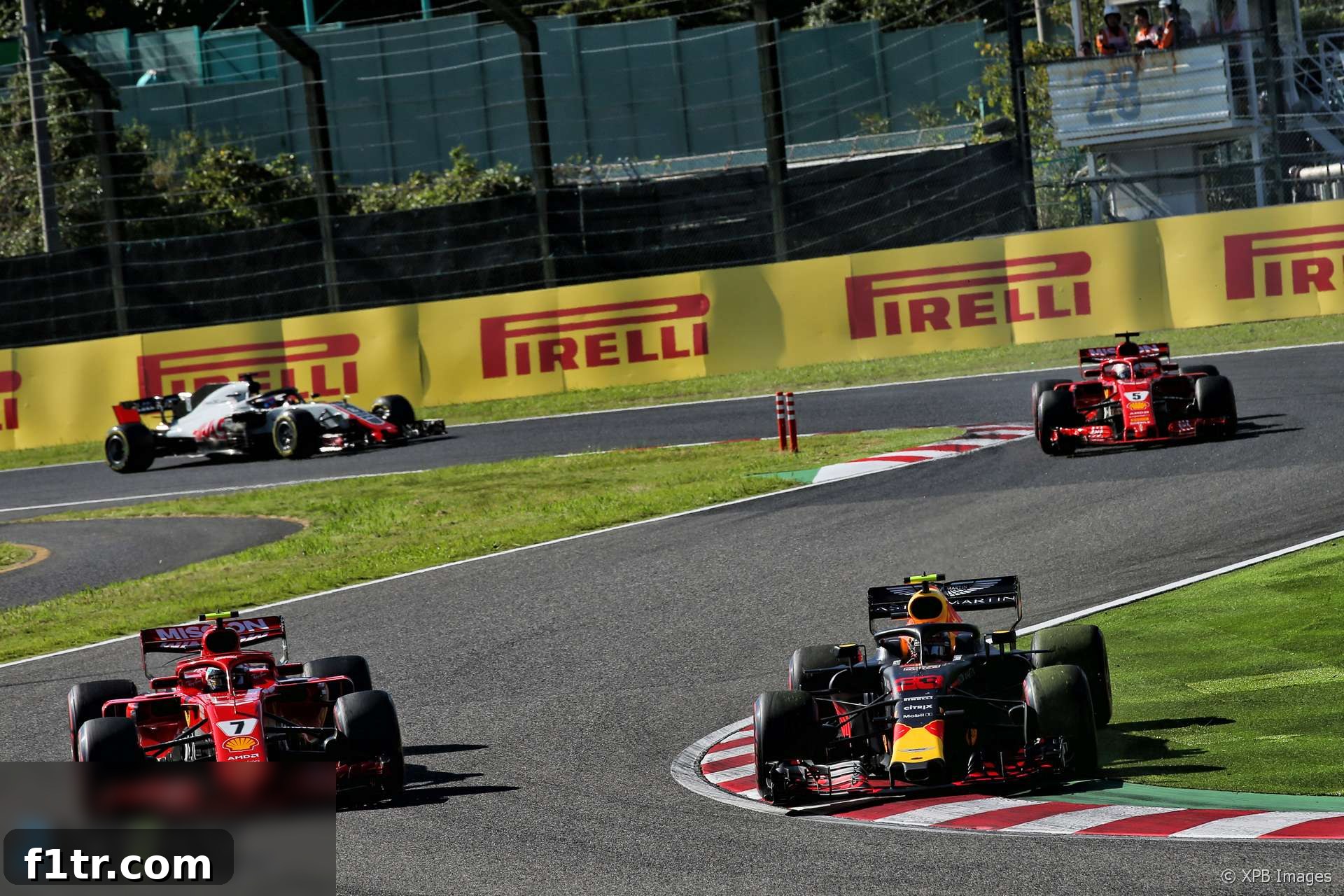
The first major flashpoint of Verstappen’s race occurred early on when he clashed with Kimi Raikkonen’s Ferrari. Verstappen was under immense pressure from Raikkonen as they approached the chicane. Pushing hard, the Red Bull car ran wide, forcing Verstappen off the track. As he rejoined, the two cars made contact. Stewards swiftly investigated the incident, ultimately holding Verstappen responsible and issuing him a five-second time penalty, a decision that would prove highly contentious from Verstappen’s perspective.
Verstappen’s defense of his actions revolved around his conscious effort to avoid cutting the corner entirely, a move that often incurs a separate penalty for gaining an advantage. “If I get a five-second penalty for that then next time I’ll just cut the track and do like Valtteri [Bottas],” Verstappen remarked post-race, clearly frustrated. His comment hinted at a perceived inconsistency in how penalties were applied, suggesting that drivers who simply cut the corner without contact sometimes escaped similar sanctions. He elaborated, “I was just trying my very best to do the corner and not make it look like ‘OK I lock up. I’ll just cut the corner’. I know what to do next time.” This statement revealed a driver weighing his options in a split second, believing he chose the lesser of two evils, only to be penalized regardless.
Kimi Raikkonen, however, offered a starkly different account, accusing Verstappen of a deliberate collision. The Ferrari driver felt Verstappen knowingly drove into him. “Obviously he ran wide and went off the track,” Raikkonen explained. “I just went on the outside and for the next corner leaving him a space on the inside. But he obviously knew that I’m there so he just drove into me and pushed me off the track. I had quite big damage so obviously it was far from ideal.” Raikkonen’s car indeed sustained significant damage, impacting his race performance. This accusation of deliberate contact painted a much more aggressive picture of Verstappen’s driving, moving beyond a simple racing incident to a question of intent and fair play.
The Nuance of Rejoining the Track
The incident highlighted a critical aspect of Formula 1 regulations: the rules surrounding rejoining the track. While drivers are expected to rejoin safely and without gaining an advantage, the grey area often lies in the proximity to other cars. Verstappen’s argument suggested he was trying to execute a clean rejoin under pressure, whereas Raikkonen felt he was intentionally squeezed off the circuit. The stewards’ decision to penalize Verstappen indicated they believed he did not rejoin in a safe manner, or at least caused an avoidable collision, irrespective of his intention to avoid a corner-cut penalty.
The Vettel Incident: A Second Clash and a Familiar Pattern
Later in the same race, Verstappen found himself in another high-profile entanglement, this time with the other Ferrari of Sebastian Vettel, who was aggressively pursuing a championship charge. Vettel attempted an overtake on Verstappen at spoon curve, a fast, challenging corner. As Vettel pulled alongside, contact was made, resulting in both cars spinning and losing valuable track positions. For Vettel, who was desperately trying to close the gap to Lewis Hamilton in the championship, this incident was particularly damaging.
Verstappen’s reaction to the Vettel collision was consistent with his earlier defense: he believed the overtake attempt was ill-advised. “With Seb it’s just not a corner where you can overtake,” he stated, implying Vettel’s move was overly ambitious. He drew parallels to an earlier incident in China from the same season, where he had made a similar error while attempting to overtake Vettel and received a penalty. “For me it was a bit similar to China this year where I made the mistake because I was a lot faster and he could easily have overtaken me the next lap,” Verstappen recalled. This comparison served to highlight his view that even experienced drivers make errors of judgment when attempting overtakes.
The Red Bull driver acknowledged the costly nature of the collision for both parties: “We both already got penalised with damage. Looking back I think it was a similar scenario to China, and I got a penalty there, but at the end of the day it is like it is and it’s just not nice that it happened.” In this instance, unlike with Raikkonen, the stewards did not issue an additional penalty, perhaps considering the self-inflicted damage as sufficient retribution for the racing incident. This lack of a formal penalty, despite significant consequences for both drivers, further fueled the debate about consistency in stewarding decisions.
The “Max Factor” and F1’s Dynamic Driving Standards
These two incidents at Suzuka were not isolated events but rather emblematic of Max Verstappen’s aggressive, often uncompromising racing style that had both thrilled fans and drawn criticism throughout his young career. His “Max Factor” – a willingness to push boundaries and sometimes even cross them – made him a captivating figure in Formula 1. However, it also put him at odds with competitors and stewards, often leading to polarizing opinions on his driving.
The 2018 season, in particular, saw several instances where Verstappen’s aggressive maneuvers came under scrutiny, sparking broader discussions within the sport about what constitutes fair racing versus dangerous driving. Balancing the desire for thrilling on-track battles with the need for driver safety and consistent application of rules is a perpetual challenge for Formula 1’s governing body. The Raikkonen and Vettel incidents at the Japanese Grand Prix served as a microcosm of this ongoing debate, illustrating the fine line between bold overtaking and regrettable collisions. Ultimately, these events contributed to Verstappen’s growing reputation as a prodigious talent whose raw speed was often accompanied by a fierce, sometimes controversial, racing edge.
Advertisement | Become a RaceFans supporter andgo ad-free
2018 F1 season
- F1 feared “death knell” for Drive to Survive after Ferrari and Mercedes snub
- McLaren staff told us we were “totally crazy” to take Honda engines in 2018 – Tost
- ‘It doesn’t matter if we start last’: How Red Bull’s junior team aided Honda’s leap forward
- Honda’s jet division helped F1 engineers solve power unit problem
- McLaren Racing losses rise after Honda split
Browse all 2018 F1 season articles