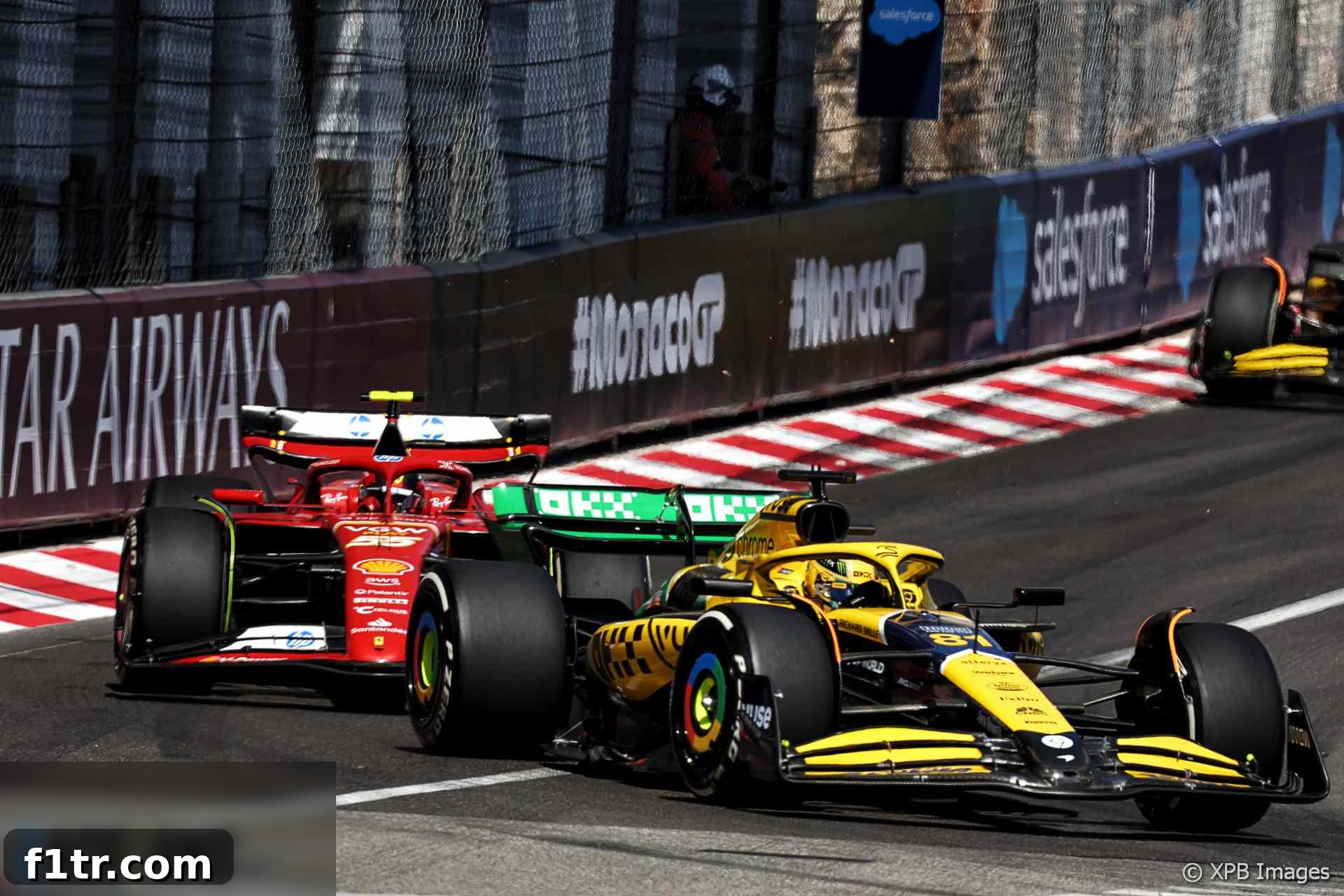
The exhilarating and often unpredictable Monaco Grand Prix, a jewel in the Formula 1 calendar, began with a dramatic opening lap that saw McLaren driver Oscar Piastri sustain significant damage to his car after contact with Carlos Sainz Jnr of Ferrari. Initial assessments by the McLaren team indicated a substantial performance loss, estimated to be around half a second per lap. This incident immediately cast a shadow over Piastri’s race prospects, but a stroke of luck in the form of an early red flag provided a crucial opportunity for the Woking-based outfit to mitigate the damage.
The collision unfolded at the notorious Sainte Devote corner, Turn 1, a notoriously tight and unforgiving section of the Monte Carlo street circuit. As the pack jostled for position in the opening moments of the race, Sainz’s Ferrari clipped the right-hand side of Piastri’s McLaren. Piastri himself acknowledged the impact, stating, “I definitely felt the touch at Turn 1, and at that part of the car, it’s such a sensitive part.” This seemingly minor contact, however, had profound implications for the intricate aerodynamics of a modern Formula 1 car, particularly its highly sensitive floor, a component crucial for generating downforce.
Become a Supporter & go ad-free
For a Formula 1 car, aerodynamic efficiency is paramount, and even the smallest disruption to the floor’s integrity can lead to a considerable loss of downforce. McLaren’s telemetry quickly confirmed the severity of the damage, initially calculating a deficit of approximately 20 points of downforce. To put this into perspective, on a circuit like Monaco, where precision and grip are everything, such a loss translates directly into a significant drop in lap time – a staggering half a second. This level of damage would typically spell disaster for a driver’s race, condemning them to a struggle for pace and position and severely impacting their ability to compete.
The Fortuitous Red Flag: A Lifeline for McLaren
However, fate intervened in the form of a dramatic multi-car pile-up involving Sergio Perez of Red Bull and both Haas drivers, Kevin Magnussen and Nico Hulkenberg, shortly after the initial start. This incident necessitated a lengthy red flag period, halting the race for almost three-quarters of an hour. While disruptive for many, this stoppage proved to be an invaluable lifeline for McLaren and Piastri. Under red flag conditions, teams are permitted to carry out repairs to their cars, a luxury not afforded during a conventional safety car period or a normal pit stop, making this a rare and critical opportunity.
Piastri highlighted the significance of this unexpected pause, emphasizing how it played directly into McLaren’s hands: “The team told me how much downforce I was losing before we tried to fix it, and it was a pretty big number. I don’t know what we managed to get it down to, but obviously, the length of the red flag helped us out quite a lot there.” The extended break allowed McLaren’s expert mechanics precious time to meticulously assess the damage and execute crucial repairs, transforming what could have been a ruined race into a salvageable one with renewed hope for points.
Precision Engineering Under Pressure: McLaren’s Repair Work
McLaren Team Principal Andrea Stella provided a detailed account of the team’s swift and effective response to the damage. He confirmed the immediate observation of a 20-point downforce loss, equating to roughly half a second per lap, as soon as the collision occurred. “As soon as the collision happened, we observed the 20 points [of downforce] down, which here in Monaco is about half a second,” Stella explained. “But then, thanks to the red flag, we were in a condition to make some repairs to the floor.”
The repair work focused on two key areas that were compromised: the side wing of the car’s floor and the sidepod. Stella elaborated on the specific interventions: “The side wing of the floor was broken, so we repaired it, we didn’t fix it entirely, and we changed the sidepod that was broken as well.” This meticulous effort by the McLaren crew, working against the clock during the red flag period in the pit lane, was instrumental in recovering a significant portion of the lost performance. While a full, perfect repair was impossible given the time constraints and the intricate nature of the damage, their efforts were remarkably effective in restoring much of the car’s aerodynamic integrity.
Mitigated Loss: A Race Transformed by Expert Repairs
The outcome of these frantic repairs was a dramatic reduction in Piastri’s performance deficit. Andrea Stella estimated that the team managed to halve the initial loss, bringing it down to a far more manageable level. “So overall, the deficit was about 10 points for the entire race, which is a couple of tenths, maybe two-tenths and a half,” he stated. This reduction from a debilitating half-second per lap to approximately two-and-a-half tenths per lap was a monumental achievement, essentially giving Piastri a fighting chance to compete closer to the front of the grid, rather than simply limping to the finish.
Despite the successful repairs, racing with a compromised car, even slightly, presents its own set of challenges. Stella admitted, “That obviously made us a bit more nervous about the possibility to keep the tyres in a good situation, in a good condition, because the car was a little damaged.” The altered aerodynamic balance, even subtle, can have a significant impact on tyre degradation, overall handling, and driver confidence. However, Piastri’s skill and adaptability shone through under pressure. “But Oscar managed to do that, and ultimately the damage was not influential for the final result,” Stella concluded, indicating that while the car wasn’t perfect, the recovery work ensured it didn’t ultimately cost Piastri valuable positions or a strong finish.
Piastri’s Perspective: Monaco’s Unique Demands on a Damaged Car
Piastri himself offered a nuanced perspective on racing with damage in Monaco, highlighting the unique characteristics of the street circuit. He remarked, “Being in Monaco, it’s probably the one track where having damage doesn’t hurt you as much.” This statement, while perhaps surprising at first glance for a track demanding such precision, acknowledges Monaco’s low-speed nature and minimal overtaking opportunities. In such an environment, outright aerodynamic speed is sometimes less critical than raw mechanical grip, precise steering, and consistent driving lines, which can mitigate some of the effects of downforce loss.
However, he quickly tempered this by emphasizing the inherent fragility and sensitivity of modern F1 cars, particularly their floors: “It was a very, very small touch. But with these cars, especially with the floor being so sensitive to the downforce it generates, it can ruin your race very easily. So I was very happy we could try and fix it.” Indeed, while Piastri may have felt the car wasn’t at its absolute peak performance compared to his closest rivals after the restart, particularly as the race progressed, the critical repairs ensured he wasn’t completely out of contention. The ability to limit the performance deficit to a mere fraction of a second per lap rather than a debilitating half-second was the key difference between a frustrating afternoon and a solid, points-scoring finish. His ability to manage the slightly compromised car and maintain competitive lap times underscored both his exceptional talent and the effectiveness of the McLaren team’s damage control strategy.
Become a RaceFans supporter and go ad-free
Beyond the Incident: The Broader Context of the Monaco GP
The incident involving Piastri and Sainz, and the subsequent red flag, was just one chapter in a tumultuous 2024 Monaco Grand Prix. The chaotic start, which saw multiple significant incidents, underscored the inherent risks and unforgiving nature of the street circuit, making it one of the most challenging races on the calendar. For McLaren, however, the ability to turn a potential disaster into a manageable challenge through rapid assessment and expert mechanical intervention speaks volumes about the team’s operational efficiency and strategic acumen. The red flag, while an unusual and often unpredictable circumstance, was maximised by a team prepared to seize every opportunity to gain an advantage or mitigate a loss.
In a sport where fractions of a second can dictate fortunes and define championship aspirations, the difference between a 0.5-second loss and a 0.25-second loss is immense. McLaren’s swift and decisive action during the red flag period not only saved Piastri’s race but also highlighted the critical role of quick thinking, strategic decision-making, and unparalleled technical expertise in the high-stakes world of Formula 1. The 2024 Monaco Grand Prix will be remembered not just for its dramatic start, but also for McLaren’s impressive recovery effort, demonstrating how a top-tier team can overcome adversity and turn a challenging situation into a commendable result, a true testament to their resilience and skill.
For more detailed insights and comprehensive analysis of all the events from the 2024 Monaco Grand Prix, including driver reactions, strategic breakdowns, and championship implications, explore the full range of coverage available.
Browse all 2024 Monaco Grand Prix articles