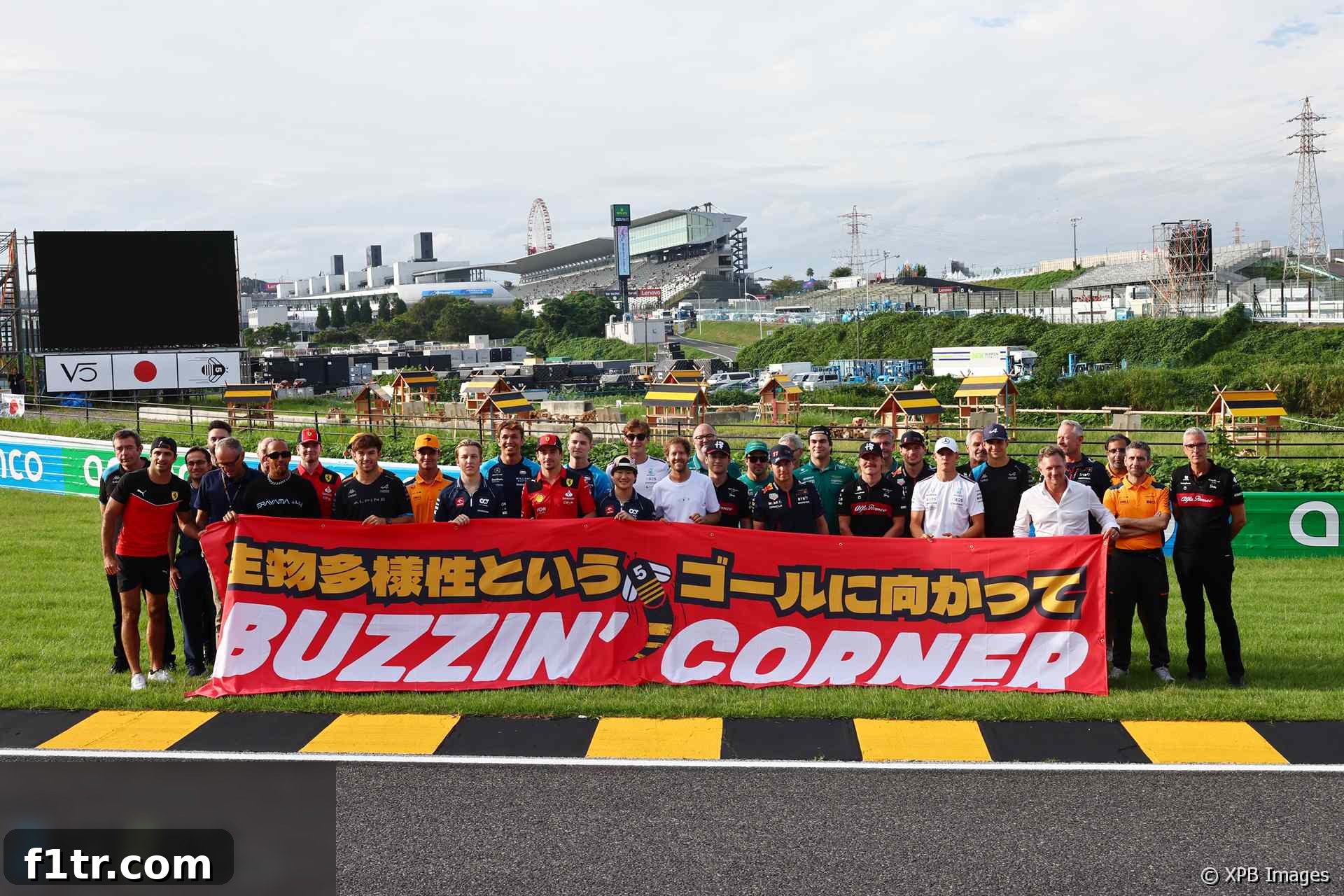
In a powerful demonstration of Formula 1’s evolving role beyond pure motorsport, legendary four-time world champion Sebastian Vettel has spearheaded a groundbreaking biodiversity initiative, uniting current F1 drivers in a collective effort to build crucial insect habitats at racing circuits worldwide. The pioneering project, aptly named “Buzzin’ Corner,” officially launched at Japan’s iconic Suzuka Circuit, setting a precedent for environmental engagement within the sport. This innovative undertaking underscores a growing commitment from within the F1 community to leverage its global platform for significant positive change, focusing on the critical issue of ecological preservation and the protection of vital pollinator populations.
Vettel, renowned for his illustrious career that saw him claim multiple championships and establish himself as one of F1’s all-time greats, chose Suzuka as the inaugural site for his initiative with profound personal significance. The Japanese circuit holds a special place in the German driver’s heart, widely regarded as his favorite track. It was here that he celebrated four Grand Prix victories during his tenure, including a memorable win in his first appearance in 2009, and famously sealed his second world title two years later. This deep-rooted connection to Suzuka made it the perfect backdrop for launching a project designed to foster a more sustainable relationship between high-speed racing and the natural world, symbolizing a full circle journey from competitive triumph to environmental stewardship.
The core of this inspiring initiative at Suzuka centered around the strategic placement of a group of bespoke ‘insect hotels’ on the inside of Turn 2. These carefully constructed habitats are designed to provide essential shelter and breeding grounds for a variety of insects, including bees and other vital pollinators, whose populations are in decline globally. To visually mark this special zone and draw attention to its environmental purpose, the apex kerb at Turn 2 was strikingly repainted in a vibrant black and yellow scheme, echoing the colors of a bumblebee. This highly visible transformation not only created a memorable landmark but also served as a constant reminder of the project’s dedication to biodiversity. The initiative extended to actively involve the current grid of F1 drivers; representatives from all ten teams, alongside other prominent figures within Formula 1, were personally invited to decorate these insect habitats, adding a unique, personal touch to each structure and further solidifying their commitment to the cause.
Sebastian Vettel: A Champion Beyond the Track
Since his retirement from Formula 1 at the close of last year, Sebastian Vettel has seamlessly transitioned from a racing icon to a vocal and proactive advocate for environmental sustainability. His post-F1 career has been characterized by a resolute dedication to highlighting pressing ecological issues and promoting sustainable practices. Vettel has consistently used his considerable fame and influence to champion environmental causes, demonstrating how high-profile figures can drive meaningful conversations and actions. His efforts extend beyond the “Buzzin’ Corner” initiative, encompassing a broader push for green innovation within motorsport and beyond. He has notably participated in high-profile events such as the Nurburgring Nordschleife and the Goodwood Festival of Speed, where he piloted sustainably-fueled F1 cars. These appearances were not mere exhibitions; they were powerful statements designed to showcase the viability and potential of alternative fuels in high-performance settings, challenging conventional perceptions and encouraging the adoption of greener technologies in an industry historically associated with significant environmental impact. Vettel’s commitment to driving actual, tangible change firmly positions him as a leading figure in the intersection of sport and environmental activism.
F1 Drivers Unite for a Greener Future
The collective participation of F1 drivers from every team in the “Buzzin’ Corner” project signifies a powerful alignment within the paddock towards shared environmental goals. Watching competitors, typically focused on split-second advantages, come together to meticulously paint and personalize insect hotels was a testament to the unifying power of Sebastian Vettel’s vision. Each driver’s involvement, from Pierre Gasly and Esteban Ocon of Alpine to Alexander Albon and Logan Sargeant from Williams, and even champions like Charles Leclerc and Lewis Hamilton, added layers of authenticity and global appeal to the initiative. The images of them engaging in this hands-on work, far removed from the high-pressure environment of race strategy, sent a clear message: environmental responsibility is a collective endeavor that transcends team rivalries. This unity amplifies the message of biodiversity preservation, showing a united front from some of the world’s most recognizable athletes. It not only raises awareness among Formula 1’s massive global fanbase but also potentially inspires broader environmental action across different sports and industries, proving that even small actions, when undertaken collectively, can have a profound impact on environmental stewardship.
Lewis Hamilton’s Powerful Endorsement
The significance of Sebastian Vettel’s environmental advocacy was perhaps best encapsulated by the heartfelt tribute from fellow seven-time world champion, Lewis Hamilton. Speaking on the initiative, Hamilton unequivocally stated that no driver in the history of Formula 1 has done more than Vettel to harness their success within the sport to catalyze positive change outside of it. His words resonate deeply, recognizing Vettel’s unique commitment to utilizing his unparalleled platform for broader societal and environmental good. Hamilton shared his admiration, remarking, “It’s great to have Seb back this weekend. He sat down and told all the drivers of his plans. It was great to see that he’s found his purpose and to be honest, in the history of the sport, I don’t know any other driver who’s ever been so outspoken and showing real compassion for the world outside of this little world that we’re living in.”
Hamilton’s praise highlights Vettel’s distinctive dedication and his willingness to speak out on critical issues, a trait not commonly associated with F1 drivers who often focus solely on their performance. He further elaborated on the inspirational power of Vettel’s actions: “It’s really great that he’s utilising his platform. I always just hope that with the things that he’s doing, for example, that he inspires the other drivers to do something, maybe in their own lane.” This sentiment underscores the potential ripple effect of Vettel’s work, encouraging his peers to identify their own passions and contribute to causes important to them. Hamilton’s endorsement not only validates Vettel’s efforts but also sets a benchmark for what it means to be a champion in the modern era – someone who excels in their field while also making a meaningful impact on the wider world. Their combined voices, as two of the sport’s most successful and influential figures, create a compelling narrative for sustainability and responsible leadership within global sports.
The Impact and Future of F1’s Green Initiatives
The “Buzzin’ Corner” initiative at Suzuka, led by Sebastian Vettel, serves as more than just a local project; it’s a powerful symbol of Formula 1’s ongoing transformation towards a more sustainable future. By focusing on vital biodiversity, specifically insect habitats and pollinator protection, the sport is addressing a critical global environmental challenge. The visible engagement of drivers from every team, coupled with the striking black and yellow kerb at Turn 2, creates a lasting impression and generates widespread awareness among millions of fans globally. This initiative aligns seamlessly with Formula 1’s broader sustainability goals, including its ambitious target of achieving Net Zero Carbon by 2030 and its commitment to introducing 100% sustainable fuels in new power units from 2026. Vettel’s personal advocacy, particularly his demonstrations with sustainably-fueled F1 cars, complements these corporate objectives by showcasing the practical applications and performance capabilities of green technologies within motorsport. The project at Suzuka demonstrates that environmental stewardship can be integrated into the very fabric of high-octane racing, fostering a dialogue about sustainability that reaches far beyond the track. The hope is that “Buzzin’ Corner” will inspire similar projects at other circuits around the world, transforming F1 venues into sanctuaries for local ecosystems. This collective effort not only enhances Formula 1’s public image as a responsible global entity but also provides a tangible pathway for the sport to contribute positively to ecological preservation. It represents a significant step towards a future where the thrill of racing coexists harmoniously with a deep respect for the planet.
Ultimately, Sebastian Vettel’s “Buzzin’ Corner” at Suzuka is more than an environmental project; it’s a profound statement about legacy and responsibility. It illustrates how an individual, empowered by their platform, can catalyze significant collective action. The sight of Formula 1 drivers, typically focused on milliseconds and intricate race strategies, meticulously decorating insect hotels is a powerful metaphor for the sport’s evolving conscience. This initiative, deeply rooted in Vettel’s personal connection to Suzuka and his broader environmental activism, has successfully united the F1 community behind a crucial cause: the protection of biodiversity. As Lewis Hamilton articulated, Vettel has found a purpose that transcends the race track, inspiring not just his fellow drivers but potentially millions worldwide to consider their own impact on the planet. This pioneering step at Suzuka paves the way for a greener, more conscious Formula 1, demonstrating that the pursuit of speed and technological excellence can, and should, go hand-in-hand with environmental stewardship and a commitment to a healthier, more vibrant planet for generations to come. The buzz from Buzzin’ Corner will undoubtedly resonate for years, echoing the vital message that every creature, no matter how small, plays a crucial role in our ecosystem.
Pictures: Vettel and F1 drivers paint bee hotels
2023 Japanese Grand Prix Related Content
- Norris: Red Bull’s dominance down to ‘small things which make a big difference’
- Mercedes must halve deficit to Red Bull before 2024 season starts – Hamilton
- Mercedes expect “tight” fight for second in championship after Ferrari gains
- Norris breaks Hulkenberg’s record for most points without a win in F1
- Transcript: What Alonso really meant by being “thrown to the lions” at Suzuka
Browse all 2023 Japanese Grand Prix articles