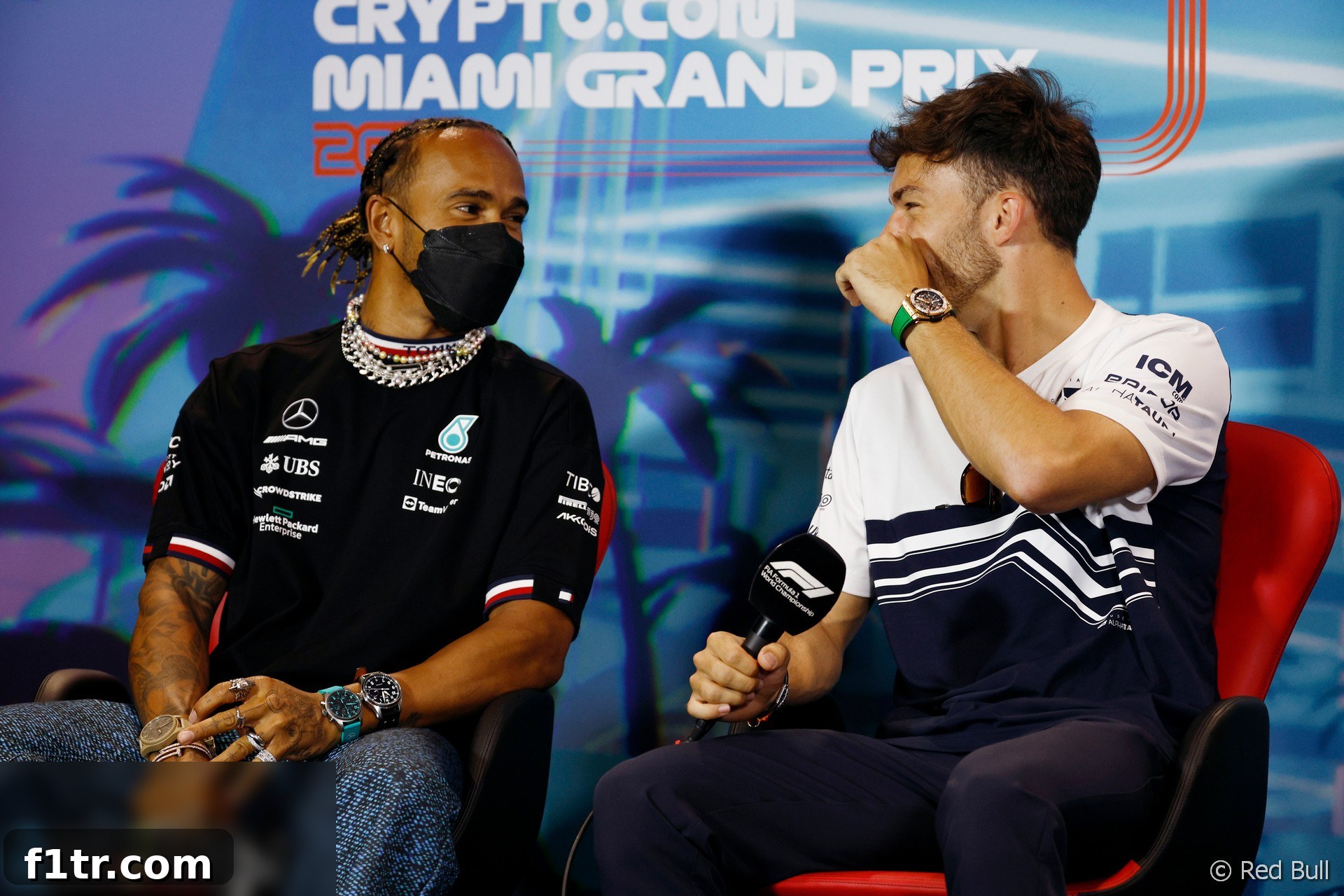
The world of Formula 1, renowned for its relentless pursuit of speed and cutting-edge technology, recently found itself embroiled in an unexpected debate: driver accessories. A renewed push by FIA race director Niels Wittich to strictly enforce safety rules regarding jewellery and underwear ignited a passionate controversy, pitting the sport’s governing body against some of its most prominent figures, most notably seven-time world champion Lewis Hamilton. While often framed as a “jewellery ban,” this regulation is far from new, yet its recent stringent application has raised significant questions about driver safety, personal expression, and the consistency of rule enforcement within motorsport’s elite echelons.
The FIA’s stance stems from critical safety considerations. Drivers were put on notice earlier in the year, with explicit reminders in Miami that jewellery, particularly body piercings or metal neck chains, could pose severe risks. In the event of a fire, metal items can superheat, increasing the risk and severity of burns. Furthermore, in the aftermath of an accident, such items could hinder crucial medical interventions or complicate necessary treatments. The official warning specified, “wearing of jewellery in the form of body piercings or metal neck chains is prohibited during the competition and may therefore be checked before the start.”
This intensified enforcement was met with immediate and vocal resistance from the paddock. Mercedes’ star driver Lewis Hamilton, known for his distinctive style and numerous piercings, felt particularly targeted by the renewed crackdown. He openly expressed his dismay, asserting that some of his piercings are fixed and cannot be easily removed. His long-standing practice of wearing jewellery throughout his 16-year career in the sport, without any prior action from the FIA or reports to stewards, underscored his argument against the sudden strict application of the rule. Sebastian Vettel even echoed this sentiment, suggesting that the FIA’s push seemed overtly “targeted to Lewis.”
Hamilton articulated his frustration, stating, “I feel like it’s almost like a step backwards if you think of the steps we’re taking as a sport, and the more important issues and causes that we need to be focused on and really pushing.” He emphasized the sport’s progress, particularly in areas of diversity and inclusion, remarking, “I think we made such great strides as a sport. Look, we’re here in Miami, this is such a small thing.” His argument highlighted a perceived disconnect between the FIA’s focus and what he considered to be the broader, more impactful agendas for Formula 1.
The inconsistency of the rule’s application became a central point of Hamilton’s argument. He pointed out the irony of a rule introduced two years before his Grand Prix debut suddenly becoming a contentious issue. “I’ve been in the sport 16 years, I’ve been wearing jewellery for 16 years, in the car I only ever have my earrings on, and my nose ring, which I can’t even remove,” he reiterated. He expressed hope for a resolution through dialogue, adding, “It seems unnecessary for us to get into this spat.” Hamilton confirmed his intention to communicate directly with FIA president Mohammed Ben Sulayem, affirming, “I’m here to be an ally of the sport, of Mohammed and Formula 1. And as I said, I think we’ve got bigger fish to fry, bigger things to do, more impact to have. So, I think that’s really where the focus should be.”
His team principal, Toto Wolff, publicly supported Hamilton’s call for a balanced approach. Wolff urged “a dialogue between Lewis and Mohammed” to navigate the delicate line between ensuring driver safety and upholding individual freedom of expression. “It is clear that regulations are here to protect the drivers,” Wolff stated, acknowledging the FIA’s primary responsibility. However, he quickly added, “On the other side, we need to keep the possibility on diversity and the means of expression and expressing yourself. And we know that this is important for Lewis.” This statement underscored the challenge of applying universal safety rules in a sport increasingly valuing personal identity and diversity.
While drivers like Hamilton champion personal expression, the FIA remains steadfast in its right to enforce safety regulations stringently. Driver safety is, without doubt, paramount, and the governing body bears the ultimate responsibility for mitigating risks. Yet, the current rule appears to contain certain ambiguities, particularly concerning symbolic items like wedding rings, which hold deep personal significance for many. These ‘grey areas’ complicate enforcement and fuel drivers’ arguments for exemptions or revised guidelines.
Haas driver Kevin Magnussen articulated this dilemma perfectly, acknowledging the FIA’s safety concerns but highlighting the emotional weight of certain items. Despite complying with the rules in Miami to avoid a hefty fine, Magnussen expressed a strong desire for specific exemptions. “I don’t want to pay the €250,000 (£214,000) fine,” he conceded, but added, “I understand what they are they saying, but it is a wedding ring around your finger. I’ll take a little bit of extra burn on my finger to race in my wedding ring. And if something was going to happen, something bad, I would want to wear my wedding ring. It kind of feels bad to take it off. With something like that, like your wedding ring, let us take that responsibility. There must be somehow to remove liability.” His comments underscore a willingness among some drivers to accept personal risk for items of profound sentimental value, challenging the blanket nature of the rule.
The renewed focus on safety, particularly regarding fire hazards, was tragically sharpened by the horrific 2020 crash involving Magnussen’s then-teammate, Romain Grosjean. Grosjean’s car exploded into a fireball, leaving him with severe burns on his hands. This incident undeniably brought the dangers of fire back to the forefront of driver safety discussions, even after decades of improvements. However, Grosjean himself, despite the visible scars on his hands, has stated unequivocally that he would never remove his wedding ring before racing. “I’ve been wearing my wedding ring all of my career,” he told Sky. “Where my ring was I was protected, so I was protected by my wife, saved by my kids. I understand some of it, but I wouldn’t like to race without my wedding ring. That is big for me.” This powerful testimony from a driver who has experienced the very dangers the FIA aims to prevent adds considerable weight to the arguments for personal exemptions.
Hamilton seized upon this distinction, particularly after receiving a temporary exemption for his fixed items of jewellery. Post-race, he confidently asserted, “I got an exemption here, I’ll get an exemption the rest of the year. Wedding rings are allowed.” This statement, however, highlights the potential for ongoing inconsistencies, as it implies a subjective application of the rule rather than a clear, universal policy. If wedding rings are deemed acceptable due to their symbolic nature and the associated personal responsibility drivers are willing to take, then the criteria for other “fixed” or religiously significant items become even more blurry, creating a complex challenge for the FIA.
Lewis Hamilton was not alone in his dissatisfaction. Pierre Gasly, who wears a cross for religious reasons and prays before entering the cockpit, acknowledged the FIA’s safety priorities but echoed Hamilton’s belief that “there are bigger things to focus on.” Gasly elaborated on his perspective: “I appreciate FIA are looking after our safety. That’s also their priority and our priority. My personal case, I have also religious items that I wear with me, when I’m racing, which are important to me, which I don’t feel comfortable not having with me driving the car, and I do feel it’s a little bit personal. We should have the freedom to do what feels right for us.” He added, “At the end of the day, we have the responsibility to go out there put our life at risk. And I do feel it should be a personal choice, but I respect the FIA and their will to always improve the safety. But I’ll appreciate a talk with them, to see if we can find a better solution than such a strict decision as they made. So we’ll see what we can do.” His plea for dialogue and a nuanced approach resonated with many, highlighting the profound personal and spiritual dimensions of the issue for some drivers.
Undoubtedly, the FIA’s intentions are rooted in the best interests of driver safety. The organization’s historical record demonstrates a consistent commitment to reducing risks in a sport inherently fraught with danger. Perhaps drivers have become somewhat accustomed to a degree of leniency in the past, leading to the perception of inconsistency. However, the manner in which the FIA has pursued this renewed enforcement has left many questioning its approach. The rigid application of a long-standing rule without prior consultation or a clear re-evaluation of its practical implications has created unnecessary friction.
The consequences for non-compliance remain a point of significant concern. While no official document explicitly outlines penalties for breaking the jewellery rule in F1, drivers like Magnussen anticipate substantial fines. The precedent set in other FIA-sanctioned events offers a glimpse into potential repercussions. At the Monaco EPrix, for instance, Porsche’s Pascal Wehrlein and Jaguar’s Mitch Evans each received a penalty point on their superlicences for wearing necklaces during qualifying. In Formula 1, accumulating enough superlicence points can lead to an automatic race ban, a scenario that carries immense implications, especially for a championship contender.
On a pivotal Friday, Lewis Hamilton made his resolve clear, demonstrating a willingness to escalate the conflict if necessary. “If they stop me, then so be it,” he declared, adding, “We’ve got a spare driver.” This defiant statement effectively drew battle lines: to enforce its ‘bling ban,’ the FIA may face the unprecedented decision of benching Formula 1’s most famous and successful driver. This would undoubtedly send shockwaves through the sport, raising fundamental questions about authority, individual rights, and the delicate balance required to govern a global phenomenon. The ongoing saga underscores the complex intersection of safety, personal identity, and regulatory power in the high-stakes world of Formula 1, suggesting that this particular debate is far from over.
News Focus
- Analyzing the dynamics of current driver market movements and team strategies.
- Examining driver lineup stability and strategic shifts across major F1 teams.
- The impact of high-stakes decisions on driver careers and team hierarchies.
- Insights into intense intra-team rivalries and their consequences on track.
- A look at contentious officiating decisions and their implications for race results.
Browse all News Focus articles