The global landscape of sports has been irrevocably altered, and Formula 1, the pinnacle of motorsport, is no exception. As the 2020 F1 season faced unprecedented delays and uncertainty, a novel solution emerged from the discussions: hosting multiple championship races at a single venue. This concept, while seemingly groundbreaking for the modern era of Grand Prix racing, echoes a fascinating chapter in F1 history when tracks routinely welcomed Formula 1 cars more than once a year. Understanding this historical precedent offers valuable insight into the adaptability and enduring appeal of the sport.
Advert | Become a Supporter & go ad-free
In contemporary Formula 1, the idea of a single circuit staging two or more points-paying races within the same calendar year is largely unprecedented. Throughout the official World Championship history, there’s no direct equivalent. The closest examples are historical anomalies, such as the 1959 German Grand Prix at AVUS, which, though contested over two heats, awarded points for only one championship round. Another experiment, the much-maligned double points finale at Abu Dhabi in 2014, attempted to artificially inflate championship drama, but was quickly abandoned due to its widespread unpopularity among fans and teams alike. These instances highlight the sport’s traditional adherence to a “one race, one venue, one championship round” format.
However, the narrative shifts significantly when we delve into the era of non-championship Formula 1 races. For decades, particularly in Britain, it was a common practice for F1 cars to compete on the same circuits multiple times a year. This tradition thrived thanks to a robust ecosystem of local teams and constructors, complemented by the occasional presence of international giants like Ferrari and Ligier, who were often enticed to make the journey across the Channel. These non-championship events served a crucial role, offering additional racing opportunities, acting as testing grounds for new components, and providing valuable entertainment for a passionate fan base.
Silverstone, a circuit frequently mentioned as a potential candidate for hosting multiple F1 races in the modern era, was a prime example of this multi-event tradition. Throughout the 1970s, it regularly hosted both the prestigious British Grand Prix and the annual BRDC International Trophy. Similarly, Brands Hatch, which famously shared the responsibility of staging Britain’s championship round during that period, also organized its popular non-points Race of Champions event, among others. These events were integral to the F1 calendar, providing continuous action for fans and vital track time for teams.
The late 1970s marked a turning point for non-championship races. As the official F1 World Championship calendar expanded, teams found themselves under increasing pressure, dedicating more time and resources to crucial tyre testing and Grand Prix preparations. The financial and logistical burden of participating in extra events became too great. By 1982, no non-championship F1 races were held, signaling the end of an era. The following year, 1983, witnessed the very last non-points-scoring Formula 1 event: the Race of Champions, once again held at the iconic Brands Hatch circuit and organized by the British Racing and Sports Car Club.
Bernie Ecclestone, then the formidable head of the Brabham team and chief of the Formula 1 Constructors’ Association (FOCA), gave his crucial blessing for the 1983 Race of Champions to proceed. He even ensured one of his team’s cars was present for the race on April 10th. However, with regular star drivers engaged in other commitments – Nelson Piquet on tyre testing duties and Riccardo Patrese competing in sports car events – former F1 driver Hector Rebaque was called upon to pilot the advanced BT52. This underscored the changing priorities, where even for a prestigious non-championship event, top drivers were not always readily available.
Advert | Become a RaceFans supporter andgo ad-free
Other leading teams similarly managed only single-car entries for the Race of Champions. Despite a somewhat slim 13-car field, the event still lived up to its grandiose title, featuring reigning world champion Keke Rosberg in his Williams and 1980 champion Alan Jones driving an Arrows. Home favorites John Watson (McLaren) and Nigel Mansell (Lotus) further bolstered the grid, ensuring a quality field for the British fans. This race was a final hurrah for a beloved format, bringing together a mix of current and former champions with up-and-coming talent.
The 1983 Race of Champions spanned 40 laps, a distance notably shorter than a full Grand Prix. Yet, almost half of the starting grid failed to reach the checkered flag. Among the numerous retirements were all the then-cutting-edge turbo-powered cars, showcasing the unreliability that still plagued these powerful machines in their early development stages. This attrition left American driver Danny Sullivan to chase reigning champion Keke Rosberg to the finish line, with the pair separated by a mere half-second. Sullivan’s second-place finish was a remarkable achievement, far outstripping anything he managed during his sole season of Grand Prix racing with Ken Tyrrell’s team that year. He would later achieve greater fame, winning the Indianapolis 500 two years later and the CART IndyCar title three years after that, demonstrating his immense talent. Alan Jones, securing third place, meant two former world champions graced the podium. This was also Jones’s second and final appearance in the Arrows A6, a car that, as Marc Surer recently recalled, was his favorite of his career.
Just five months later, Brands Hatch hosted another significant F1 event: the 1983 European Grand Prix. This championship round, scheduled as a replacement for a canceled race in New York, marked the second championship event in Britain that year (Silverstone having hosted the British Grand Prix). Of the drivers who had competed in the Race of Champions, Jones, Brian Henton, Jean-Louis Schlesser, Chico Serra, and Rebaque did not return for the European Grand Prix. Instead, a further 21 drivers showed up, swelling the entry list and leading to three failing to qualify for the 26-strong grid. Among those surprisingly missing the cut was Williams driver Jacques Laffite, who had also failed to qualify at Monza two weeks prior.
In defense of Laffite, Williams had stretched their resources thin by entering a third car for test driver Jonathan Palmer, making his F1 debut. When Keke Rosberg crashed in practice, the team was caught out, having to shuffle spare parts between their cars. Palmer ultimately made the cut in 25th place, but Laffite was relegated to spectator status for the second consecutive week, highlighting the intense competition and logistical challenges even for established teams.
Elio de Angelis delivered a moment of joy for Lotus, securing their first pole position since the death of founder Colin Chapman the previous December, and indeed, their first in nearly five years. This was also excellent news for tobacco brand John Player, who sponsored both Lotus and the race itself. Unfortunately for de Angelis, his main event ended prematurely due to Renault engine problems, a common refrain in that turbo era.
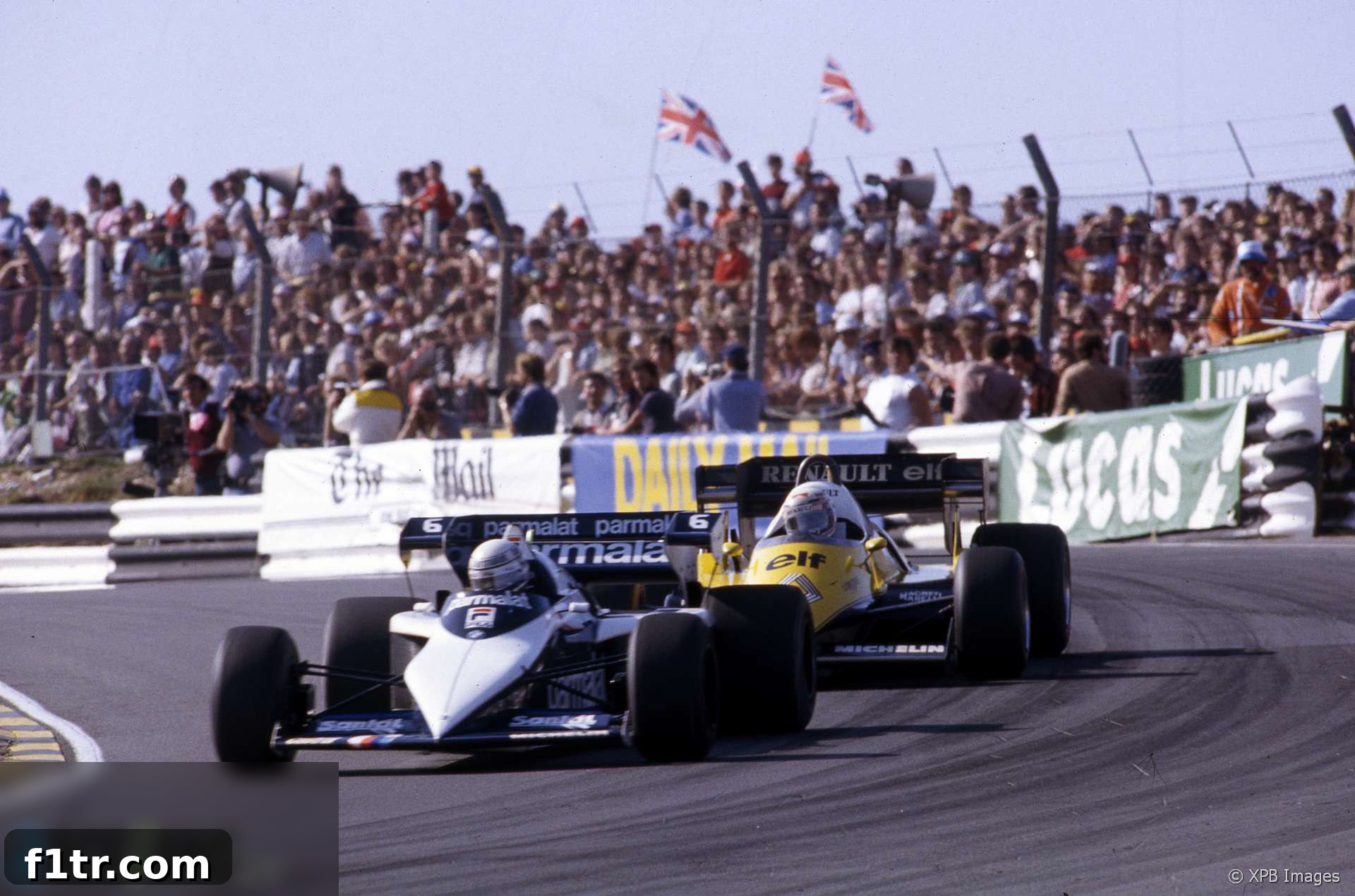
The European Grand Prix at Brands Hatch carried immense championship implications. Alain Prost, Nelson Piquet, and René Arnoux arrived at the circuit separated by a mere five points at the top of the drivers’ standings, setting the stage for a thrilling showdown ahead of the Kyalami decider. Piquet amplified the pressure on Prost by securing a dominant victory, replicating his triumph from Monza. Arnoux, however, spun out at Surtees and failed to score, significantly damaging his title hopes. Prost, demonstrating his characteristic consistency, limited the damage by finishing a crucial second.
Nigel Mansell provided Lotus’s sponsor with further reason to celebrate, achieving a commendable third place. This marked Mansell’s maiden visit to the rostrum in front of his adoring home crowd, a significant milestone in his burgeoning career. Two years later, at the very same circuit, he would achieve his first of many victories on British soil, cementing his status as a national hero. This 1983 event was a pivotal moment for both the championship contenders and the emerging British talent.
Since the non-championship F1 races faded from the sporting landscape 37 years ago, many countries, including Britain, Italy, Spain, Germany, and Japan, have hosted multiple championship rounds in a single year across different circuits. Yet, the unique scenario of a single track welcoming Formula 1 cars to race twice in a single year for championship points has remained an unrepeated historical footnote. The ability for tracks to do so in the past was a direct result of the sport’s immense popularity and the enthusiasm of race promoters, who could reliably count on drawing large crowds to the stands more than once a year. In stark contrast, the contemporary reality for the 2020 season was that even if multiple races were to be held at the same venue, the events would almost certainly have to take place in front of empty grandstands, a stark reminder of how much the world has changed and the challenges Formula 1 has to navigate.
Advert | Become a RaceFans supporter andgo ad-free
Result: 1983 Race of Champions, Brands Hatch
| Position | Number | Driver | Car | Laps | Time / gap / reason |
|---|---|---|---|---|---|
| 1 | 1 | Keke Rosberg | Williams-Ford Cosworth | 40 | 53’15.253 |
| 2 | 4 | Danny Sullivan | Tyrrell-Ford Cosworth | 40 | +0.490 |
| 3 | 30 | Alan Jones | Arrows-Ford Cosworth | 40 | +28.64 |
| 4 | 34 | Brian Henton | Theodore-Ford Cosworth | 40 | +40.52 |
| 5 | 26 | Raul Boesel | Ligier-Ford Cosworth | 40 | +40.971 |
| 6 | 17 | Jean-Louis Schlesser | RAM-Ford Cosworth | 39 | +1 lap |
| 7 | 33 | Roberto Guerrero | Theodore-Ford Cosworth | 39 | +1 lap |
| DNF | 29 | Chico Serra | Arrows-Ford Cosworth | 31 | Gearbox |
| DNF | 28 | Rene Arnoux | Ferrari | 24 | Tyres |
| DNF | 5 | Hector Rebaque | Brabham-BMW | 15 | Handling |
| DNF | 2 | John Watson | McLaren-Ford Cosworth | 9 | Vibrations |
| DNF | 12 | Nigel Mansell | Lotus-Renault | 7 | Handling |
| DNF | 40 | Stefan Johansson | Spirit-Honda | 5 | Engine |
Result: 1983 European Grand Prix, Brands Hatch
| Position | Number | Driver | Car | Laps | Time / gap / reason |
|---|---|---|---|---|---|
| 1 | 5 | Nelson Piquet | Brabham-BMW | 76 | 1:36’45.865 |
| 2 | 15 | Alain Prost | Renault | 76 | +6.571 |
| 3 | 12 | Nigel Mansell | Lotus-Renault | 76 | +30.315 |
| 4 | 22 | Andrea de Cesaris | Alfa Romeo | 76 | +34.396 |
| 5 | 35 | Derek Warwick | Toleman-Hart | 76 | +44.915 |
| 6 | 36 | Bruno Giacomelli | Toleman-Hart | 76 | +52.190 |
| 7 | 6 | Riccardo Patrese | Brabham-BMW | 76 | +1’12.684 |
| 8 | 9 | Manfred Winkelhock | ATS-BMW | 75 | +1 lap |
| 9 | 28 | Rene Arnoux | Ferrari | 75 | +1 lap |
| 10 | 16 | Eddie Cheever | Renault | 75 | +1 lap |
| 11 | 30 | Thierry Boutsen | Arrows-Ford Cosworth | 75 | +1 lap |
| 12 | 33 | Roberto Guerrero | Theodore-Ford Cosworth | 75 | +1 lap |
| 13 | 42 | Jonathan Palmer | Williams-Ford Cosworth | 74 | +2 laps |
| 14 | 40 | Stefan Johansson | Spirit-Honda | 74 | +2 laps |
| 15 | 26 | Raul Boesel | Ligier-Ford Cosworth | 73 | +3 laps |
| 27 | Patrick Tambay | Ferrari | 67 | Accident | |
| 3 | Michele Alboreto | Tyrrell-Ford Cosworth | 64 | Engine | |
| 32 | Piercarlo Ghinzani | Osella-Alfa Romeo | 63 | Throttle | |
| 29 | Marc Surer | Arrows-Ford Cosworth | 50 | Engine | |
| 1 | Keke Rosberg | Williams-Ford Cosworth | 43 | Engine | |
| 23 | Mauro Baldi | Alfa Romeo | 39 | Clutch | |
| 7 | John Watson | McLaren-TAG | 36 | Accident | |
| 4 | Danny Sullivan | Tyrrell-Ford Cosworth | 27 | Oil leak | |
| 8 | Niki Lauda | McLaren-TAG | 25 | Engine | |
| 11 | Elio de Angelis | Lotus-Renault | 12 | Oil pump | |
| 25 | Jean-Pierre Jarier | Ligier-Ford Cosworth | 0 | Clutch |
Did not qualify: Kenny Acheson (RAM-Ford Cosworth), Corrado Fabi (Osella-Alfa Romeo), Jacques Laffite (Williams-Ford Cosworth)
Go ad-free for just £1 per month>> Find out more and sign up
Pictures: 1983 European Grand Prix, Brands Hatch
More Formula 1 History
- When did F1 last have a mid-season break longer than five weeks? 1990
- Did Norris actually win Formula 1’s closest championship fight of all time?
- Hamilton is Ferrari’s first new driver in 44 years to complete season without a podium
- Ferrari are on course to lose an F1 record they’ve held since 2004
- Red Bull in 2010 or Ferrari in 1979? Past title fights illustrate McLaren’s current dilemma
Browse all history articles