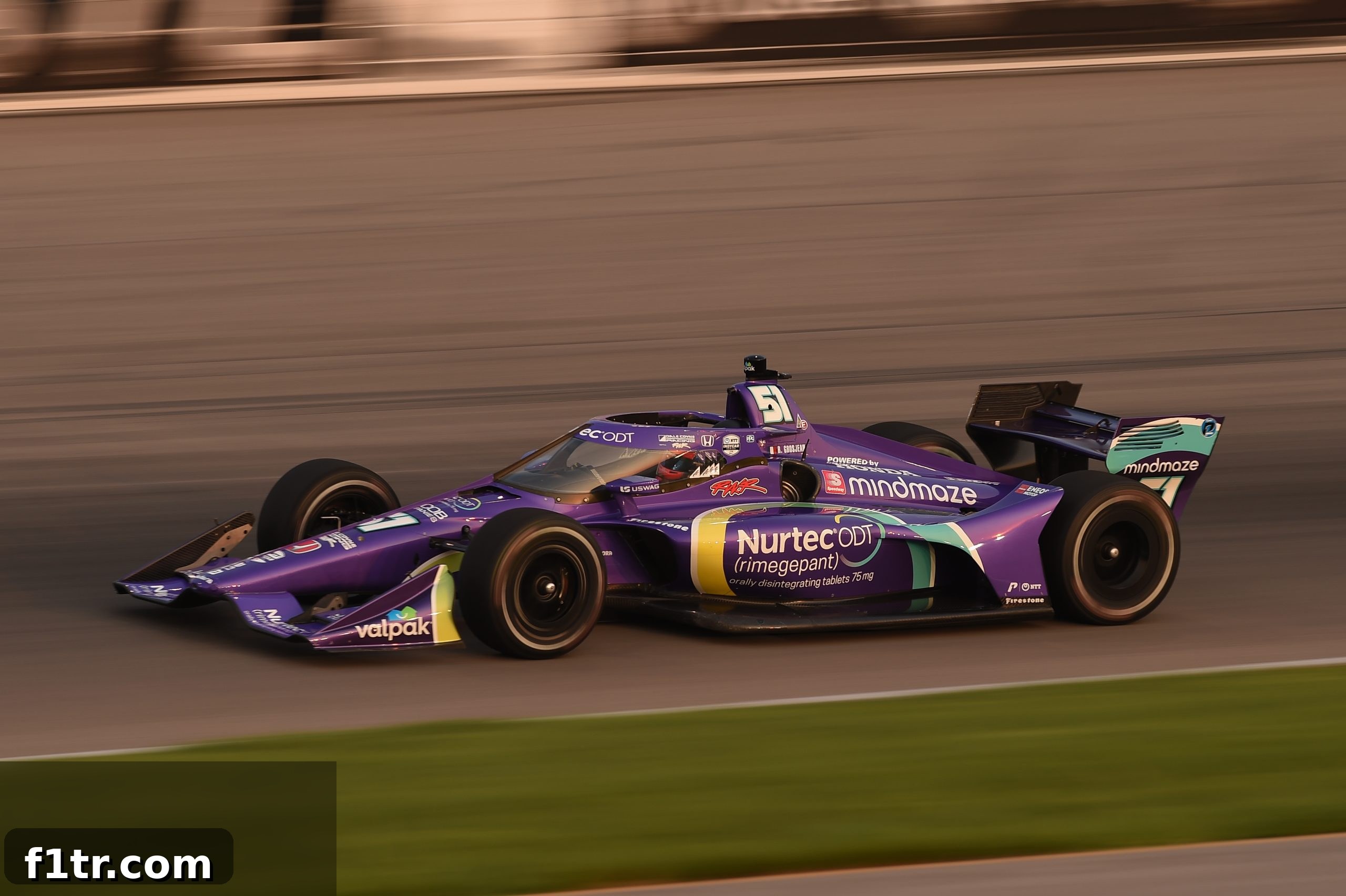
Romain Grosjean’s Pivotal IndyCar Oval Debut at Gateway: A New Frontier
After a stellar start to his IndyCar career on road and street courses, including two impressive second-place finishes at the iconic Indianapolis Motor Speedway road course, French motorsport sensation Romain Grosjean prepared for his most significant challenge yet: his oval racing debut. The eyes of the motorsport world, particularly those who followed his dramatic Formula 1 journey and remarkable recovery, turned towards Gateway Motorsports Park (officially World Wide Technology Raceway), where Grosjean was set to embark on an entirely new chapter in his decorated career.
Grosjean’s transition from Formula 1 to IndyCar was already one of the most compelling narratives in recent memory. Having survived a horrific crash at the 2020 Bahrain Grand Prix, his decision to join Dale Coyne Racing with Rick Ware Racing for the 2021 IndyCar season was a testament to his enduring passion for racing. His initial commitment focused solely on the road and street course events, a cautious approach given the unique demands and perceived risks of oval racing, especially in the wake of his life-threatening incident.
Embracing the “Proper Rookie” Mindset
Despite his extensive experience and success across various high-level motorsport categories, Grosjean candidly acknowledged the monumental step he was taking. “Next week I’m a rookie, a proper rookie,” Grosjean remarked ahead of the Gateway race. “I’ve been named a rookie all year long. I don’t feel like one. Next week I am one. I just want to gradually go for it, improve myself, and learn about it.” This declaration underscored the profound difference between the road course racing he had mastered and the high-speed, strategic world of oval competition.
Oval racing in IndyCar is a discipline unlike any other. It demands precision, unwavering focus, and a unique understanding of aerodynamics and tire degradation. Unlike road courses, where drivers navigate a series of varied turns, elevation changes, and heavy braking zones, ovals often consist of constant turning, minimal braking, and relentless pursuit of the perfect line. It’s a ballet of throttle control, subtle steering inputs, and an almost intuitive connection with the car’s behavior at blistering speeds. For a driver accustomed to the intricate braking and cornering techniques of Formula 1, adapting to the sustained lateral G-forces and aerodynamic dependency of an oval car is a fundamental re-education.
The Unforeseen Path to Oval Competition
While his initial contract stipulated road and street courses, the allure and challenge of oval racing began to subtly influence Grosjean. As early as March, just weeks into his IndyCar career, he hinted at the possibility, admitting there was a ‘high chance’ he would contest the 500-kilometer race at Gateway. This marked a significant shift in his perspective, signaling a growing comfort and curiosity within the IndyCar paddock.
The turning point came when Grosjean had his first taste of oval racing during an official test at Gateway the previous month. This crucial session provided him with invaluable experience and a firsthand understanding of the unique dynamics involved. It was here that he began to unravel the mysteries of this specialized form of racing, laying the groundwork for his competitive debut.
A Different Beast: Understanding Oval Racing Dynamics
His maiden oval test proved to be an eye-opening experience. “There was so much to learn. It’s so different from every type of racing I’ve done before,” Grosjean remarked. His initial impressions highlighted the seemingly contradictory nature of oval driving. “It’s a weird one. The car drives itself. People are telling you that’ll be fine, and you’re like, ‘what are they talking about, I drive my car!’ On the ovals I think the car does the work, and you control the speed, and it’s quite a bit of a strange feeling,” he added.
This “car drives itself” sensation refers to the incredible aerodynamic grip generated at high speeds, which effectively glues the car to the track. Drivers often describe it as feeling like the car is on rails, but this illusion belies the immense skill required to manage that grip, anticipate changes in downforce, and precisely control the throttle through sustained, high-speed corners. The challenge then shifts from aggressive braking and corner entry to maintaining momentum, managing tire wear, and navigating traffic with surgical precision, often inches from competitors at nearly 300 kph.
Despite the initial strangeness, Grosjean quickly found an appreciation for the unique thrill. “I think it’s just going to be a great experience. I want to see how it’s going, everyone seems to be enjoying ovals there. I still prefer road courses, but I like braking late. I’m looking forward to it and seeing what we can get out of it,” he shared. This blend of caution and excitement perfectly encapsulated his approach to this new challenge.
Safety and Family Approval: A Decisive Factor
The decision for Grosjean to tackle an oval was not made lightly, especially given the severity of his fiery crash in Bahrain, which left him with significant burns and an intense period of recovery. The memory of that incident weighed heavily on him and his family, making safety a paramount concern. Of the limited selection of ovals remaining on the IndyCar calendar that year, Gateway stood out as the lowest-risk choice for a rookie making their debut in this demanding discipline.
Crucially, his wife, Marion, and their three children accompanied him to Gateway for the July test. Their presence and firsthand observation of the track environment and the testing process played a vital role in easing their anxieties. Witnessing the controlled conditions, understanding the safety protocols, and seeing Romain comfortable behind the wheel on the oval helped alleviate their fears, providing the crucial family approval that empowered Grosjean to move forward with his oval debut.
Gateway: The Ideal Starting Point for a Rookie Oval Driver
Gateway Motorsports Park, a 1.25-mile (2.012-kilometer) egg-shaped oval, presented an ideal learning ground for Grosjean. Its characteristics offer a more forgiving introduction to oval racing compared to the higher-banked, higher-speed superspeedways like Texas Motor Speedway or the legendary Indianapolis Motor Speedway oval itself. Average speeds around Gateway peak at around 290 kph (180 mph), while the banking through turns one and two does not exceed 11 degrees. These factors contribute to a track that, while fast, is less inherently intimidating for a novice.
Furthermore, making a debut at a standalone event like Gateway is a far more relaxed setting than the intense pressure cooker of the Indianapolis 500, a race that demands years of experience and carries immense historical weight. Gateway allowed Grosjean to focus purely on learning the nuances of oval racing without the added burden of “The Greatest Spectacle in Racing.” The track’s unique layout, with different corner radii and banking, also offered a diverse set of challenges that would prepare him for a wider range of oval experiences, should he choose to pursue them.
The Evolving Perspective: From Skepticism to Adrenaline
With his family’s full support and a successful test under his belt, Grosjean officially appeared on the entry list for Saturday’s race, piloting his familiar number 51 Coyne/RWR Dallara-Honda. His usual substitute for oval races, Pietro Fittipaldi, would move to the number 52 car, a testament to the team’s commitment to supporting both drivers. After the initial test in July, Grosjean’s perspective on oval racing had profoundly shifted.
“Everyone who thinks it’s easy to run ovals is absolutely mistaken. It is tough and requires a different feeling, but I must say I’m enjoying it. I’m looking forward to discovering more,” he stated. This was a significant admission from a driver whose career had been defined by the intricate demands of road course racing. His enjoyment stemmed from the unique adrenaline and constant challenge that ovals presented.
“The racing is going to be the very exciting part. Every time you go into a corner, it’s a high-speed corner, and it’s fun, but it keeps the adrenaline going,” he elaborated. The sustained intensity, the precision required to maintain speed through the corners, and the proximity to other cars create a constant surge of adrenaline that is distinct from the explosive bursts experienced on road courses. For Grosjean, a driver who thrives on pushing boundaries, this new sensation was clearly captivating.
Grosjean’s Broader Impact on IndyCar
Romain Grosjean’s journey into IndyCar, and particularly his decision to embrace oval racing, transcended mere athletic competition. His presence injected a significant dose of international appeal and intrigue into the series. As a high-profile former Formula 1 driver, he brought with him a global fanbase and a compelling personal story of resilience and courage. His willingness to confront his fears and adapt to a completely different form of motorsport served as an inspiration, attracting new viewers and media attention to IndyCar.
His detailed and honest reflections on the challenges and joys of learning oval racing provided a unique perspective, demystifying a discipline that many European racing fans might not fully understand. By sharing his experiences, he helped bridge the gap between different racing cultures, showcasing the skill and dedication required in all forms of top-tier motorsport. His debut at Gateway was not just a personal milestone but also a moment that further elevated IndyCar’s profile on the world stage, demonstrating its allure for elite drivers seeking diverse and thrilling challenges.
As Romain Grosjean prepared to make his competitive oval debut at Gateway, the motorsport community watched with bated breath. This race was more than just another event on the calendar; it was a testament to his incredible fortitude, adaptability, and unwavering love for racing. It marked a pivotal moment in his IndyCar career, signaling his full immersion into the diverse and exhilarating world of North American open-wheel racing. His journey from the confines of Formula 1 cockpits to the high-speed challenges of IndyCar ovals underscored his status as one of motorsport’s most compelling and resilient figures.
IndyCar
- IndyCar driver McLaughlin cleared of injury after crashing through barrier at Barber
- Schumacher says his IndyCar feels like ‘an F2 car, just with better tyres’
- IndyCar “way faster than Formula 1” in some corners, says Grosjean
- FIA to award more F1 superlicence points to IndyCar drivers from 2026
- Schumacher to race full-time in IndyCar with RLL in 2026
Browse all IndyCar articles