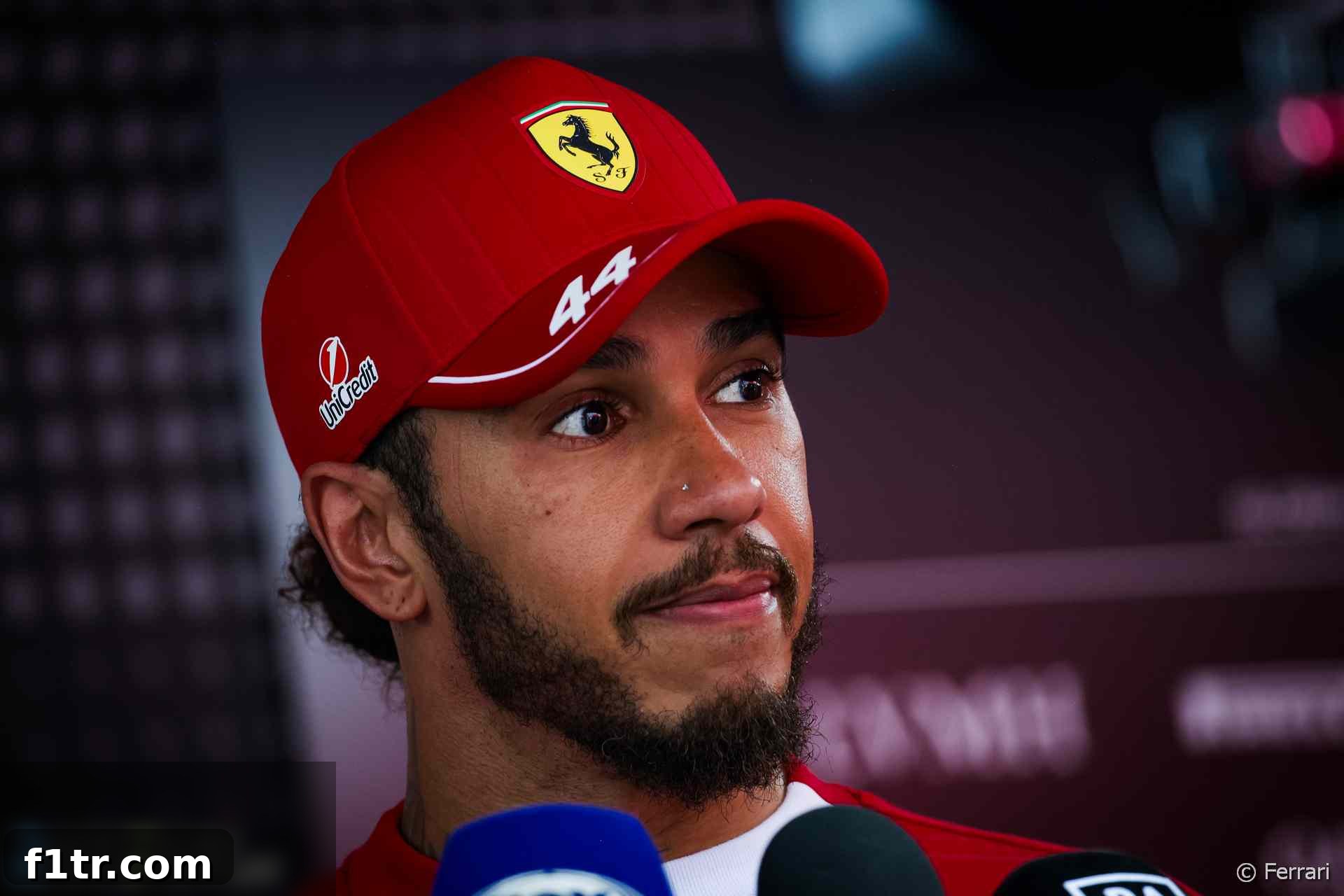
The summer break arrived for Lewis Hamilton amidst a storm of personal frustration, his candid assessment of his new Ferrari — labeling his efforts and the car’s performance with words like “shit” and “useless” — echoing through the paddock after a dismal points-less finish in Hungary. This period of reflection undoubtedly served as a stark reminder of the immense challenge he has embraced by joining the Scuderia.
There’s no denying that Hamilton’s initial foray with the Prancing Horse has been a demanding one, falling short of the lofty expectations that naturally accompany a driver of his caliber moving to such an iconic team. However, to view his season as an unmitigated disaster would be an oversimplification. Prior to that particularly brutal weekend at the Hungaroring, there were tangible signs of progress, moments of brilliance, and an undeniable commitment to mastering a car that has proven tricky for even its most seasoned drivers.
Advert | Become a Supporter & go ad-free
It’s also crucial to place Hamilton’s struggles within the broader context of Ferrari’s season. The team itself has experienced a regression compared to the competitive form they displayed last year. Their challenger, the SF-25, despite showing flashes of pace, has yet to secure a genuine Grand Prix victory, highlighting the fundamental performance hurdles that both Hamilton and his highly regarded teammate, Charles Leclerc, have had to contend with throughout the championship campaign. The team’s overall performance dip indicates that the challenges faced by Hamilton are not solely individual but deeply rooted in the car’s characteristics and the team’s development trajectory.
Early Season Glimmers and Strategic Gambles
The opening round of the season, a highly anticipated debut for Hamilton in red, offered a misleading glimpse of potential. Hamilton initially led the race, a direct consequence of an aggressive, albeit ultimately over-optimistic, strategy in a rain-affected event. While the tactical gamble put him at the front for a fleeting moment, he eventually faded to a tenth-place finish, underscoring the complexities and risks involved in pushing the boundaries of strategy, especially with a new car and team dynamic. This early experience set a precedent for a season filled with learning curves and adaptation.
Lewis Hamilton
| Best | Worst | |
|---|---|---|
| GP start | 4 | 18 |
| GP finish | 4 (x3) | 12 |
| Points | 109 | |
The season’s sprint races, however, have provided Hamilton with some of his most significant triumphs and strong points finishes. In Shanghai, he delivered a masterclass performance, leading all the way from pole position to secure a commanding victory in the sprint race. This achievement offered a potent reminder of his raw speed and race craft. Yet, suspicions within the paddock that the Ferrari SF-25 could only be made truly competitive when run at ride heights lower than what was sustainable for a full Grand Prix distance seemed to gain traction following the subsequent main race. Both Hamilton and Charles Leclerc were later disqualified from the Grand Prix for a separate technical infringement, casting a shadow over what had initially appeared to be a promising weekend.
Hamilton’s second-best result of the season also came in a sprint format, this time at the vibrant Miami Grand Prix. A perfectly timed and executed switch to slick tires as the track rapidly dried out saw him surge through the field, ultimately securing a valuable third-place finish. These sprint successes highlight Hamilton’s enduring ability to capitalize on changing conditions and execute flawless strategic decisions under pressure, even as he grapples with the overall characteristics of his new machinery.
Adapting to the SF-25 and the Teammate Dynamic
As Ferrari’s engineers diligently worked on improving the SF-25, Lewis Hamilton embarked on his own parallel mission: understanding and adapting his driving style to extract the maximum performance from the car. This often involved a process of trial and error, a fundamental shift from years of driving a Mercedes car that had been meticulously tailored to his preferences. Over the initial rounds of the championship, Charles Leclerc routinely held an edge over Hamilton in qualifying sessions, demonstrating his innate familiarity and comfort with the Ferrari’s specific demands.
However, a recurring pattern emerged on race day. Hamilton, leveraging his vast experience and renowned race craft, often managed to improve his track position, showcasing his ability to manage tires, optimize strategy, and fight through the field. This consistency in Sunday performances, even when starting further back, was a testament to his enduring quality and a crucial factor in keeping him within striking distance of Leclerc in the drivers’ championship.
Even in the tight confines of Monaco, Hamilton demonstrated this knack for climbing the order, helping to mitigate the team’s blushes after he incurred a three-place grid drop on Saturday. His ability to perform under pressure, even when the cards were stacked against him, underlined his resilience. Montreal, however, presented a different kind of challenge, where a bizarre and unavoidable incident involving a groundhog crossing his path tragically compromised his race, illustrating how luck can sometimes play an unforeseen and frustrating role in motorsport outcomes.
Advert | Become a RaceFans supporter andgo ad-free
Mid-Season Momentum and Missed Opportunities
Having secured just a single top-five finish from the first six Grand Prix races, Hamilton notably elevated his performance level at Imola. He executed an impressive eight-place gain to finish fourth, a result significantly aided by shrewdly timed pit stops during periods of race neutralization. This performance showcased a growing understanding of the car and effective collaboration with his strategic team. Yet, despite subsequently securing two more fourth-place finishes, the elusive podium finish in his Ferrari overalls remains a significant milestone he is yet to achieve.
Perhaps his clearest opportunity for a podium came at Silverstone, a circuit where he has historically excelled. Here, he had a genuine chance to beat Nico Hulkenberg to third place. While an excuse could be made for Hulkenberg getting the better of him in Spain, where the Sauber driver benefited from significantly fresher tyres, Silverstone presented a missed opportunity of Hamilton’s own making. A hasty and ill-timed switch to slick tires at the very end of the race proved to be a critical misjudgment, allowing Hulkenberg to consolidate his podium position. Such moments, though painful, are part of the learning process for a driver adapting to a new team and car, where the fine margins of strategy can make all the difference.
In the challenging, rain-affected conditions at Spa-Francorchamps, Hamilton once again displayed his superior wet-weather driving skills, hauling himself up from an eighteenth-place start to finish a commendable seventh. While a strong drive, the necessity of such a recovery was amplified by his second first-round qualifying elimination in as many days, highlighting a recurring inconsistency in Saturday’s performance that needs addressing. The variability in qualifying remains a key area for Hamilton and Ferrari to focus on as they push for stronger starting positions.
The very same weekend at Spa brought a contrasting narrative for his teammate. Charles Leclerc immediately put Ferrari’s much-anticipated suspension upgrade to excellent use, delivering his fifth podium finish of the season. This stark contrast in results underscored the effectiveness of the upgrade and Leclerc’s seamless integration with it. He followed this strong showing with a solid fourth-place finish in Hungary, while Hamilton, unfortunately, started and finished in a disappointing twelfth, further fueling his public frustration and emphasizing the gap that emerged between the two drivers on that particular weekend.
Assessing the Trajectory: Disappointment vs. Potential
While Lewis Hamilton’s inaugural season with Ferrari has undoubtedly been a challenging one, it’s perhaps not the unmitigated disaster that some observers are quick to portray. He finds himself immediately behind Charles Leclerc in the highly competitive drivers’ championship standings, and until the frustrating Hungarian Grand Prix, he had consistently brought his SF-25 home in the top ten at every Grand Prix event. This level of consistency, even when battling an unfamiliar car and strong opposition, speaks volumes about his underlying talent and perseverance.
However, despite the visible efforts and moments of strong performance, Hamilton himself must feel a deep sense of disappointment. Regardless of how difficult he anticipated this transition to be, the lack of a podium finish or a significant statement victory by the mid-point of the season weighs heavily on a driver accustomed to a relentless pursuit of success. The Ferrari journey represents a new chapter, a fresh challenge, and while the initial results haven’t met the sky-high expectations, the potential for a formidable partnership between Hamilton and the Scuderia remains. The second half of the season will be crucial in demonstrating whether they can unlock the SF-25’s full potential and propel Hamilton back to the front of the Formula 1 grid, cementing his legacy in new colors.
Miss nothing from RaceFans
Get a daily email with all our latest stories – and nothing else. No marketing, no ads. Sign up here:
Advert | Become a RaceFans supporter andgo ad-free
Formula 1
- Controversies, Norris, Newey and more: Five new motorsport books reviewed
- One of F1’s greatest races happened 15 years ago today. Or did it?
- “Overtaking is overtaking”: Domenicali denies F1’s yo-yo racing is “artificial”
- The crashes F1 is trying to prevent may be rare – but the danger is obvious
- F1 returning to India soon after 2027 sounds like wishful thinking
Browse all Formula 1 articles