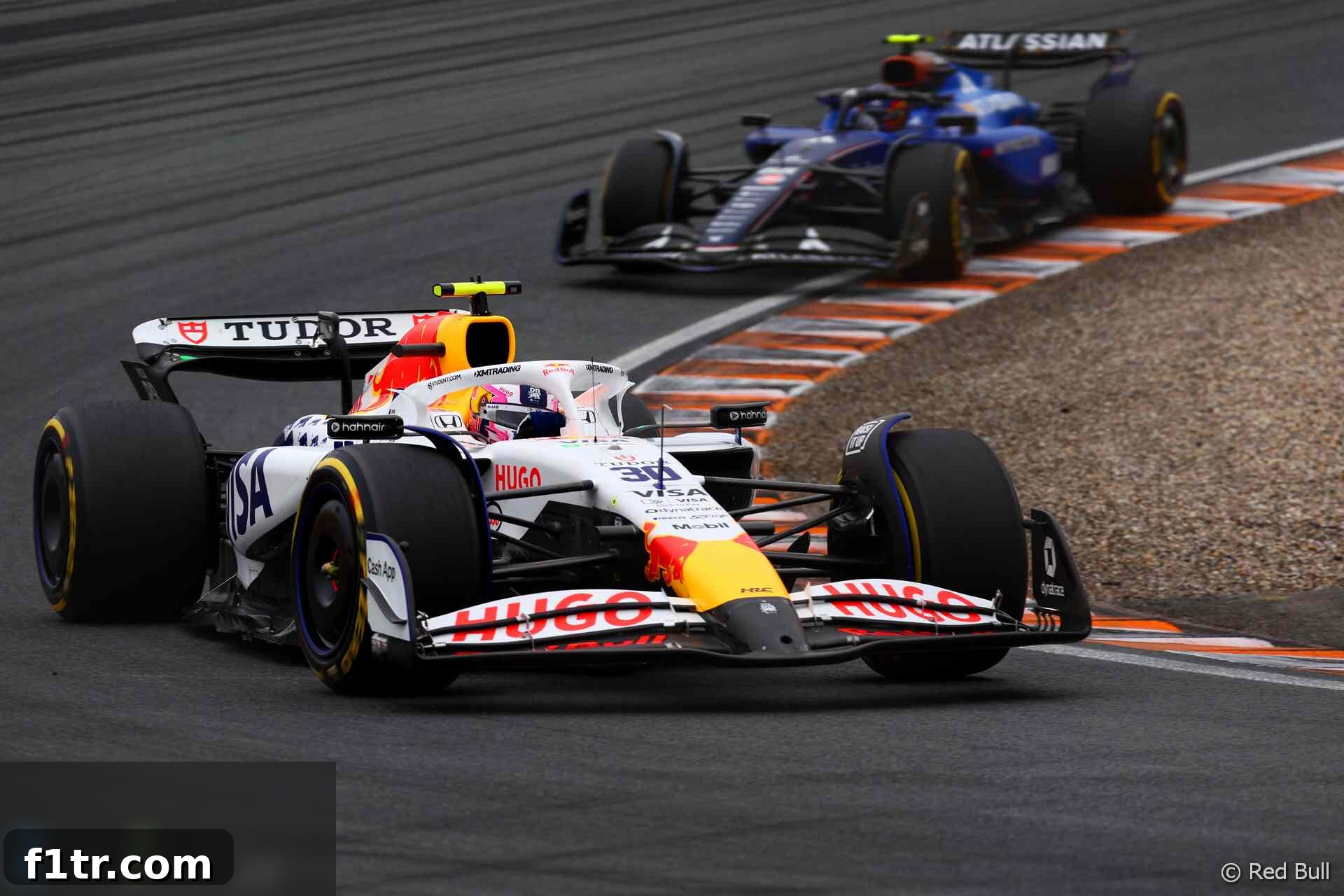
Liam Lawson has publicly accepted the revised verdict from the Formula 1 stewards regarding his collision with Carlos Sainz Jnr. This marks a significant shift in his stance, as he had previously stated that his rival’s initial penalty was entirely justified. The incident, which occurred during a high-stakes moment at the Dutch Grand Prix, sparked considerable debate and ultimately led to an unprecedented review process that highlights the complexities of F1 stewarding.
Advertisement
Lawson Shifts Stance: Accepts Sainz Collision as Racing Incident After Stewards’ U-Turn
The controversy began at the Zandvoort circuit when Sainz received a 10-second time penalty and two penalty points for his role in the collision with Lawson. However, the Williams team, for whom Sainz was driving at the time, later requested that the stewards review their decision. This right of review, a crucial but rarely invoked mechanism in Formula
Formula 1, allows teams to present “significant new elements” that were not available to the stewards at the time of their initial ruling. The Dutch Grand Prix stewards, after careful reconsideration, overturned their decision to solely blame Sainz for the incident.
While the stewards were unable to revoke the 10-second time penalty that Sainz had already served during the race – a practical limitation once a race has concluded and results are final – they did rescind the two penalty points initially assigned to him. This partial reversal indicated a change in their interpretation of the events, acknowledging a more nuanced perspective on the collision.
Initial Reaction vs. Evolving Understanding
Immediately following the chaotic Dutch Grand Prix, Liam Lawson, then driving for AlphaTauri, was unequivocal in his assessment. He firmly believed that Sainz’s original penalty was warranted. “For it to be his corner, he has to be ahead at the apex,” Lawson had stated in Zandvoort. “He wasn’t anywhere near that today, so that’s why he got a penalty for it, I’m guessing.” This direct quote captured Lawson’s on-the-spot analysis, reflecting a common driver’s perspective on racing etiquette and the critical importance of track positioning at the corner’s apex.
However, the narrative began to evolve. Lawson himself participated in the subsequent hearing dedicated to reviewing Sainz’s penalty. During this session, he initially contested the argument put forth by Williams, which claimed that he had briefly lost control of his car just prior to the contact. Williams’s assertion was a pivotal element in their request for review, suggesting that external factors beyond Sainz’s sole control contributed to the incident. Despite Lawson’s initial opposition, the stewards ultimately accepted the argument presented by Williams. This acceptance formed the crucial basis for their decision to rescind Sainz’s penalty points, highlighting the detailed scrutiny and multiple perspectives considered in such reviews.
Acceptance of the “Racing Incident” Verdict
Reflecting on the comprehensive review process and the updated verdict, Lawson has now expressed his agreement that the collision was, in fact, a racing incident. Speaking ahead of a subsequent race weekend, he articulated his evolved understanding. “Honestly, every incident is going to be slightly different in its own way,” he commented, acknowledging the inherent variability and unique circumstances surrounding each on-track confrontation in Formula 1.
Lawson elaborated on the challenges faced by regulatory bodies in defining clear-cut rules for every conceivable scenario in a sport as dynamic as Formula 1. “You have regulations, written as they are, and we’re always trying to maximise them and race to them as much as we can. I think we all probably agree that they’re not always right or we feel they can be slightly better, but it’s very hard to write a clear set of regulations in Formula 1 when every single scenario is different.” This statement underscores a shared sentiment among drivers and teams about the difficulty of applying universal rules to incredibly diverse racing situations.
For Lawson, the final determination brought clarity and closure. “For me, it didn’t make a difference — it was a racing incident. If you look at it on TV, that’s what it looks like, I would say, as well. I have no problem with it, that’s for sure.” His acceptance is a testament to the transparency and thoroughness of the review process, even if it initially contradicted his immediate post-race feelings. It showcases a maturity in understanding the intricate nuances of motorsport officiating.
Advertisement
The Implications of F1 Stewarding and Review Processes
The case of Liam Lawson and Carlos Sainz at the Dutch Grand Prix serves as a compelling illustration of the intricate and often contentious nature of stewarding in Formula 1. The decision to review and partially overturn Sainz’s penalty carries significant implications for future incidents and the overall perception of regulatory consistency. This specific review highlighted the FIA’s willingness to re-examine controversial decisions, provided that new and relevant evidence is brought forward. It reinforces the principle that initial rulings, made under intense pressure and with limited real-time information, are not immutable.
The “right of review” mechanism is a vital safeguard, ensuring fairness and encouraging teams to provide all available data for a comprehensive assessment. However, it also opens the door to potential challenges against every contentious penalty, potentially leading to longer periods of uncertainty post-race. The balance lies in maintaining the integrity of immediate race results while allowing for corrections when significant new elements come to light.
What Constitutes a “Racing Incident”?
The term “racing incident” is frequently used in motorsport, often acting as a resolution for collisions where no single driver is deemed predominantly at fault. It implies that the contact was an unavoidable consequence of two or more drivers competing aggressively for the same piece of track, within the normal bounds of hard racing. Factors such as track conditions, the specific corner’s characteristics, driver skill, and even momentary lapses in concentration can all contribute to an incident being classified this way. Lawson’s eventual acceptance of this classification suggests that the totality of evidence, including potentially unseen angles or telemetry data, pointed towards a shared responsibility or an unavoidable coming-together.
The stewards’ initial ruling often relies heavily on video footage and driver testimonies immediately after the race. During a review, however, teams can present detailed telemetry, advanced simulations, and expert witness testimonies, which can collectively paint a much clearer picture of the milliseconds leading up to and during the collision. This deeper dive into data is crucial for re-evaluating complex situations and determining whether an incident was a clear breach of rules or simply an unfortunate outcome of competitive racing.
Consistency in Stewarding: An Ongoing Challenge
The F1 community, including drivers, teams, and fans, consistently demands greater consistency in stewarding decisions. The Sainz-Lawson incident, with its initial penalty and subsequent reversal, exemplifies the inherent challenges in achieving this. Each incident, as Lawson himself noted, is unique. While the FIA strives to provide a clear framework of regulations and precedents, the subjective interpretation of events by different sets of stewards can lead to perceived inconsistencies. The review process, while offering a chance to correct mistakes, also highlights the initial discrepancies, fuelling ongoing discussions about training, guidelines, and the technological tools available to stewards.
Looking Ahead for Drivers and Regulations
For both Carlos Sainz and Liam Lawson, this incident, and its resolution, represent a learning experience. For Sainz, the rescinding of penalty points was a partial vindication, even if the time penalty remained. For Lawson, it demonstrates an evolving understanding of the sport’s intricacies, moving beyond immediate emotional reactions to a more considered and rational acceptance of official rulings. It also reinforces his growing reputation as a thoughtful and measured driver, capable of adapting his views based on new information.
This case further encourages ongoing dialogue between the FIA, teams, and drivers to refine the rulebook and improve the consistency and transparency of stewarding decisions. As Formula 1 continues to push the boundaries of technology and competition, the systems in place to govern fair play must evolve in parallel, ensuring that the sport remains thrilling, fair, and understandable for all stakeholders.
Don’t Miss the Latest Formula 1 Updates
Receive our daily email with all the newest stories – no marketing, no ads. Sign up below:
Related Articles on the Dutch Grand Prix and F1 Penalties
- Williams’s Penalty Review Success: What it Means for Future F1 Challenges
- Lawson now accepts Sainz collision was a “racing incident” after stewards’ U-turn
- Stewards’ U-turn over Zandvoort penalty shows ‘how far the FIA have come’ – Sainz
- The FIA’s stewards grabbed the chance to correct their mistake – unlike last time
- Sainz’s Dutch GP penalty points cancelled as stewards accept Williams’ request for review
Browse all Dutch Grand Prix articles