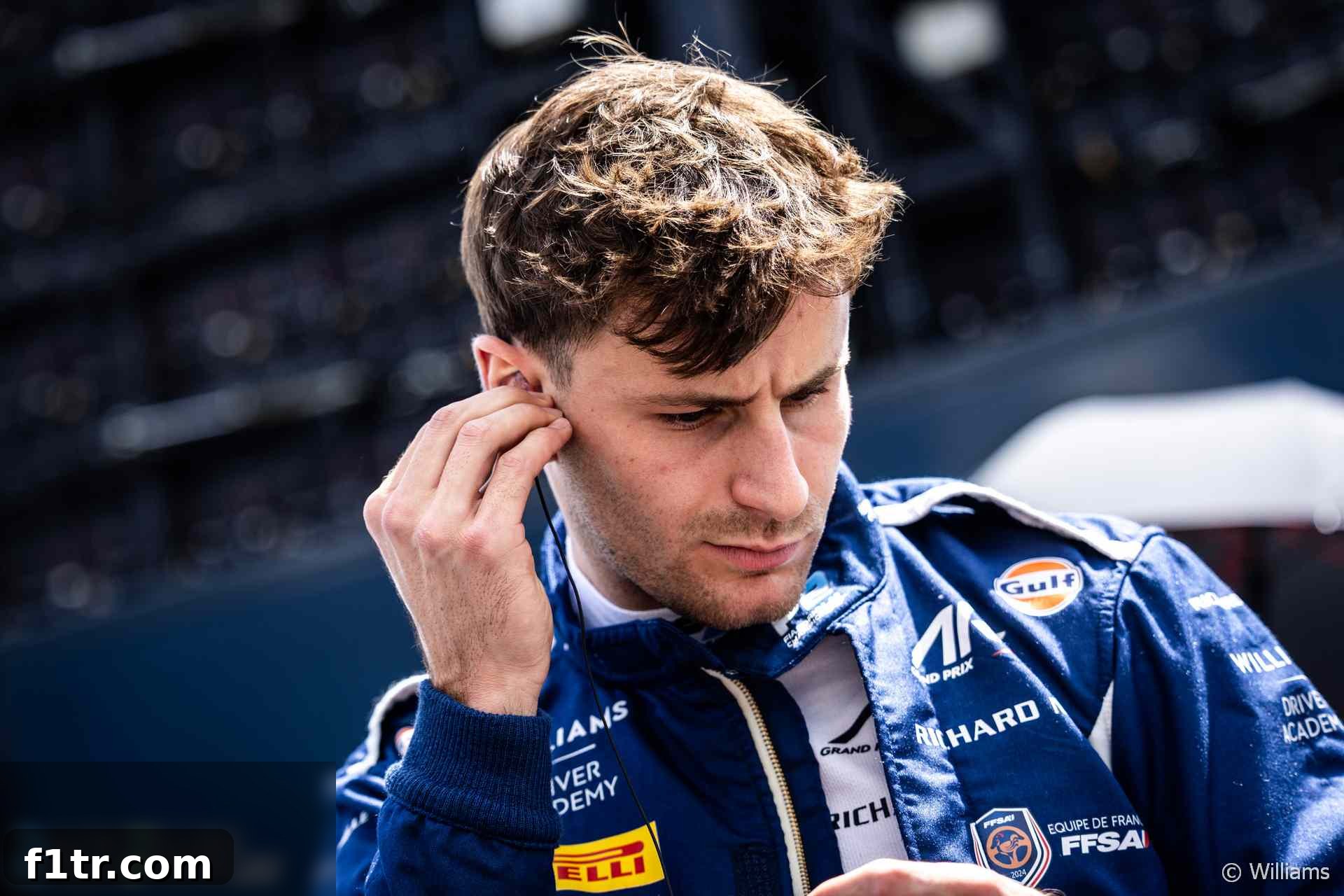
Williams Racing has officially announced Victor Martins as its dedicated Test and Development Driver for the highly anticipated 2026 Formula 1 season, signaling a strategic investment in future talent and the crucial development of its next-generation machinery. This significant appointment underscores the team’s commitment to leveraging young prospects and cutting-edge simulation technology as they prepare for the sport’s impending regulatory overhaul.
Martins, aged 24, initially joined the illustrious Williams junior driver development programme just last year, quickly making an impression within the Grove-based outfit. His journey has seen him briefly affiliated with Alpine, a connection that will be rekindled as he prepares to drive for their World Endurance Championship team this season, broadening his experience across different top-tier motorsport disciplines. This dual role will undoubtedly provide him with a diverse range of driving experiences and technical understanding, invaluable assets for his F1 development duties.
The Frenchman isn’t entirely new to the pinnacle of motorsport, having made his official Formula 1 practice session debut at the Spanish Grand Prix last year. This initial taste of F1 machinery provided him with crucial real-world context, a foundational experience that will prove invaluable as he steps into this more formal development role. However, Martins, a celebrated 2022 Formula 3 champion, experienced a challenging and ultimately disappointing third season in Formula 2, a category often seen as the final proving ground for F1 aspirants.
After a promising rookie season in 2023, where he finished an impressive fifth in the standings with ART Grand Prix, Martins had entered his 2024 campaign with high hopes of mounting a serious title challenge. Despite demonstrating flashes of brilliance, including securing two feature race victories, he concluded the season in a somewhat understated 11th position overall. This placed him seven places behind fellow Williams junior, Luke Browning, who enjoyed a stronger debut full year in the fiercely competitive feeder series. While his F2 performance may not have met initial expectations, Williams’ continued faith in Martins highlights their recognition of his underlying talent, technical acumen, and potential beyond raw championship results.
The Pivotal Role of a Test and Development Driver in Modern F1
In the hyper-competitive world of Formula 1, the role of a Test and Development Driver has evolved significantly. With stringent restrictions on track testing, the primary avenue for car development has shifted indoors to sophisticated driver-in-loop (DIL) simulators. Victor Martins will be at the forefront of this crucial work, collaborating closely with experienced development drivers Oliver Turvey and Harrison Scott within the team’s dedicated simulation programme. Their collective efforts will be instrumental in shaping the performance characteristics of future Williams challengers.
A DIL simulator is far more than just a video game; it’s an immersive, highly accurate virtual environment designed to replicate every aspect of a Formula 1 car’s behaviour and a real-world track. Drivers provide critical feedback on car setup, aerodynamic balance, suspension characteristics, and tyre behaviour, all before components are even manufactured or taken to the track. This iterative process allows engineers to rapidly test and refine new concepts, significantly reducing development time and costs. For a team like Williams, aiming to return to the sport’s elite, maximizing the efficiency and effectiveness of their simulation programme is paramount.
Williams’ Ambitious Vision for the 2026 Regulations
The 2026 Formula 1 season marks a seismic shift in the sport’s technical regulations, particularly concerning power units and aerodynamics. This regulatory reset presents a unique opportunity for every team on the grid to gain a competitive advantage, and Williams is keenly focused on being at the forefront of this change. The appointment of Victor Martins is a clear indicator of their proactive approach to this challenge.
Williams Sporting Director Sven Smeets emphasized Martins’ crucial contribution, describing him as “a talented driver who has consistently given invaluable guidance and feedback to the team, improving our on-track performance and supporting our race drivers throughout the 2025 season.” This direct contribution, often behind the scenes, is vital. While race drivers Alex Albon and Logan Sargeant focus on race weekends, development drivers ensure that the fundamental tools and understanding are in place for continuous improvement.
Smeets further elaborated on the practical relevance of Martins’ experience: “His recent experience driving the FW47 in Barcelona and supporting the TPC [Testing of Previous Cars] programme gives him the real-world context to make a real impact on the development of the FW48 and future car programmes.” This blend of on-track mileage, even in previous-generation cars, combined with extensive simulator work, creates a holistic understanding that is indispensable for guiding the design and setup of brand-new cars, especially those conforming to drastically different regulations.
Martins’ Ambition and the Road Ahead
For Victor Martins, this promotion represents a significant milestone in his career and a clear pathway towards his ultimate goal of a full-time F1 race seat. Expressing his gratitude and excitement, Martins stated, “Williams is an iconic team with an incredible history, and I’m excited to be part of the project to bring this team back to the front of the grid.” His words reflect a deep understanding of Williams’ heritage and their current trajectory.
Under the leadership of Team Principal James Vowles, Williams has been steadily rebuilding, implementing strategic changes, and investing in infrastructure and personnel. While the team finished 7th in the constructors’ championship in 2023, the sentiment of a team on the rise is accurate. Martins’ role will be pivotal in maintaining this upward momentum, providing a critical link between engineering theory and practical application.
The journey from junior category success to a full-time F1 race seat is arduous, but the role of a test and development driver is often a crucial stepping stone. It allows drivers to integrate deeply with an F1 team, understand its methodologies, and directly contribute to performance, showcasing their value beyond just lap times in a junior series. For Martins, this is an unparalleled opportunity to demonstrate his long-term potential and immerse himself in the complex world of Formula 1 car development.
The Strategic Importance of Driver Development
Williams’ long-standing commitment to nurturing young talent through its driver academy is a testament to its forward-thinking strategy. The junior driver programme is designed to identify, support, and integrate promising individuals into the team’s operations. Martins’ progression from a junior driver to a dedicated test and development role exemplifies the effectiveness of such programmes. It not only provides a pipeline for future talent but also ensures a continuous flow of fresh perspectives and highly skilled individuals contributing to the team’s immediate and long-term success.
The 2026 regulations will necessitate an unprecedented level of development work, with teams essentially designing a fundamentally new car from the ground up. Having experienced and adaptable drivers like Martins, Turvey, and Scott working tirelessly in the simulator will be a cornerstone of Williams’ strategy to hit the ground running when the new era begins. Their ability to translate complex engineering data into tangible driving sensations and precise feedback will be a competitive differentiator.
In conclusion, Victor Martins’ appointment as Williams’ Test and Development Driver for 2026 is far more than a routine announcement. It represents a strategic move by Williams Racing to future-proof its technical development, invest in promising talent, and rigorously prepare for one of Formula 1’s most significant regulatory changes in recent memory. As Martins embarks on this crucial role, his contributions from the simulator will be silently shaping the future performance of a legendary team aiming to reclaim its former glory on the world stage.
View the current list of 2026 F1 drivers and teams
Formula 1 Insights & Related Articles
- Understanding F1 Driver Development Programmes
- The Evolution and Impact of F1 Simulator Technology
- Decoding the 2026 F1 Technical Regulations
- Williams Racing: A Legacy Reimagined
- Pathways to F1: The Junior Driver Journey
Browse all Formula 1 articles