“As stewards, we are not here to inflict pain on drivers,” insisted Garry Connelly, the FIA’s chairman of Formula 1 stewards, following a rare pre-race meeting between officials and competitors in Qatar. He elaborated, “We’re here to provide a level playing field. It’s not us against the drivers, it’s the drivers against the drivers, and we’re here to make sure everyone gets a fair go.” These noble sentiments, aiming for harmony and fairness, unfortunately, proved fleeting, lasting barely two days before the tension between those who race and those who officiate the sport reignited with significant force.
Advert | Become a Supporter & go ad-free
Controversy Before the Race: Verstappen’s Grid Penalty
The stage for a contentious weekend was set even before the main race lights went out. Reigning world champion Max Verstappen found himself at the center of the latest controversial decision by the FIA’s appointed panel of stewards. He was handed a one-place grid penalty for ‘driving unnecessarily slowly’ in front of George Russell at the end of Q3. This ruling, coming in a season already filled with highly debated calls, was particularly impactful as it coincidentally handed pole position to the very driver Verstappen was accused of impeding. The perceived injustice only amplified Verstappen’s frustration, fueling his determination for the race ahead.
Having just clinched his fourth world title, Verstappen was eager to celebrate with a dominant performance, but the penalty relegated him to the less-favored right side of the front row. George Russell, meanwhile, was wheeled into ‘his’ pole position grid slot, eyeing back-to-back Grand Prix victories. Verstappen’s task was clear: overcome the grid disadvantage, silence his critics, and metaphorically ‘stick it’ to Russell and the stewards simultaneously.
The Explosive Race Start: Verstappen’s Masterclass
The start of the Qatar Grand Prix was nothing short of spectacular. Russell, known for his perfect record of converting pole positions into opening-lap leads, was expected to hold his ground. However, when the lights went out, the Red Bull of Max Verstappen launched off the line with an almost palpable fury, as if powered by pure spite and a point to prove. Russell failed to cut across early enough to block Verstappen, who aggressively claimed the inside line into Turn 1.
Verstappen braked significantly deeper than the Mercedes, forcing Russell wider than he would have preferred into the long right-hand opening turn. This strategic move robbed Russell of any opportunity to cut back to the inside for Turn 2. The resultant gap to Verstappen’s inside proved irresistible for Lando Norris, who hastily filled the McLaren-sized space. Despite Norris momentarily being ahead for a matter of meters exiting Turn 1, Verstappen maintained the superior position, sweeping around Turn 2 to seize the lead decisively.
Behind the leading duo, Russell dropped to third, closely followed by Charles Leclerc, Oscar Piastri, and Carlos Sainz Jnr. Sergio Perez navigated the midfield melee to emerge in seventh, with Fernando Alonso and Lewis Hamilton trailing. However, before the field could truly settle into a rhythm, the Safety Car was deployed due to a chaotic first-corner incident involving Franco Colapinto and Esteban Ocon, bringing their races to an early end.
Advert | Become a RaceFans supporter andgo ad-free
Early Race Dynamics and Tyre Management
Once the track was clear and the Safety Car retreated on lap five, Verstappen masterfully managed the restart, offering Norris no opportunity to challenge for the lead. Further back, Oscar Piastri capitalized on the restart, picking up fourth position from Charles Leclerc by simply out-dragging the Ferrari along the pit straight as the green flags waved.
As he so often does when leading, Verstappen immediately began to build a significant advantage over Norris, quickly breaking out of DRS range. Yet, Norris was not prepared to let the Red Bull disappear into the distance. Lap after lap, the McLaren driver maintained a relentless pace, consistently staying within two seconds of the leader. While he never quite entered DRS contention, he also never allowed Verstappen’s advantage to stretch beyond that crucial two-second margin, keeping the pressure on the world champion.
Pirelli’s pre-race tyre predictions suggested that the medium compound would last until approximately lap 20 before teams would opt for hard tyres. However, the race unfolded differently. By lap 25, only two of the nineteen cars on medium tyres – those of George Russell and Valtteri Bottas – had made their pit stops. Drivers demonstrated exceptional tyre management, carefully preserving their heavily-stressed left-front tyres, enabling them to maintain consistent lap times even as the rubber approached and passed its anticipated half-life.
As the pit stop window loomed, Verstappen’s team encouraged him to reduce his tyre management and push harder for faster lap times. But Norris, displaying equally impressive pace and control, was more than capable of matching the Red Bull’s increased speed, refusing to let the gap expand beyond two seconds. This tight battle at the front hinted at a strategic showdown until unforeseen circumstances intervened.
Mid-Race Drama: Albon’s Mirror and Yellow Flag Confusion
On lap 29, Alexander Albon, running in 13th place, was diligently watching his mirrors for the pursuing Nico Hulkenberg. As he sped down the pit straight, a bizarre incident occurred: his left-hand mirror inexplicably jettisoned itself from his Williams, landing precariously in the middle of the track. Trackside marshals quickly spotted the hazard and deployed double waved yellow flags, which Verstappen encountered shortly thereafter.
The race leader responsibly lifted entirely off the throttle as he passed the incident scene, fulfilling his obligations under the rules in a manner that left no room for steward intervention. However, Norris, benefiting from DRS along the straight thanks to Bottas’s lapped Sauber, suddenly gained a significant amount of time. His gap to Verstappen, previously 1.8 seconds before the pit straight, shrunk to just a second as they rounded Turn 2.
Verstappen, puzzled by Norris’s sudden gain, instinctively pressed his radio button to instruct Red Bull to check if Norris had complied with the yellow flags – after all, how else could such a substantial time gain be explained? By the time Sergio Perez arrived at the scene, the double waved yellow flags had been controversially removed, replaced only with a static yellow light on the marshals’ board.
Advert | Become a RaceFans supporter andgo ad-free
Questionable Race Control Decisions and Escalating Hazards
Rui Marques, the FIA F1 race director in only his second weekend in the role, would have been acutely aware that Albon’s lost mirror remained on the circuit. Yet, for reasons that remain unclear, the local yellow flag zone approaching the first corner was rescinded on the race control system. This bewildering decision meant drivers were expected to race at speeds exceeding 300 kph with a significant piece of carbon fiber debris lying directly on the racing line. And for the next two laps, they did.
Inevitably, the circuit’s precarious condition led to further complications. Valtteri Bottas, pulling to the middle of the track to obey blue flags for Charles Leclerc behind him, ran directly over the mirror. This not only scattered even more debris across the pit straight but also, coincidentally, coincided with a sudden spate of punctures. Just before passing the hazardous zone, both Carlos Sainz and Lewis Hamilton reported left-front punctures to their respective teams. Sainz managed to recover to the pit lane for new tyres, but as he exited and Hamilton entered, the Safety Car was deployed for the second time in the race, bringing a much-needed halt to the dangerous conditions.
Safety Car Chaos and Strategic Pit Stops
The second Safety Car period provided the perfect opportunity Red Bull had been waiting for. They immediately pitted their leading driver, Max Verstappen, to switch him onto the more durable hard tyres. Lando Norris followed suit, as did Leclerc, Piastri, Perez, Pierre Gasly, and George Russell, who had already pitted earlier on lap 23, giving him fresh tyres for the restart.
As the race prepared to resume on lap 39, race control announced that the Safety Car would withdraw at the end of the lap. Verstappen was informed, but the world champion, renowned for his exceptional restart skills, was receiving conflicting signals from the Safety Car ahead of him. “There are still some lights on,” he reported to his team over the radio. “Look! I don’t know what to do!”
Verstappen’s momentary hesitation, caused by the malfunctioning Safety Car lights, meant he failed to execute his typically flawless restart. This allowed Lando Norris to gain a significant slipstream down the pit straight. Norris launched an attack on the outside into Turn 1, aiming for the lead, but Verstappen’s characteristically aggressive and uncompromising defending allowed him to narrowly retain his position. Behind them, Charles Leclerc employed similar robust tactics to fend off Oscar Piastri, preserving his third place.
Before the lap could even be completed, the race was neutralized for a third time. Sergio Perez had spun before the restart and suffered a clutch failure, leaving him stranded on the side of the circuit. Further around the lap, Nico Hulkenberg also spun out, adding to the series of unfortunate events.
Another Restart, Another Controversy
Both Verstappen and Norris reported that the Safety Car lights were not functioning as expected, causing further confusion. However, despite the ongoing issues, Verstappen managed to execute a much cleaner and more effective restart the third time around, immediately pulling a gap. This time, it was Norris who found himself on the defensive, with Leclerc much closer behind him than Norris was to the Red Bull leader.
Advert | Become a RaceFans supporter andgo ad-free
The Decisive Blow: Norris’s Stop-Go Penalty
With Leclerc repelled, Norris refocused his attention on chasing Verstappen for the lead. It wasn’t long before the McLaren was once again within DRS range, creating the tantalizing prospect of a direct battle for victory. However, Norris would never get that chance to truly fight for the win.
On lap 44 – a staggering 14 laps after the alleged infringement occurred – the stewards delivered a bombshell, stunning McLaren by issuing Norris a ten-second stop-go penalty. This confirmed Max Verstappen’s earlier suspicions: his rival had indeed failed to lift under the double waved yellow flags on lap 30, a direct and severe breach of crucial safety regulations. Suddenly, the brewing fight for victory between the two young titans was abruptly over. McLaren wasted no time, pitting Norris immediately to serve the penalty, which consequently dropped him to the very rear of the field, eliminating him from podium contention.
Neither Norris nor the McLaren team contested the severe punishment. A ten-second stop-go penalty is the standard and necessary sanction for such a serious infringement of regulations designed to protect the lives of drivers and track marshals. Charles Leclerc and Oscar Piastri, who were both promoted one position as a direct result of Norris’s misdemeanour, now occupied the two podium places behind Verstappen and were certainly not likely to object to the stewards’ decision.
Verstappen’s Triumph and Team Reactions
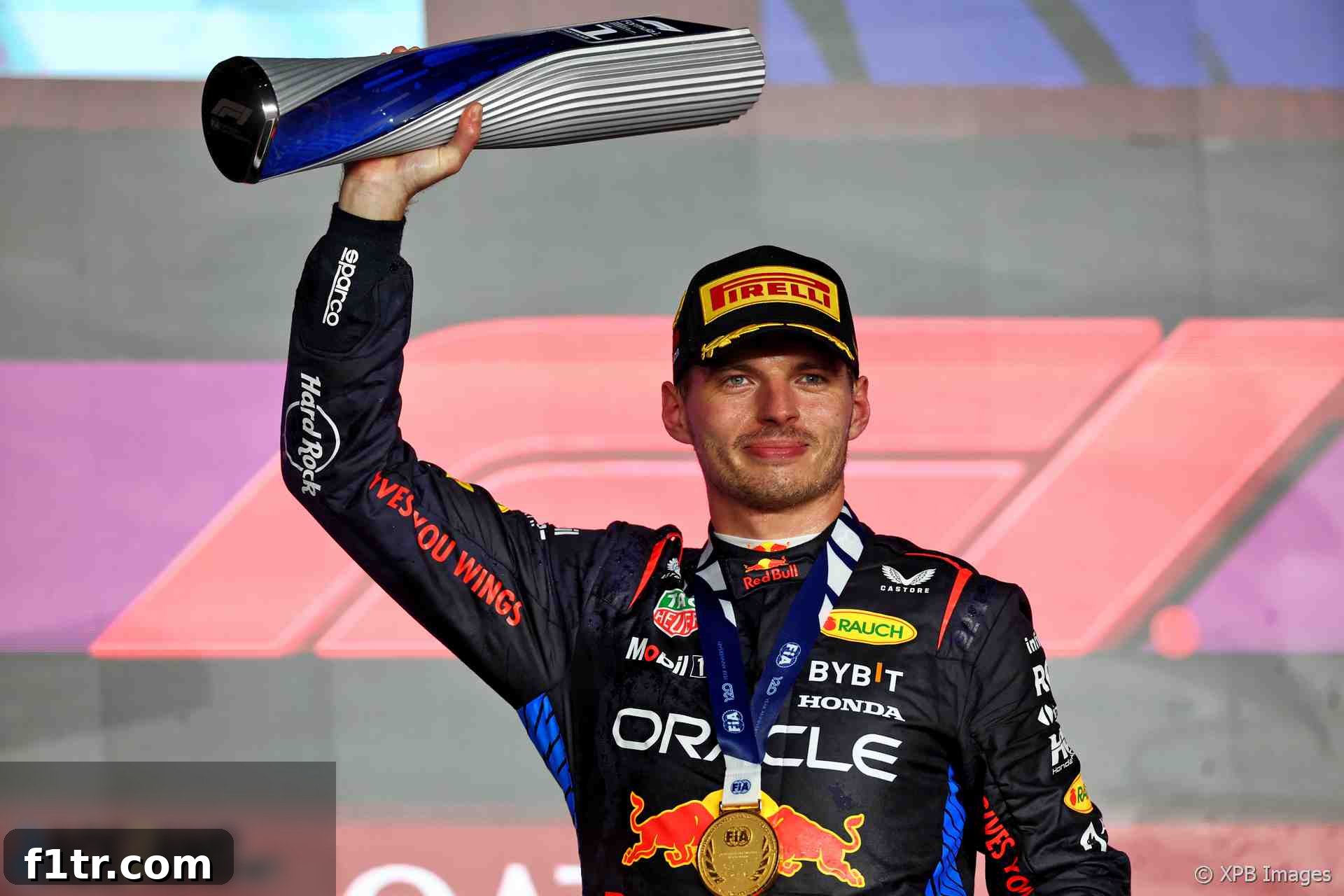
With Lando Norris no longer breathing down his neck, Max Verstappen could finally afford to relax and manage his lead to the checkered flag. The weekend in Qatar had been far from relaxing for the newly crowned world champion, starting with set-up woes on Friday and a frustrating grid penalty on Saturday. But few things motivate Verstappen more than the opportunity to prove his doubters and detractors wrong. Once again, he had expertly channeled those emotions into a commanding Grand Prix victory, demonstrating his unparalleled ability to perform under pressure.
Verstappen completed the 57th and final lap to claim his ninth win of his fourth world championship season, and his first dry Grand Prix victory since June. Red Bull had occasionally struggled at sprint weekends earlier in the season, but even Verstappen had to admit that this was a remarkable turnaround after he barely finished in the points during Saturday’s sprint race. “It’s probably been one of the biggest,” Verstappen remarked about Red Bull’s gains after the sprint race. “When you’re fighting Haas in the sprint to fighting for the win in the main race – it’s been quite a big swing in performance,” highlighting the team’s incredible recovery and his own adaptability.
Podium Finishers and Championship Implications
Charles Leclerc crossed the finish line six seconds behind Verstappen, securing an impressive second place. This podium finish had not looked likely earlier in the weekend, given the track characteristics, but it crucially kept Ferrari’s hopes alive in the constructors’ championship battle heading into the final round in Abu Dhabi. “Finishing second after such a weekend, where the track characteristics are very far off from the optimal of the track characteristics we need for our car, is a surprise,” Leclerc admitted. “We exceeded our expectations because coming into the weekend, I kind of expected to lose a bit of points compared to McLaren here. However, we recovered some, so that’s good.”
Oscar Piastri, who had “won” the sprint race, finished third, completing the podium. His pit stop just before the second Safety Car could ultimately have cost him an opportunity to finish higher, perhaps even second. “That’s how racing goes sometimes, unfortunately,” he accepted philosophically. “Sometimes you get lucky, sometimes you don’t. I feel like we’ve had that happen quite a few times this year, but we’ve had our fair share of luck as well,” reflecting on the unpredictable nature of Formula 1.
Despite receiving a five-second time penalty after the race for falling more than twice the allowed distance behind another car under the Safety Car, George Russell managed to retain his fourth-place finish. Pierre Gasly reclaimed sixth in the constructors’ championship standings with his strong fifth-place finish, ahead of Carlos Sainz, who made a remarkable recovery to sixth after his early puncture. Fernando Alonso ended Aston Martin’s four-race points-less streak, while Zhou Guanyu also ended a much longer points drought for Sauber. In what was likely his penultimate Grand Prix, Kevin Magnussen scored points in ninth after an intense duel with Alexander Albon, with Lando Norris still salvaging a commiseration point in tenth.
Advert | Become a RaceFans supporter andgo ad-free
Lingering Questions and F1’s Fractured Relationship
As the 23rd podium ceremony of the season concluded, with just one remaining in F1’s longest-ever season, FIA president Mohammed Ben Sulayem was present in parc ferme to congratulate the top three. Perhaps even he could not ignore the stark reality: a weekend that had begun with a concerted effort to mend the fractured relationship between the governing body and the drivers of its elite championship had instead seen all discussions dominated by two major, controversial decisions by the stewards and a questionable call by the sport’s newest race director in only his second Grand Prix weekend.
Abu Dhabi, the scene of Formula 1’s most controversial moment in the last decade (2021), loomed. Three years later, despite significant changes within the FIA and its F1 personnel, the underlying problems surrounding consistent officiating, transparent decision-making, and effective communication remain. These issues, highlighted by the chaos and confusion in Qatar, are evidently too deep-seated and complex to be resolved in just a single meeting or a handful of races. The Qatar Grand Prix served as a powerful reminder that while the racing itself delivered drama and excitement, the foundational issues regarding governance and driver trust continue to cast a long shadow over the pinnacle of motorsport.
More on the 2024 Qatar Grand Prix
- Horner ‘believes 100%’ Verstappen did not threaten to crash into Russell
- Russell and Verstappen cast new light on clash which triggered explosive row
- Hamilton’s puncture not caused by mirror debris – Mercedes
- Another start-to-finish win shows Qatar GP could be F1’s most processional race
- “Am I dead last now?” Unheard radio from Hamilton’s disastrous Qatar GP
Browse all 2024 Qatar Grand Prix articles
Recent F1 Race Reviews
- Antonelli lucks in for second win and becomes youngest F1 championship leader
- Emotional Antonelli grabs first Formula 1 victory in Chinese Grand Prix
- Russell sees off Ferrari threat to lead Mercedes one-two in Melbourne
- Norris clinches F1 title by two points as Verstappen wins finale at Yas Marina
- McLaren strategy blunder in Losail hands Verstappen crucial win and shot at title
Read all F1 race reviews