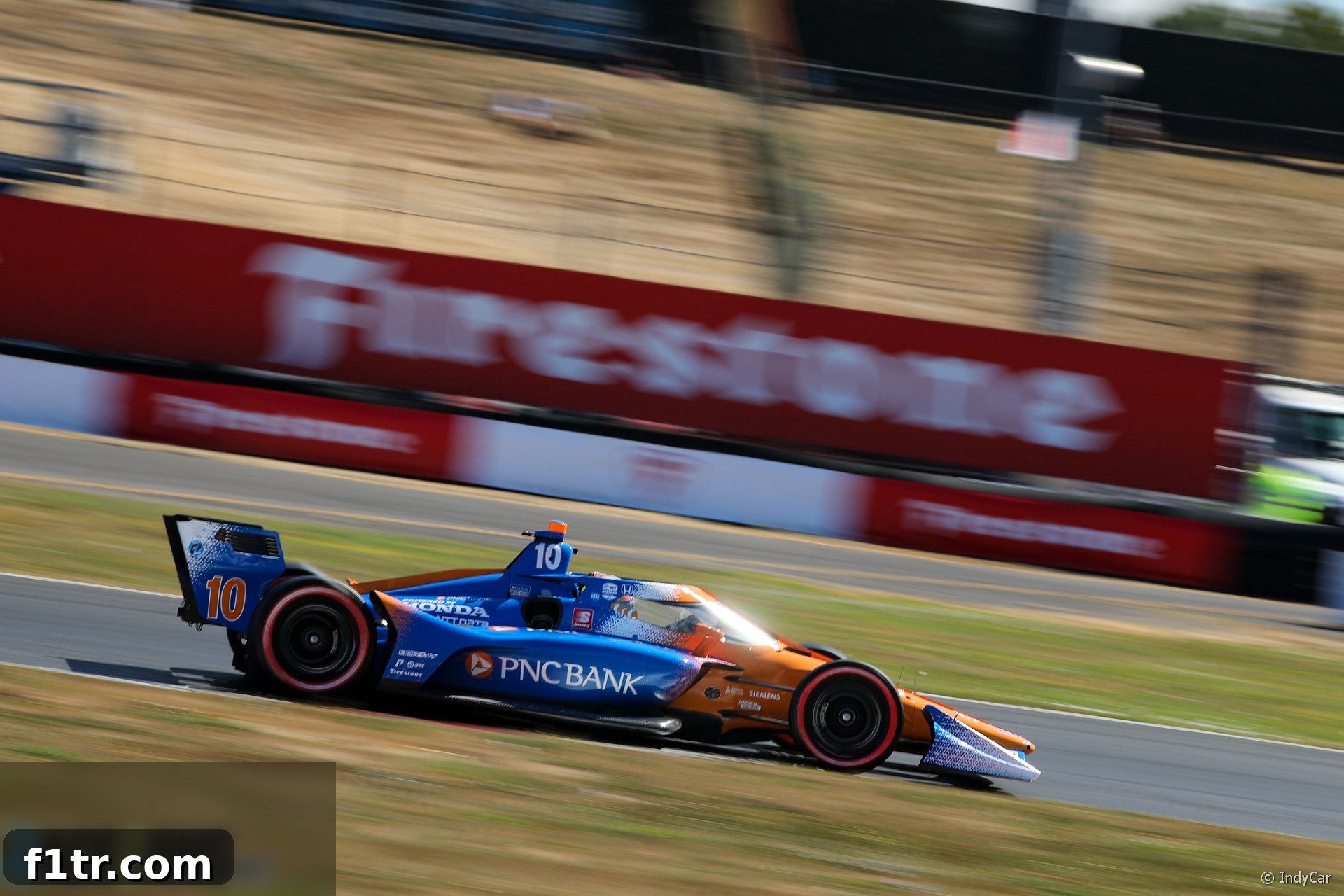
In a thrilling display of strategic mastery and raw speed, Álex Palou clinched a momentous victory at the IndyCar Grand Prix of Portland, starting from a hard-earned pole position. This triumphant performance not only marked his third win of the season but also saw him decisively reclaim the lead in the fiercely contested IndyCar Series championship. With just two races remaining, Palou now holds a crucial 25-point advantage over his closest rival, Patricio O’Ward, setting the stage for an electrifying conclusion to the season.
The race at Portland International Raceway was anything but straightforward, commencing with immediate drama. A chaotic multi-car incident unfolded on the opening lap, involving Palou, his Chip Ganassi Racing teammate Scott Dixon, and several other prominent drivers. The tight Turn 1 and 2 chicane proved treacherous, leading to significant disruptions across the field. James Hinchcliffe was unfortunately forced to retire from the race as a direct consequence of the pile-up, while fan favorites Romain Grosjean and Hélio Castroneves were forced into the garage for extensive and time-consuming repairs, severely impacting their races.
Amidst the chaos, Palou, seeking to navigate the bottleneck, was among several drivers who shortcutted the chicane. While this maneuver initially kept him out of the thick of the accident, race control subsequently ordered him to the back of the field, dropping him to a challenging 18th position. A lengthy caution period followed to re-establish the correct running order and clear debris, during which Palou and Dixon seized the opportunity to make their first routine pit stops, a move that would prove pivotal in their recovery.
O’Ward’s Early Dominance and Rahal’s Strategic Play
Meanwhile, at the front of the pack, Patricio O’Ward, who started from seventh on the grid, executed a brilliant opening lap, surging through the field to seize the lead. For a significant period, O’Ward appeared to be in a commanding position, threatening to extend his championship lead by as much as 50 points. Graham Rahal, demonstrating strong pace, slotted into second place behind O’Ward, and the two drivers maintained this order as the race settled into a rhythm, leading the field until the start of the first pit window.
The strategic battle intensified as the pit stops began. O’Ward made his first stop on Lap 29, opting for fresh tires. Rahal and his experienced crew, however, gambled on the overcut strategy, pushing deeper into their stint before pitting on Lap 35. This audacious move paid off handsomely, as Rahal emerged from the pits with the net lead, having successfully leapfrogged O’Ward. Following his stop, O’Ward struggled to find optimal pace on the primary compound tires, a factor that allowed Rahal to gradually build a comfortable advantage at the front, dictating the tempo of the race.
Mid-Race Cautions Reshape Strategies
The complexion of the race underwent another significant shift with the arrival of the second full-course caution. This yellow flag was triggered by two simultaneous incidents: the debuting Callum Ilott’s car came to a halt at Turn 7, while Dalton Kellett experienced an issue and stopped at Turn 1. The timing of this caution, coming relatively deep into the race, opened up new strategic possibilities. Many drivers, including those who had fallen back earlier, now found a two-stop strategy to be a legitimate path to victory. Graham Rahal, who had been leading, remained out on track, delaying his second pit stop until Lap 74, attempting to maximize his track position. This caution period injected a fresh wave of excitement and uncertainty, bringing drivers like Dixon, Palou, Alexander Rossi, Jack Harvey, and Josef Newgarden firmly back into contention for the win.
Palou’s Decisive Overcut and Victory Charge
The defining moment of the Grand Prix arrived in the latter stages, showcasing Álex Palou’s exceptional race craft and strategic execution. Palou made his crucial final pit stop on Lap 79. Employing the powerful overcut strategy once more, he managed to gain valuable track time on fresh tires before his stop, allowing him to jump ahead of Alexander Rossi for the effective net lead of the race. What made this maneuver even more remarkable was that Palou achieved this while on a used set of primary tires, underscoring his precise driving and the team’s perfect timing. Scott Dixon, following suit, made his final stop on the very next lap, rejoining the track just behind the newly formed lead duo of Palou and Rossi, setting the stage for a tense sprint to the finish.
With the advantage of softer alternate tires, Alexander Rossi mounted a formidable challenge, closing the gap to within half a second of Palou. The pressure was immense, but Palou remained steadfast. With fewer than ten laps remaining, Rossi, pushing to the absolute limit, ran wide exiting Turn 6. This slight but critical error was enough to give Palou the breathing room he needed, creating a buffer of approximately 1.5 seconds. Palou expertly managed this gap, maintaining his composure and pace to cross the finish line victorious, securing a hard-fought and strategically brilliant win.
Podium Finishers and Standout Performances
The Grand Prix of Portland delivered a stellar lineup on the podium. Alexander Rossi’s second-place finish marked his first podium of the season, a welcome return to form for the Andretti Autosport driver. Scott Dixon, demonstrating his characteristic consistency and veteran skill, rounded out the podium in third place, a remarkable recovery after the early race incident. Beyond the top three, several drivers delivered exceptional performances, battling through the field. Jack Harvey, starting from a lowly 20th position on the grid, carved his way through traffic to secure an impressive fourth place, matching his best finish of the season from St. Petersburg. Similarly, Josef Newgarden staged a fantastic charge, climbing from 18th to finish fifth, highlighting the strength of his Penske Chevrolet.
Further down the order, Felix Rosenqvist showed resilience, recovering from locking up into Turn 1 on the opening lap – an incident that nearly triggered an even larger crash – to finish a solid sixth. Marcus Ericsson continued his strong season with a seventh-place finish, while Colton Herta secured eighth. Scott McLaughlin took a significant step towards clinching Rookie of the Year honors with a commendable ninth-place finish. In contrast, Romain Grosjean, after his early garage visit for repairs, finished a distant 21st, 15 laps down.
Championship Battle Intensifies
The race was also heavily influenced by the timing of the caution periods, which unfortunately did not play into the hands of Graham Rahal. Despite leading a race-high 36 laps, Rahal ultimately finished tenth, a testament to how quickly fortunes can change in IndyCar racing. Patricio O’Ward, Palou’s main championship rival, endured a challenging third stint on the primary tires, struggling with pace and eventually falling to a disappointing 14th place, a result that significantly impacted his championship aspirations.
The outcome of the Grand Prix of Portland created a dramatic 35-point swing at the top of the championship standings. Álex Palou, with his triumphant victory, now commands a crucial lead over Patricio O’Ward. Josef Newgarden sits third in the standings, 34 points adrift of Palou, still very much in contention. Scott Dixon is fourth, 49 points behind, showcasing the enduring strength of the Ganassi team. Marcus Ericsson, currently fifth, is the last driver who remains mathematically eligible to win the championship, trailing Palou by 75 points. With only two races left on the calendar, the IndyCar Series championship battle promises to be an exhilarating showdown, with Palou holding a psychological and points advantage as the season reaches its dramatic climax.
Race Result – NTT IndyCar Series Grand Prix of Portland
| Position | Car | Driver | Team | Engine |
|---|---|---|---|---|
| 1 | 10 | Alex Palou | Ganassi | Honda |
| 2 | 27 | Alexander Rossi | Andretti | Honda |
| 3 | 9 | Scott Dixon | Ganassi | Honda |
| 4 | 60 | Jack Harvey | Meyer Shank | Honda |
| 5 | 2 | Josef Newgarden | Penske | Chevrolet |
| 6 | 7 | Felix Rosenqvist | McLaren SP | Chevrolet |
| 7 | 8 | Marcus Ericsson | Ganassi | Honda |
| 8 | 26 | Colton Herta | Andretti | Honda |
| 9 | 3 | Scott McLaughlin | Penske | Chevrolet |
| 10 | 15 | Graham Rahal | RLL | Honda |
| 11 | 18 | Ed Jones | Coyne/Vasser | Honda |
| 12 | 30 | Takuma Sato | RLL | Honda |
| 13 | 12 | Will Power | Penske | Chevrolet |
| 14 | 5 | Patricio O’Ward | McLaren SP | Chevrolet |
| 15 | 28 | Ryan Hunter-Reay | Andretti | Honda |
| 16 | 20 | Conor Daly | Carpenter | Chevrolet |
| 17 | 21 | Rinus VeeKay | Carpenter | Chevrolet |
| 18 | 14 | Sebastien Bourdais | Foyt | Chevrolet |
| 19 | 59 | Max Chilton | Carlin | Chevrolet |
| 20 | 48 | Jimmie Johnson | Ganassi | Honda |
| 21 | 22 | Simon Pagenaud | Penske | Chevrolet |
| 22 | 51 | Romain Grosjean | Coyne/RWR | Honda |
| 23 | 6 | Helio Castroneves | Meyer Shank | Honda |
| 24 | 45 | Oliver Askew | RLL | Honda |
| 25 | 77 | Callum Ilott | Juncos Hollinger | Chevrolet |
| 26 | 4 | Dalton Kellett | Foyt | Chevrolet |
| 27 | 29 | James Hinchcliffe | Andretti Steinbrenner | Honda |
Related IndyCar Articles
- IndyCar driver McLaughlin cleared of injury after crashing through barrier at Barber
- Schumacher says his IndyCar feels like ‘an F2 car, just with better tyres’
- IndyCar “way faster than Formula 1” in some corners, says Grosjean
- FIA to award more F1 superlicence points to IndyCar drivers from 2026
- Schumacher to race full-time in IndyCar with RLL in 2026
Browse all IndyCar articles