In a season defined by unprecedented challenges and a relentless pursuit of perfection, Lewis Hamilton cemented his legacy as one of Formula 1’s all-time greats. The 2020 Formula 1 World Championship saw Hamilton claim his record-equalling seventh drivers’ title, a testament to his unparalleled skill and the dominant Mercedes-AMG Petronas F1 Team package. Yet, despite this overwhelming success, the season was not without its moments of intense scrutiny and unexpected controversy, particularly regarding a series of penalties that, at various points, appeared to threaten his seemingly unstoppable march to the championship. These incidents, scattered across three key races, sparked debate, influenced race outcomes, and provided rare glimpses of vulnerability for the otherwise imperious Briton.
Advert | Become a Supporter & go ad-free
Indeed, a closer examination reveals that had it not been for three distinct and controversial penalties levied against him, Lewis Hamilton might have finished ahead of his teammate, Valtteri Bottas, in virtually every race he contested throughout that remarkable year. Bottas ultimately finished ahead of Hamilton in Austria, Italy, and Russia – all Grands Prix where the stewards issued penalties to car number 44. The only other instance of Bottas leading Hamilton home was the season finale in Abu Dhabi, where a less than fully fit Hamilton returned to racing after contracting Covid-19, highlighting just how impactful these penalty-affected races were on their head-to-head comparison.
The Austrian Grand Prix: A Turbulent Season Opener
Hamilton’s first entanglement with officialdom arrived swiftly at the season-opening Austrian Grand Prix. The controversy began during Saturday’s qualifying session when stewards investigated whether he had adequately slowed for yellow flags. Initially, Hamilton was cleared of any wrongdoing. However, in a highly unusual turn of events just hours before the race, Red Bull Racing successfully requested a review of the incident, presenting new video footage published by Formula 1. This compelling evidence ultimately revealed that Hamilton had indeed breached the regulations, leading to a revised ruling.
He was subsequently handed a three-place grid penalty, a decision that stripped him of his front-row starting position alongside his teammate Bottas. This reshuffle promoted Max Verstappen to second on the grid and significantly altered the dynamic of the race start. Bottas, starting from pole position, went on to clinch the victory. For Hamilton, his woes compounded during the race itself when he received a second penalty for a collision with Red Bull’s Alexander Albon, an incident that ultimately knocked him off the podium entirely. While Bottas could justifiably argue he might have won that race regardless of Hamilton’s pre-race penalty, the stewards’ intervention undoubtedly shaped the early contest between the two Mercedes drivers.
Italian Grand Prix: Pit Lane Blunder at Monza
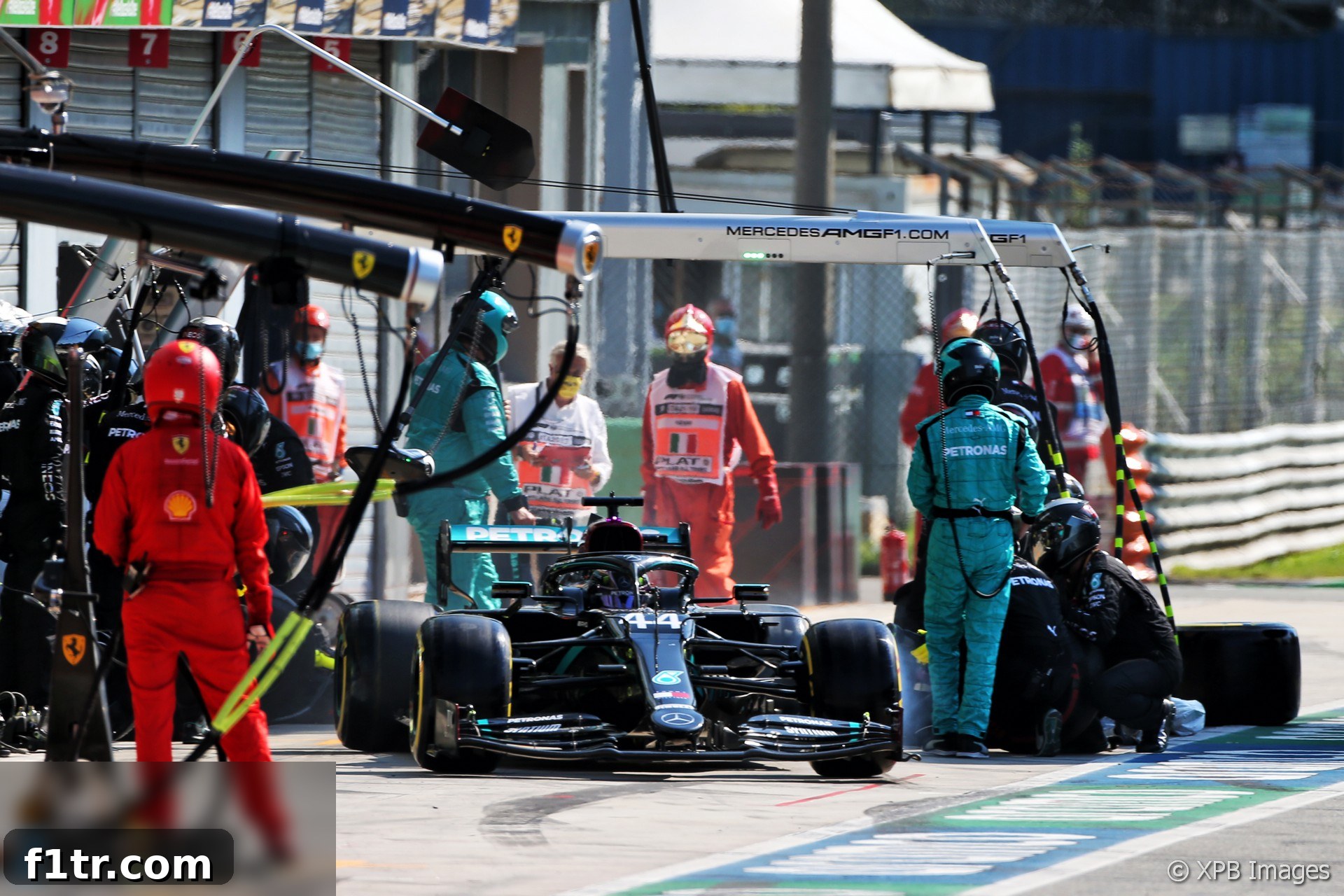
Hamilton’s next significant penalty emerged at the Italian Grand Prix in Monza, a race that proved to be a pivotal moment in his championship campaign. By this stage of the season, Hamilton was comfortably leading the drivers’ championship, holding a formidable 40-point advantage over Max Verstappen, with Bottas a further 10 points adrift. In the early stages of the race, Hamilton demonstrated his typical dominance, pulling clear of the field while Bottas found himself entangled in the midfield pack, struggling for pace and position.
However, the complexion of the race dramatically shifted when the Safety Car was deployed in response to Kevin Magnussen’s Haas breaking down at the pit lane entry. In the chaos and with very little time to react, neither Hamilton nor his Mercedes team noticed the crucial signal indicating that the pit lane entrance was closed. Hamilton, leading the race, instinctively turned into the pit lane for a tire change, inadvertently breaching a fundamental safety regulation. The rules explicitly stipulated a fixed 10-second stop-go penalty for such an infraction – a penalty so severe it effectively destroyed his race. This incident showcased how even the most experienced teams and drivers can be caught out by rapidly evolving race conditions and stringent regulations.
During the subsequent red flag period, Hamilton, clearly frustrated and seeking clarification, took the highly unusual step of visiting the stewards in person in the middle of a race to discuss the incident. Despite his direct appeal, the decision remained unchanged. The penalty stood, and when the race eventually restarted, Hamilton valiantly recovered to finish seventh, two places behind his teammate. This marked the first time in seven races that Bottas had taken points off Hamilton in a direct head-to-head, underscoring the profound impact of the penalty.
Advert | Become a RaceFans supporter andgo ad-free
Russian Grand Prix: Practice Start Peril in Sochi
Just three weeks later, more points slipped away from Hamilton in Sochi, Russia, once again due to a penalty incurred by his team mate. As at Monza, this was for an unusual infraction – one that raised eyebrows across the paddock. On this occasion, the stewards ruled that Hamilton had performed two practice starts before the race in an unapproved and potentially dangerous location. For each violation, he was initially given a five-second time penalty, totaling a combined 10 seconds, and a penalty point on his Super Licence.
Having led the early stages of the race, Hamilton’s advantage evaporated as he served the combined 10-second penalty during his pit stop. This setback allowed his teammate Bottas and Red Bull’s Verstappen to leapfrog him, effectively deciding the outcome of the race in Bottas’s favour. The decision played a significant role in Bottas cutting a further 10 points out of Hamilton’s championship lead, providing the Finn with a much-needed boost in morale and championship standing.
Hamilton was visibly and audibly unimpressed at suffering a second significant setback in three races. His frustration boiled over, leading him to suggest that the decision against him might have been a deliberate attempt to trim his advantage in the championship. “I didn’t put anyone in danger,” he insisted. “I’ve done this at a million tracks over the years and never been questioned on it. But it is what it is,” he continued, adding a provocative statement: “It’s to be expected. They are trying to stop me, aren’t they?”
Hamilton’s strong words sparked a flurry of reactions, both within the F1 community and among fans. Not everyone, however, shared Hamilton’s view that he had chosen a safe position to practice his starts. Daniil Kvyat, one of the drivers who had to navigate past the stationary Mercedes on track, offered a differing perspective. “You go very fast there, already like 250kph. So it wasn’t a good place to be,” Kvyat explained, clearly highlighting the safety concerns. “I was surprised,” Kvyat added, “I knew you couldn’t really do that.” His comments underscored the potential dangers and the clear breach of established protocols, even if Hamilton perceived it differently.
An Unprecedented U-Turn: The Rescinded Penalty Points
The consequences of Hamilton’s latest penalty initially appeared severe, extending beyond just the race result. The two additional penalty points put him on a cumulative total of 10, placing him just two points away from an automatic race ban – a scenario that would have had massive implications for the championship battle. However, in a truly remarkable and extremely unusual turn of events, the stewards later made the decision to rescind the penalty points Hamilton had been given for the incident. This unprecedented U-turn followed a post-race meeting between the stewards, Hamilton, Mercedes team principal Toto Wolff, and the team’s sporting director Ron Meadows. The decision to withdraw penalty points after an initial ruling is exceptionally rare in Formula 1, further fanning the flames of debate surrounding the consistency and application of regulations.
Advert | Become a RaceFans supporter andgo ad-free
Hamilton’s Reflection and Lessons Learned
Hamilton’s run of penalties in 2020 was particularly unexpected for a driver whose record before the stewards had historically been among the cleanest and most exemplary in the sport. Speaking after the season had concluded, Hamilton offered a more tempered reflection on his earlier suggestion that someone was “trying to stop me.” He admitted that it had been “a human reaction” uttered “in the heat of the moment,” acknowledging the intensity of the competitive environment.
Nonetheless, despite this softening of tone, he made it clear that he still fundamentally disagreed with the decisions themselves. “With the FIA and with the stewards, I think there’s been a growth of respect between us and understanding,” said Hamilton in response to a question from RaceFans, emphasizing a maturing relationship. “I still don’t think those penalties were the necessary penalties. But it is what it is and it’s not my job to come up with what the penalties should be.” This statement perfectly encapsulated his position: accepting the outcome while maintaining his personal conviction about the fairness of the rulings.
In what was otherwise an excellent and dominant 2020 performance by Lewis Hamilton, these penalties stood out as significant contributors to his rare defeats at the hands of his teammate, Valtteri Bottas. They highlight one of the few obvious areas for potential improvement, even for a driver of Hamilton’s caliber – a heightened awareness of every nuanced regulation and race procedure. Hamilton himself, ever the competitor, acknowledged the learning curve. “I learnt a lesson from it and they won’t be able to catch me out for that again, that’s for sure,” he stated with characteristic resolve.
He continued, expressing his commitment to unwavering vigilance: “I’m just going to be very vigilant and diligent, moving forwards. And not only as an athlete, I’m always trying to find an edge. I’m always trying to find that extra bit. It’s a fine line between being over the edge and beneath it. It’s fine if that one was over the edge. I learnt from it and it won’t happen again.” This insightful reflection underscores his continuous drive for self-improvement and his determination to leave no stone unturned in his quest for perfection, even in the face of contentious decisions.
The Broader Implications for Formula 1
Beyond the immediate impact on Lewis Hamilton’s season, these penalties sparked broader discussions within Formula 1 regarding stewarding consistency, the clarity of regulations, and the communication between race control, teams, and drivers. The Austrian GP’s yellow flag review, the Monza pit lane closure oversight, and the Sochi practice start controversy each presented unique challenges for the sport’s governing body and officiating teams. The unprecedented decision to rescind penalty points in Sochi particularly intensified scrutiny, prompting questions about the process of review and appeal, and the perception of fairness across the grid. These incidents serve as a reminder that even in a highly technical and regulated sport, the human element – both in decision-making and in reaction to those decisions – remains a powerful force shaping the narrative and outcomes of a championship.
Join Our F1 Community and Support Independent Journalism!
If you’ve enjoyed our in-depth Formula 1 coverage during the 2020 season and beyond, please consider taking a moment to find out more about our Supporter Drive.
We’re dedicated to bringing you quality, original, and independent motorsport coverage. By becoming a Supporter, you help us continue our mission. Here’s how you can sign up and contribute:
- Join the RaceFans Supporters Drive Today!
Exploring the 2020 F1 Season: Key Moments & Analysis
- Romain Grosjean’s Emotional F1 Test Return Post-Bahrain Crash
- Behind the Scenes: Grosjean’s Bahrain Fireball Crash Chassis on Display
- Team Mate Showdown: Bottas vs Rosberg – A Comparison with Hamilton at Mercedes
- The Financial Impact: F1 Revenues Decline by $877 Million in Covid-Affected 2020 Season
- Lewis Hamilton and Mercedes Confirm New Deal for 2021 Season
Browse all 2020 F1 season articles for more insights and updates.