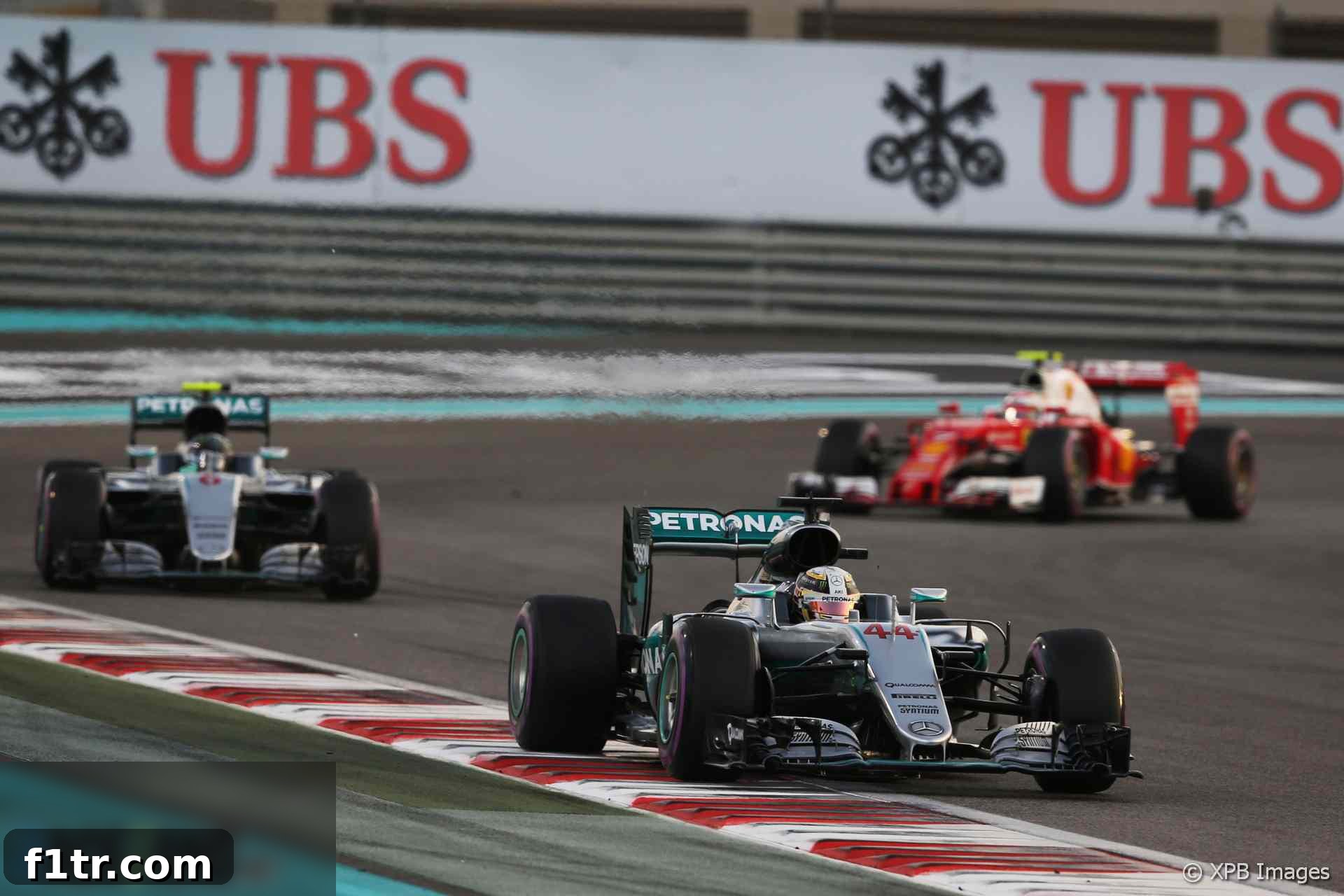
The 2016 Formula 1 season culminated in one of the most nail-biting, pressure-cooker finales in the sport’s illustrious history. At the heart of this high-stakes drama was Nico Rosberg, chasing his lifelong dream of becoming a Formula 1 World Champion, and his Mercedes-AMG Petronas teammate, the reigning champion Lewis Hamilton. The stage was set at the Yas Marina Circuit for the 2016 Abu Dhabi Grand Prix, an event that would push both drivers to their absolute psychological and physical limits.
For Rosberg, the journey to this moment had been a protracted battle, marked by years of intense rivalry with Hamilton, whom he had raced against since their karting days. The 2016 season saw Rosberg deliver a career-best performance, showcasing remarkable consistency and resilience. He entered the final race with a twelve-point lead over Hamilton, meaning he needed a podium finish to secure the title, regardless of Hamilton’s result. This mathematical advantage, however, did little to quell the immense pressure that weighed heavily on his shoulders as he lined up on the grid.
As the lights went out, the tension was palpable. Hamilton immediately took the lead from pole position, a position he never relinquished throughout the race. Rosberg, starting second, knew his primary objective was to maintain his position and manage the gap to the chasing pack. However, what unfolded was a strategic masterclass from Hamilton, designed to put Rosberg under maximum stress and potentially open the door for other drivers to overtake him, thereby costing him the championship.
Rosberg later reflected on the almost unbearable intensity of the race, describing the experience as “so unbelievably intense out there.” He confessed to reporters, “It was unbelievable.” The mental strain began early, particularly with the unexpected challenge posed by Red Bull’s Max Verstappen. Rosberg recounted the surprise, “First of all with Max [Verstappen]. I thought today of all days I’m not going to see him, and there he was again. I had him all over in the last couple of races.”
Verstappen, known for his aggressive and audacious driving style, had quickly recovered from a spin at the start to climb through the field, placing himself directly in Rosberg’s path. This unexpected obstacle forced Rosberg into an early, high-stakes battle. The Mercedes pit wall quickly recognized the critical nature of the situation. Rosberg recalled the urgent message from his team: “‘It’s critical to pass.’ Critical for the championship.”
Understanding the immense implications, Rosberg knew he had to act decisively. “So I tried to get past, I knew it was going to be difficult, I gave it everything, he gave it everything and it worked out.” The duel with Verstappen was a test of nerve and precision, a micro-championship in itself played out over a few tense laps. Successfully navigating past the young Dutchman was a crucial turning point, providing Rosberg with a momentary reprieve, but also an early indicator of the relentless pressure he would face. “And that was such an intense feeling in the car. I’ve never felt anything like that in the car,” he admitted, highlighting the profound emotional and physical demands of the moment.
However, the greatest challenge was yet to come. In the final phase of the race, Hamilton, leading the Grand Prix, began to deliberately slow his pace. His strategy was clear: to back Rosberg into the clutches of the cars behind, specifically the Ferrari of Sebastian Vettel and Verstappen, who were both closing rapidly. Hamilton’s intention was to create a scenario where Rosberg might be vulnerable to attack, an overtake from either driver potentially costing him the championship. This controversial tactic injected an additional layer of unprecedented pressure into an already high-stakes event.
Rosberg found himself in an unenviable position, caught between a rock and a hard place. He described the ordeal vividly: “I thought it was done and then Lewis continued to back me up into everybody else. He did it really well because I had no chance to pass him.” Hamilton was meticulously managing his pace, displaying cunning race craft. “He was flat out in sector one, making sure that I was never in DRS, and then just slowing down in the rest so the others came in again. And that was horrible.”
The term “horrible” barely encapsulated the psychological torment Rosberg endured. He could see his championship dream hanging by a thread, constantly checking his mirrors. “Horrible because I could see in my mirror the place where the championship would be lost. Those two guys in my mirror.” The slightest error, a momentary lapse in concentration, could have catastrophic consequences. With his tires starting to grain and the reduced downforce from following closely behind Hamilton, the margin for error was non-existent. “So if I made the smallest mistake, because my tyres starting graining and everything, and I had Lewis in front so not good downforce. The smallest mistake, it’s finished,” he elaborated, emphasizing the perilous tightrope walk he was performing.
As the final laps ticked by, the world watched with bated breath. Rosberg, despite the immense pressure, held his nerve. He successfully defended his position, navigating the tactical gamesmanship and the looming threats from behind. When he finally crossed the finish line in second place, securing the points needed for the championship, the overwhelming emotion was one of profound relief and disbelief. “It’s ridiculous,” he exclaimed, struggling to process the monumental achievement. “I can’t believe it. I can’t wait to celebrate with my team and all my friends.”
The entire weekend had been a crucible of mental fortitude for Rosberg. “The pressure was massive this weekend,” he acknowledged. While he found moments of calm, going into the race with a positive mindset, the underlying intensity was constant. “I found patches of really cool, where I was quite happy with my state of mind, I went into the race with quite a good one. I was happy about that.” Yet, the overall experience was unlike anything he had ever encountered. “But it was such an intense mind the whole weekend. Unbelievable. I’ve never done something like that in my life. It was so difficult.”
The immediate aftermath of securing the title brought an outpouring of emotion that was both physical and overwhelming. “The first bit of emotion was relief, I was crying my eyes out on the lap back,” he confessed. It was the release of years of dedication, sacrifices, and the incredible strain of competing at the pinnacle of motorsport against one of the greatest drivers of all time. His tears were not just of joy, but of the sheer relief that the arduous journey had finally reached its triumphant conclusion.
Nico Rosberg’s 2016 World Championship victory was a testament to his perseverance, skill, and mental strength. It marked the culmination of a fierce rivalry and one of the most memorable championship deciders in Formula 1 history. Just five days after achieving his ultimate dream, Rosberg shocked the sporting world by announcing his retirement from Formula 1, stating he had reached the “pinnacle” and was unwilling to make the sacrifices necessary to maintain that level of performance. This decision cemented his championship as a unique and iconic moment, a driver reaching the absolute summit of his sport and then stepping away, forever etching his name into the annals of Formula 1 history as a true world champion who conquered not only his rivals but also the immense psychological demands of the sport.
Related: 2016 Abu Dhabi Grand Prix Content
- 2016 Abu Dhabi Grand Prix team radio transcript
- 2016 F1 Fanatic Predictions Championship won by SBFIM29
- Top ten pictures from the 2016 Abu Dhabi Grand Prix
- 2016 Abu Dhabi Grand Prix driver ratings
- Rosberg ends longest-ever wait for championship
Browse all Abu Dhabi Grand Prix articles