Red Flags in Formula 1 Qualifying: Should Mistakes Be Penalized?
The exhilarating world of Formula 1 often delivers unpredictable drama, especially during its high-stakes qualifying sessions. Drivers push the absolute limits of their machinery and skill, striving for every millisecond that can grant them a critical grid advantage. However, recent events, particularly the 2022 Emilia-Romagna Grand Prix, have ignited a fierce debate about the unintended consequences of the sport’s red flag rules: do some drivers inadvertently benefit from their own mistakes during these crucial sessions?
The Imola weekend marked the first sprint event of the 2022 season, shifting the traditional qualifying format to Friday evening. What unfolded was a chaotic session, heavily influenced by changing weather conditions, specifically persistent rain. This led to an unprecedented five red flag stoppages across the three qualifying segments (Q1, Q2, and Q3) – a record since the current format was introduced in 2006. This extraordinary number of interruptions brought into sharp focus a contentious issue: moments when drivers who caused these stoppages appeared to gain an advantage, rather than suffer a penalty.
The Imola Controversy: When Errors Yield Unforeseen Benefits
The 2022 Emilia-Romagna Grand Prix provided several compelling examples where drivers, despite causing significant disruptions, found themselves in surprisingly strong positions. These incidents fueled widespread discussion among fans and pundits, questioning the fairness and integrity of the qualifying process under such circumstances.
Carlos Sainz Jnr’s Q2 Incident
During Q2, Ferrari’s Carlos Sainz Jnr tragically crashed at the second Rivazza corner. While this incident prematurely ended his own qualifying session, its timing proved remarkably fortuitous for his grid position. The red flag triggered by Sainz’s crash coincided with a sudden downpour, effectively halting any further meaningful improvements for the remaining drivers in Q2. As Sainz was provisionally second fastest at the time of his spin, his error inadvertently guaranteed his progression into Q3 and secured him at least tenth place for the sprint race. For those outside the top ten when the rain descended, their hopes of advancing were abruptly dashed by circumstances beyond their control, initiated by a rival’s mistake.
Kevin Magnussen’s Q3 Spin
In the tense Q3 session, both Sergio Perez and Charles Leclerc were midway through what should have been their initial timed laps when Kevin Magnussen, driving for Haas, slid off the track at Acque Minerali. This incident necessitated another red flag. Crucially, Magnussen managed to keep his car out of the gravel trap, navigating it onto an access road before safely returning to the pits under the red flag conditions. He was able to rejoin the session later and impressively qualified fourth, seemingly unpenalized for the incident that disrupted the runs of several front-running competitors. His ability to recover and still achieve a strong grid slot highlighted the lack of direct consequence for the session’s disruption.
Lando Norris’s Session-Ending Spin
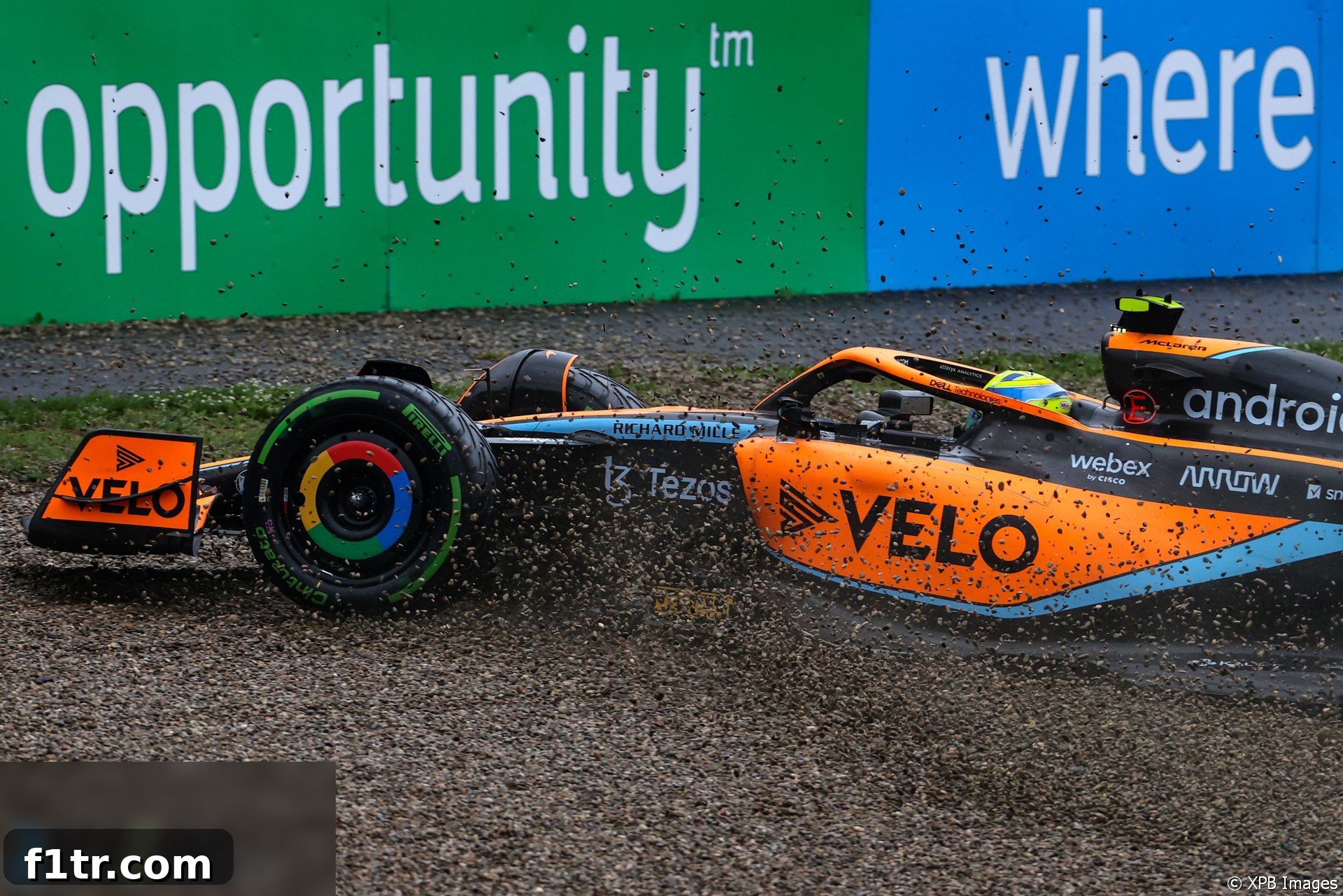
The drama continued into the closing minutes of Q3. After yet another red flag, this time for Valtteri Bottas’s exhaust problem, Lando Norris spun on his out-lap at the very same Acque Minerali corner where Magnussen had earlier encountered trouble. This fifth and final red flag of the session effectively brought an end to qualifying, with too little time remaining for any further competitive laps. Prior to this final stoppage, Norris had recorded a provisional third place. His error, therefore, had the unusual effect of solidifying his position, as no other driver was afforded the opportunity to challenge or improve upon their times. In essence, his mistake secured him third on the grid for the sprint race, denying rivals a final chance to overtake him.
These incidents, particularly Norris’s, generated significant debate across social media platforms. Fans questioned the fairness of a system where a driver’s mistake could inadvertently benefit them by preventing others from improving their times. The perceived lack of disadvantage for causing a red flag, when the efforts of all other drivers are significantly impacted, became a central point of contention.
Echoes of Monaco 2021: Leclerc’s Controversial Pole
The events at Imola were not isolated occurrences. They echoed a similar, highly publicized incident from the 2021 Monaco Grand Prix. In that qualifying session, Charles Leclerc secured pole position for his home race after crashing at the exit of the Swimming Pool section during the final minutes of Q3. This accident brought out a red flag, preventing any other drivers – crucially Max Verstappen, who was on a potential pole-challenging lap – from completing their attempts. Leclerc, therefore, kept his provisional pole, achieved through an error that simultaneously denied his rivals a chance to beat his time. This historical precedent reinforced the perception that F1’s red flag rules could, under specific circumstances, reward rather than penalize driver mistakes, undermining the competitive spirit of qualifying.
The Core Debate: Ensuring Fairness and Integrity in F1 Qualifying
The recurring pattern of drivers benefiting from causing red flags brings to the forefront a critical debate concerning fairness and sporting integrity in Formula 1. Qualifying is designed to be the ultimate test of speed and precision, a direct comparison of driver and machine performance. When external factors, especially those initiated by a competitor’s error, skew these results, it raises fundamental questions about the purity of the competition. The underlying tension is between ensuring safety – the primary reason for a red flag – and preventing strategic exploitation or accidental advantage from disrupting the fair outcome of a session. Many argue that the current framework might inadvertently incentivize risky behavior or, at worst, allow for manipulation, even if unintentional.
IndyCar’s Stricter Stance: A Blueprint for F1?
In contrast to Formula 1, the NTT IndyCar Series employs a significantly different and notably stricter approach to red flags during qualifying. This alternative regulatory framework offers a potential model for F1 to consider in addressing its own red flag controversies.
According to rule 8.3.4 of the 2022 IndyCar Series rulebook, a clear and decisive penalty is imposed: “if a car causes a Red Condition [red flag] in any segment, the car’s best two timed laps of the segment shall be disallowed.” This rule goes further, stipulating that a driver responsible for causing a red flag cannot continue in that session. Furthermore, they may be prohibited from advancing to the next stage of qualifying, even if their remaining times, after the deletion of their best two laps, would otherwise have been sufficient. This comprehensive penalty aims to ensure that causing a red flag always carries a significant sporting disadvantage.
The philosophy behind IndyCar’s rule is clear: any mistake severe enough to halt a qualifying session must carry a direct and tangible consequence for the driver responsible. This approach prioritizes maintaining a level playing field and discouraging actions that could unfairly impact other competitors’ chances. By automatically deleting the two fastest laps, IndyCar effectively negates any potential benefit a driver might gain from stopping a session, and in most cases, severely compromises their qualifying performance. This rule is applied consistently across all types of circuits, from high-speed ovals to tight street courses, ensuring a predictable outcome for such incidents.
Arguments For Implementing Stricter F1 Red Flag Penalties
The persistent debate surrounding red flag incidents in F1 qualifying has led many to advocate for adopting a system similar to IndyCar’s. Proponents of stricter penalties highlight several key benefits:
- Enhanced Sporting Integrity and Fairness: The most compelling argument is that it eliminates the possibility of a driver benefiting from their own error. Qualifying should be a pure test of speed and skill. When a mistake inadvertently secures a driver’s position or denies rivals a chance to improve, it undermines the fundamental fairness of the competition. A penalty ensures that a driver’s final position is a true reflection of their performance, unassisted by session-stopping incidents.
- Strong Deterrent Against Reckless Driving: Knowing that causing a red flag will result in the deletion of their best laps would act as a powerful deterrent. While outright deliberate manipulation is rare, the rule would discourage overly ambitious or reckless driving that risks bringing out a red flag, particularly in the dying moments of a session. It encourages drivers to manage risk more effectively.
- Leveling the Playing Field: Currently, drivers who are on fast laps when a red flag occurs have their efforts nullified. They lose precious track time, tire life, and often their rhythm. Penalizing the instigator directly helps to balance the scales, ensuring that the consequences of a red flag fall primarily on the person who caused it, rather than disproportionately affecting innocent parties.
- Preventing Strategic Exploitation: While difficult to prove, the potential for deliberate exploitation of the rules (e.g., spinning to secure a provisional pole) would be largely nullified. With automatic lap deletion, there would be no sporting advantage to gain from intentionally stopping a session.
- Improved Fan Perception: Many fans feel a sense of injustice when a driver benefits from a mistake. A clearer, more punitive rule would likely be welcomed by a significant portion of the fanbase, reinforcing their trust in the fair application of sporting regulations.
The Norris incident at Imola, where his out-lap spin secured his third place by preventing rivals from improving, stands as a prime example. Introducing lap deletion would have likely seen him lose that position, sending a clear message that such errors carry consequences.
Counterarguments: Why F1 Might Hesitate to Adopt IndyCar’s Rule
While the arguments for stricter red flag penalties are compelling, there are significant counterarguments and potential drawbacks that Formula 1 would need to consider carefully before implementing a rule akin to IndyCar’s:
- Prioritizing Safety Above All Else: The fundamental reason for a red flag is safety. Any hazard on the track must be dealt with promptly and safely, protecting both drivers and marshals. A severe penalty like lap deletion could inadvertently pressure drivers to try and recover their car from a dangerous situation or continue driving a damaged car, rather than stopping immediately and safely, for fear of losing their best times. This could lead to more dangerous scenarios on track.
- Unfairness in Genuine Accidents or Mechanical Failures: Not all red flags are a result of driver recklessness. A driver might spin due to a sudden gust of wind, a cold tire, or an unexpected loss of grip. More critically, a mechanical failure – such as Alex Albon’s exploding brakes at Imola – could cause a red flag through no fault of the driver. Penalizing such incidents by deleting best laps could be seen as deeply unfair, robbing a driver of a hard-earned position due to circumstances entirely beyond their control.
- Impact on the Spectacle and Driver Aggression: Formula 1 thrives on drivers pushing the absolute limits. The final moments of Q3, especially on challenging street circuits like Monaco or Baku, are often breathtaking as drivers take immense risks for pole position. The knowledge that a slight misjudgment could result in the loss of their two best lap times might make drivers overly cautious, leading to a less aggressive and perhaps less thrilling qualifying spectacle. The sport risks losing some of its inherent excitement if drivers are afraid to push the envelope.
- Defining ‘Fault’ and Consistency: While some incidents are clear-cut, others can be ambiguous. What if two cars collide and cause a red flag? How is ‘fault’ precisely determined in a split-second decision under immense pressure? Granting stewards more discretion in such matters could lead to inconsistencies, while an automatic deletion rule might be too blunt an instrument.
- Does Not Restore Lost Opportunities: Even if the instigator is penalized, the rule does not restore lost track time or invalidated laps for other drivers. While it punishes the perpetrator, it doesn’t fully rectify the disadvantage faced by those whose qualifying efforts were disrupted.
- F1’s Unique Context: F1 cars are incredibly complex and fast. The margins are finer, and the consequences of errors are often higher than in other series. A direct ‘copy-paste’ of rules from another series, even one as prestigious as IndyCar, might not be perfectly suited to F1’s specific dynamics and strategic nuances.
Towards a Balanced Solution: F1’s Path Forward
The discussion surrounding red flag penalties in Formula 1 qualifying is undoubtedly complex, with compelling arguments on both sides. While the desire to prevent drivers from accidentally or deliberately benefiting from their mistakes is strong, any proposed solution must be carefully weighed against the core principles of safety, fairness, and maintaining the exhilarating spectacle of F1.
A straightforward adoption of IndyCar’s “two laps deleted” rule, while seemingly simple, might prove to be too blunt an instrument for Formula 1. It doesn’t fully account for the nuance of genuine mechanical failures, the inherent risks drivers take, or the potential chilling effect on driver aggression during critical moments on barrier-lined street circuits. The risk of unfairly penalizing a driver for an unavoidable incident, or inadvertently compromising safety by encouraging drivers to stay on track longer, are significant concerns.
Perhaps a compromise solution is required – one that addresses the issue of unfair advantage without introducing excessive rigidity or jeopardizing safety. F1 could explore a tiered penalty system, where the severity of the penalty is proportionate to the nature and cause of the red flag. For instance, a minor spin that requires minimal recovery and doesn’t genuinely block the track might incur a smaller penalty (e.g., losing only the lap on which the incident occurred), whereas a major crash causing significant damage or track blockage could warrant a more severe consequence, such as a grid drop for the sprint or main race.
Another consideration could be a clearer definition and application of “fault” by the stewards, coupled with an emphasis on intent where possible. However, relying too heavily on subjective judgment can lead to inconsistency, which is equally undesirable. Ultimately, Formula 1 must devise a solution that upholds the integrity of qualifying, ensures that errors carry appropriate consequences, and prevents any perceived exploitation of the rules, all while maintaining the absolute priority of driver and marshal safety.
The debate is certainly one that needs to be had, ensuring that drivers cannot crash their way to success in qualifying, but a nuanced, F1-specific approach may prove more effective than a direct adaptation.
The Fan Perspective: Shaping the Future of F1 Regulations
Do you agree that Formula 1 should introduce IndyCar’s ‘two lap times deleted’ red flag qualifying rule?
- No opinion (1%)
- Strongly disagree (37%)
- Slightly disagree (12%)
- Neither agree nor disagree (3%)
- Slightly agree (25%)
- Strongly agree (22%)
Total Voters: 125
Engaging with the fan community is crucial for shaping the future of Formula 1 regulations. The diverse opinions reflected in such polls underscore the complexity of balancing sporting fairness with the demands of top-tier motorsport.
A RaceFans account is required in order to vote. If you do not have one, register an account here or read more about registering here.
Debates and Polls
- What must Formula 1 fix with its new rules – and what should it leave unchanged?
- ADUO: Do F1 teams who fall behind deserve to get help to catch up?
- F1 is considering doubling its sprint races. Do you want more or fewer?
- Will this be a fight or a rout? 20 questions for the 2026 Formula 1 season
- Which Formula 1 team has the best-looking car – and the worst – for the 2026 season?
Browse all debates and polls