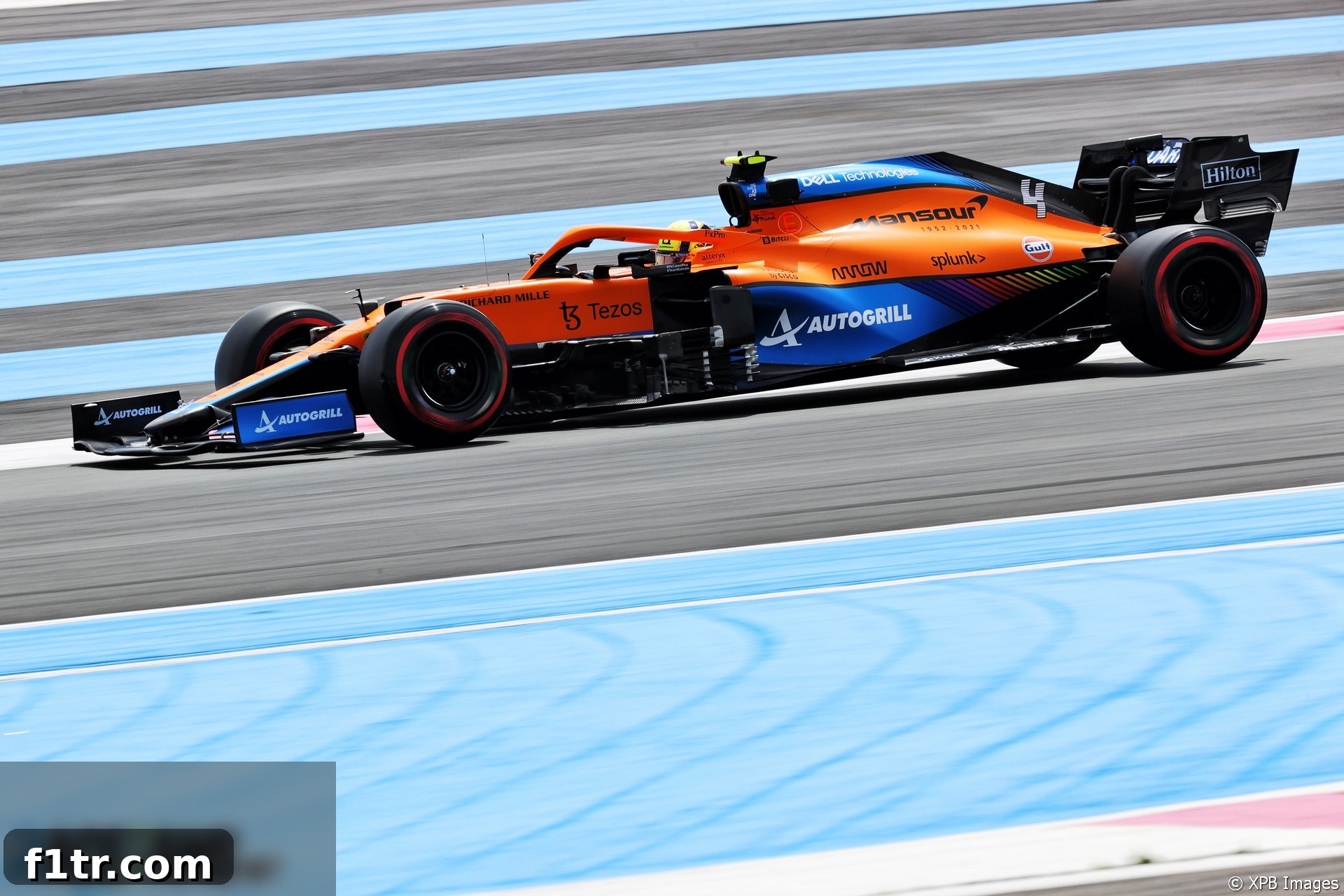
Lando Norris’s French GP Qualifying Scare: A Lucky Escape and McLaren’s Performance Puzzle
The exhilarating world of Formula 1 qualifying often throws unexpected challenges at even the most seasoned drivers, and the 2021 French Grand Prix was no exception for McLaren’s dynamic young talent, Lando Norris. During the crucial Q2 session at the Circuit Paul Ricard, Norris found himself precariously close to an early exit, a situation stemming from an unforeseen fuel issue that cut short his final, potentially critical, qualifying run.
Advert | Become a Supporter & go ad-free
The Q2 Drama Unfolds: A Race Against the Clock and the Fuel Gauge
As the clock ticked down in Q2, Norris was provisionally holding seventh place, a decent position that should have allowed him to confidently push for a stronger lap in his final attempt. However, the unexpected communication from his race engineer, Will Joseph, brought an abrupt halt to his plans. Norris was instructed to pit immediately, foregoing his last timed run. Joseph assured him that the full explanation would follow after the session, leaving Norris, and observers, in a state of suspense.
This kind of situation is a nightmare for any Formula 1 driver during qualifying. Every thousandth of a second counts, and abandoning a lap, especially with the track evolving and competitors constantly improving, is a huge gamble. The implications of insufficient fuel are severe; not only does it prevent a car from completing its designated laps, but it can also lead to penalties if the car is found to have less than the mandatory one-litre fuel sample remaining at the end of a session. Such a penalty would be catastrophic, often resulting in disqualification from qualifying.
Despite the forced early retirement from his final Q2 run, fortune smiled upon Norris. His earlier lap proved strong enough to withstand the improvements from his rivals, securing his passage into the top ten shootout of Q3. He ultimately lined up eighth on the grid for Sunday’s French Grand Prix, a result that, while solid, came with a considerable helping of tension and relief.
Norris Reflects: “A Bit Lucky” to Escape Elimination
Recounting the dramatic moments after qualifying, Norris shed light on the technical hiccup that nearly cost him dearly. “We had a problem with the fuel going into the car properly, so I didn’t have enough fuel, which is an issue,” he explained. The issue, likely related to the fuel pump or sensors, meant that the car wasn’t receiving the expected amount of fuel, or at least the team’s telemetry indicated a critical shortage.
The young Brit admitted that his progression to Q3 was less about pure pace on that specific moment and more about a fortunate circumstance. “I didn’t get my second run in, but I did a good enough lap one that didn’t cost us anything, but I was a bit lucky.” This candid admission underscores the razor-thin margins in F1. Had another competitor found just a fraction more pace, Norris’s weekend could have taken a significantly different turn, potentially starting much further down the grid and facing a far more challenging race.
The experience of waiting in the garage, powerless to influence the outcome while rivals continued to lap and improve, was a nervous one for Norris. In a sport where control is paramount, being a bystander as your fate is decided by others’ performance is a psychologically taxing situation. “The track is obviously improving all the time,” Norris observed, highlighting the dynamic nature of qualifying sessions where rubber is laid down and grip increases with every passing minute, making early laps vulnerable to being surpassed.
Navigating the Evolving Conditions at Paul Ricard
Beyond the internal fuel issue, Norris also pointed to the external challenge of the circuit itself and its changing conditions. The Circuit Paul Ricard, with its vast run-off areas and distinctive blue and red stripes, is known for being sensitive to wind changes. “And I think actually the wind changed a bit in the end of Q2 so it caught me by surprise a little bit coming into Q3, which wasn’t the perfect scenario,” he noted. A shift in wind direction or strength can drastically alter a car’s aerodynamic balance, making corners feel different and potentially unsettling the car.
Such changes demand quick adaptation from both the driver and the engineers, often requiring adjustments to wing settings or tire pressures. For Norris, already grappling with the fuel scare, the additional challenge of an evolving track put him “a little bit on the back foot.” His surprise at his relatively strong grid position despite these factors speaks volumes about the unpredictable nature of qualifying and the tight competition. “I’m surprised that, I guess, I wasn’t a little bit further back when it all seemed to improve that much.”
McLaren’s Performance Puzzle: A Search for Balance
While Norris performed admirably under pressure, the underlying message from qualifying was a concerning one for McLaren: a comparative lack of performance against some key rivals. Both Ferraris, driven by Charles Leclerc and Carlos Sainz, as well as Pierre Gasly’s AlphaTauri, managed to out-qualify Norris. This suggested that McLaren was struggling to extract the ultimate pace from their MCL35M package on the French circuit.
“The car wasn’t terrible,” Norris clarified, indicating that the fundamental handling was not problematic. However, the devil was in the details, specifically concerning the car’s behavior across different types of corners. “We suffered a bit with the difference between the slow and high-speed corners, just finding the right balance all together.” This is a classic challenge in Formula 1 car design and setup.
A car setup optimized for high-speed corners might lack grip and responsiveness in slow-speed sections, and vice-versa. Achieving a harmonious balance that allows the car to perform consistently across a diverse range of corners is crucial for a strong lap time. McLaren seemed to be wrestling with this compromise at Paul Ricard. “So nothing huge, it’s not like the car was awful to drive. I felt like I did a decent lap, not perfect but decent, but we’re just not quick enough,” Norris concluded, pinpointing the core issue: the overall pace deficit rather than any specific driving error or major handling flaw.
This performance disparity against rivals like Ferrari and AlphaTauri underscored the intense midfield battle of the 2021 season. Every tenth of a second mattered in the fight for constructor points and championship positions. While McLaren had shown strong form earlier in the season, Paul Ricard presented a different set of aerodynamic and mechanical demands that the team appeared to be struggling to fully master on this particular weekend.
Advert | Become a RaceFans supporter andgo ad-free
Looking Ahead: The French Grand Prix Race
Starting from eighth on the grid, Norris faced a challenging but not insurmountable task in the French Grand Prix race. Paul Ricard, with its long straights and technical corners, offers some overtaking opportunities, particularly into the first chicane. However, maintaining tire life and executing a strong race strategy would be paramount, especially if the McLaren still exhibited a performance deficit compared to its immediate competitors.
The aim for Norris and McLaren would be to maximize their points haul, consolidate their position in the Constructors’ Championship, and learn valuable lessons from the qualifying struggles. The Q2 fuel scare, while ultimately without significant consequence thanks to Norris’s earlier effort, served as a stark reminder of the fine margins and technical complexities that define success and failure in Formula 1.
Related Articles: 2021 French Grand Prix Insights
- The potentially crucial differences in how Bottas and Perez help their team mates
- How much-maligned Paul Ricard produced “one of the most exciting races for five years”
- Todt would “prefer less controversy” in Formula 1
- Wolff encouraged by ‘real progress’ from Bottas in French GP
- Red Bull’s French GP win disproves accusations over tyres and wings – Horner
Browse all 2021 French Grand Prix articles