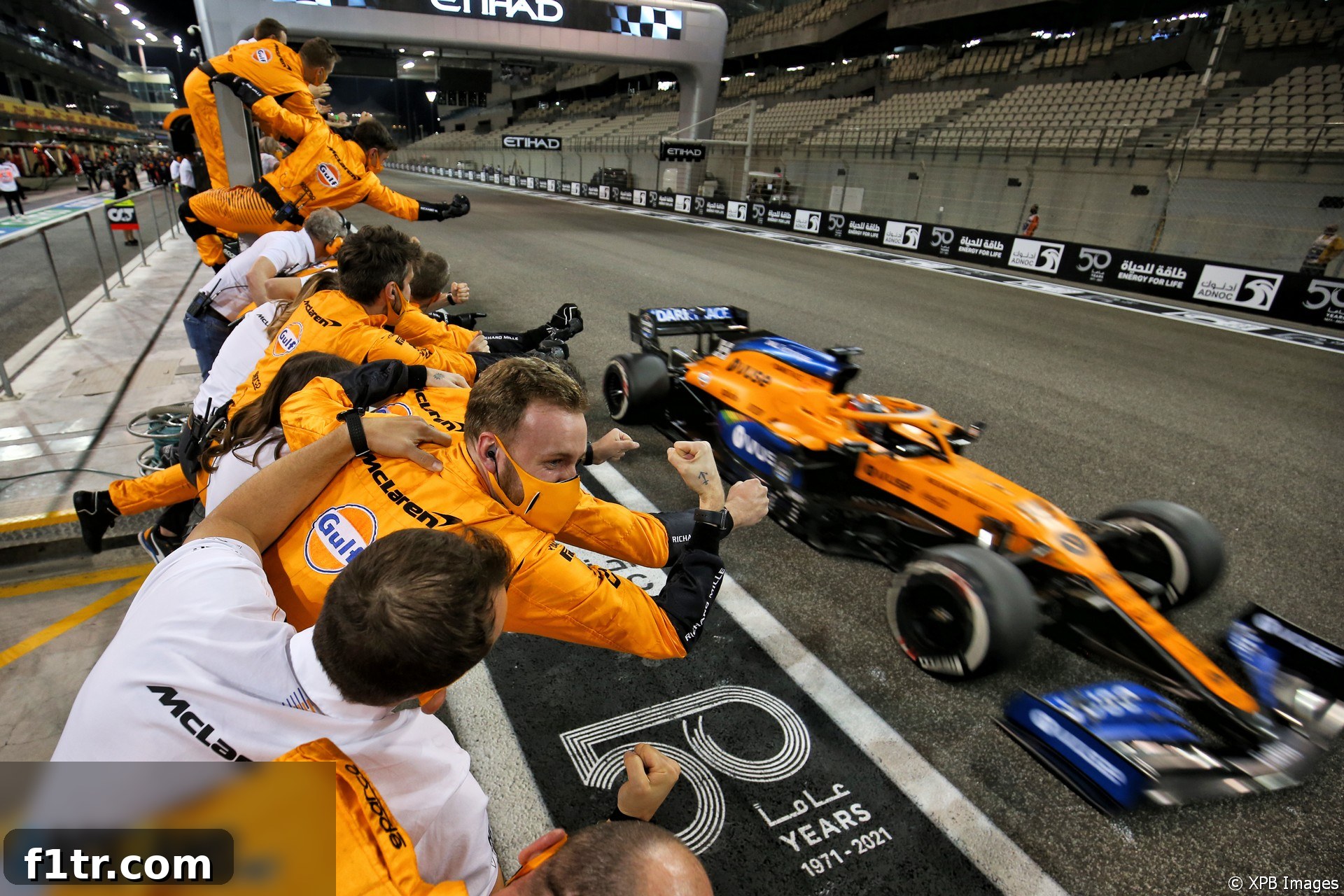
McLaren officially secured the highly coveted third position in the Formula 1 Constructors’ Championship, a significant achievement confirmed following a critical stewards’ ruling regarding an investigation into Carlos Sainz Jr.’s pit lane conduct during the thrilling Abu Dhabi Grand Prix. This verdict brought a dramatic conclusion to one of the most fiercely contested battles in recent Formula 1 memory, solidifying McLaren’s place ahead of their rivals, Racing Point.
Advert | Become a Supporter & go ad-free
McLaren Seals Third Place in Constructors’ Title After Intense F1 Season Finale
The 2020 Formula 1 season culminated in an extraordinary finale at the Yas Marina Circuit, with the battle for third place in the Constructors’ Championship reaching a fever pitch. McLaren, a team with a storied history in the sport, found themselves locked in an intense points struggle with Racing Point. Entering the Abu Dhabi Grand Prix, the stakes were incredibly high, with millions in prize money, significant prestige, and crucial momentum for the upcoming seasons hanging in the balance.
On race day, McLaren’s drivers, Carlos Sainz Jr. and Lando Norris, delivered a strong performance, crossing the finish line in fifth and sixth positions, respectively. This collective effort yielded a crucial haul of points. In contrast, Racing Point faced a challenging race. While Sergio Perez, a key points scorer for the team, was forced to retire early due to a technical issue, his teammate Lance Stroll managed to salvage a single point. Despite Stroll’s effort, McLaren’s combined points tally from Sainz and Norris was enough to provisionally overtake Racing Point, placing them third in the championship standings.
The Pit Lane Controversy: An Unfolding Drama
However, the celebratory atmosphere for McLaren was momentarily overshadowed by an announcement from the race stewards during the Grand Prix itself. Carlos Sainz Jr. was placed under investigation for allegedly slowing excessively as he entered the pit lane. This development introduced a tense period of uncertainty, as a severe penalty could have potentially demoted Sainz low enough in the finishing order to shift the championship advantage back to Racing Point. The possibility of such a penalty created considerable anxiety within the McLaren garage and captivated F1 fans globally, who were keenly following the unfolding drama.
The incident in question occurred when Sainz entered the pits, closely followed by Lando Norris and just ahead of Racing Point’s Lance Stroll. Racing Point’s team principal and CEO, Otmar Szafnauer, was quick to voice his team’s concerns, alleging that the McLaren driver had deliberately driven too slowly to facilitate a ‘double stack’ pit stop for McLaren – a strategy where both cars pit consecutively. This, Szafnauer argued, impeded Stroll and unfairly altered the race dynamic.
“He [slowed] and you’re not allowed to do that,” remarked Racing Point CEO Otmar Szafnauer during the race to Sky Sports. “He went slowly so they could stack them. And what it cost was Lance getting out ahead of him. And now it’s completely changed the race and you’re not allowed to do that.” Szafnauer’s comments highlighted the strategic implications of such an action and his team’s strong belief that McLaren had gained an unfair advantage. However, Stroll himself offered a more tempered view, stating that the delay “didn’t really cost us much,” suggesting a less significant impact than his team’s assessment.
Stewards’ Impartial Verdict: Clearing the Air
The stewards, entrusted with upholding the sporting regulations of Formula 1, meticulously investigated the incident following the race. Their inquiry involved a thorough review of telemetry data, video evidence, and direct input from the teams and drivers involved. After careful consideration, they concluded that while Sainz did indeed drive slightly below the mandated speed limit in the pit lane, this deviation was minimal in duration and magnitude. Crucially, the stewards determined that the marginal speed reduction had a negligible impact on the race and did not confer any unfair advantage to McLaren. Consequently, they decided to take no further action against the Spanish driver.
The detailed explanation provided by the stewards shed light on their decision-making process:
- Team Communication: “Car 55 [Sainz] was advised by its team, that it was 2.4 seconds in front of car 18 [Stroll] approaching the Pit Entry. There was no instruction by the Team to slow down.” This clarifies that McLaren did not issue any direct orders for Sainz to deliberately slow down, debunking Racing Point’s key accusation of strategic slowing.
- Pit Lane Entry Maneuver: “On approaching the start of the pit lane car 55 accelerated then as per normal practice, braked briefly to less than 80 km/h just prior to the line and then accelerated up to 80. This was exactly the same as car four [Lando Norris]. (Car 18 also braked to below 80 prior to the line then accelerated up to 80 as it crossed the line).” This detailed account established a precedent, showing Sainz’s actions mirrored those of his teammate, Lando Norris, and were consistent with common pit entry procedures, including Stroll’s own.
- Speed Fluctuation: “Within the pit lane, car 55 was at 80 kph for all but approximately five seconds when it dropped to no less than 70 kph. We estimate this resulted in car 55 arriving at the pit stop around 0.6 second later than if it had maintained a speed of 80 kph.” The stewards quantified the slowdown, isolating it to a mere five seconds where the speed dropped to 70 kph. The resulting delay was a minimal 0.6 seconds, which they deemed insignificant in the broader context of the race and the championship implications.
- Double Stack Avoidance: “Therefore, we are not of the view that this action in any way resulted in the team avoiding a “double stack” situation as car four was well clear of the pit stop at this time.” This was a crucial finding, directly refuting Racing Point’s core claim. The stewards confirmed that Norris was already well clear of his pit box by the time Sainz arrived, meaning there was no strategic need or successful attempt to ‘stack’ cars due to Sainz’s speed.
- Driver’s Caution: “We also accept the explanation of the driver of car 55 that he was exercising a degree of caution as video evidence confirms the presence of a lot of other teams’ personnel in the pit lane at the time.” The human element was considered, with Sainz’s explanation of exercising caution for safety reasons being accepted. The pit lane, especially during a race, is a highly congested and potentially dangerous area, and driver caution is often warranted.
- Impact on Stroll: “Car 18 was able to maintain a speed of 80 kph in the pit lane except for a very short period of time (approximately 1 second) and therefore we do not consider that it was materially impacted by the actions of the driver of car 55.” This finding directly supported Stroll’s own assessment that the incident did not significantly affect his race, further weakening Racing Point’s protest.
- Post-Pit Stop Analysis: “We also checked the relative speeds of the cars after leaving their pit stops and can see no evidence of car 55 driving unnecessarily slowly.” The investigation extended beyond the pit entry, confirming that Sainz maintained appropriate speeds once out of his pit box, reinforcing the lack of deliberate strategic slowing.
Interestingly, the stewards acknowledged the delay in their verdict. “Normally the stewards prefer to take decisions of this nature during the race however in this case the necessary telemetry was only available shortly before the finish,” they explained. This highlights the complexity of such investigations and the reliance on detailed data that sometimes only becomes fully accessible after the race concludes.
A Defining Moment for McLaren and Sainz’s Farewell
With the stewards’ decision firmly in place, McLaren’s third-place finish in the Constructors’ Championship was definitively confirmed. This achievement marked a monumental step forward for the Woking-based outfit, especially in a season where they were still operating with Renault power units before their highly anticipated switch to Mercedes engines. Securing third place not only brings significant financial benefits, which can be reinvested into car development and infrastructure, but also provides a massive morale boost for the entire team.
For Carlos Sainz Jr., this dramatic conclusion to his final race with McLaren before his move to Ferrari was particularly poignant. His strong performance, coupled with Lando Norris’s consistent speed, underpinned McLaren’s resurgence. Sainz’s role in this success cannot be overstated, having been a pivotal figure in the team’s upward trajectory since joining them. His mature handling of the pit lane incident and his professionalism throughout the investigation further cemented his reputation as a top-tier F1 driver.
Lando Norris, too, played a crucial part in McLaren’s championship success. His blistering pace and consistent points finishes throughout the season, including his performance in Abu Dhabi, were instrumental in accumulating the necessary points to fend off their rivals. The partnership between Sainz and Norris proved to be one of the strongest driver pairings on the grid, fostering a healthy competitive environment that propelled McLaren forward.
The Implications for the Future
This championship result signifies McLaren’s return to consistent competitiveness at the sharp end of the midfield. It validates the strategic decisions made by team CEO Zak Brown and Team Principal Andreas Seidl, showcasing the positive impact of their leadership and the revitalized culture within the team. For Racing Point, while the sting of narrowly missing out on third place might linger, their performance throughout the 2020 season, particularly with Sergio Perez’s race win, demonstrated their potential. As they transition into the Aston Martin F1 team, they will undoubtedly carry this competitive spirit into the next era.
The Abu Dhabi Grand Prix delivered a fittingly dramatic end to an unconventional and challenging F1 season. McLaren’s hard-fought victory in the Constructors’ standings, sealed by an impartial stewards’ decision, underscores the relentless competition in Formula 1 and sets the stage for even more thrilling battles in the seasons to come. It was a testament to McLaren’s resilience, strategic acumen, and the sheer talent of its drivers.
Sainz’s Team Radio When He Pitted
The following transcript captures the communication between Carlos Sainz Jr. and his McLaren race engineer during the critical pit stop sequence:
| To Sainz | Carlos we’re boxing this lap. |
| To Sainz | It will be a double shuffle. |
| Sainz | Carlos pit lane. |
| To Sainz | Leave the launch map on. |
| To Sainz | Launch map, launch map, launch map. |
| To Sainz | Could be close to Vettel ahead so use overtake. |
Advert | Become a RaceFans supporter andgo ad-free
More on the 2020 Abu Dhabi Grand Prix
- Mercedes also had MGU-K concerns over Russell’s car
- Ferrari hail “outstanding professional” Vettel after his final drive for team
- 2020 Abu Dhabi Grand Prix Star Performers
- Driver line-up confirmed for Yas Marina test, two teams won’t attend
- Paddock Diary: Abu Dhabi Grand Prix
Browse all 2020 Abu Dhabi Grand Prix articles