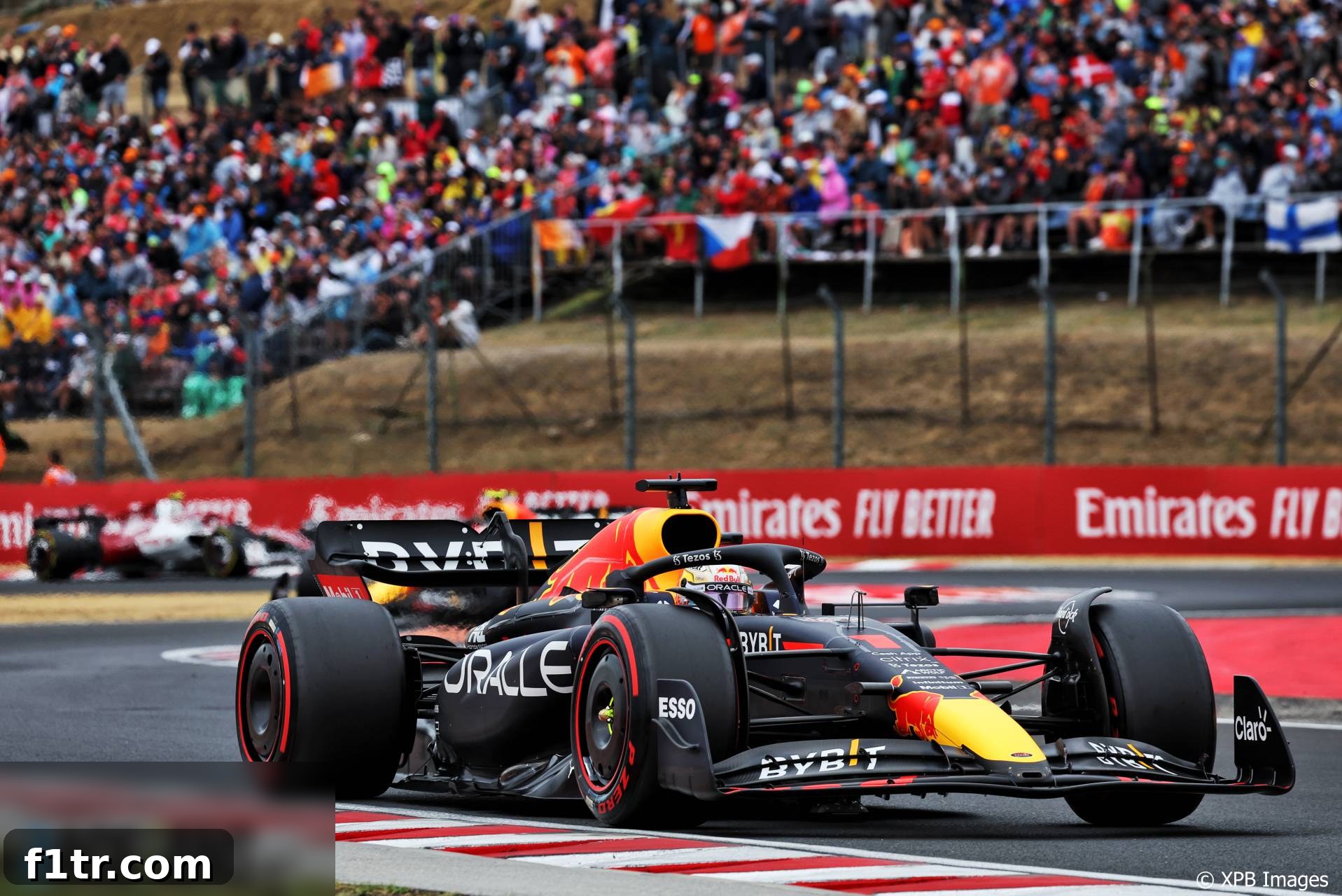
The 2022 Hungarian Grand Prix at the challenging Hungaroring circuit delivered a thrilling and unpredictable spectacle, culminating in an extraordinary victory for Max Verstappen. Starting from a challenging tenth position on the grid, the reigning world champion navigated a race filled with strategic gambles, on-track battles, and fluctuating weather conditions to clinch a dominant win. This remarkable comeback was further highlighted by a mid-race spin that briefly threatened his charge, yet he recovered with impeccable poise. In stark contrast, Ferrari, who had shown strong pace earlier in the weekend, endured a disappointing afternoon, failing to secure a single podium spot despite leading much of the race.
Verstappen’s path to victory was a masterclass in strategic execution and raw driving talent. His Red Bull Racing team capitalized on crucial pit stops, successfully undercutting both Carlos Sainz Jnr of Ferrari and George Russell of Mercedes on his final stop. Following these strategic plays, Verstappen demonstrated his on-track prowess by twice passing Charles Leclerc, his primary championship rival, to seize the lead of the race. The latter stages of the race also saw a formidable charge from Lewis Hamilton, who skillfully overtook his Mercedes teammate Russell to claim second place. Russell, delivering another impressive performance, completed a superb double podium finish for Mercedes-AMG Petronas F1, underscoring the team’s significant performance improvements.
For Ferrari, what started with high hopes quickly unraveled. Sainz, after a solid race, finished fourth, just outside the podium positions. Leclerc, whose race strategy proved detrimental, plummeted to sixth place after a late-race gamble on soft tyres within the final 20 laps failed to pay off, leaving him exposed to faster-charging competitors.
The pre-race atmosphere was thick with anticipation, not least due to the capricious Hungarian weather. Earlier rain showers had left the circuit damp, but as the cars lined up for the formation lap, the track appeared to have dried out considerably. However, in the tense minutes before the green lights illuminated, a light drizzle began to fall over the grid, creating an added layer of uncertainty and inflating the tension among drivers and strategists alike. This unpredictable element immediately put tyre choices under the spotlight.
As the lights went out, initial tyre choices played a pivotal role. George Russell, starting from pole position, opted for the soft compound tyres, a bold choice designed for maximum early grip. In contrast, the Ferrari duo of Sainz and Leclerc elected for the more durable medium tyres for their first stint, aiming for a longer run. Russell executed a perfect start, holding off the charging Sainz, who attempted an ambitious move around the outside of Turn 1. However, the young Briton held his nerve and his line, firmly retaining the lead, much to the delight of the Mercedes garage and fans.
The opening lap was not without incident further down the field. A collision between Sebastian Vettel and Alex Albon through Turn 2 resulted in damage to the Williams’ front wing, scattering debris across the circuit. This necessitated the deployment of a Virtual Safety Car (VSC) to allow marshals to safely clear the track. Albon’s unfortunate contact also earned him the black-and-orange mechanical flag, compelling him to pit for repairs and dropping him to the very back of the field, a significant setback early in the race. Moments later, the green flag was waved, allowing the racing to resume at full speed, with Russell having already established a safe gap beyond the DRS activation range from the Ferraris.
Another early incident involved Kevin Magnussen, who was also called into the pits after receiving a black-and-orange flag. His Haas suffered front wing endplate damage, sustained during contact with Daniel Ricciardo at the frantic start of the race. These early mechanical issues and enforced pit stops highlighted the unforgiving nature of the Hungaroring’s tight and twisty layout, where even minor contact can have disproportionate consequences on race strategy.
While the front battle unfolded, the Red Bulls of Verstappen and Sergio Perez began their determined charge through the midfield. Starting from 10th and 11th respectively, their soft tyres provided superior grip and pace, allowing them to rapidly gain positions. They efficiently dispatched both Esteban Ocon and Fernando Alonso of Alpine, expertly moving into sixth and seventh places, showcasing the raw speed of their RB18 chassis and the strategic advantage of their initial tyre compound choice.
On Lap 12, the relentless pursuit continued as Lewis Hamilton utilized the DRS advantage along the pit straight to brilliantly overtake Lando Norris for fourth place into Turn 1. Hot on his heels, Verstappen wasted no time in following the Mercedes past the McLaren, swiftly moving into fifth. The very next lap, Norris’s struggles intensified as he lost yet another position, this time to Sergio Perez on the approach to Turn 1, indicative of McLaren’s fading pace on their starting tyres.
Recognizing Norris’s diminishing performance and increasing tyre wear, McLaren opted to pit him for medium tyres at the end of Lap 14, hoping to inject new life into his race. Out at the front, George Russell, despite his strong start, was visibly beginning to struggle with rear tyre wear, slowly falling back into the clutches of the hungry Ferraris. With Sainz closing within DRS range by Lap 16, Mercedes made the proactive decision to call Russell into the pits for a fresh set of medium tyres. He rejoined the track in sixth position, strategically placed between the two Alpines, ready to fight his way back.
Sainz followed suit, pitting at the end of the subsequent lap. However, a slight delay in his release from the pit box, a matter of mere fractions of a second, proved critical, allowing Russell to maintain his hard-earned track advantage. Verstappen, executing a perfectly timed pit stop, also entered the pits, capitalizing on his new tyres to successfully undercut Hamilton when the Mercedes finally pitted at the end of Lap 19. These rapid-fire pit exchanges underscored the critical role of timing and execution in modern Formula 1 strategy.
Leclerc, having stayed out longer than his competitors, inherited the lead. When he eventually pitted for his second set of medium tyres at the end of Lap 21, his extended first stint paid dividends, as he rejoined the race in a strong second place, having successfully jumped his teammate Sainz. Russell’s lead over Leclerc was initially around two seconds, a gap that the Monégasque driver gradually reduced, bringing himself within DRS range by Lap 27, setting the stage for a thrilling battle for the lead.
Leclerc’s first attempt to seize the lead, a half-hearted look into Turn 1, did not pay off. However, it was becoming increasingly apparent that Russell was struggling to match the relentless pace of the Ferrari. As they commenced Lap 31, Leclerc executed his best run on the Mercedes of the entire race, unleashing a blistering attack. He expertly dived around the outside of the leader entering Turn 1, making a decisive move to claim the lead of the race, much to the frustration of the Mercedes pit wall.
With Leclerc now out in front, Russell found himself falling back, coming within DRS range of Sainz behind. Verstappen, circulating in fourth, was also rapidly closing in on the pair, reducing the gap to less than a second. Sensing an opportunity, Verstappen made his second pit stop for medium tyres at the end of Lap 39. In a strategic response, both race leader Leclerc and Russell pitted on the very next lap. Crucially, Leclerc made the contentious switch to the harder compound tyres, a decision that would later be heavily scrutinized. However, Verstappen’s out-lap on his fresh mediums was nothing short of phenomenal, allowing him to beat Russell out of the pit lane and seize an unexpected second place, a pivotal moment in the race.
Armed with significantly softer and fresher tyres, Verstappen quickly reeled in Leclerc. Along the pit straight, he easily passed the Ferrari, which was struggling for grip on its hard tyres, to jump into the net lead of the race for the very first time. Yet, the drama was far from over. At the end of that very lap, pushing the limits, Verstappen momentarily lost control of his car under throttle on the exit of Turn 13. The Red Bull spun a full 360 degrees, a heart-stopping moment for his team and fans. Remarkably, he managed to continue, though he had momentarily dropped behind Leclerc once more, setting up another intense chase.
Undeterred by his brief spin, Verstappen quickly regained the ground he had lost to Leclerc. With the superior pace of his medium tyres, he eventually repassed the Ferrari, making another decisive move out of the first corner to reclaim the net lead of the race. Sainz, running on a different strategy, eventually pitted at the end of Lap 48 for soft tyres, rejoining the track in fifth position behind Russell. This handed the lead of the race temporarily to Hamilton, who was the only leading driver yet to make his second pit stop, providing a brief glimmer of hope for the seven-time world champion.
Hamilton eventually made his second stop on Lap 51, taking on a set of soft tyres for the final 19 laps. He emerged from the pits behind Sainz in fourth, setting himself up for a charge. This sequence of pit stops finally promoted Max Verstappen into the overall lead of the race for the first time, a position he would not relinquish. Behind him, Leclerc, struggling significantly on his hard tyres, found himself under increasing pressure from Russell, who was on the more effective medium compound.
The strategic misstep by Ferrari became glaringly obvious on Lap 54, as Russell effortlessly passed Leclerc for second place. In a desperate attempt to salvage some points or regain pace, Ferrari opted to bring Leclerc in for a third pit stop at the end of the lap, switching him to soft tyres. He rejoined the race in a distant sixth place, over half a minute adrift of the now runaway leader, Verstappen, a clear sign of a strategy that had backfired spectacularly.
Meanwhile, Hamilton, benefiting from his fresher soft tyres, showcased incredible pace, rapidly closing in on Sainz in third. He executed a masterful slipstream maneuver along the pit straight, powering past the Ferrari to snatch the final podium spot. Hamilton’s charge wasn’t over. He quickly caught up to his teammate Russell, who was holding second place, and deftly passed him into Turn 1, securing an impressive second position and cementing Mercedes’ strongest performance of the season.
As the final laps dwindled, a light drizzle began to fall once more, adding a final twist to the already dramatic race. With just four laps remaining, Valtteri Bottas was forced to pull off the track at Turn 11, reporting a loss of power from his Alfa Romeo. This incident triggered another Virtual Safety Car, allowing marshals to safely recover the stricken vehicle without disrupting the final battles too much.
The rain intensified as the race resumed with just over a lap remaining, creating treacherous conditions for the drivers. However, Max Verstappen, demonstrating his unparalleled skill in challenging circumstances, managed to meticulously navigate his way around the final tour. He calmly took the chequered flag, completing a truly remarkable recovery drive from tenth on the grid to win by over eight seconds from a resurgent Hamilton in second. George Russell held on to complete a fantastic double podium for Mercedes, a testament to their improved car and strategic execution.
Carlos Sainz ultimately finished fourth, a respectable result but overshadowed by Ferrari’s overall disappointment. Sergio Perez held onto a strong fifth place, fending off a late charge from Leclerc by a mere four tenths of a second, highlighting the dramatic drop in performance for the Ferrari driver. Lando Norris finished a minute behind the lead Ferrari in seventh, ahead of the consistently performing Alpine duo of Fernando Alonso and Esteban Ocon. Sebastian Vettel, in his final Hungarian Grand Prix, claimed the final championship point in tenth place after a spirited late-race battle with his Aston Martin teammate Lance Stroll.
This 2022 Hungarian Grand Prix will undoubtedly be remembered as a pivotal moment in the championship, a race where Max Verstappen’s audacious talent and strategic brilliance shone brightest, and where Ferrari’s title challenge took another significant hit. The unpredictable Hungaroring once again delivered a thrilling spectacle, leaving fans eagerly anticipating the next chapter of the Formula 1 season.