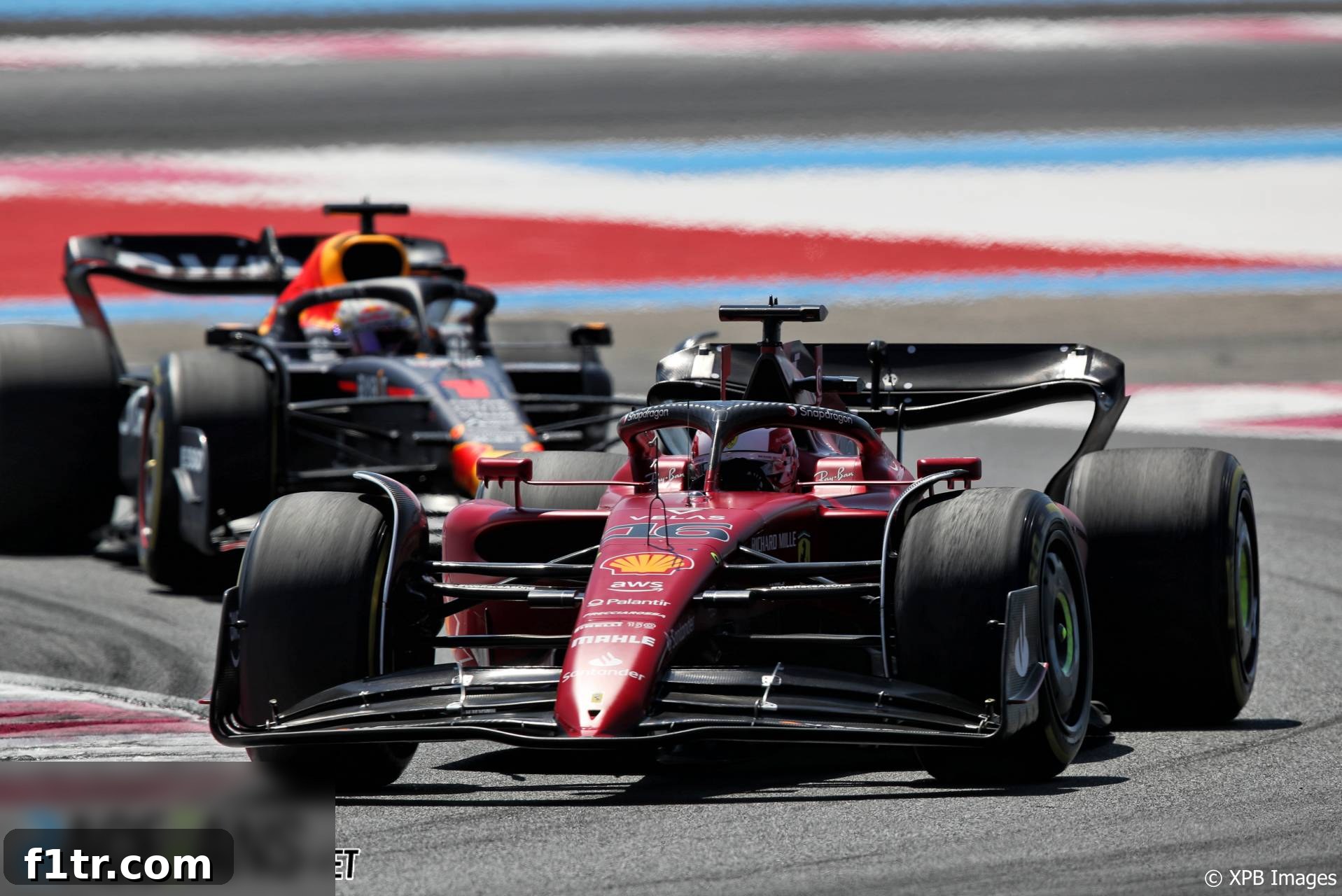
Charles Leclerc, the talented Ferrari driver, publicly accepted full responsibility for the costly error that led to his retirement from the French Grand Prix while dramatically leading the race. This incident, occurring at a pivotal point in the 2022 Formula 1 season, sent shockwaves through the paddock and significantly impacted the championship battle, leaving fans and the team alike grappling with the implications.
Advert | Become a Supporter & go ad-free
The Monegasque driver’s race ended abruptly on the 18th lap at the Circuit Paul Ricard. Having started from pole position, Leclerc had meticulously controlled the pace, fending off the formidable challenge of his championship rival, Max Verstappen, throughout the opening stages. His Ferrari F1-75 appeared to be in strong contention for a crucial victory until a moment of intense pressure and a subsequent misjudgment saw him spin off the track at the exit of the demanding double right-hander, Beausset. The car veered sharply, crashing nose-first into the Tecpro barrier, bringing his dominant run to a sudden and heartbreaking halt.
The immediate aftermath of the crash was captured vividly over team radio, with Leclerc’s raw frustration echoing through the air. “I didn’t know I left my radio on,” he later admitted, reflecting on the candid outburst that revealed the depth of his disappointment. “But obviously, it’s extremely frustrating. These moments are incredibly tough for any racing driver, especially when you feel like you’ve thrown away a potential win.”
Leclerc’s self-assessment was remarkably candid, highlighting a pervasive struggle that had marred parts of his otherwise brilliant season. “I feel like I’m performing at probably the highest level of my career since the beginning of the season,” he explained, acknowledging his consistent speed and qualifying prowess. “But there’s no point of performing at a very high level if then I do those mistakes. The raw pace is there, the setup understanding is there, but converting that into consistent, error-free race performances is the ultimate goal, and I fell short today.”
The Ferrari star didn’t shy away from quantifying the financial and, more importantly, championship cost of his driving errors. “I think there are 32 points in overall – 25 today, I think it was likely that we were going to win this race because we were fast, and seven in Imola with my mistake,” he meticulously calculated. This stark admission underlined the immense pressure he felt and the high stakes of the 2022 season. Each point lost was a significant blow in the tightly contested battle against Red Bull Racing and Max Verstappen.
“So at the end of the year, we will count back, and if there are 32 points missing then I know it’s coming from me and I did not deserve to win the championship,” Leclerc stated with an almost brutal honesty. This self-inflicted critique showcased his dedication to accountability and his fierce desire for perfection. “But for the second half of the season, I need to get on top of those things if I want to be a world champion. It’s about refinement, minimizing the risks, and ensuring that raw speed translates into championship-winning consistency.” The psychological burden of these errors was clearly weighing heavily on him, forcing a profound introspection into his approach to racing.
Following his spin through the asphalt run-off area, the sight of his Ferrari impacting the barrier at the corner’s exit was a grim one. Initially, in the heat of the moment, Leclerc communicated to his race engineer, Xavier Marcos Padros, that he was having difficulty releasing the throttle. This immediate concern naturally triggered memories of a previous technical issue. However, after further assessment and calm reflection, he confirmed that this crash was not a repeat of the throttle problem he had encountered in Austria just a few weeks prior.
Instead, the root cause lay in the delicate handling characteristics of his car and the challenging track conditions. “No, it’s been a very tricky balance all weekend,” Leclerc clarified, shedding light on the underlying struggle. “I like to have oversteer, but whenever there is heat, it makes it very difficult to be consistent. I have not been very consistent, and I paid the price of doing one big mistake during the race.” Oversteer, while often preferred by aggressive drivers for its ability to help rotate the car through corners, becomes a double-edged sword when grip levels are compromised by high track temperatures, demanding absolute precision and immaculate control. The Paul Ricard circuit, known for its long, sweeping turns and often scorching summer conditions, tested drivers’ patience and car setup to their limits, and on this occasion, Leclerc found himself on the wrong side of that fine margin.
In a final attempt to salvage his race, Leclerc tried to reverse his damaged Ferrari from the barrier. His efforts, however, proved unsuccessful, leading to an even greater sense of missed opportunity. “I couldn’t reverse, which was a shame because then I saw the car, and the car was actually not too damaged. We could still run,” he lamented, imagining a scenario where he might have continued, albeit likely with a significant time penalty or a pit stop for repairs. This observation only deepened the sting of the incident. “But this is a detail. First of all, I need to not put cars in the wall, and then they should work better.” His concluding remarks underscored his determination to eliminate such fundamental errors, recognizing that even the most advanced machinery cannot compensate for driver mistakes.
Leclerc’s Radio Messages After His Crash
The immediate radio exchange between Charles Leclerc and his race engineer, Xavier Marcos Padros, offered a raw insight into the shock and confusion that followed the crash. These messages quickly became a symbol of the race’s dramatic turning point and Leclerc’s personal struggle.
| Marcos Padros | Are you okay? |
| Leclerc | I cannot go off throttle |
| Marcos Padros | Eight-second pause Now it’s zero percent. |
| Leclerc | No! |
This exchange vividly illustrates Leclerc’s initial belief that a technical issue might have caused his car to continue accelerating, a terrifying prospect for any driver. The subsequent confirmation from his engineer that the throttle was indeed at zero percent would have instantly shifted his focus from potential mechanical failure to the stark reality of a self-inflicted error, amplifying the immediate sense of regret and frustration that permeated his “No!”
Advert | Become a RaceFans supporter andgo ad-free
The French Grand Prix incident served as a stark reminder of the unforgiving nature of Formula 1. While Leclerc’s speed and talent are unquestionable, the championship demands not just pace but relentless consistency and an almost superhuman ability to avoid mistakes under immense pressure. The 32 points he calculated as lost became a poignant statistic in the narrative of his 2022 season, a season where Ferrari’s performance had often promised so much, only to be undermined by a combination of strategic missteps and driver errors. For Leclerc, this race was more than just a DNF; it was a profound learning experience, a crucible in which his resolve to become a world champion would truly be tested in the races that followed. The path to redemption would be long, but his honest self-assessment indicated a driver ready to confront his demons and emerge stronger.
2022 French Grand Prix
- Ferrari’s season of missed chances led to “difficult” criticism for Binotto
- McLaren looking into why their starts are “more inconsistent” this year
- Mercedes expect Hungarian GP will ‘expose our qualifying weakness’
- Hamilton and Russell ‘out-performing a car that’s not good enough’ – Wolff
- “We need to decide now”: Inside Sainz and Ferrari’s French GP strategy dilemma
Browse all 2022 French Grand Prix articles