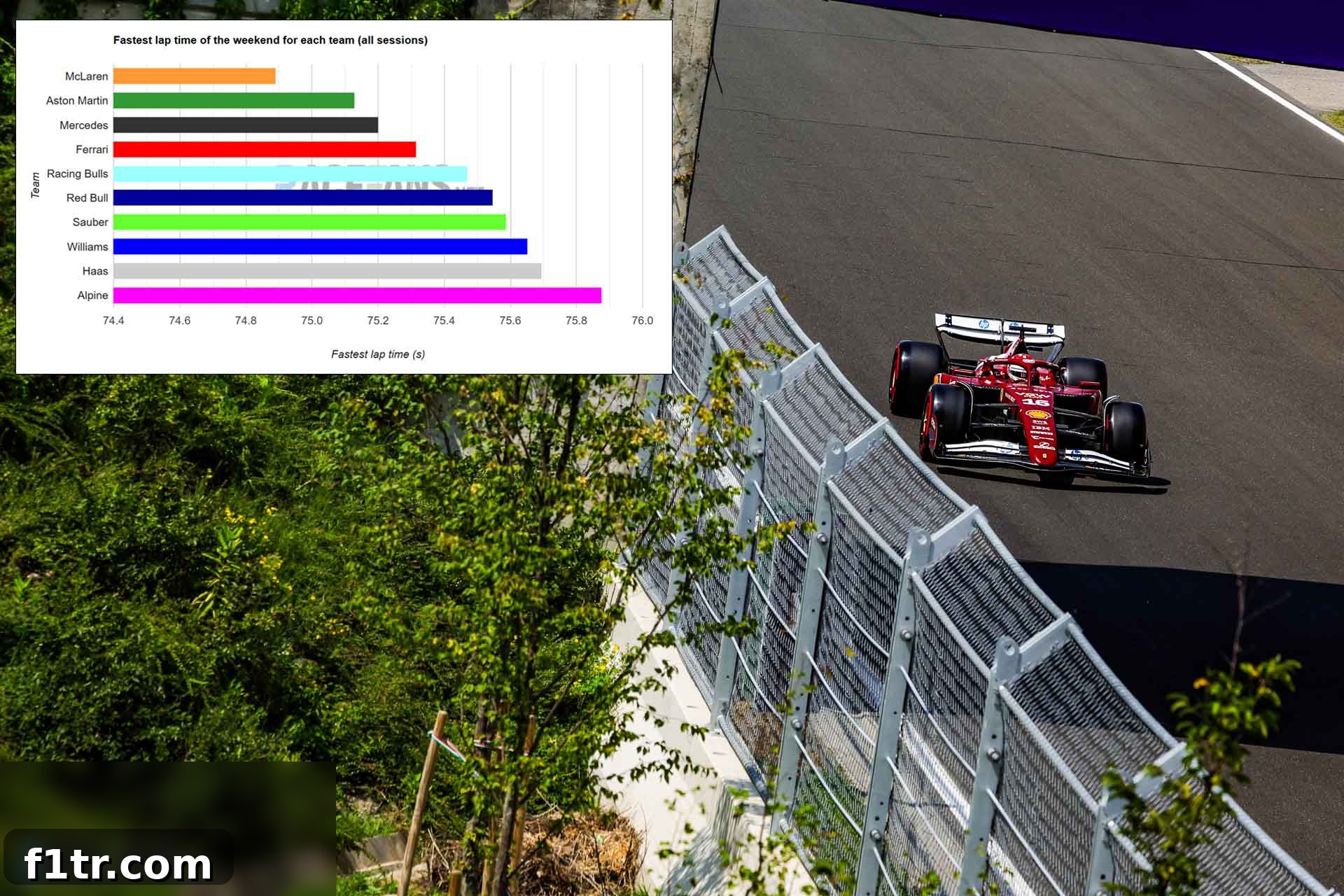
The Hungarian Grand Prix weekend at the Hungaroring kicked off with a palpable sense of anticipation, particularly after McLaren demonstrated overwhelming pace during the practice sessions. Their performance suggested that the qualifying session might be a mere formality, with a clear front-runner already established. However, the capricious nature of Formula 1, especially at a circuit known for its challenging characteristics, proved once again that predictions are often shattered by the unexpected. The qualifying session itself unfolded as a captivating drama, throwing up a series of significant surprises that reshaped the grid and ignited fervent discussions among fans and pundits alike.
Unpredictable Grid: Shifting Dynamics in Qualifying
Despite the prevailing belief that McLaren held a decisive advantage, the qualifying session painted a very different picture. Ferrari, having only logged the fourth-fastest lap time of the weekend heading into Saturday, emerged as an unlikely contender for pole position. Both McLaren, Aston Martin, and Mercedes had shown superior raw pace throughout the earlier sessions, leading many to believe that the Scuderia would be fighting for a spot on the second or third row at best. Yet, Formula 1’s dynamic environment and the sheer talent of its drivers often conspire to deliver moments of pure brilliance, and Hungary’s qualifying was no exception.
In a turn of events that confounded initial expectations, Charles Leclerc managed to seize a stunning pole position for the Grand Prix. This was not merely the result of a single, perfectly executed lap where every corner was mastered and every millisecond extracted. Instead, it was a testament to his adaptability and the profound impact of rapidly changing track conditions that swept across the Hungaroring as Q3 commenced. The session’s final segment was dramatically influenced by external factors that played a crucial role in shuffling the competitive order.
A substantial weather front, bringing with it a storm, passed directly to the north of the circuit during the critical Q3 period. While the track experienced only a minimal amount of rainfall – certainly not enough to necessitate a switch to intermediate tyres – the atmospheric changes had a far-reaching effect. Crucially, rising wind speeds and a significant drop in track surface temperature combined to alter the grip levels and balance of the cars. The asphalt temperature plummeted from a scorching 50 degrees Celsius to below 40 degrees Celsius within a short span, a substantial shift that profoundly affected tire performance and driver confidence across the field. This environmental volatility created a unique challenge, rewarding those who could adapt quickest and penalizing those whose setups were less forgiving in cooler, windier conditions.
Charles Leclerc stood out in his ability to consistently improve his lap times from one session to the next, navigating the treacherous conditions with remarkable precision. His pole-winning lap of 1’15.372 was not the absolute fastest recorded over the entire weekend; five other drivers posted quicker laps at various points. However, the critical distinction lay in Leclerc’s mastery of the challenging Q3 environment. He was the only one who could extract maximum performance when it mattered most, illustrating a rare blend of car control and strategic acumen under pressure. This performance underscored his reputation as one of the sport’s most naturally gifted drivers, capable of delivering when the stakes are highest and conditions are at their most demanding.
Adding another layer of intrigue to the Hungarian Grand Prix weekend, Red Bull Racing found themselves in an uncharacteristic position of struggle. It’s not uncommon for the reigning champions to appear less dominant on Friday practice sessions, often sandbagging or fine-tuning their setup before unleashing their true pace in qualifying and the race. However, this weekend deviated from that familiar script. Their lack of competitiveness on Friday was, surprisingly, not followed by a more robust showing on Saturday. In fact, Red Bull’s best qualifying lap at the Hungaroring was slower than their benchmark from 12 months prior, a stark indicator of their relative struggles. This unexpected downturn raised questions about their car’s suitability for the circuit’s unique characteristics, particularly under the evolving aerodynamic regulations.
Curiously, despite their era of dominance in recent years, Red Bull has not secured a pole position at the Hungaroring since the introduction of the current generation of aerodynamic regulations in 2022. This statistic highlights a peculiar trend, suggesting that the tight, twisty nature of the Hungarian circuit might expose specific areas where their car design, while generally superior, faces particular challenges. The technical demands of the Hungaroring, with its emphasis on mechanical grip and efficient downforce through a series of slow to medium-speed corners, appears to be a puzzle Red Bull is still trying to fully solve under the current regulations. Their inability to replicate their usual front-running performance here has certainly added an element of unpredictability to the grid.
Sector-by-Sector Breakdown: Aston Martin’s Remarkable Ascent
Perhaps one of the most dramatic weekend-to-weekend performance shifts observed in recent memory came from Aston Martin. Just a short while ago, at the Spa-Francorchamps circuit, they struggled considerably, appearing among the slowest teams. However, they arrived at the Hungaroring with a renewed vigour, transforming their pace to become the second-fastest team overall in qualifying. This incredible turnaround saw their drivers, Fernando Alonso and Lance Stroll, secure the third row of the grid, a testament to their engineers’ ability to adapt the car to different circuit demands and potentially benefiting from recent development upgrades. Alonso, ever the veteran, led the charge for the team, demonstrating his consistent ability to extract maximum performance.
An interesting internal battle unfolded within the Aston Martin garage during qualifying. While Fernando Alonso ultimately out-qualified his teammate, Lance Stroll showcased moments of exceptional individual pace. Intriguingly, Stroll recorded quicker sector times than Alonso in all three sectors of the Hungaroring circuit. However, the critical challenge, particularly with the fragile soft compound tyres used in qualifying, lies in stringing together three perfect sectors into one seamless lap. Stroll, despite his raw speed in segments, was unable to combine his absolute best efforts into a single, cohesive lap that would have placed him higher on the grid. The delicate balance required to maintain tyre performance and grip through a demanding lap, especially as track conditions evolved, likely played a significant role in his inability to fully capitalize on his individual sector strengths. This aspect of “ultimate lap” versus actual qualifying lap is often a fine margin in Formula 1, distinguishing pure pace from consistent execution.
| P. | # | Driver | S1 | S2 | S3 | Ultimate lap (deficit) |
|---|---|---|---|---|---|---|
| 1 | 81 | Oscar Piastri | 27.357 (1) | 26.374 (1) | 21.012 (1) | 1’14.743 (+0.198) |
| 2 | 4 | Lando Norris | 27.443 (2) | 26.396 (2) | 21.051 (2) | 1’14.890 |
| 3 | 18 | Lance Stroll | 27.493 (5) | 26.416 (3) | 21.220 (4) | 1’15.129 |
| 4 | 63 | George Russell | 27.496 (6) | 26.455 (5) | 21.211 (3) | 1’15.162 (+0.039) |
| 5 | 16 | Charles Leclerc | 27.485 (3) | 26.453 (4) | 21.312 (8) | 1’15.250 (+0.122) |
| 6 | 14 | Fernando Alonso | 27.523 (7) | 26.529 (7) | 21.229 (5) | 1’15.281 |
| 7 | 6 | Isack Hadjar | 27.586 (12) | 26.560 (8) | 21.229 (5) | 1’15.375 (+0.094) |
| 8 | 12 | Andrea Kimi Antonelli | 27.631 (17) | 26.476 (6) | 21.316 (10) | 1’15.423 (+0.359) |
| 9 | 5 | Gabriel Bortoleto | 27.590 (13) | 26.595 (10) | 21.315 (9) | 1’15.500 (+0.086) |
| 10 | 1 | Max Verstappen | 27.643 (18) | 26.588 (9) | 21.296 (7) | 1’15.527 (+0.020) |
| 11 | 87 | Oliver Bearman | 27.554 (8) | 26.687 (11) | 21.321 (12) | 1’15.562 (+0.132) |
| 12 | 55 | Carlos Sainz Jnr | 27.485 (3) | 26.704 (14) | 21.373 (14) | 1’15.562 (+0.090) |
| 13 | 44 | Lewis Hamilton | 27.583 (11) | 26.698 (13) | 21.338 (13) | 1’15.619 (+0.083) |
| 14 | 30 | Liam Lawson | 27.623 (15) | 26.687 (11) | 21.320 (11) | 1’15.630 |
| 15 | 43 | Franco Colapinto | 27.567 (9) | 26.740 (16) | 21.512 (17) | 1’15.819 (+0.056) |
| 16 | 22 | Yuki Tsunoda | 27.623 (15) | 26.734 (15) | 21.542 (18) | 1’15.899 |
| 17 | 27 | Nico Hulkenberg | 27.646 (19) | 26.853 (19) | 21.459 (15) | 1’15.958 (+0.123) |
| 18 | 10 | Pierre Gasly | 27.572 (10) | 26.935 (20) | 21.459 (15) | 1’15.966 |
| 19 | 31 | Esteban Ocon | 27.603 (14) | 26.769 (17) | 21.651 (19) | 1’16.023 |
| 20 | 23 | Alexander Albon | 27.725 (20) | 26.841 (18) | 21.657 (20) | 1’16.223 |
The Grand Prix Landscape: Field Performance and Historical Context
While McLaren showed a significant uplift in pace compared to their own performance at the Hungaroring in the previous year, demonstrating clear progress with their car development, they were still unable to challenge the absolute track record. The benchmark for the Hungaroring remains the formidable 1’13.447 set by Lewis Hamilton in 2020. This indicates that while the current generation of Formula 1 cars are incredibly fast, and teams like McLaren are making substantial strides, they haven’t yet reached the peak performance levels seen during certain periods of the sport’s history, particularly in terms of outright single-lap pace at this specific venue. The 2020 regulations, combined with Hamilton’s exceptional form and the Mercedes W11’s dominance, created a unique scenario that set a very high bar. The current cars, while requiring different driving styles and setup approaches, are still striving to match such historical records.
The qualifying session for the Hungarian Grand Prix truly delivered a spectacle of unpredictability and high-stakes racing. From McLaren’s initial practice dominance evaporating in qualifying, to Ferrari’s unexpected pole, Red Bull’s rare struggles, and Aston Martin’s inspiring resurgence, the narrative of the weekend has been anything but straightforward. The fluctuating track conditions played a pivotal role, highlighting the immense skill required by drivers to adapt instantly to falling temperatures and swirling winds. These dynamics set the stage for what promises to be an enthralling race, where strategy, tire management, and outright pace will all converge to determine the ultimate winner. The grid, shaped by these dramatic turns, guarantees a thrilling contest on Sunday, reminding us why the Hungarian Grand Prix is often one of the most exciting events on the Formula 1 calendar.
2025 Hungarian Grand Prix Insights
- Leclerc admits problem which struck Ferrari in Hungary is likely to recur
- Permane impressed by Lawson’s progress after “breakthrough” in Austria
- Albon expects “dogfight” as Williams aim to hold fifth place
- Mercedes eye more wins post-break after dropping revised rear suspension
- McLaren pair equal Senna and Prost’s run in second-fastest ever Hungarian GP
Browse all 2025 Hungarian Grand Prix articles