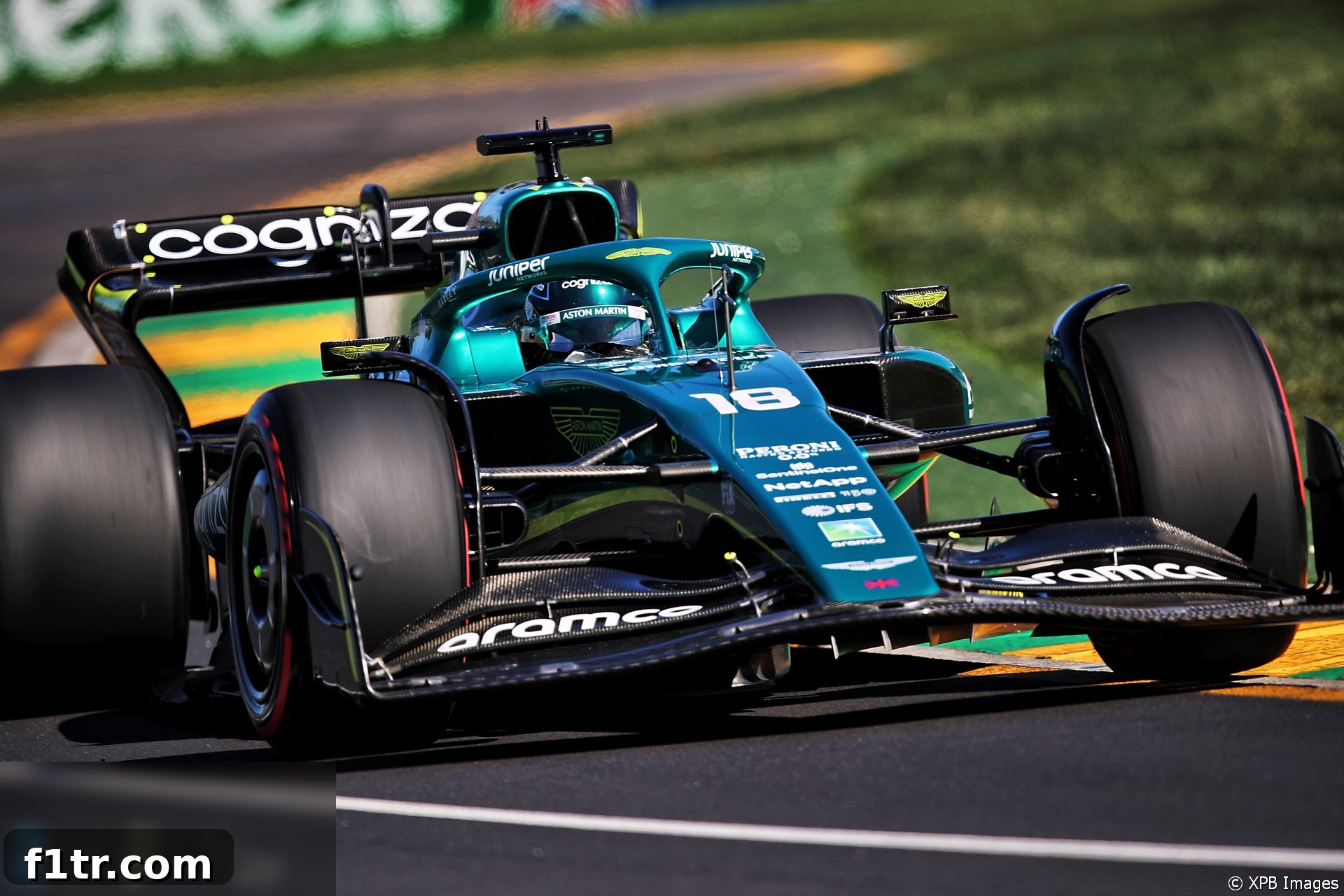
The Australian Grand Prix is a spectacle of speed, strategy, and often, high-stakes wheel-to-wheel racing. However, sometimes the intensity on track spills over into controversy, particularly when it comes to defensive driving. This was precisely the case when the stewards in Melbourne deemed Lance Stroll guilty of an infringement, handing the Aston Martin driver a five-second time penalty for making what they judged to be more than one move while defending his position.
This decision ignited a fervent debate among fans, pundits, and drivers alike: Was the penalty justified? Did Stroll’s actions truly cross the line from aggressive, legitimate defense into an illegal, dangerous maneuver? This article delves into the incident, the regulations, and the divergent perspectives surrounding this seldom-sanctioned but crucial aspect of Formula 1 racing.
The Incident: A Tense Battle for Position
The incident unfolded during a critical phase of the race on lap 37. Valtteri Bottas, driving for Alfa Romeo, was locked in a determined pursuit of Lance Stroll’s 12th position. Both drivers were on hard compound tyres, having strategically pitted earlier in the race, setting the stage for a prolonged and intense battle for track supremacy.
As the cars exited the final corner and roared down the main straight, commencing lap 38, Bottas skillfully tucked into the powerful slipstream of Stroll’s Aston Martin. This allowed him to activate his Drag Reduction System (DRS), giving him a significant speed advantage. Adding another layer of complexity, Stroll also had DRS active, benefiting from being within a second of Esteban Ocon’s 11th-placed Alpine ahead. This created a high-speed cat-and-mouse game, where both drivers were trying to maximize their aerodynamic efficiency while also defending or attacking.
What followed was a sequence of maneuvers by Stroll that drew the attention of the race stewards. First, Stroll moved decidedly to the right, aiming to cover the inside line into Turn 1 and prevent Bottas from gaining an easy pass. As Bottas drew closer, seemingly anticipating a move to the left, Stroll appeared to drift back towards the conventional racing line. However, almost immediately, Stroll shifted his car back to the right for a second time, firmly reclaiming the inside line as they approached the braking zone for Turn 1.
This rapid succession of direction changes caught Bottas off guard. Faced with the unpredictable movements of the Aston Martin, Bottas appeared to momentarily lift off the throttle, displaying uncertainty and potentially avoiding contact. He was forced to take the less optimal outside line into Turn 1, remaining behind Stroll, who successfully defended his position for that lap. The tension was palpable, highlighting the razor-thin margins and split-second decisions inherent in Formula 1 racing.
Just one lap later, the dynamic shifted. Bottas managed to execute a successful overtake on Stroll on the approach to Turn 1. However, the race was soon neutralized when the Virtual Safety Car was deployed mere seconds later, as Max Verstappen’s Red Bull came to a halt in Turn 2, adding another twist to the unfolding narrative.
Understanding the FIA’s Stance on Defensive Driving
To fully grasp the stewards’ decision, it’s essential to understand the specific regulation at play. The FIA’s International Sporting Code, specifically Article 2 B of Chapter IV, Appendix L, clearly states that “more than one change of direction to defend a position is not permitted.” This rule is fundamental to ensuring both safety and fairness in wheel-to-wheel racing.
The rationale behind this regulation is multifaceted. Firstly, it’s a critical safety measure. When a defending driver makes multiple changes of direction, it creates an unpredictable and potentially hazardous scenario for the attacking driver, especially at high speeds. The attacking driver has less time to react and judge their braking points or evasive maneuvers, significantly increasing the risk of a collision. Secondly, it ensures fair competition. The rule prevents drivers from ‘weaving’ or blocking in an overly aggressive manner, which can stifle genuine overtaking opportunities and make racing unduly difficult or even impossible for the car behind. It aims to strike a balance between allowing robust defense and promoting clean, exciting racing.
While drivers are permitted to make one move to defend their line, typically towards the inside of a corner, any subsequent move back towards the racing line and then another defensive shift is generally deemed illegal. This single-move rule is designed to give the attacking driver a clear indication of the defending driver’s intent and a predictable space to make their move.
In-Car Communications: Unfiltered Reactions
On the Radio During the Race
During the immediate aftermath of the Turn 1 incident on lap 38, Valtteri Bottas maintained radio silence regarding Stroll’s defensive maneuvers. This is not uncommon, as drivers are often focused on the next sequence of corners or managing their car’s performance in the heat of battle. However, Bottas’s frustration eventually surfaced later in the race. After the Virtual Safety Car restart, Stroll managed to re-pass Bottas, a move into Turn 3 that Bottas voiced his displeasure about over the team radio. It was only after this later complaint that Bottas was informed that Stroll would be receiving a time penalty. Crucially, the specific incident for which the penalty was issued—the lap 38 weaving—was not explicitly communicated to him at that moment.
Meanwhile, Lance Stroll’s radio communications during the incident provided a window into his own challenges. His focus seemed to be primarily on his car’s handling. As he entered the crucial pit straight, just before the weaving incident, Stroll was heard telling his race engineer, Ben Michell, “It’s just cooking the fronts, man,” referring to his tyre temperatures. He then received instructions for car settings (“entry five” on the approach to Turn 13) and continued to discuss his car’s performance, stating, “It’s not the frickin’ diff[erential],” leaving his radio open until he had successfully navigated Turn 2. His comments suggested he was wrestling with his car’s balance and grip, potentially influencing his defensive reactions.
A few laps later, nearing the end of lap 44, Stroll found himself under pressure once again, this time from Pierre Gasly. It was at this point that he received a direct warning from his engineer: “Caution, Lance, no weaving when defending.” This instruction clearly indicated that the team, or at least the race director, was aware of his previous defensive actions and was reminding him of the rules, perhaps anticipating further infringements.
Post-Race Reflections: Divergent Views
The post-race comments from both drivers further illuminated their contrasting perspectives on the incident.
Valtteri Bottas minced no words about the impact of Stroll’s defensive moves. “The weaving just made it really hard to decide where to go,” Bottas explained. “It was a bit on the limit, I guess.” His choice of words, “really hard to decide,” underscores the unpredictability Stroll’s maneuvers introduced, making it difficult for Bottas to commit to an overtaking line or maintain full confidence in his braking. His assessment that it was “a bit on the limit” suggested he felt it bordered on, if not entirely crossed, the line of acceptable defensive driving.
Lance Stroll, on the other hand, expressed genuine bewilderment regarding the penalty. “I was a bit surprised to hear I got a penalty for that,” he stated. His repeated phrase, “I don’t know why I got a penalty for that,” conveyed a sense of injustice and a lack of understanding of the stewards’ interpretation of his actions. This suggests that from his perspective, his defense was a natural and permissible part of hard racing, perhaps not distinguishing between one strong defensive move and multiple changes of direction.
The Official Verdict: A Clear Breach of Regulations
The stewards, after a thorough review of video replays and telemetry data during the race, reached a definitive conclusion. They determined that Lance Stroll had indeed breached Article 2 B of Chapter IV, Appendix L of the FIA’s International Sporting Code, the very regulation prohibiting “more than one change of direction to defend a position.”
Their detailed explanation clarified their reasoning: “On the main straight, car 18 (Stroll) was ahead of car 77 (Bottas). Stroll moved right to defend against a potential overtake from Bottas. Stroll returned to the racing line and then moved to the right for a second time to defend from another move by Bottas. The second move breaches the regulation which prohibits more than one change of direction to defend a position.” The stewards highlighted the sequence of moves – an initial defensive move, a return towards the racing line, and then a subsequent second defensive move – as the clear violation.
As a consequence of this breach, the stewards imposed a five-second time penalty on Stroll. Since he did not make any further pit stops for the remainder of the race, this penalty was applied to his total race time at the checkered flag. In addition to the time penalty, one penalty point was also added to Stroll’s super license, bringing his cumulative total to eight points. This penalty point is a significant detail, as accumulating twelve points within a 12-month period results in an automatic race ban, underscoring the severity with which such infringements are viewed.
The Broader Implications: Defensive Driving in F1
This incident with Lance Stroll and Valtteri Bottas serves as a potent reminder of the delicate balance between aggressive racing and adherence to the rulebook in Formula 1. Defensive driving is an art form in itself, requiring precision, timing, and a deep understanding of track dynamics and competitor intentions. Drivers are constantly pushing the boundaries, trying to extract every ounce of performance and track position, but the FIA’s regulations are there to ensure a baseline of safety and fairness.
The “one-move” rule is a cornerstone of this philosophy. While some argue it takes away from the spectacle of hard racing, proponents emphasize its necessity in preventing dangerous weaving and promoting clear, decisive overtaking attempts. Incidents like Stroll’s force a critical examination of how this rule is interpreted and applied, especially in the high-speed, high-pressure environment of a Formula 1 straight. The grey area often lies in the exact definition of a “move” and whether a subtle shift back to the racing line constitutes a distinct “return” before a second defensive action. These are the nuances that stewards must navigate with every contentious on-track moment.
For Stroll, the penalty points on his super license are particularly pertinent. While eight points are not immediately critical, they bring him closer to the threshold for a race ban, adding pressure to maintain cleaner racing in future events. For the sport as a whole, such decisions reinforce the message that while close racing is encouraged, dangerous or illegal defensive tactics will be penalized, ultimately aiming to uphold the integrity and safety standards of Formula 1.
Your Verdict: Weighing in on the Controversy
The Australian Grand Prix incident involving Lance Stroll sparked considerable debate, highlighting the subjective nature of judging defensive driving in Formula 1. Was the five-second time penalty a fair and appropriate punishment, or did the stewards err in their judgment? Some argue that Stroll’s moves were borderline but ultimately within the spirit of hard racing, while others contend that any deviation from the single-move rule compromises safety and fair play.
Below are the results from a poll conducted after the incident, reflecting the diverse opinions within the racing community on whether Lance Stroll deserved his penalty for weaving. We invite you to consider the evidence and form your own conclusion on this significant racing incident.
Do you agree with the stewards’ decision to apply a five-second time penalty to Lance Stroll for weaving?
- No opinion (5%)
- Strongly disagree (3%)
- Slightly disagree (8%)
- Neither agree nor disagree (4%)
- Slightly agree (25%)
- Strongly agree (55%)
Total Voters: 137
What are your thoughts? Should Stroll have faced a harsher penalty, or none at all? Share your insights and perspectives in the comments section below.
Further Debates and Polls in Motorsport
- What must Formula 1 fix with its new rules – and what should it leave unchanged?
- ADUO: Do F1 teams who fall behind deserve to get help to catch up?
- F1 is considering doubling its sprint races. Do you want more or fewer?
- Will this be a fight or a rout? 20 questions for the 2026 Formula 1 season
- Which Formula 1 team has the best-looking car – and the worst – for the 2026 season?
Browse all debates and polls